
- 252 pages
- English
- ePUB (mobile friendly)
- Available on iOS & Android
eBook - ePub
The Facilitator's Toolkit
About this book
Maggie Havergal and John Edmonstone's Facilitator's Toolkit provides your organization with a resource on which every manager can draw. The authors explain the basic skills of facilitation, how and when to use them (and not to use them). The main part of the manual then offers a Toolkit of almost 100 tools for facilitation; tools for organizing groups; tools for strategic thinking; tools for problem solving; diagnostic tools; tools for managing people, including other facilitators; tools for decision making; tools for planning; tools for managing conflict and dealing with problems, situations or people.
Part One
Facilitation: Why and How
Why and how
What is a Facilitator?
A facilitator is a person who helps a group or team to work together in a collaborative way, by focusing on the process of how the team’s participants work together. The facilitator helps the team to get to an agreed endpoint and helps learning to take place (both for the team as a whole and for individuals within it). Facilitators often also have a normal full-time job, and they may perform their facilitation role in addition to this. This means that a facilitator is someone who:
- designs sessions or events with a specific focus or intent;
- provides processes, tools and techniques which get work accomplished effectively and quickly in a group setting;
- keeps the event on track and ensures that goals are met;
- draws out the participation of all team members;
- helps to resolve any conflicts in the group.
What a Facilitator is not
Facilitators are not there to manage the activities and the content of the team – the what: that is a matter for the team itself. Facilitators apply their expertise in leading the process, but they are not:
- participants in the team itself;
- team leaders, either formally or informally. The existence of the facilitator means that the team leader aims to play a peer-level, rather than a management-role in the event, and that a more open exchange of ideas or faster-paced work than is possible on a day-to-day basis is needed;
- team administrators, providing back-up and support;
- negotiators on the team’s behalf, either with senior management or with other groups;
- servants who simply do the bidding of the team.
Nor are they expert teachers: they have no power or authority to impose any action on the group and they have no vested interest in the outcome of the team’s work.
In particular, facilitators are not manipulators, using ‘soft’ methods to ensure compliance with pre-agreed outcomes. They will have a contractual relationship with their original client and with the team itself (see below). The ‘manipulator in facilitator’s clothing’ is a real danger and the following warning signs should alert everyone:
- refusal to record team members’ ideas;
- changing team members’ wording without permission;
- providing solutions for the team;
- getting involved in the content of the team’s work;
- monopolizing the discussion;
- being closed to team suggestions.
Figure 1 shows a matrix made up of two dimensions –Judgemental/Non-Judgemental and Neutral/Advocate. The first ranges from critical and opinionated at one extreme, to offering no views at all at the other. The second dimension ranges from not taking sides and remaining detached, to actively supporting a particular viewpoint.
Most team members will fall into the Judgemental/Advocate cell of the matrix, having strong views and opinions and being eager to put these forward. Facilitators, on the other hand, are to be found in the Non-Judgemental/Neutral cell. They do not actively support a particular viewpoint, and are not concerned to take sides.
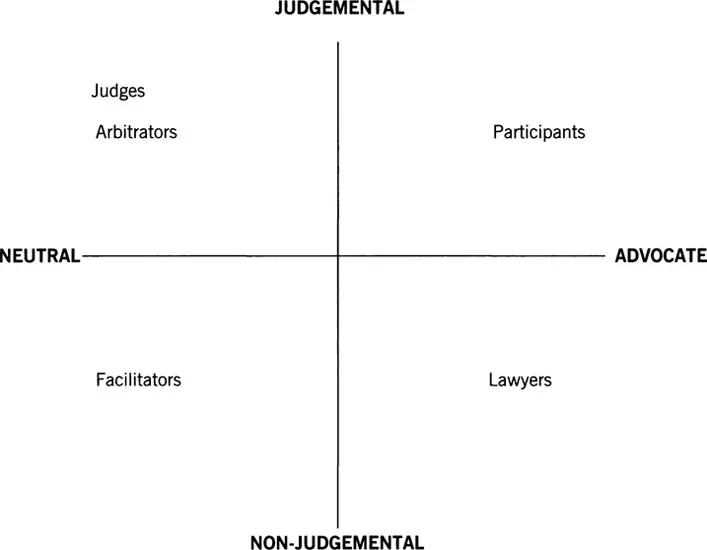
Figure 1 Facilitator roles and other roles
When Should a Facilitator be Used?
There are many occasions when facilitators might be used, but the most common are:
- Where distrust or bias is apparent (or suspected). Previous experiences may have led to wary or aggressive behaviour on the part of team members. Unblocking this will be the key to successful outcomes, and the assistance of a facilitator will be vital to achieving this.
- Where individuals might feel intimidated by the status differentials existing in a team. This might happen in, say, a project team made up of managers and other contributors who bring different skills and expertise to the project task, but who have varying levels of seniority. The results the team can achieve may then be hampered by issues of relative status, importance or rank. A facilitator can uncover these issues and have the group resolve them in a candid and positive manner.
- Where rivalries between individuals and teams can be reduced by the presence of a facilitator as a neutral third party. For example, the solution to a problem may be in the way groups work together, or even between specific people. A facilitator may be needed to create better understanding and to aid the negotiations between the warring tribes or warrior barons.
- Where problems are poorly or differently defined by different parties, and where a shared understanding is the prerequisite for problem-solving. If problems are ‘fuzzy’ or not clearly stated, or where different people see the problem differently, a facilitator may be needed to reach a shared agreement and to help everyone towards a workable solution.
- Where the breadth or scope of an issue is so large that a team cannot handle all the thinking and process aspects at once. Sometimes the scale of a situation and all its possible aspects are so vast that they are beyond the reach of the normal ways a team thinks and behaves. Thinking and behaving differently may be the key to tackling the issue, and a facilitator can encourage people to do this and can design a workshop to help them start the process.
- Where, in complex or novel situations, ‘better-than-usual’ joint working is necessary. Increasingly, managers have to face situations where previous experience offers no guide to action. Facing clusters of new and inter-related difficulties, or having to deal with a new reality, may mean that a team can benefit from a facilitator’s help.
- Where, in a crisis situation, a timely decision is needed and the team’s work must be speeded up. Usually in these situations, ‘business as usual’ is not an option, and what was once thought to be impossible becomes suddenly a reality. The team needs to gather its thoughts quickly, decide on the best way forward, and probably find support within its own resources for the emotional aspects of the crisis. A facilitator can help in this situation.
Conversely, a facilitator should not be used:
- Where there are already high levels of trust and solidarity existing within the team.
- Where team members are all working broadly at similar levels and where status differentials are small, or not regarded as important.
- Where there are no rivalries within the team, or where the rivalries are acute or intense. In the first case, facilitation can add little to the team’s own normal ways of working and, in the second, direct executive action may well be the best way to deal with the problem.
- Where problems are already well understood and defined, or where there is clear agreement on the nature of a problem and the preferred ways to solve it.
- Where the problem faced is relatively simple, and the team may be encouraged to face this, pool their thinking, and reach a conclusion from their own resources. A facilitator’s intervention here can encourage a team to be lazy or dependent, while bigger problems grow up unnoticed in the background.
- Where the problem a team faces is one it has already faced, and has solved successfully in the past.
- Where, in a regular or routine business meeting, the normal agenda and activities of the team will rightly predominate.
In summary then, facilitators are best used to:
- get clarity over problem identification and resolution;
- get more people involved in the process in better ways;
- get new and original ideas developed;
- foster understanding, support and follow-through
and generally to enable a team to work better, smarter and faster.
What does a Facilitator do?
Essentially facilitators undertake two major activities – ‘reading’ and ‘nudging’.
Reading is made up of two activities:
- recognizing the symptoms of process problems;
- diagnosing the underlying patterns.
Nudging involves intervening in the group proceeses of the team.
The model is shown in Figure 2.
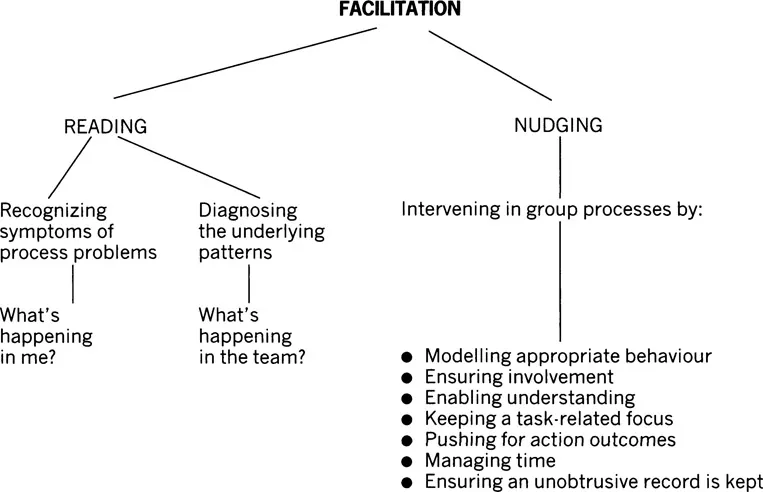
Figure 2 A model of facilitation
Reading
Recognizing the symptoms of process problems
A team can be said to be having process problems when it acts unproductively for extended periods – when it is not getting its work done. Understanding of the symptoms of process problems can have two sources:
- What’s happening in me? The facilitator’s own feelings, reactions and sensations (of boredom, anxiety, tension or irritation) are often the first clue to process problems.
- What’s happening in the group? The behaviour of the group members provides further clues to process problems. Abrupt changes in body language, such as people moving away from the grou...
Table of contents
- Cover
- Half Title
- Title
- Copyright
- Contents
- List of figures and tables
- Acknowledgements
- Introduction
- Part One: Facilitation: Why and How
- Part Two: The Toolkit
- Part Three: Putting the Toolkit to Use
- Part Four: Reviewing Facilitation
Trusted by 375,005 students
Access to over 1.5 million titles for a fair monthly price.
Study more efficiently using our study tools.
Frequently asked questions
Yes, you can cancel anytime from the Subscription tab in your account settings on the Perlego website. Your subscription will stay active until the end of your current billing period. Learn how to cancel your subscription
No, books cannot be downloaded as external files, such as PDFs, for use outside of Perlego. However, you can download books within the Perlego app for offline reading on mobile or tablet. Learn how to download books offline
Perlego offers two plans: Essential and Complete
- Essential is ideal for learners and professionals who enjoy exploring a wide range of subjects. Access the Essential Library with 800,000+ trusted titles and best-sellers across business, personal growth, and the humanities. Includes unlimited reading time and Standard Read Aloud voice.
- Complete: Perfect for advanced learners and researchers needing full, unrestricted access. Unlock 1.5M+ books across hundreds of subjects, including academic and specialized titles. The Complete Plan also includes advanced features like Premium Read Aloud and Research Assistant.
We are an online textbook subscription service, where you can get access to an entire online library for less than the price of a single book per month. With over 1.5 million books across 990+ topics, we’ve got you covered! Learn about our mission
Look out for the read-aloud symbol on your next book to see if you can listen to it. The read-aloud tool reads text aloud for you, highlighting the text as it is being read. You can pause it, speed it up and slow it down. Learn more about Read Aloud
Yes! You can use the Perlego app on both iOS and Android devices to read anytime, anywhere — even offline. Perfect for commutes or when you’re on the go.
Please note we cannot support devices running on iOS 13 and Android 7 or earlier. Learn more about using the app
Please note we cannot support devices running on iOS 13 and Android 7 or earlier. Learn more about using the app
Yes, you can access The Facilitator's Toolkit by Maggie Havergal,John Edmonstone in PDF and/or ePUB format, as well as other popular books in Business & Business General. We have over 1.5 million books available in our catalogue for you to explore.