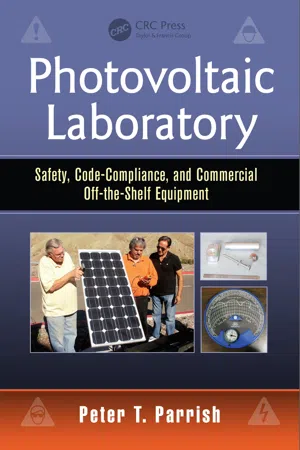
Photovoltaic Laboratory
eBook - ePub

Photovoltaic Laboratory

Safety, Code-Compliance, and Commercial Off-the-Shelf Equipment

  1. 362 pages
  2. English
  3. ePUB (mobile friendly)
  4. Available on iOS & Android
eBook - ePub

Photovoltaic Laboratory

Safety, Code-Compliance, and Commercial Off-the-Shelf Equipment

About this book

Photovoltaic Laboratory: Safety, Code-Compliance, and Commercial Off-the-Shelf Equipment is the only textbook that offers students the opportunity to design, build, test, and troubleshoot practical PV systems based on commercially available equipment. Complete with electrical schematics, layouts, and step-by-step installation instructions, this hands-on laboratory manual:

  • Promotes "safety first" by covering working in extreme weather conditions, personal protective equipment, working at heights, electrical safety, and power tool safety
  • Includes chapters on trade math, DC/AC electrical circuits, and assessing a property for a photovoltaic system (e.g., surveying the available space, shading, and solar harvest)
  • Discusses aspects of mechanical and electric integration specific to different roof types, and characterizing a PV module under different levels of irradiation and ambient temperature
  • Addresses the design, installation, and testing of off-grid PV systems with DC-only loads and with DC and AC loads, as well as 2.4 kw DC grid-tied PV systems with microinverters and string inverters
  • Trains students on exactly the sort of equipment that they will encounter in the field, so they gain valuable experience and skills that translate directly to real-world applications

Photovoltaic Laboratory: Safety, Code-Compliance, and Commercial Off-the-Shelf provides in-depth, project-driven instruction on everything from attaching brackets and flashing to modeling PV cells, modules, and arrays. This textbook is ideal preparation for those seeking a career in the PV industry—from system installers and designers to quality assurance and sales/marketing personnel.

Trusted byĀ 375,005 students

Access to over 1.5 million titles for a fair monthly price.

Study more efficiently using our study tools.

Information

Publisher
CRC Press
Year
2018
Print ISBN
9781138459854
eBook ISBN
9781498782517
Chapter 1

Safety1

1.1 Introduction

This laboratory will cover the aspects of working outdoors with emphasis on extreme weather conditions, personal protective equipment (PPE), power tool safety, working at heights, electrical safety, carrying and lifting, and some other general safety guidelines. This chapter is NOT a substitute for an Occupational Safety and Health Administration (OSHA) 10 construction safety course, and students are strongly advised to take an OSHA 10 course as well as a first aid and CPR course offered by qualified providers. Students are encouraged to download and review the OSHA safety publications cited at the end of this chapter.

1.2 Student Learning Objectives

At the end of this lab the student will be able to
  • Appraise a job situation and take appropriate measures to mitigate adverse safety conditions related to heat stress, including dressing appropriately for different outdoor environments
  • Recognize symptoms of heat stress and respond appropriately
  • Appraise working conditions at heights
  • Demonstrate proper use of extension ladders
  • Implement fall prevention and fall protection procedures employing appropriate equipment
  • Identify and understand electrical hazards and how to mitigate them
  • Identify and properly use appropriate personal protective equipment

1.3 Working in Extreme Weather Conditions

In California, we have the full gamut of extreme weather with the exception of tropical storms. The tallest peak is Mt. Whitney, at 4,421 m (14,505 ft.), and the lowest point is Badwater Basin in Death Valley at –82 m (–282 ft.). Furthermore, Furnace Creek in Death Valley holds the record for the highest recorded temperature on the face of the Earth at 56.7°C (134°F). I personally find it remarkable that Mt. Whitney and Badwater Basin are only 210 km (131 mi.) apart.
More germane to the topic of extreme weather is the fact that some of the best sites for photovoltaic (PV) systems in the United States are in the Mojave Desert and neighboring ā€œhigh desertā€ areas. The annual insolation for the high desert is approximately 7.6 kWh/m2/day. The average high temperature for Barstow, California in July is 41°C (105°F), while average daytime low temperature is 3°C (37°F). In addition to these temperature extremes, the high desert also has very low humidity and can experience wind gusts to 70 km/h (43 mi./h) during summer afternoons. To prepare for temperature extremes, low humidity, and occasional high winds is a significant safety challenge.
The first step in addressing this challenge is to employ appropriate clothing for the climate and time of year. The second step is to understand the hazards associated with extreme heat and cold, and to mitigate them to a point where the hazards are manageable. The third step is to recognize heat stress symptoms and take appropriate acti...

Table of contents

  1. Preface
  2. Acknowledgments
  3. Introduction
  4. How to Use This Textbook
  5. The Author
  6. Chapter 1 - Safety
  7. Chapter 2 - Trade Math for PV—Measurements, Units, and Calculations
  8. Chapter 3 - Measurements of DC and AC Electrical Circuits
  9. Chapter 4 - The Site Survey
  10. Chapter 5 - Racking Systems—General Considerations
  11. Chapter 6 - Characterization of a PV Module
  12. Chapter 7 - Modeling the PV Cell, Module, and Array
  13. Chapter 8 - Lead-Acid Absorbent Glass Mat Batteries
  14. Chapter 9 - Off-Grid PV System with DC-Only Loads
  15. Chapter 10 - Off-Grid PV System with DC and AC Loads
  16. Chapter 11 - 2.4 kW DC Grid-Tied PV System with Microinverters
  17. Chapter 12 - 2.4 kW DC Grid-Tied PV System with String Inverter
  18. Appendix I: Small Mock Roofs
  19. Appendix II: Roll-Around Walls
  20. Appendix III: 21 ft. by 18 ft. Roof

Frequently asked questions

Yes, you can cancel anytime from the Subscription tab in your account settings on the Perlego website. Your subscription will stay active until the end of your current billing period. Learn how to cancel your subscription
No, books cannot be downloaded as external files, such as PDFs, for use outside of Perlego. However, you can download books within the Perlego app for offline reading on mobile or tablet. Learn how to download books offline
Perlego offers two plans: Essential and Complete
  • Essential is ideal for learners and professionals who enjoy exploring a wide range of subjects. Access the Essential Library with 800,000+ trusted titles and best-sellers across business, personal growth, and the humanities. Includes unlimited reading time and Standard Read Aloud voice.
  • Complete: Perfect for advanced learners and researchers needing full, unrestricted access. Unlock 1.5M+ books across hundreds of subjects, including academic and specialized titles. The Complete Plan also includes advanced features like Premium Read Aloud and Research Assistant.
Both plans are available with monthly, semester, or annual billing cycles.
We are an online textbook subscription service, where you can get access to an entire online library for less than the price of a single book per month. With over 1.5 million books across 990+ topics, we’ve got you covered! Learn about our mission
Look out for the read-aloud symbol on your next book to see if you can listen to it. The read-aloud tool reads text aloud for you, highlighting the text as it is being read. You can pause it, speed it up and slow it down. Learn more about Read Aloud
Yes! You can use the Perlego app on both iOS and Android devices to read anytime, anywhere — even offline. Perfect for commutes or when you’re on the go.
Please note we cannot support devices running on iOS 13 and Android 7 or earlier. Learn more about using the app
Yes, you can access Photovoltaic Laboratory by Peter T. Parrish in PDF and/or ePUB format, as well as other popular books in Technology & Engineering & Energy. We have over 1.5 million books available in our catalogue for you to explore.