- 424 pages
- English
- ePUB (mobile friendly)
- Available on iOS & Android
eBook - ePub
Energy-Efficient Electric Motors, Revised and Expanded
About this book
This detailed reference provides guidelines for the selection and utilization of electric motors for improved reliability, performance, energy-efficiency, and life-cycle cost. Completely revised and expanded, the book reflects the recent state of the field, as well as recent developments in control electronics, the economics of energy-efficient motors and systems, and advanced power electronic drivers. It includes five new chapters covering key topics such as the fundamentals of power electronics applicable to electric motor drives, adjustable speed drives and their applications, advanced switched reluctance motor drives, and permanent magnet and brushless DC motor drives.
Information
1
Induction Motor Characteristics
1.1 THREE-PHASE INDUCTION MOTORS
In the integral horsepower sizes, i.e., above 1 hp, three-phase induction motors of various types drive more industrial equipment than any other means. The most common three-phase (polyphase) induction motors fall within the following major types:
NEMA (National Electrical Manufacturers Association) design B: Normal torques, normal slip, normal locked amperes
NEMA design A: High torques, low slip, high locked amperes
NEMA design C: High torques, normal slip, normal locked amperes
NEMA design D: High locked-rotor torque, high slip
Wound-rotor: Characteristics depend on external resistance
Multispeed: Characteristics depend on design—variable torque, constant torque, constant horsepower
There are many specially designed electric motors with unique characteristics to meet specific needs. However, the majority of needs can be met with the preceding motors.
1.1.1 NEMA Design B Motors
The NEMA design B motor is the basic integral horsepower motor. It is a three-phase motor designed with normal torque and normal starting current and generally has a slip at the rated load of less than 4%. Thus, the motor speed in revolutions per minute is 96% or more of the synchronous speed for the motor. For example, a four-pole motor operating on a 60-Hz line frequency has a synchronous speed of 1800 rpm or a full-load speed of
or
In general, most three-phase motors in the 1- to 200-hp range have a slip at the rated load of approximately 3% or, in the case of four-pole motors, a full-load speed of 1745 rpm. Figure 1.1 shows the typical construction for a totally enclosed, fan-cooled NEMA design B motor with a die-cast aluminum single-cage rotor.
Figure 1.2 shows the typical speed-torque curve for the NEMA design B motor. This type of motor has moderate starting torque, a pull-up torque exceeding the full-load torque, and a breakdown torque (or maximum torque) several times the full-load torque. Thus, it can provide starting and smooth acceleration for most loads and, in addition, can sustain temporary peak loads without stalling. The NEMA performance standards for design B motors are shown in Tables 1.1, 1.2, 1.3.
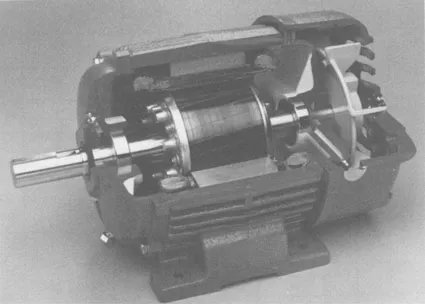
FIGURE 1.1 NEMA design B totally enclosed, fan-cooled polyphase induction motor. (Courtesy Magnetek, St. Louis, MO.)
In the past, there were no established standards for efficiency or power factor for NEMA design B induction motors. However, NEMA had established standards for testing and labeling induction motors. Recently, NEMA has established efficiency standards for energy-efficient polyphase induction motors. These standards are discussed in detail in Chapter 2.
1.1.2 NEMA Design A Motors
The NEMA design A motor is a polyphase, squirrel-cage induction motor designed with torques and locked-rotor current that exceed the corresponding values for NEMA design B motors. The criterion for classification as a design A motor is that the value of the locked-rotor current be in excess of the value for NEMA design B moto...
Table of contents
- Cover
- Half Title
- Title Page
- Copyright Page
- Dedication
- Table of Contents
- Preface
- 1 Induction Motor Characteristics
- 2 Energy-Efficient Motors
- 3 Fundamentals of Electric Motor Drives
- 4 The Power Factor
- 5 Applications of Induction Motors
- 6 Adjustable-Speed Drives and Their Applications
- 7 Induction Motors and Adjustable-Speed Drive Systems
- 8 Brushless DC Motor Drives
- 9 Switched Reluctance Motor Drives
- 10 Utility Interface Issues
- Index
Trusted by 375,005 students
Access to over 1.5 million titles for a fair monthly price.
Study more efficiently using our study tools.
Frequently asked questions
Yes, you can cancel anytime from the Subscription tab in your account settings on the Perlego website. Your subscription will stay active until the end of your current billing period. Learn how to cancel your subscription
No, books cannot be downloaded as external files, such as PDFs, for use outside of Perlego. However, you can download books within the Perlego app for offline reading on mobile or tablet. Learn how to download books offline
Perlego offers two plans: Essential and Complete
- Essential is ideal for learners and professionals who enjoy exploring a wide range of subjects. Access the Essential Library with 800,000+ trusted titles and best-sellers across business, personal growth, and the humanities. Includes unlimited reading time and Standard Read Aloud voice.
- Complete: Perfect for advanced learners and researchers needing full, unrestricted access. Unlock 1.5M+ books across hundreds of subjects, including academic and specialized titles. The Complete Plan also includes advanced features like Premium Read Aloud and Research Assistant.
We are an online textbook subscription service, where you can get access to an entire online library for less than the price of a single book per month. With over 1.5 million books across 990+ topics, we’ve got you covered! Learn about our mission
Look out for the read-aloud symbol on your next book to see if you can listen to it. The read-aloud tool reads text aloud for you, highlighting the text as it is being read. You can pause it, speed it up and slow it down. Learn more about Read Aloud
Yes! You can use the Perlego app on both iOS and Android devices to read anytime, anywhere — even offline. Perfect for commutes or when you’re on the go.
Please note we cannot support devices running on iOS 13 and Android 7 or earlier. Learn more about using the app
Please note we cannot support devices running on iOS 13 and Android 7 or earlier. Learn more about using the app
Yes, you can access Energy-Efficient Electric Motors, Revised and Expanded by Ali Emadi in PDF and/or ePUB format, as well as other popular books in Technology & Engineering & Electrical Engineering & Telecommunications. We have over 1.5 million books available in our catalogue for you to explore.