eBook - ePub
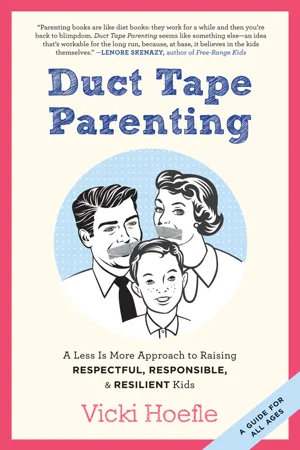
Duct Tape Parenting
A Less is More Approach to Raising Respectful, Responsible and Resilient Kids
- 288 pages
- English
- ePUB (mobile friendly)
- Available on iOS & Android
eBook - ePub
Duct Tape Parenting
A Less is More Approach to Raising Respectful, Responsible and Resilient Kids
About this book
There's a new set of 3Rs for our kids-respect, responsibility, and resilience-to better prepare them for life in the real world. Once developed, these skills let kids take charge, and let parents step back, to the benefit of all. Casting hover mothers and helicopter parents aside, Vicki Hoefle encourages a different, counter-intuitive-yet much more effective-approach: for parents to sit on their hands, stay on the sidelines, even if duct tape is required, so that the kids step up. Duct Tape Parenting gives parents a new perspective on what it means to be effective, engaged parents and to enable kids to develop confidence through solving their own problems. This is not a book about the parenting strategy of the day-what the author calls "Post-It Note Parenting"-but rather a relationship-based guide to span all ages and stages of development. Witty, straight-shooting Hoefle addresses frustrated parents everywhere who are ready to raise confident, capable children to go out in the world.
Information
SECTION II
GET OUT THE DUCT TAPE AND TAKE A LEAP OF FAITH
At this moment, after all the information covered in section 1, you might be wondering, How in the world will I integrate all this new thinking into my next sequence of decisions? The answer is … drumroll, please … DUCT TAPE. This is your chance to shift your focus away from your child’s pesky behaviors and habits and focus on what it will take for you to raise an independent, responsible, respectful, and resilient child. You will train yourself to say less, do less, interfere less, and micromanage less, and allow your children to take a more active role in their lives and the life of the family. This will provide opportunities for them to practice new skills, learn from their mistakes, and navigate their own lives whenever possible.
You’re going to use duct tape on your mouth, hands, and even your rear end if necessary (literally or figuratively, it’s up to you) to refrain from jumping in and taking over. Instead, you will learn to trust that your children can change and will change, and that with new information, you too can change.
When you accept that your role as a parent is to step out rather than step in and fix or interfere or correct, then you will begin to steer your family in the direction you envisioned at the very beginning of parenthood. You’ll replace the power struggles, demands, and dysfunction in the family with cooperation, appreciation, and mutual respect. That’s it. Duct tape, relationship and training strategies, and faith.
After twenty years, I can honestly say that I continue to use the Duct Tape Method each time the kids and I hit a rough patch. It usually means that I have stopped thinking, started reacting, and I am parenting on autopilot. When this happens, it’s a reminder that I need a reality check to ensure that I am actually parenting effectively. After all, kids change as they grow. What seems important one minute is irrelevant the next. The Duct Tape Method is the fastest and most effective way I know of reminding myself what parenting is really about. It’s about the long-term relationship I am building with my children and their ability to grow into independent, enthusiastic, engaged adults.
The point of gathering new information, which is possible when we stop talking and start observing, is to help guide our parenting decisions. In the following chapters, I’ll outline how a small shift in thinking, along with a more hands-off approach to parenting, can make dramatic, lasting, and astonishing changes in individual family members and in the family as a whole.
What you need to know is that the duct tape will be for you, mom and dad. Not the kiddo. So, get ready to tape yourself into new parenting habits. You can actually tape yourself, but a mental visual is just as effective. Please, don’t tape yourself into any sticky situations.
6
Duct Tape for the Relationship: Repairing Family Fractures Is a Solution
Love me when I least deserve it, because that is when I really need it.—Swedish proverb
Who do you feel like cooperating with? Someone who bosses you around or someone who trusts and respects you?—Vicki Hoefle
Relationship strategies are for parents who want to be in sync with, connected to, tuned in to, and loved by their kids, all while maintaining respect, order, and a level of understanding unique to the family’s dynamics. Relationship strategies have the power to solve daily challenges that go along with raising kids, including getting out of the door on time, dealing with sibling squabbles, and having the kids help out without nagging and reminding them. Relationship strategies help parents and kids stay connected during the ups and downs of life in the family zoo and support parents as they learn to let go a bit and trust that their kids are learning to navigate the world in a way that has meaning for them. This is the magic. Once you commit to building a solid relationship with your kids and not micromanaging their behavior, everything shifts.
If that is not reason enough, remember, the next generations are the future leaders of our families, communities, country, and this well-connected planet. If the children of today are to become tomorrow’s leaders, doesn’t it seem reasonable that they spend time in childhood developing the skills necessary to successfully navigate first their own world and then the world at large? If these same kids are going to make decisions about how I will be treated as an incontinent, toothless ninety-year-old, I want them to have fond memories of me. No kidding. The world is a maze of interconnected relationships that have us either working together or against each other. Our children’s introduction to healthy relationships begins at home.
But how exactly does a parent shift from the microcosm of behavior management to the macrocosm of relationship building? Here is one idea I introduce to parents that helps them shift their thinking and open up new possibilities in their parenting.
In every moment, parents are either:
• Interfering with the relationship they have with their child and the child’s ability to grow into an independent, capable, responsible, respectful, resilient adult.
• Enhancing their relationship with their child and the child’s ability to grow into an independent, capable, responsible, respectful, resilient adult.
Even well-intended parents inadvertently interfere on a regular basis. Many parents think that they are enhancing the relationship with their children when they try to drive home values and good habits with their micromanagement, corrections, and quick-fix tactics. Here’s where the obstacle lies. How can we, the adults, change our parenting approach if we think we are doing what we’re supposed to, even if it’s not working? Maybe that’s why you’re still reading this. You know that the relationship matters, but it’s the list of “Yeah, buts” and “This isn’t workings” that keeps getting in the way. You might understand all of this in theory, but in execution, you come up shy of committing to the relationship.
Duct Tape Moment
If you notice you’re drilling your kids with questions and thoughts and useless inquiries or criticisms, tape your mouth until you can curb the rapid-fire. Kids don’t need guidance and information 24-7. They don’t need to walk in the door and be engaged with you and walk you through the minute details of their day. It’s a hovering habit that is ineffective at staying connected to your child. You can be quiet and be connected. You can let them get lost in their own worlds—it does not mean you don’t care or that your child is slipping away from you.
The First Step
It’s time now to shift from your current state of behavior-focused parenting over to a relationship-focused approach to parenting. This move across the hall requires a leap of faith on your part as you put your trust in the idea that letting go and stepping back in certain areas of your parenting will move you to a more satisfying and respectful relationship with your kids (and yes, will still get you out of the house on time without yelling or tears). Accepting that all the interfering strategies actually limit independence and cause more power struggles and discord will also help when it comes time for you to stay quiet, allow life to unravel a bit, and watch quietly while the kids learn to navigate their lives with more confidence and enthusiasm, which is exactly what enhances the relationship and builds independent, capable, responsible, respectful, and resilient kids.
If that sounds inviting, then it’s time to let go of what’s not working and consciously develop a duct-taped, hands-off, and relationship-focused approach to parenting. It’s finally time to toss the interfering junk (ineffective discipline strategies) into the nearest dumpster. In order to do this—to really make a difference in your family—you have to accept that you are in control of what happens next and the changes your family experiences are based on how committed you are to changing. What exactly are you going to change? You are going to change two things, your thinking and your approach.
Start Where You Are: What Do You Think about Your Children Today
When I ask parents what their kids do that drives them crazy, they can rattle off an emotionally charged list without hesitation. Remember the list you made way back in chapter 1? “She’s stubborn.” “He’s bossy all the time.” “She talks back.” “He’s messy.”
When I ask the same parents to identify the child’s strengths, silence falls and eyes shift downward as confusion and embarrassment fills the room. I watch it happen over and over as the mood shifts when parents realize they are more comfortable listing what’s wrong than what’s right with their children.
Once they begin to rev up with examples and positive descriptions, I see a list that reflects the upside to stubborn (tenacious), bossy (born leader), and strong-willed (knows what he wants).
Here’s Where We Start the New Thinking
How would life with your child be different if you reframed your ideas about what constitutes a thinking, engaged, fabulously brilliant, responsible, respectful, resilient child?
What if you don’t really want to get rid of all the things that drive you crazy, but rather aim to tweak your child’s “negative behaviors” into a strength-filled, useful skill set?
Negative behaviors come from the same place as brilliance. Your kids are just using their unique talents in the wrong direction! It’s our job to say, Well, I don’t actually want to extinguish that personality trait, I just want to redirect it. Isn’t that closer to the real definition of parenting? Helping to guide and direct your children toward the useful side of life as they develop their unique skills, preferences, and talents?
Think about your child. You may have a label or two. Try to look at the label in a more positive light.
• A sassy child is a future entertainer.
• A bossy child is a future lea...
Table of contents
- Cover
- Half Title
- Title Page
- Copyright Page
- Dedication
- Table of Contents
- Foreword
- Acknowledgments
- Introduction
- Section I Before We Get the Duct Tape, Let’s See What Needs Fixing: Note, It’s Not the Kids
- Section II Get out the Duct Tape and Take a Leap of Faith
- Afterword: Ode to Mom and Dad: The Kids’ Perspective
- Resources
- Index
Trusted by 375,005 students
Access to over 1.5 million titles for a fair monthly price.
Study more efficiently using our study tools.
Frequently asked questions
Yes, you can cancel anytime from the Subscription tab in your account settings on the Perlego website. Your subscription will stay active until the end of your current billing period. Learn how to cancel your subscription
No, books cannot be downloaded as external files, such as PDFs, for use outside of Perlego. However, you can download books within the Perlego app for offline reading on mobile or tablet. Learn how to download books offline
Perlego offers two plans: Essential and Complete
- Essential is ideal for learners and professionals who enjoy exploring a wide range of subjects. Access the Essential Library with 800,000+ trusted titles and best-sellers across business, personal growth, and the humanities. Includes unlimited reading time and Standard Read Aloud voice.
- Complete: Perfect for advanced learners and researchers needing full, unrestricted access. Unlock 1.5M+ books across hundreds of subjects, including academic and specialized titles. The Complete Plan also includes advanced features like Premium Read Aloud and Research Assistant.
We are an online textbook subscription service, where you can get access to an entire online library for less than the price of a single book per month. With over 1.5 million books across 990+ topics, we’ve got you covered! Learn about our mission
Look out for the read-aloud symbol on your next book to see if you can listen to it. The read-aloud tool reads text aloud for you, highlighting the text as it is being read. You can pause it, speed it up and slow it down. Learn more about Read Aloud
Yes! You can use the Perlego app on both iOS and Android devices to read anytime, anywhere — even offline. Perfect for commutes or when you’re on the go.
Please note we cannot support devices running on iOS 13 and Android 7 or earlier. Learn more about using the app
Please note we cannot support devices running on iOS 13 and Android 7 or earlier. Learn more about using the app
Yes, you can access Duct Tape Parenting by Vicki Hoefle,Alex Kajitani in PDF and/or ePUB format, as well as other popular books in Psychology & Mental Health in Psychology. We have over 1.5 million books available in our catalogue for you to explore.