- 312 pages
- English
- ePUB (mobile friendly)
- Available on iOS & Android
eBook - ePub
About this book
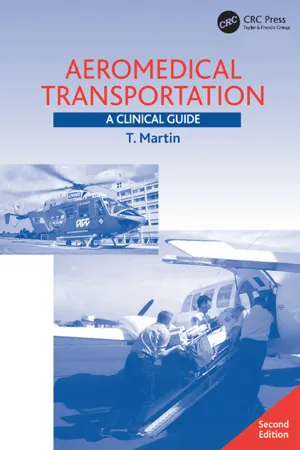
Still the only book published anywhere in the world which is devoted entirely to the principles of aeromedical transport, Aeromedical Transportation has rightly become known as the sole reference for the industry. This second edition has been radically revised and updated; featuring the latest research, updated references and new chapters on the transport of intensive care patients, and medical emergencies/death in flight. Since the first edition was published in 1996, the concept of 'evidence-based medicine' has been accepted as essential in any book which endeavours to be the accepted knowledge base in its subject area. A very practical text, international in its approach, much of its content is devoted to clinical matters. Administration and organisation are also discussed, but are addressed from the standpoint of the clinical aeromedical escort. The text is suitable for medical, paramedical and nursing personnel and for those working in organizations whose duties include the transportation of the sick and injured by air.
Information
PART I
Introduction
Chapter 1
History of Aeromedical Transportation
Beginnings
Since earliest times, men have sought the gift of flight. As creatures grounded by nature, man’s imagination took the form of gods drawn across the sky by chariots of fire or heroes borne to battle or their Valhalla on winged stallions. Mortals seldom experienced the power of flight. The Chinese Emperor Shun was said to have escaped his captors by ‘donning the work clothes of a bird’. The Greek architect Daedalus (designer of the Maze of the Minotaur) and his son Icarus fled the isle of Crete by soaring to freedom on wings made of feathers and wax. Icarus was also the first aviation fatality. Enraptured by the joys of flight, he neglected the warnings of his father and flew too close to the sun, melting the fabric of his wings and plummeting down into the sea.
Myth became reality in 1783 when the first terrestrial creatures took to the air in a Montgolfier balloon. These pioneer aeronauts ascended to a height of 1700 feet. Upon landing, one of the aeronauts (Montauciel, a sheep) was noted to be calmly munching grass, while one colleague (a duck) was cowering in a corner and the other (a rooster) suffered a broken wing from being kicked by Montauciel prior to lift-off. As faith in the ability of living creatures to tolerate air travel had been vindicated, the first manned ascent was crewed by the French physician Pilatre de Rozier and the Marquis d’Arlandes in November of the same year.
One of the first balloon ascents was witnessed by Benjamin Franklin, American envoy to France. When a sceptic in the crowd noted that the balloon was, ‘interesting, but what use is it?’, Franklin remarked, ‘What use is a newborn baby?’ It was a portent of things to come, for in 1903 the owners of the Wright Cycle Factory in Dayton, Ohio, piloted the first successful heavier-than-air craft across the sand dunes at Kitty Hawk.
Less than a century later, aircraft and air travel have become part of our daily world. The phenomenon of flight has shrunk the globe and pushed back the frontiers of space. It is hardly surprising that aeromedical services form an integral part of the modern emergency care system.
Origins of aeromedical transportation
For many years it was popularly believed that the very first aeromedical flights evacuated patients from the besieged city of Paris during the Franco-Prussian War in 1870. However, contemporary records of the 67 balloons known to have left Paris during the siege make no mention of the carriage of any sick or wounded. The origin of this popular myth is unclear, but may have resulted from an error in the translation of the original French reports. Many of the balloons were under contract to the French postal service and carried letters, government dispatches, homing pigeons, and passengers on governmental or war related business. Like many other myths, perhaps the fabled medical evacuation flights should have happened, but there is verifiable documentary evidence that they did not. Some 20 years later a Dutch military doctor by the name of DeMooy proposed that casualties might be evacuated by horse-drawn tethered balloons but, again, there is no evidence that such flights actually took place.
The history of aeromedical transportation is therefore not quite as long as the history of flight itself, but certainly does not lag far behind it. Despite the statement reported in a French medical journal (Le Caducée) in 1912, that ‘the use of the aeroplane for (medical) evacuation is, for the moment, in the realm of fiction’, the first aeromedical flights were not long in coming. In fact, the earliest recorded evacuation of wounded casualties by aeroplane took place during the first world war, when Serbian patients were carried in an unmodified French fighter plane. In 1916, Dr Chassaing persuaded the French government to build an aircraft capable of carrying two stretchers. A year later it was being used successfully to evacuate the wounded from the battlefield at Amiens. As aviation technology progressed, the potential value of aircraft as airborne ambulances became obvious.
The first recorded British air ambulance flight took place in 1917 when a soldier in the Camel Corps in Turkey who had been shot in the ankle was flown to hospital in 45 minutes, thus avoiding a three-day journey on the ground. In the same year, the Reverend John Flynn, a Presbyterian minister with the Australian Inland Mission, conceived the idea of combining ‘wireless’, aviation, and medicine to produce a ‘mantle of safety’ across the outback. Over the next ten years, with the assistance of inventors, radio technicians, doctors, philanthropists and fellow missionaries, Flynn saw his dream literally take off. Although sporadic medical flights had been occurring for at least a year, the Inland Mission’s Aerial Medical Service was the first organized program. The first official flight was from Cloncurry in Queensland on 17 May 1928; the aircraft was a de Havilland DH50 biplane, on secondment from the infant Queensland and Northern Territory Airline Service (now QANTAS, Australia’s national carrier). The first communications network started out of Cloncurry at the same time, utilizing pedal powered radios developed by Alfred Traeger. Without radio, the Aerial Medical Service (AMS) would have been rendered worthless for want of a means of dispatch; it was to take the advent of microwave transmissions to make telephones widely available within the outback. Although it was initially a one-year experiment, flying continued for twelve years at Cloncurry and, until 1934, it was the sole AMS base.
Another vital component of Flynn’s ‘mantle of safety’ was a network of Inland Mission hostels and hospitals staffed by nurses throughout the outback. The first hostel opened in 1912 at Oodnadatta. Within 14 years, ten hostels/hospitals had been established, all staffed by registered nurses. With few doctors in the outback, the concept of flying nurses was also developed. In 1939 a young nurse, Meg McKay flew from Cloncurry to Bulia to assist with immunisations and surgery, and the concept of a flying nurse was firmly established. The name of the organization was changed to the Flying Doctor Service (FDS) in 1942 and, by the end of the second world war, the military flight nurse concept was well proven. In 1945, the Victorian, South Australian, and New South Wales sections of the Flying Doctor Service jointly funded an experiment of a flying nurse based at Broken Hill. The FDS was probably the first aeromedical organization to train and employ flight nurses. By the time of Flynn’s death in 1951, his concept had grown to a federation of six sections and a dozen bases. Its value to the people of the outback was recognized in 1955 with the granting of the ‘Royal’ prefix and it remains a vital part of outback Australian life to this day.
Between the wars, both the British and French employed aircraft for the transportation of casualties resulting from colonial conflicts. The Royal Air Force (RAF) first used aircraft in the casevac role in Somaliland, in 1919, when three patients were moved 175 miles on stretchers strapped to the fuselage of a de Havilland DH9 aircraft. A few years later, the French evacuated several thousand injured soldiers in confrontations with the Berber and Riffian tribesmen in Morocco.
Meanwhile, throughout the 1920s, military aeroplanes were used for disaster relief missions in the USA and, during the same period, the RAF operated an air ambulance service within a 100 mile radius of an airfield near to London. In 1933 the first UK civilian air ambulance service was instigated. Serving the Scottish Isles, the descendant of this service still operates today, carrying the sick and injured from the remote islands of Scotland to the mainland. Long distance, high altitude, aeromedical evacuation, however, was pioneered by the Luftwaffe. During the Spanish civil war (1936-41) they used trimotor Junkers JU 52 aircraft in missions lasting up to ten hours and flown at an altitude of 18 000 ft.
It was the Second World War, though, which heralded rapid advancement and created much work for the newly formed military casualty evacuation (casevac) organizations. Initially, the aeroplane supplemented ground and ship-borne evacuation of casualties but, in the latter years of the conflict, more than 90 per cent of allied casualties were evacuated by air. As more spacious aircraft became available, there was sufficient room for patient care to be continued in flight. In 1942 the US military began training flight transport personnel for the specific purpose of medical escort duties, and the first dedicated aeromedical unit (the 38th Medical Air Ambulance Squadron) was formed. Using transport aircraft such as the Douglas C-47 Skytrain and the C-54 Skymaster, over a million sick and wounded soldiers were airlifted to the United States during the last three years of the war.

The military continued to dominate the growth and development of aeromedical transportation in the immediate post-war period, a steady stream of conflicts and minor wars ensuring their interest. During this same period, other notable advances had a marked effect. The development of rotary wing aircraft was of particular significance because of their ability to operate in confined spaces. In fact, a helicopter was first used in the search and rescue (SAR) and casualty evacuation (casevac) role in Burma during the latter stages of the second world war. Lt Carter Harman, of the US Army Air Force, transported several wounded airmen near Mawlu in Burma on 23 April 1944. Details of this flight are not clear, but this WWII combat zone mission is believed to be the first time a helicopter was actually used to rescue and transport a trauma patient. However, the origin of the first helicopter SAR unit in January 1945 is well documented.
In an historic episode, a Sikorsky YR-4 helicopter (Figure 1.2) was dismantled at Wright Field, Dayton, Ohio in the USA, and flown half way around the world to Myitkyina, Burma where it was reassembled and flown over jungles and 5000 ft (1500 m) mountain peaks to accomplish its first mission. Although the original mission was to rescue downed aircrew, in the few days taken to airlift the helicopter and crew to Burma, these aircrew had already been rescued by ground forces.
However, soon after their arrival in Burma, news came in of a soldier who had accidentally shot himself through the hand with a .30 caliber machine gun while on duty at a weather station located on a mountain in the Naga hills, 160 miles northwest of Myitkyina. The soldier’s hand was rapidly becoming infected and no experienced medical personnel were available to treat it. It would have taken approximately ten days for the man to walk from the station to a location where he could have medical care. The possibility of parachuting a medical officer on to the mountain had been considered but the nature of the terrain would have made it virtually impossible to get him down alive.
So it was on 26 January 1945 that the first mission took place. The helicopter had no radio and, since the American pilots, Capt Peterson and Lt Steiner, were unfamiliar with the country, it was decided that they would be escorted by two light fixed wing aircraft (L-5) of the Air Jungle Rescue Unit. The mission necessitated refuelling stops en route and personnel of the Royal Air Force provided support at a remote jungle clearing. The helicopter flew at tree top level with an average air speed of about 60 knots while that of the L-5s was 30 to 40 knots faster. Consequently, the L-5 pilots were forced to circle continuously to keep the helicopter in sight.

Source: US AAF, from the National Air and Space Museum archives, Washington DC.
The patient was a 21 year old soldier, Private Howard Ross, of North Tonawanda, New York. Although he had received a radio message that help was on the way, he had absolutely no idea in what form it would take. Little was he to know of his notable role in the history of helicopter rescue. Contemporaneous reports state that ‘His hand was considerably swollen, but he was highly excited at his rescue. His recovery was uneventful.’ (Holmes, 2005).
After this proving mission, Capt Peterson and Lt Steiner returned to Myitkyina and began to instruct the Air Jungle Rescue Unit personnel in the operation and maintenance of the helicopter, thus forming the first ever dedicated helicopter SAR and casevac unit.
The British later used helicopters in the casevac role in Malaya, immediately after the cessation of WWII hostilities, but the first real large scale evacuation of wounded soldiers by helicopter occurred during the Korean war. The Bell-47 and Sikorsky S-51 were used to ferry patients from battalion aid stations to waiting hospital units. Patients were strapped to litters outside the aircraft, and covered with a canopy to prevent injury from wind or rotor wash. Over 20 000 wounded servicemen were transported in this fashion.
However, the Vietnam War was the definitive showcase for demonstrating the efficacy of helicopter medical...
Table of contents
- Cover
- Half Title
- Title Page
- Copyright Page
- Table of Contents
- List of Figures
- List of Tables
- Preface to the Second Edition
- Preface to the First Edition
- Acknowledgements
- List of Abbreviations
- Glossary
- PART I INTRODUCTION
- PART II PHYSICS AND PHYSIOLOGY
- PART III OPERATIONAL CONSIDERATIONS
- PART IV CLINICAL CONSIDERATIONS
- PART V ORGANIZATION AND ADMINISTRATION
- Index
Trusted by 375,005 students
Access to over 1.5 million titles for a fair monthly price.
Study more efficiently using our study tools.
Frequently asked questions
Yes, you can cancel anytime from the Subscription tab in your account settings on the Perlego website. Your subscription will stay active until the end of your current billing period. Learn how to cancel your subscription
No, books cannot be downloaded as external files, such as PDFs, for use outside of Perlego. However, you can download books within the Perlego app for offline reading on mobile or tablet. Learn how to download books offline
Perlego offers two plans: Essential and Complete
- Essential is ideal for learners and professionals who enjoy exploring a wide range of subjects. Access the Essential Library with 800,000+ trusted titles and best-sellers across business, personal growth, and the humanities. Includes unlimited reading time and Standard Read Aloud voice.
- Complete: Perfect for advanced learners and researchers needing full, unrestricted access. Unlock 1.5M+ books across hundreds of subjects, including academic and specialized titles. The Complete Plan also includes advanced features like Premium Read Aloud and Research Assistant.
We are an online textbook subscription service, where you can get access to an entire online library for less than the price of a single book per month. With over 1.5 million books across 990+ topics, we’ve got you covered! Learn about our mission
Look out for the read-aloud symbol on your next book to see if you can listen to it. The read-aloud tool reads text aloud for you, highlighting the text as it is being read. You can pause it, speed it up and slow it down. Learn more about Read Aloud
Yes! You can use the Perlego app on both iOS and Android devices to read anytime, anywhere — even offline. Perfect for commutes or when you’re on the go.
Please note we cannot support devices running on iOS 13 and Android 7 or earlier. Learn more about using the app
Please note we cannot support devices running on iOS 13 and Android 7 or earlier. Learn more about using the app
Yes, you can access Aeromedical Transportation by T. Martin in PDF and/or ePUB format, as well as other popular books in Medicine & Emergency Medicine & Critical Care. We have over 1.5 million books available in our catalogue for you to explore.