The authors have put together a fascinating narrative of the creation process of one of the most successful example of frugal engineering in recent years. They bring out insightful details of what managerial, organizational and technological pathways were taken to come up with a disruptive innovation that has the potential to change the entry-level automobile market in India and other emerging markets. The book significantly deepens and extends the knowledge of disruptive and reverse innovation, as well as of strategic alliance management. The book keeps the reader captive and is a must read for all who have an interest in innovation.
eBook - ePub
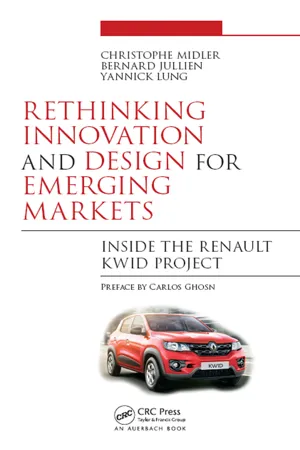
Rethinking Innovation and Design for Emerging Markets
Inside the Renault Kwid Project
- 178 pages
- English
- ePUB (mobile friendly)
- Available on iOS & Android
eBook - ePub
Rethinking Innovation and Design for Emerging Markets
Inside the Renault Kwid Project
About this book
Information
Publisher
Auerbach PublicationsYear
2017Print ISBN
9781138088016
9781138037205
Edition
1eBook ISBN
9781351712033
Part I
Incredible Kwid
Before we can tell the story of this project, we must draw a line to define its scope. When does it begin and end? How far should we go in analyzing developments and their impacts? In our case, we knew the beginning of the story relatively well, having written the Logan’s story in 2013.1 In a way, that project forms an important prologue to our story, at least for the key stakeholders who were involved in both projects. However, at the time of writing this book, the program had only reached the commercial start-up phase for Renault’s Kwid product and Nissan’s Redi-GO product in India, whereas this program has international ambitions. We focus only on the platform design (common to both companies) and the Renault product, partly because our knowledge of the Nissan side is incomplete and partly because the story of its vehicle is only just beginning.
This narrative is organized chronologically. It starts with the reconstruction of the emergence of the project in 2010–2011 to the decision to develop the program in its initial market in India. The second stage traces the difficulties of starting the program, difficulties that lead to the affirmation of an original development approach. We then analyze this process in terms of the organization of product-process development in the Indian location before detailing the supply relationships with local suppliers. After the design phase, we retrace the industrialization phase from the investment decisions to the product ramp-up and the commercial launch from October, 2015, to June, 2016. Finally, we outline the prospects for the international deployment of this new line of vehicles, especially in Brazil.
1 Bernard, Jullien, Yannick Lung, and Christophe Midler. The Logan Epic. A New Trajectory for Innovation. Dunod, Paris, 2013.
Chapter One
Upstream Exploration: April 2010–October 2011
1.1 A Growth Strategy with Echoes of 1995
Upstream exploration for the project began in the first quarter of 2010. A working group was appointed in April under the leadership of Arnaud Deboeuf, who had been the Duster Program Manager and then the Entry Program Director.1
The strategic brief presented by Carlos Ghosn was very similar to the one used at the inception of the Logan project in Louis Schweitzer’s strategic study of 1995.2 As before, the CEO’s objective was to increase the overall sales volume, the Renault-Nissan Alliance aiming to attain a 10% share of the global market. To achieve this ambitious objective, the Alliance had to target markets then growing, such as the “BRICs” (Brazil, Russia, India, China), and the segments with the largest sales volumes within these markets.
This strategic diagnosis spoke to the stability of the major trends in mobility from 1995 on, as well as the strategic stability of carmakers, which generally developed growth strategies for emerging markets. However, the uniqueness of Renault’s strategy lay in its “bottom-up” approach to specific products.
1.2 The Need for Coordination Within the Renault-Nissan Alliance
The second element of the exploration specifications was the need for a coordinated approach within the Renault-Nissan Alliance. This was a major change compared to the development of the Logan, which took place prior to Renault’s acquisition of Nissan in 1999. The Logan project had emerged after Renault acquired Dacia as a niche project in Romania in September, 1999. At that time, the project was “sized” for 60,000 vehicles per year for the Romanian market, before being upsized to 150–180,000 for Eastern European markets, with the low investment making it possible to turn a profit even on such a low volume. However, by 2010, such an approach was out of the question—the aim was to go global from day one. Besides, initial studies would show that the strategy demanded a significant investment, which in turn implied large volumes. It was hard to envisage such scale without consolidating the sales of vehicle ranges that the two companies would each develop along the lines of the first expected model.
These phases of upstream exploration led to the study of multiple scenarios, as was the practice with large automotive groups. The two companies initially had different approaches, arising from their distinctive paths. The objective of the working group was to elaborate on their respective scenarios and converge on a shared view of the market and the two firms’ product plans.
For Renault, the approach was comprehensive, but it emphasized the future of its strategy in India. There were several reasons for this. First was the crucial importance of this market, particularly in terms of its potential for the firm. Second was the fact that Renault already had a strong presence in Russia and Brazil with the Entry. Third was that the Chinese market, since the Yalta, which shared the global market between Renault and Nissan in 1999, fell largely within Nissan’s sphere of influence, and was therefore less accessible for Renault.
By contrast, India in 2010 was a market Renault had already explored with the Logan, albeit with disappointing results.3 To some extent, the Entry returned to the fore with the very successful launch of the Duster, in 2012. Unfortunately, it was a high-end product for India. The brand gained recognition in the market, but its presence was marginal. “With the Pulse, we re-styled the Micra for Renault. Renault wanted to enter the sub-four-meter market, which represents 40% of the market. However, 70% of the cars sold in the Indian market are below the starting price range of the group (see Figure 1.1). It was necessary to make a product below the Sandero in terms of the economic equation” (Patrick Le Charpy, Head of Advanced Design at LCI [see Section 1.3], who also heads the Indian design centers).

Figure 1.1 Analysis of the Indian market and Renault’s position within it.
When it came to targeting the core Indian market, initial ideas centered on designing a simplified car based on existing platforms—Nissan’s previous Micra, Renault’s Logan—to limit investment (a “decontenting” strategy). However, the gap in the cost objective imposed by price constraints was too high: the sub-four-meter Indian market (beyond which taxation increased significantly4) required a selling price between 1.5 and 3.5 lakhs (€2,000–€4,500). This basically divided the cost objective by half in comparison with what had to be done for the Logan. And, just as with the Logan, the idea of a disruptive new product began to take root. Learning from the Entry program would play a key role, especially because the key figures of this exploration had experienced that program directly.
The explorations also examined alliances with partners. Among these were exchanges with Bajaj, the manufacturer of two-and three-wheel vehicles and the leader in rickshaws (small three-wheeled vehicles seen everywhere on Indian roads). A priori, this seemed an interesting approach, not least because of the frugality of this manufacturer. The idea explored in 2010 and 2011 was to develop a common platform and a model with the Indian company. Bajaj would commercialize it for B2B taxi companies, while Renault would be in charge of the private consumer market, which it would have to capture via an “automobile” network rather than via the distributors of two-wheeled vehicles, through which Bajaj reached households.
However, as this scenario was explored further, incompatible differences in approach soon surfaced. Bajaj developed its vehicle as a quadricycle, not a car. The alliance with Renault was advantageous, since Bajaj could integrate the European quadricycle standard in India, giving it a decisive competitive edge. For its part, however, Renault quickly saw that even if India met Bajaj’s requirements, it would be impossible to recognize such a product as a car elsewhere in the world. Even in India, the scenario of creating a quadricycle standard seemed quite unlikely, given that competitor Tata would undoubtedly lobby hard against it. Tata had just launched the Nano, which met the Indian automobile standards. When the first images of the Bajaj prototypes were released, the writing was clearly on the wall: it would be impossible to put a Renault logo on such a product without seriously damaging the brand’s image (see the Bajaj mockup in Figure 1.2). Thus the Bajaj hypothesis ended in June of 2011.

Figure 1.2 Bajaj mockup. (© Renault, reprinted with permission.)
Nissan tackled the problem in a different way. In fact, its product planning department was developing a strategy to recreate a new entry-level brand, named Datsun, for cars below $7,000—somewhat similar to what Renault had done with Dacia for the Logan and the Entry range. Its recipe for covering the international market was to quickly develop a product plan comprising specific models in various countries, based on existing platforms. In the Indian market, the first product was the GO, derived from the earlier Micra and launched in 2014. In Russia, the DO, based on the Lada Kalinda platform, followed in 2015. However, it was clear that something other than the GO was needed in India. Datsun launched a pre-study with Defiance, an Indian engineering firm, to design a new platform ex nihilo (but a cheaper alternative to the GO) for a new product codenamed I2. However, after a few months, it was clear that this company’s design capabilities were very limited for handling the end-to-end development of a new platform. The answer was a common platform supporting two distinct products: one Renault, one Datsun.
1.3 The Key Role of an Integrated Exploratory Approach: LCI
At Renault, the study advanced and took shape under the impetus of the Cooperative Innovation Laboratory (LCI) and the Design Department. LCI was a new entity, founded in 2006 by extending DISA (the Innovations and Vehicle Synthesis Department), the in-house vehicle engineering department established to explore new vehicle concepts by Yves Dubreil, former Director of the Twingo project and a key figure for promoting innovation within the company. LCI combined product, engineering, and design competencies, and exploring the Indian market would be an ideal opportunity for it to demonstrate its capabilities in contributing to new relevant answers using its new creative approach. Hence, it was mobilized intensively for this project.
“At the start of the project in 2010, the director for pre-projects, the LCI director, and I met over lunch at the Technocentre’s canteen,” recounts Patrick Le Charpy. The initial idea proposed by Philippe Klein, the Renault product plan director, was to use the Micra as the base, and LCI duly worked on this idea for six months. In the beginning, the Design department quickly constructed two small-scale mock-ups, with dimensions extrapolated from the existing vehicles—somewhat like a mini-Zoe and a mini-Captur. However, they failed to convince.
At the in-house Indian design studio in Mumbai, Ramesh Gound, one of the three designers on the team of Jean-Philippe Salar, worked on a small crossover brief, a “baby Duster” inspired by the Indian success of the Duster, which had just been launched in India. Gérard Detourbet, who saw the sketches in January, 2011, marked it immediately as the preferred path. The same month, during a project review at the in-house design office in Mumbai, Renault Design Director Laurens van den Acker, who joined the company in 2009, and Patrick Le Charpy discovered Ramesh Gound’s “green” sketch and validated this choice (see Figure 1.3).

Figure 1.3 The “green” sketch by Ramesh Gound, a member of the Renault Design Studio, Mumbai, January, 2011. (© Renault Design Studio, reprinted with permission.)
“We knew straight away we were on the right path,” recalls Laurens van Den Acker. Indeed, LCI pursued this direction by mobilizing a team of 15 to 20 people, along with the product and architecture design departments, and no alternate scenarios were developed. With this design, LCI believed it had the key to completing the project and to becoming an important, possibly indispensable authority on stimulating new innovation within the group. So it worked toward this goal: “At LCI, 70% of our activity is based on requests and we make our own decisions for the remaining 30%. This was the case for this project. It was important for LCI to show it could provide added value by proposing new innovations,” says Patrick Le Charpy.

Figure 1.4 The converged mock-up, June, 2011. (© Renault Design Studio, reprinted with permission.)
From January to July, 2011, LCI worked on the project. This work culminated in a so-called “converged” mock-up (see Figure 1.4) that incorporated economic and ergonomic constraints. “Our design was, as always, in competition with other more conventional approaches developed at the Technocentre. Tracks that favored rather the internal habitability against the strength and dynamism of the exterior design. But people who knew the Indian market clearly preferred our product vision,” recalls Jean-Philippe Salar—a position that eventually prevailed.
This does not mean that the finalization of the design was easy. “There were conflicts over complying with the economic constraints. For width, Design wanted 1,600 mm, while Project wanted 1,500 mm; for the size of the wheels, Design wanted 14 inches and Project wanted 13 inches,” said Laurens van den Aker. Ultimately, the project won: Gérard Detourbet, former program director of Entry, who worked single-mindedly on this project from July, 2011, but was involved in it right from the beginning, proposed 13-inch wheels, prompting Laurens van den Aker to note: “I have never been asked to use 13-inch wheels before …” The agreement was as follows: the vehicle was to have 13-inch wheels, but the wheel arch would accommodate 14 inches for markets in which it was mandatory (namely, Brazil). Moreover, Gérard Detourbet accepted that plastic rods for the wings would be provided, to increase the apparent visual size of the 13-inch wheels.

Figure 1.5 Stills from the film showing the converged mock-up XBA operating on the road, July, 2011. (© Renault Design Studio, reprinted with permission.)
In July, 2011, the converged mock-up was completed, and LCI made a brief film to showcase the product’s suitability for Indian traffic (see Figure 1.5). This communication tool played a crucial role in prompting the decision to start the project. Arnaud Deboeuf presented it no fewer than three times to Carlos Ghosn before he finally gave the green light.
1.4 The Alliance Converges on a Strategic Scenario
Meanwhile, with the hypothesis of an all-new Renault car, now codenamed “XBA,” becoming more detailed, an agreement had to be reached with Nissan. This entailed a complex period of converging product plans and engineering, finally accomplished by January, 2012, at which point the scenario of the program was finally frozen. The steps along the way to this goal were as follows.
• The Alliance meeting in October, 2011, adopted the strategy of a single platform for products initially intended for India and Indonesia, and produced in India by the Al...
Table of contents
- Cover
- Half Title
- Title Page
- Copyright Page
- Table of Contents
- About the Authors
- Foreword
- Introduction
- Part I Incredible Kwid
- Part II Fractal Innovation, Frugal Engineering, and Emerging Countries Growth Strategy
- Conclusion
- Bibliography
- Appendix: List of People Interviewed
- Index
Trusted by 375,005 students
Access to over 1.5 million titles for a fair monthly price.
Study more efficiently using our study tools.
Frequently asked questions
Yes, you can cancel anytime from the Subscription tab in your account settings on the Perlego website. Your subscription will stay active until the end of your current billing period. Learn how to cancel your subscription
No, books cannot be downloaded as external files, such as PDFs, for use outside of Perlego. However, you can download books within the Perlego app for offline reading on mobile or tablet. Learn how to download books offline
Perlego offers two plans: Essential and Complete
- Essential is ideal for learners and professionals who enjoy exploring a wide range of subjects. Access the Essential Library with 800,000+ trusted titles and best-sellers across business, personal growth, and the humanities. Includes unlimited reading time and Standard Read Aloud voice.
- Complete: Perfect for advanced learners and researchers needing full, unrestricted access. Unlock 1.5M+ books across hundreds of subjects, including academic and specialized titles. The Complete Plan also includes advanced features like Premium Read Aloud and Research Assistant.
We are an online textbook subscription service, where you can get access to an entire online library for less than the price of a single book per month. With over 1.5 million books across 990+ topics, we’ve got you covered! Learn about our mission
Look out for the read-aloud symbol on your next book to see if you can listen to it. The read-aloud tool reads text aloud for you, highlighting the text as it is being read. You can pause it, speed it up and slow it down. Learn more about Read Aloud
Yes! You can use the Perlego app on both iOS and Android devices to read anytime, anywhere — even offline. Perfect for commutes or when you’re on the go.
Please note we cannot support devices running on iOS 13 and Android 7 or earlier. Learn more about using the app
Please note we cannot support devices running on iOS 13 and Android 7 or earlier. Learn more about using the app
Yes, you can access Rethinking Innovation and Design for Emerging Markets by Christophe Midler,Bernard Jullien,Yannick Lung in PDF and/or ePUB format, as well as other popular books in Business & Business General. We have over 1.5 million books available in our catalogue for you to explore.