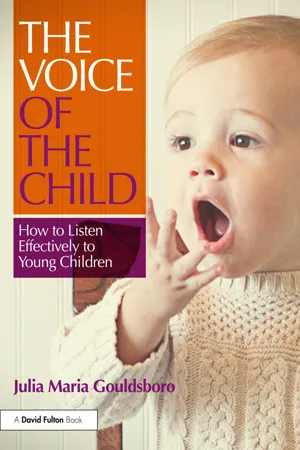
The Voice of the Child
eBook - ePub

The Voice of the Child

How to Listen Effectively to Young Children

  1. 124 pages
  2. English
  3. ePUB (mobile friendly)
  4. Available on iOS & Android
eBook - ePub

The Voice of the Child

How to Listen Effectively to Young Children

About this book

If we want children to be successful, confident, independent learners, we need to relearn the skill of truly listening. The Voice of the Child builds on a number of theories which recognise the importance of interacting with, and listening, to the children in our care, and demonstrates how these can be put into practice - listening, communicating and hearing the voice of the child effectively.

The book addresses each phase of a child's development, from birth through to five years, and explains how communication skills can be used to support individual children's specific needs. Chapters offer practical tips and strategies to help early years practitioners to listen and communicate in such a way as to encourage and enhance the development of a child's speech and language skills. With case studies and reflective questions included throughout, the book highlights the importance of listening to children in order to keep them safe, ensure they feel included in their community, and to promote their confidence and self-esteem.

The Voice of the Child is essential reading for early years practitioners and students, including those on Childhood Studies courses, who want to gain a clear understanding of how their own communication skills can impact on the child.

Trusted by 375,005 students

Access to over 1.5 million titles for a fair monthly price.

Study more efficiently using our study tools.

Information

Publisher
Routledge
Year
2017
Print ISBN
9781138636163
eBook ISBN
9781351796132

1
The pedagogy of listening

This chapter introduces the theoretical perspectives that value the importance of listening to children. It will give an overview on how theoretical perspectives and philosophical approaches consider the importance of listening. It will reflect on current thinking and, in relation to speaking and listening, will suggest how to apply theory to practice, enabling effective listening with children in our care to be successful.
ufig1_1.webp
Children need to be listened to right from birth
Table 1.1 Key words
Key words Explanation

Theorist/theoretical perspective Early years educators can draw on many theories to inform and guide their practice
Examples include Bruner, Vygotsky and Piaget
Philosophical approach Philosophical approaches influence play and learning
Examples include Forest schools, Reggio Emilia approach, Steiner schools and Montessori schools
Legislation Laws that have a direct influence on education through policies and procedures in settings
Examples include the Children Act 2004 and the Equality Act 2010
Pedagogy The holistic way that we teach children and support their development can be described as the ethos of a setting
The ‘pedagogy of listening’ is a phrase created by Carla Rinaldi, adviser to Reggio Children (Rinaldi, 1983, cited in Clark and Moss, 2011). It underpins a child’s social relationships and their relationship with the environment.
Listening involves children and adults using many languages and codes to express themselves. It also involves pauses and turn-taking. To listen means to welcome and recognise different opinions and viewpoints. In addition, it involves listening to something or someone in context; listening demands dialogue. To listen to the voice of the child, a practitioner needs to understand how to listen effectively.
All settings have an ethos, a pedagogical approach that emphasises how they will support children in their learning and development. A pedagogical approach is based on holistic development where a setting has a strong ethos or mission statement about how children under their care are nurtured and how interaction with the child supports development in all areas of learning and growth. Many settings adopt a philosophical approach, such as Montessori or Forest schools, and most settings have foundations in the theoretical perspectives of education.

A summary of theoretical perspectives and philosophical approaches

Theories suggest many ways that children learn and develop in all areas. Below are examples of theoretical perspectives for speech and language, reflecting how theorists enable the practitioner to support the voice of the child.

Noam Chomsky

Noam Chomsky explained that, as humans, we have an innate mechanism built in to us to develop speech known as a language acquisition device (LAD). Chomsky summarised that all children have an instinct to acquire language and suggested that children learn speech even if they have been deprived of a stimulating environment (Berwick and Chomsky, 2016). However, further research into speech and cases such as ‘Genie, the wild child’ (Rymer, 1994) illustrate that, if adults and peer groups do not nurture speech, it will not flourish or progress.
Genie is a true story of a child that had abusive parents and spent many years tied to a chair with no interaction with the outside world. When discovered, living in terrible conditions, adults supported her by interacting with her and communicating through signs and gestures. They observed how she began to learn vocabulary rapidly, even though she had missed the crucial age when most children acquire it. However, it was observed that her communication and interaction did not develop as well. It would seem interaction with others is vital for language to develop successfully. Jerome Bruner identified this support as the language acquisition support system (LASS).

Jerome Bruner

Jerome Bruner (1983) believed that children required a system, namely LASS, whereby they need to hear language around them. This involves the practitioner playing a pivotal role by providing age-appropriate resources and having the skills to encourage young children to learn to read, write and speak. The main factors that support a child in language acquisition are having rich interactions and warm relationships (Daly et al., 2006).
It may be accurate, as Chomsky suggests, that we are all born with an innate sense of language, but it appears that if children do not have positive social interactions, they will not progress in language and speech or know how to use meaningful speech for social interaction. One of the main factors that impinges on language development is when a child has not had opportunities for social interaction at a young age. Bruner described language as central to a child’s learning and development. He saw children’s cognitive development linked to language and divided the process into three areas:
  • Enactive mode: understanding the world through senses. Children, from a very early age, learn and develop by exploring through touch, taste, smell, sight and hearing. This is where they build up their vocabulary and descriptions of the environment.
  • Iconic: whereby children increase their understanding through visual imagery or use items to represent something – for example, a banana may represent a telephone. Children start to make sense of the world and give meaning to objects.
  • Symbolic mode: children transfer the meaning of pictures or other items. They use language and symbols to make sense of the world – for example, print, signs and pictures.
Daly et al., 2006
Bruner’s theory can be useful to language acquisition as the stages can help in supporting the individual stages of children in language acquisition. Some may need more opportunities for sensory play to increase vocabulary; some children may be very quick at deciphering images and visual cues, transferring it into print.
Bruner saw the role of the adult as one that supports a child, ‘scaffolding’ their learning to enable them to become confident and independent in their development.
The voice of the child is part of genetics, but the role of the adult is essential in fostering the voice of the child. This means that the adult must be a good role model.

Albert Bandura

Albert Bandura described the importance of the adult as a good role model, paramount to children’s development. Children watch and learn from each other and adults. This impacts immensely on adults as they need to be good role models for children. His experiment, called the ‘Bobo doll’, observed children’s response to watching adults behaving aggressively towards a toy (the Bobo doll) (1961) (Bandura et al., 1963).
Regarding speech and language, children will pick up words and phrases used by adults and other children. Sometimes this may be inappropriate language. If adults or peers behave aggressively, children may imitate this behaviour. If adults use words that are negative or demeaning, children may copy these words or label themselves as bad or rude. Language is a powerful means for either building up someone’s self-esteem or breaking it down. Bandura argues that adults can help children develop positive behaviours and attitudes by ‘out-loud’ thinking and problem-solving (David, 2004).
Children need opportunities to make sense of their world. They work within a comfort zone, repeating actions and movements, repeating phrases they understand and can link to meaning; then they are ready to move on. The role of the adult is to enable children to progress in their learning. The voice of the child achieves success and development when it is fostered and extended with the support of caring and positive adults.

Lev Vygotsky

Lev Vygotsky considered that children need adults to extend their learning. He called this the zone of proximal development. Extending learning relies on observations and knowing the child well to plan for next steps that challenge their capability. Vygotsky viewed language as one of the greatest tools for communicating with the outside world. He saw a link between language and thought. He believed that children needed to talk to adults about everyday experiences and described this as the process of speech (Daly et al., 2006).

Vygotsky: the process of speech

Two years: children use social speech, which Vygotsky defined as external communication, used to talk to others. The role of the adult is vital here as someone who listens and interacts with the child, and who extends conversations by asking questions to recall information from stories shared or experiences encountered.
Three years: Vygotsky explained that children used private speech, which he linked to thought; he explains that thought and language merge. Private speech is speech spoken to oneself for communication, self-guidance and self-regulation of behaviour. Children from two to about seven years old are usually observed engaging in private speech. Although it is audible, it is neither intended for nor directed at others. Vygotsky sees ‘private speech’ as a means for children to plan activities and strategies and therefore aid their development. As practitioners, this has an impact on our teaching. Children need to use their voice to make sense of their learning. They need opportunities to talk aloud about what they are doing, what they need, how they will achieve their aims, so teachers need to learn the skill of listening and when to interact and when to observe.
Children are not the only ones that practice private speech. Many adults may revert to this skill, talking to themselves through a difficult task or when reading out instructions.
Seven years: Vygotsky explains that children use what he described as silent speech, which enable children to self-regulate their learning. For example, we see this in schools when children develop from reading aloud to reading in their heads or calculating addition and subtraction using pens, paper and resources to mental maths (Dolva, 2009).
ufig1_2.webp
A treasure basket can ‘provide the rich and nurturing environment that babies and young children need if they are to thrive mentally, emotionally and physically’ (Hughes, 2009)
Practitioners need a clear understanding of development so tha...

Table of contents

  1. Cover
  2. Title
  3. Copyright
  4. Contents
  5. Acknowledgements
  6. Introduction
  7. 1 The pedagogy of listening
  8. 2 Understanding the stages of development: listening to baby, birth to 12 months
  9. 3 Development from 12 months to three years
  10. 4 School readiness: speech and language development for three to five years
  11. 5 Active listening
  12. 6 The hundred languages of children: listening to the varied voices of a child
  13. 7 The child’s voice as a participant in the community
  14. 8 Concluding thoughts
  15. References
  16. Index

Frequently asked questions

Yes, you can cancel anytime from the Subscription tab in your account settings on the Perlego website. Your subscription will stay active until the end of your current billing period. Learn how to cancel your subscription
No, books cannot be downloaded as external files, such as PDFs, for use outside of Perlego. However, you can download books within the Perlego app for offline reading on mobile or tablet. Learn how to download books offline
Perlego offers two plans: Essential and Complete
  • Essential is ideal for learners and professionals who enjoy exploring a wide range of subjects. Access the Essential Library with 800,000+ trusted titles and best-sellers across business, personal growth, and the humanities. Includes unlimited reading time and Standard Read Aloud voice.
  • Complete: Perfect for advanced learners and researchers needing full, unrestricted access. Unlock 1.5M+ books across hundreds of subjects, including academic and specialized titles. The Complete Plan also includes advanced features like Premium Read Aloud and Research Assistant.
Both plans are available with monthly, semester, or annual billing cycles.
We are an online textbook subscription service, where you can get access to an entire online library for less than the price of a single book per month. With over 1.5 million books across 990+ topics, we’ve got you covered! Learn about our mission
Look out for the read-aloud symbol on your next book to see if you can listen to it. The read-aloud tool reads text aloud for you, highlighting the text as it is being read. You can pause it, speed it up and slow it down. Learn more about Read Aloud
Yes! You can use the Perlego app on both iOS and Android devices to read anytime, anywhere — even offline. Perfect for commutes or when you’re on the go.
Please note we cannot support devices running on iOS 13 and Android 7 or earlier. Learn more about using the app
Yes, you can access The Voice of the Child by Julia Maria Gouldsboro in PDF and/or ePUB format, as well as other popular books in Education & Education General. We have over 1.5 million books available in our catalogue for you to explore.