eBook - ePub
An HR Guide to Workplace Fraud and Criminal Behaviour
Recognition, Prevention and Management
- 496 pages
- English
- ePUB (mobile friendly)
- Available on iOS & Android
eBook - ePub
An HR Guide to Workplace Fraud and Criminal Behaviour
Recognition, Prevention and Management
About this book
It is reliably estimated that over 70 per cent of all job applications contain misleading information. If that was the limit of deception at work faced by HR and line managers, then maybe things wouldn't be too bad. But deception isn't limited simply to the area of recruitment; there's also absenteeism, minor theft, misuse of information, not to mention the tissue of half-truths and falsehoods thrown up by an employee seeking to camouflage theft, responsibility for a fatal accident or a multi-million pound fraud. An HR Guide to Workplace Fraud and Criminal Behaviour is full of advice, best practice and case studies of deception from around the world. In fact, everything you need to: ¢ protect your workplace and the employees within it from incompetent or dangerous co-workers, theft, violence and criminality in all its forms; ¢ ensure your company's continued reputation and compliance with employment, criminal and other legislation; ¢ safeguard your shareholders or other stakeholders from the consequences of fraud, litigation or other loss. HR managers have an important part to play both in ensuring the ethical development of any organization and in protecting that organization from dishonest employees. This book offers a definitive guide to meeting these responsibilities head on.
PART 1
The Problem of Deception
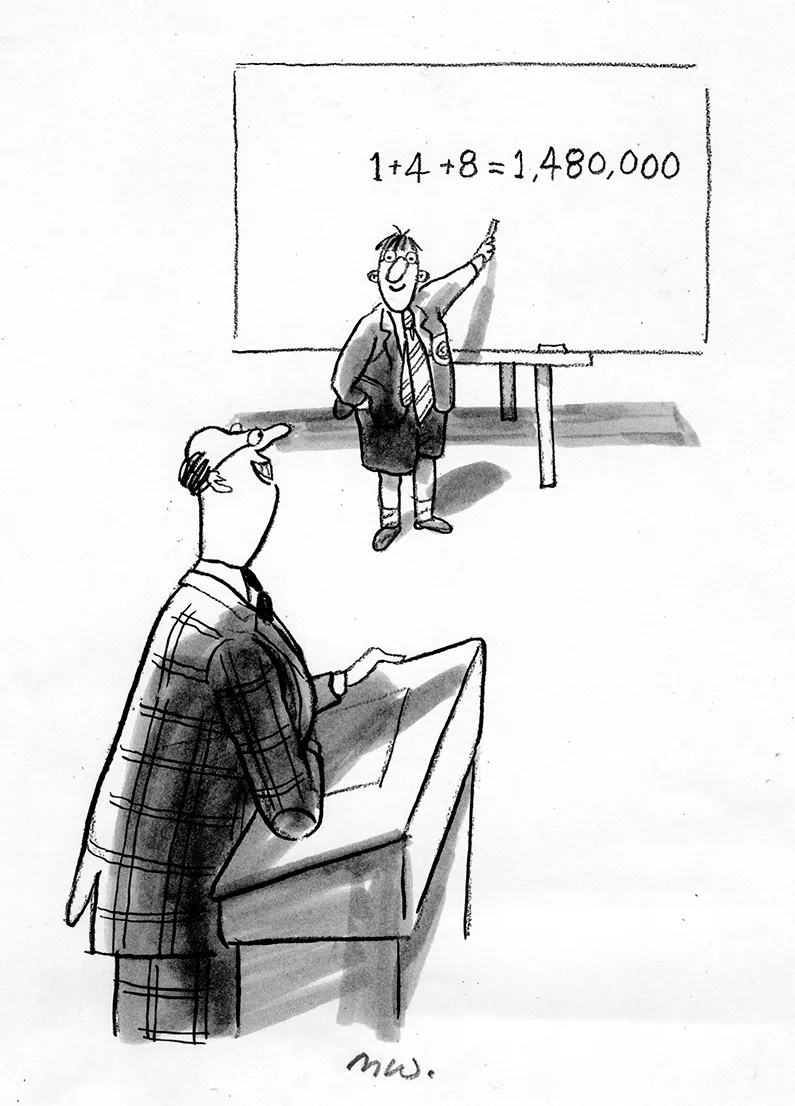
‘THAT’S IT, POTTER, YOU’LL MAKE A GREAT ACCOUNTANT’
CHAPTER 1
Introduction
Lies are the truth to people who don't know better
Lies in business
Most days of your life you are deceived. Think about it! No, please, really think about it. Take it on board at a conscious level: look upwards and to your left.1 Deception is a really bad scene.
The cheque is in the post
A Typical Day?
You got out of bed, read lots of lies in the newspaper; watched the breakfast show, with people pretending to be happy early in the morning; walked to the station with your neighbour who told you he had just been promoted, when you know he had been fired; caught the train, but could not get a first-class seat because the compartments were full of fare dodgers; came into the office, spoke to your colleagues who said your new employee was doing fine, when you know he is not; received a call from Bill Smith saying that he could not come to work today as he was ill; attended meetings; approved a bunch of purchase invoices for payment; signed a few expense statements, some of which looked a bit dodgy; telephoned a customer who promised you the cheque was in the post; called your banker, but his PA told you he was in a meeting and would call you back; had lunch with a job candidate and then lost to him at golf because he cheated. You then returned home; spoke to the kids, who told you they had no homework and were going to a disco; watched television, read your emails and responded to them and then clambered into bed, pretending you had a bad migraine.
How many lies were you told during this very ordinary day? Did you do anything about them? Were any of them really important?
The fact is that most people would prefer to be deceived than be perceived as being distrustful
In the majority of cases, the lies you are told are insignificant, but sometimes they have very serious consequences. In his book Rogue Trader, Nicholas Leeson said:
Buying Time
‘I put the phone down. These conversations were always the same with Mary [Mary Walz was his functional manager whose career was seriously damaged by Mr Leeson's dishonesty]. She tried to give me some kind of tough instruction, but I always deflected her so she ended with the promise of another chat tomorrow. This was fine by me. Each tomorrow I passed was another day …
I just needed to buy time.’
When Tony Railton, an auditor from Baring's head office, was sent to Singapore to sort out the trading positions, Mr Leeson said:
Incredible Explanation
‘I wondered what Tony Railton had uncovered. My list of deceit was too long … it could have been anything from the Balance Sheet to the Citibank account or to the 88888 account. I waited for him. Then the penny dropped and then the millions dropped. I realised Railton was asking me a question rather than accusing me of fraud … and wrestling me to the ground in a citizen's arrest. If he was asking a question he might not know the answer.
‘“It's a consolidation account we use, something like the gross account reporting we do for you,” I said airily. This was all gobbledegook. He couldn't possibly swallow this one. I put one hand out of sight below my desk and pinched my thigh to stop myself from laughing at my own idiocy. My explanation made no sense, but it was the best I could come up with on the spot and he believed it.’
For every credibility gap, there is a gullibility fill …
Fortunately you may never be confronted with someone quite like Mr Leeson but, just the same, there are hundreds of occasions every year when it would be to your advantage to extract the truth from people who don't want to tell it. Whatever job you do, your success ultimately depends on your ability to sort out the good from the bad and to deal, effectively and politely, with deception.
All lies in jest, until a man hears what he wants to hear and disregards the rest2
The cunning plan
This book explains how and why lies are told and how you can deal with them whatever job you do. There are two main sorts of lies. The first is the achievement lie, which is told in order to lead you down the garden path so that you give a job to a bad candidate, part with your money or do something else that is against your interest. The second sort is the exculpatory lie, used to hide wrongdoing and normally told after the event, such as in a disciplinary interview or when someone is challenged for doing something wrong.
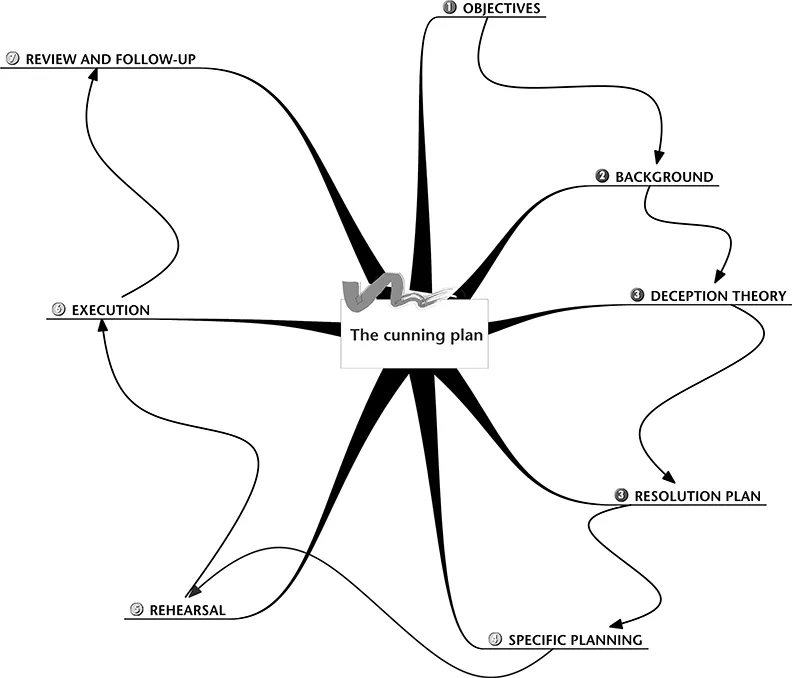
Mind Map® 1 Elements of the cunning plan
But either way, the fact is that the clues to deception are overwhelming, providing you register them at a conscious level. Once you have done this, the initiative swings in your favour. You must decide what your objectives are: do you want to deal with the lie or let it pass? If you decide to expose it you must plan and rehearse your approach and then execute it in a clinical and low-key way (see Mind Map 1). And the more you practice, the better you will become.
By working through this book, you should become almost as successful as Herman in dealing with hot air and deception in business. If you want, you will also be able to develop non-verbal methods of communicating with your pets, other humans and humanoids who don't understand plain language.
This book is intended as a practical guide primarily for human resources specialists and line managers who want to improve their performance and that of their organization based on four principles:
- Dishonesty, violence and other unpleasant behaviour is caused by humans.
- Every process, operation or asset is safe if the only people who have access to them are honest.
- Decisions will always be much more effective if they are based on the truth.
- People who act dishonestly should be identified, exposed and removed from further temptation as quickly and as quietly as possible; they should be punished and made to repay.
Good lies you can still continue to enjoy as they will do you no harm. Some of the techniques suggested in Chapters 6 and 7 are only appropriate for really tough interviews where gross deception is suspected and where the stakes are really high. The chances are that in the sorts of interviews you have to conduct you will not have to use these, but it is important that you should know about them so that you can use diluted versions in your day-to-day work.
If you think telling the truth is difficult, try lying
Buying this book
If you are reading these words in a bookshop and considering whether to buy the book, remember that even if you don't plan to read it, you can still benefit greatly from buying it. The reason it has a gaudy cover and big letters is so that you can leave it on your desk or take it with you into meetings instead of your Filofax or mobile telephone. Just let everyone see it and you will have improved your chances of not being deceived by 75.876 per cent.
Better still why not buy three copies: one for the office, one for your personal use and keep the last on your golf trolley. Do this and you will increase your chances of finding the truth simply by letting people know that you are aware of the possibilities that they might try to deceive you. If you want to improve your chances of finding the truth to 98.617 per cent you should open the book in meetings, flick through the pages, look at the person you suspect might be dissembling the truth and say: ‘Aaaah … that's it. I knew it was in there somewhere’. This will unnerve most liars.
Structure of the book
General
This book covers lies in all shapes and sizes, and the situations in which they most commonly occur (Figure 1.1).
The book is writ...
Table of contents
- Cover Page
- Title Page
- Copyright Page
- Contents
- List of Figures
- List of Tables
- List of Mind Maps®
- Foreword
- Prologue
- Part 1: The Problem of Deception
- 1 Introduction
- 2 Taxonomy
- 3 The Human Mind
- 4 Signs of Deception
- Part 2: Countermeasures
- 5 Your Personal Manifesto
- 6 Planning Tough Interviews
- 7 Conducting Tough Interviews
- 8 Forms
- Part 3: Solutions to HR Problems
- 9 HR Procedures
- 10 Other Applications
- Part 4: In Court
- 11 Giving Evidence
- Appendix 1: Suspects Checklist
- Appendix 2: Evaluation Matrix
- Index
Trusted by 375,005 students
Access to over 1.5 million titles for a fair monthly price.
Study more efficiently using our study tools.
Frequently asked questions
Yes, you can cancel anytime from the Subscription tab in your account settings on the Perlego website. Your subscription will stay active until the end of your current billing period. Learn how to cancel your subscription
No, books cannot be downloaded as external files, such as PDFs, for use outside of Perlego. However, you can download books within the Perlego app for offline reading on mobile or tablet. Learn how to download books offline
We are an online textbook subscription service, where you can get access to an entire online library for less than the price of a single book per month. With over 1.5 million books across 990+ topics, we’ve got you covered! Learn about our mission
Look out for the read-aloud symbol on your next book to see if you can listen to it. The read-aloud tool reads text aloud for you, highlighting the text as it is being read. You can pause it, speed it up and slow it down. Learn more about Read Aloud
Yes! You can use the Perlego app on both iOS and Android devices to read anytime, anywhere — even offline. Perfect for commutes or when you’re on the go.
Please note we cannot support devices running on iOS 13 and Android 7 or earlier. Learn more about using the app
Please note we cannot support devices running on iOS 13 and Android 7 or earlier. Learn more about using the app
Yes, you can access An HR Guide to Workplace Fraud and Criminal Behaviour by Michael J. Comer,Timothy E. Stephens in PDF and/or ePUB format, as well as other popular books in Business & Business General. We have over 1.5 million books available in our catalogue for you to explore.