- 496 pages
- English
- ePUB (mobile friendly)
- Available on iOS & Android
eBook - ePub
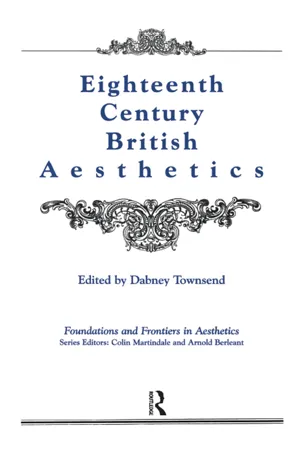
Eighteenth-Century British Aesthetics
About this book
In "Eighteenth Century British Aesthetics", editor Dabney Townsend has brought together the work of such well-known writers as John Dryden, Joshua Reynolds, David Hume, and Samuel Johnson with the more obscure works of aestheticians such as Uvedale Price, Daniel Webb, John Baillie, and James Harris, whose work is difficult to find, but is nonetheless important, informative, and interesting. These twenty-two selections, accompanied by Dabney Townsend's historical essay on the development of eighteenth century aesthetics, make the history of aesthetics accessible to both students and specialists alike.
Information
CHAPTER 1
“Introduction” to Charles du Fresnoy, De Arte Graphica
De Arte Graphica Preface of the Translator, with a Parallel, of Poetry and Painting 1695
It may be reasonably expected, that I should say something on my own behalf, in respect to my present undertaking. First, then, the reader may be pleased to know, that it was not of my own choice that I undertook this work. Many of our most skillful painters and other artists were pleased to recommend this author to me, as one who perfectly understood the rules of painting; who gave the best and most concise instruction for performance, and the surest to inform the judgment of all who loved this noble art: that they who before were rather fond of it, than knowingly admired it, might defend their inclination by their reason; that they might understand those excellencies which they blindly valued, so as not to be farther imposed on by bad pieces, and to know when nature was well imitated by the most able masters. ’Tis true indeed, and they acknowledge it, that beside the rules which are given in this treatise, or which can be given in any other, that to make a perfect judgment of good pictures, and to value them more or less when compared with one another, there is farther required a long conversation with the best pieces, which are not very frequent either in France or England; yet some we have, not only from the hands of Holbein, Rubens, and Van Dyck, (one of them admirable for history-painting, and the other two for portraits,) but of many Flemish masters, and those not inconsiderable, though for design, not equal to the Italians. And of these latter also, we are not unfurnished with some pieces of Raphael, Titian, Correggio, Michael Angelo, and others.
But to return to my own undertaking of this translation, I freely own, that I thought my self uncapable of performing it, either to their satisfaction, or my own credit. Not but that I understood the original Latin, and the French author perhaps as well as most Englishmen; but I was not sufficiently versed in the terms of art; and therefore thought that many of those persons who put this honorable task on me, were more able to perform it themselves, as undoubtedly they were. But they assuring me of their assistance, in correcting my faults where I spoke improperly, I was encouraged to attempt it, that I might not be wanting in what I could, to satisfy the desires of so many gentlemen who were willing to give the world this useful work. They have effectually performed their promise to me; and I have been as careful on my side, to take their advice in all things; so that the reader may assure himself of a tolerable translation: Not elegant, for I proposed not that to my self; but familiar, clear, and instructive. In any of which parts, if I have failed, the fault lies wholly at my door. In this one particular only I must beg the readers pardon. The prose translation of the poem is not free from poetical expressions, and I dare not promise that some of them are not fustian, or at least highly metaphorical; but this being a fault in the first digestion (that is, the original Latin) was not to be remedied in the second (viz.) the translation. And I may confidently say, that whoever had attempted it must have fallen into the same inconvenience; or a much greater, that of a false version.
When I undertook this work, I was already engaged in the translation of Virgil, from whom I have borrowed only two months, and am now returning to that which I ought to understand better. In the mean time I beg the readers pardon, for entertaining him so long with my self: ’Tis an usual part of ill manners in all authors, and almost in all mankind, to trouble others with their business; and I was so sensible of it beforehand, that I had not now committed it, unless some concernments of the readers had been interwoven with my own. But I know not, while I am atoning for one error, if I am not falling into another: for I have been importuned to say something farther of this art; and to make some observations on it in relation to the likeness and agreement which it has with poetry, its sister. But before I proceed, it will not be amiss, if I copy from Bellori (a most ingenious author, yet living) some part of his idea of a painter, which cannot be unpleasing, at least to such who are conversant in the philosophy of Plato. And to avoid tediousness, I will not translate the whole discourse, but take and leave as I find occasion.
God Almighty, in the fabric of the universe, first contemplated himself, and reflected on his own excellencies; from which he drew, and constituted those first forms, which are called idea’s: So that every species which was afterwards expressed was produced from that first idea, forming that wonderful contexture of all created beings. But the celestial bodies above the moon being incorruptible, and not subject to change, remained for ever fair, and in perpetual order: On the contrary, all things which are sublunary are subject to change, to deformity, and to decay. And though nature always intends a consummate beauty in her productions, yet through the inequality of the matter, the forms are altered; and in particular, human beauty suffers alteration for the worse, as we see to our mortification, in the deformities, and disproportions which are in us. For which reason the artful painter and the sculptor, imitating the divine maker, form to themselves as well as they are able, a model of the superior beauties; and reflecting on them endeavor to correct and amend the common nature; and to represent it as it was first created without fault, either in color or in lineament.
This idea, which we may call the Goddess of painting and of sculpture, descends upon the marble and the cloth, and becomes the original of those arts; and being measured by the compass of the intellect, is it self the measure of the performing hand; and being animated by the imagination, infuses life into the image. The idea of the painter and the sculptor, is undoubtedly that perfect and excellent example of the mind; by imitation of which imagined form, all things are represented which fall under human sight: Such is the definition which is made by Cicero in his book of the orator to Brutus. "As therefore in forms and figures there is somewhat which is excellent and perfect, to which imagined species all things are referred by imitation, which are the objects of sight, in like manner we behold the species of eloquence in our minds, the effigies, or actual image of which we seek in the organs of our hearing. This is likewise confirmed by Proclus in the dialogue of Plato called Timaeus: If, says he, you take a man, as he is made by nature and compared him with another who is the effect of Art; the work of nature will always appear the less beautiful, because art is more accurate than nature." But Zeuxis, who from the choice which he made of five virgins, drew that wonderful picture of Helena, which Cicero in his Orator before mentioned, sets before us as the most perfect example of beauty, at the same time admonishes a painter, to contemplate the ideas of the most natural forms; and to make a judicious choice of several bodies, all of them the most elegant which he can find: by which we may plainly understand that he thought it impossible to find in any one body all those perfections which he sought for the accomplishment of a Helena, because nature in any individual person makes nothing that is perfect in all its parts. For this reason Maximus Tyrius also says, that the image which is taken by a painter from several bodies produces a beauty, which ’tis impossible to find in any single natural body, approaching to the perfection of the fairest statues. Thus nature on this account is so much inferior to art, that those artists who propose to themselves only the imitation and likeness of such or such a particular person, without election of those idea’s before-mentioned, have often been reproached for that omission: Demetrius was taxed for being too natural; Dionysius was also blamed for drawing men like us, and was commonly called, Aνθρωπóγραφoζ that is, a painter of men. In our times Michael Angelo da Caravaggio, was esteemed too natural. He drew persons as they were; and Bamboccio, and most of the Dutch painters, have drawn the worst likeness. Lysippus of old, upbraided the common sort of sculptors, for making men such as they were found in nature; and boasted of himself that he made them as they ought to be; which is a precept of Aristotle, given as well to poets as to painters. Phidias raised an admiration even to astonishment, in those who beheld his statues, with the forms, which he gave to his Gods and heroes; by imitating the idea rather than nature. And Cicero speaking of him affirms, that figuring Jupiter and Pallas, he did not contemplate any object from whence he took the likeness, but considered in his own mind a great and admirable form of beauty, and according to that image in his soul, he directed the operation of his hand. Seneca also seems to wonder, that Phidias having never beheld either Jove or Pallas, yet could conceived their divine images in his mind. Apollonius Tyanaeus says the same in other words, that the fancy more instructs the painter than the imitation; for the last makes only the things which it sees, but the first makes also the things which it never sees.
Leon Battista Alberti tells us, that we ought not so much to love the likeness as the beauty, and to choose from the fairest bodies severally the fairest parts. Leonardo da Vinci instructs the painter to form this idea to himself: And Raphael, the greatest of all modern masters, writes thus to Castiglione, concerning his Galatea: “To paint a fair one, ’tis necessary for me to see many fair ones; but because there is so great a scarcity of lovely women, I am constrained to make use of one certain idea, which I have formed to my self in my own fancy.” Guido Reni sending to Rome his St. Michael which he had painted for the church of the Capuchins, at the same time wrote to Monsignor Massano, who was Maestro di Casa (or steward of the house) to Pope Urban the Eighth, in this manner: “I wish I had the wings of an Angel, to have ascended into paradise, and there to have beheld the forms of those beatified spirits, from which I might have copied my archangel: But not being able to mount so high, it was in vain for me to search his resemblance here below: so that I was forced to make an introspection, into my own mind, and into that idea of beauty, which I have formed in my own imagination. I have likewise created there the contrary idea of deformity and ugliness; but I leave the consideration of it, ’till I paint the devil: and in the mean time shun the very thought of it as much as possibly I can, and am even endeavoring to blot it wholly out of my remembrance.”
There was not any lady in all antiquity, who was mistress of so much beauty as was to be found in the Venus of Gnidus, made by Praxiteles, or the Minerva of Athens by Phidias; which was therefore called the beautiful form. Neither is there any man of the present age, equal in the strength, proportion, and knitting of his limbs, to the Hercules of Farnese, made by Glycon: Or any woman who can justly be compared with the Medicean Venus of Cleomenes. And upon this account, the noblest poets and the best orators, when they desired to celebrate any extraordinary beauty, are forced to have recourse to statues and pictures, and to draw their persons and faces into comparison. Ovid endeavoring to express the beauty of Cyllarus, the fairest of the centaurs, celebrates him as next in perfection, to the most admirable statues.
Gratus in ore vigor, cervix, humeriq; manusq;
Pectoraq; Artificum laudatis Proxima Signis.
A pleasing vigor his fair face expressed;
His neck, his hands, his shoulders, and his breast,
Did next in gracefulness and beauty stand,
To breathing figures of the sculptor’s hand.
In another place he sets Apelles above Venus.
Si Venerem Cois nunquam pinxisset Apelles,
Mersa sub aequoreis illa lateret Aquis.
thus varied.
One birth to seas the Cyprian Goddess owed,
A second birth the painter’s art bestowed:
Less by the seas than by his power was given;
They made her live, but he advanced to heaven.
The idea of this beauty, is indeed various, according to the several forms which the painter or sculptor would describe; as one in strength, another in magnanimity: and sometimes it consists in cheerfulness, and sometimes in delicacy; and is always diversified by the sex and age.
The beauty of Jove is one, and that of Juno another: Hercules, and Cupid are perfect beauties, though of different kinds; for beauty is only that which makes all things as they are in their proper and perfect nature, which the best painters always choose by contemplating the forms of each. We ought farther to consider, that a picture being the representation of a human action, the painter ought to retain in his mind, the examples of all affections, and passions, as a poet preserves the idea of an angry man, of one who is fearful, sad or merry, and so of all the rest: For ’tis impossible to express that with the hand, which never entered into the imagination. In this manner as I have rudely and briefly shewn you, painters and sculptors, choosing the most elegant natural beauties, perfectionate the idea, and advance their art, even above nature it self, in her individual productions; which is the utmost mastery of human performance.
From hence arises that astonishment, and almost adoration which is paid by the knowing to those divine remainders of Antiquity. From hence Phidias, Lysippus, and other noble sculptors, are still held in veneration; and Appelles, Zeuxis, Protogenes, and other admirable painters, though their works are perished, are and will be eternally admired; who all of them drew after the ideas of perfection, which are the miracles of nature, the providence of the understanding, the exemplars of the mind, the light of the fancy; the sun which from its rising, inspired the statue of Memnon, and the fire which warmed into life the image of Prometheus: ’Tis this which causes the graces, and the loves to take up their habitations in the hardest marble, and to subsist in the emptiness of light, and shadows. But since the idea of eloquence is as far inferior to that of painting, as the force of words is to the sight, I must here break off abruptly, and having conducted the reader as it were to a secret walk, there leave him in the midst of silence to contemplate those ideas; which I have only sketched, and which every man must finish for himself.
In these pompous expressions, or such as these, the Italian has given you his idea of a painter; and though I cannot much commend the style, I must needs say there is somewhat in the matter: Plato himself is accustomed to write loftily, imitating, as the critiques tell us, the manner of Homer; but surely that inimitable poet, had not so much of smoke in his writing, though not less of fire. But in short, this is the present genius of Italy. What Philostratus tells us in the proem of his figures is somewhat plainer; and therefore I will translate it almost word for word.
He who will rightly govern the art of painting, ought of necessity first to understand human nature. He ought likewise to be endued with a genius to express the signs of their passions whom he represents; and to make the dumb as it were to speak; he must yet further understand what is contained in the constitution of the cheeks, in the temperament of the eyes, in the naturalness (if I may so call it) of the eye-brows; and in short whatsoever belongs to the mind and thought. He who thoroughly possesses all these things will obtain the whole: And the hand will exquisitely represent the action of every particular person. If it happen that he be either mad, or angry, melancholic, or cheerful, a sprightly youth, or a languishing lover; in one word, he will be able to paint whatsoever is proportionable to any one. And even in all this there is a sweet error without causing any shame: For the eyes and minds of the beholders being fastened on objects which have no real being, as if they were truly existent, and being induced by them to believe them so, what pleasure is it not capable of giving? the ancients, and other wise men, have written many things concerning the symmetry which is in the art of painting; constituting as it were some certain laws for the proportion of every member, not thinking it possible for a painter to undertake the expression of those motions which are in the mind, without a concurrent harmony in the natural measure: For that which is out of its own kind and measure, is not received from nature, whose motion is always right. On a serious consideration of this matter it will be found, that the art of painting has a wonderful affinity with that of poetry; and that there is betwixt them a certain common imagination. For as the poets introduce the Gods and heroes, and all those things which are either majestical, honest or delightful, in like manner the painters, by the virtue of their out-lines, colors, lights and shadows, represent the same things and persons in their pictures.
Thus, as convoy ships either accompany, or should accompany their merchants till they may prosecute the rest of their voyage without danger, so Philostratus has brought me thus far on my way, and I can now sail on without him. He has begun to speak of the great relation betwixt painting and poetry, and thither the greatest part of this discourse by my promise was directed. I have not engaged my self to any perfect method, neither am I loaded with a full cargo. Tis sufficient if I bring a sample of some goods in this voyage. It will be easy for others to add more when the commerce is settled: For a treatise twice as large as this of painting could not contain all that might be said on the parallel of these two sister arts. I will take my rise from Bellori before I proceed to the author of this book.
The business of his preface is to prove, that a learned painter should form to himself an idea of perfect nature. This image he is to set before his mind in all his undertakings, and to draw from thence as from a store-house, the beauties which are to enter into his work; thereby correcting nature from what actually she is in individuals, to what she ought to be, and what she was created. Now as this idea of perfection is of little use in portraits (or the resemblances of particular persons) so neither is it in the characters of comedy, and tragedy; which are never to be made perfect, but always to be drawn with some specks of frailty and deficiency; such as they have been described to us in history, if they were real characters; or such as the poet began to shew them at their first appearance, if they were only fictitious, (or imaginary). The perfection of such stage-characters consists chiefly in their likeness to the deficient faulty nature, which is their original: Only, as ’tis observed more at large hereafter, in such cases there will always be found a better likeness, and a worse; and the better is constantly to be chosen: I mean in tragedy, which represents the figures of the highest form amongst mankind. Thus in portraits, the painter will not take that side of the face which has some notorious blemish in it; but either draw it in profile (as Apelles did Antigonus, who had lost one of his eyes) or else shadow the more imperfect side. For an ingenious flattery is to be allowed to the professors of both arts; so long as the likeness is not destroyed. ’Tis true that all manner of imperfections must not be taken away from the characters, and the reason is, that there may be left some grounds of pity for their misfortunes. We can never be grieved for their miseries who are thoroughly wicked, and have thereby justly called their calamities on themselves. Such men are the natural objects of our hatred, not of our commiseration. If on the other side their characters were wholly perfect (such as for example, the character of a saint or martyr in a play,) his, or her misfortunes, would produce impious thoughts in the beholders: they would accuse the heavens of injustice, and think of leaving a religion, where piety was so ill requited....
Table of contents
- Cover
- Title Page
- Copyright Page
- Table of Contents
- Introduction: Aesthetics in the Eighteenth Century
- CHAPTER 1 “Introduction” to Charles du Fresnoy, De Arte Graphica (1695)
- CHAPTER 2 A Large Account of the Taste in Poetry, and the Causes of the Degeneracy of It (1702)
- CHAPTER 3 Characteristics of Men, Manners, Opionions, Times (1711)
- CHAPTER 4 The Spectator (1712)
- CHAPTER 5 Reflections Upon Laughter (1725)
- CHAPTER 6 Three Treatises (1744)
- CHAPTER 7 An Essay on the Sublime (1744)
- CHAPTER 8 The Rambler (1751)
- CHAPTER 9 Analysis of Beauty, Written with a View of Fixing the Fluctuating Ideas of Taste (1753)
- CHAPTER 10 Of the Delicacy of Taste and Passion (1741)
- CHAPTER 11 A Philosophical Enquiry into the Origin of Our Ideas of the Sublime and Beautiful (1757/1759)
- CHAPTER 12 An Essay on Taste (1759)
- CHAPTER 13 A Course of Lectures on Oratory and Criticism (1759/1777)
- CHAPTER 14 An Inquiry into the Beauties of Painting and into the Merits of the Most Celebrated Painters, Ancient and Modern (1760)
- CHAPTER 15 Elements of Criticism (1762)
- CHAPTER 16 The Idler (1759)
- CHAPTER 17 Essays on Poetry and Music, as They Affect the Mind (1762)
- CHAPTER 18 Lectures on Rhetoric and Belles Lettres (1783)
- CHAPTER 19 Essay on the Nature and Principles of Taste (1790)
- CHAPTER 20 Three Essays (1791)
- CHAPTER 21 An Essay on the Picturesque as Compared with the Sublime and Beautiful (1794)
- CHAPTER 22 Of the nature of that Imitation which Takes Place in What are Called the Imitative Arts (1795)
- Index
Trusted by 375,005 students
Access to over 1.5 million titles for a fair monthly price.
Study more efficiently using our study tools.
Frequently asked questions
Yes, you can cancel anytime from the Subscription tab in your account settings on the Perlego website. Your subscription will stay active until the end of your current billing period. Learn how to cancel your subscription
No, books cannot be downloaded as external files, such as PDFs, for use outside of Perlego. However, you can download books within the Perlego app for offline reading on mobile or tablet. Learn how to download books offline
Perlego offers two plans: Essential and Complete
- Essential is ideal for learners and professionals who enjoy exploring a wide range of subjects. Access the Essential Library with 800,000+ trusted titles and best-sellers across business, personal growth, and the humanities. Includes unlimited reading time and Standard Read Aloud voice.
- Complete: Perfect for advanced learners and researchers needing full, unrestricted access. Unlock 1.5M+ books across hundreds of subjects, including academic and specialized titles. The Complete Plan also includes advanced features like Premium Read Aloud and Research Assistant.
We are an online textbook subscription service, where you can get access to an entire online library for less than the price of a single book per month. With over 1.5 million books across 990+ topics, we’ve got you covered! Learn about our mission
Look out for the read-aloud symbol on your next book to see if you can listen to it. The read-aloud tool reads text aloud for you, highlighting the text as it is being read. You can pause it, speed it up and slow it down. Learn more about Read Aloud
Yes! You can use the Perlego app on both iOS and Android devices to read anytime, anywhere — even offline. Perfect for commutes or when you’re on the go.
Please note we cannot support devices running on iOS 13 and Android 7 or earlier. Learn more about using the app
Please note we cannot support devices running on iOS 13 and Android 7 or earlier. Learn more about using the app
Yes, you can access Eighteenth-Century British Aesthetics by Dabney Townsend in PDF and/or ePUB format, as well as other popular books in Philosophy & Aesthetics in Philosophy. We have over 1.5 million books available in our catalogue for you to explore.