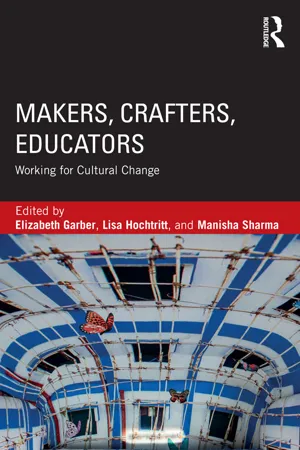
Makers, Crafters, Educators brings the do-it-yourself (DIY) ethos of maker and crafter movements into educational environments, and examines the politics of cultural change that undergird them. Addressing making and crafting in relation to community and schooling practices, culture, and place, this edited collection positions making as an agent of change in education. In the volume's five sections—Play and Hacking, Access and Equity, Interdependence and Interdisciplinarity, Cultural and Environmental Sustainability, and Labor and Leisure—authors from around the world present a collage of issues and practices connecting object making, participatory culture, and socio-cultural transformation. Offering gateways into cultural practices from six continents, this volume explores the participatory culture of maker and crafter spaces in education and reveals how community sites hold the promise of such socio-cultural transformation.
eBook - ePub
Makers, Crafters, Educators
Working for Cultural Change
- 254 pages
- English
- ePUB (mobile friendly)
- Available on iOS & Android
eBook - ePub
Makers, Crafters, Educators
Working for Cultural Change
About this book
Information
1
INTRODUCTION
Makers, Crafters, Educators: Working for Cultural Change
People make meaning through making. They also gain pleasure from doing so, “a joie de faire” that Ellen Dissanayake argues from a biobehavioral position (40). Faythe Levine, author of Handmade Nation, contends that through making and crafting people can come to realize that “they have the power to make their lives what they want them to be through simple personal choices” because making things, “anything, with your hands is a quiet political ripple in a world dominated by mass production” (Levine 58). Making and crafting, and educating about them, is a global movement, a “do-ocracy” of people who take action to make because people are happier when they are “doing or making things for themselves” (Gauntlett 226). Gauntlett talks about making as a social activity that connects people, much as Davies found in her study of maker and hackerspaces. With authors of one report finding that as of 2012 almost half of people in the United States engaged in some form of craft (Davies 16) and 40 million U.S. Americans were part of what Richard Florida has termed “the creative class” (Hatch 52), making and crafting are part of the zeitgeist of this moment in time.
As you read this Introduction, you may be asking yourself why makers and crafters are hinged together within it. Crafting is a type of making, underlying their twining in this volume. At the center are makers, crafters, and educators who engage DIY (do-it-yourself) and DIT (do-it-together) practices as strategies for cultural change; authors and makers within the volume offer gateways, or hacks, into cultural practices. These authors are engaging with a tactile and visionary world. In these senses, crafting and making are knit closely together.
This volume is focused on making and crafting as cultural change, which we are defining as developing cultural capital—such as making, crafting, and educating—to influence and effect changes on individual, community, governmental, and/or economic behavior. You, the reader, will sense different emphases on the development of the individual and the social unit vis-à-vis cultural variations and diverse sites of practice across the global perspectives of the six continents the essays cover.
Putting craft and making in historical context, craft arose out of a perceived separation of materials and certain approaches to making that were different from art (see, for example, Greenhalgh and Fariello in the Works Cited). While the perceived differences are immaterial to this volume, some key ideas associated with craft are that it is handmade, often associated with function or utility, sometimes perceived as nostalgic or retro as well as associated with a pastoral lifestyle, is associated with certain materials (e.g., textiles and fibers, clay, wood), involves skill, and is often practiced by amateurs (Adamson) in addition to professionals. Craft as it is thought of in today’s industrialized societies is rooted in the British Arts and Crafts Movement as purveyed by art critic John Ruskin and interior designer and poet William Morris. Both wrote during a time when industrial means of manufacturing were changing how people worked and lived, making the knowledge and products of the craftsperson seem irrelevant. These changes led to aesthetic preference for a machined-looking object, where evidence of the hand became eschewed, and to the valuing of idea over skill or material objects (Fariello 17). Today, we see a renaissance of appreciation for the handmade, and moreover for making, even as crafters are challenging the connotations associated with craft.
While making reaches back as long as people have lived, the maker movement is much more recent. Gauntlett identifies an “attitude to everyday life” (57) through iterations of learning spaces such as the knitting circles after the 1700s; decorative or applied arts; the Arts and Crafts Movement articulated in the 1800s; the DIY culture emerging in the 1960s; Punk DIY or lo-fi culture and craftivism that grew with the popularity of the Internet; and contemporary maker, hacker, and slow movements. Early hackerspaces arose in Europe in the 1980s and 1990s as counter-cultural spaces (Grenzfurthner and Apunkt n.p.). Their early political agenda ceded to their existence as “tiny geeky workshop paradises” (n.p.), making them more like North American hackerspaces, that, Davies argues, tend to be “leisure-oriented” (33). She traces makerspaces to Make: magazine, allowing, however, that the term makerspace “tends to be used as a label for a more diverse range of spaces, with a wider range of histories, than hackerspace” (34). A non-profit version of makerspaces, still a franchise, is the Fab Lab. With an educational mission, they are often part of universities or schools. Although most makerspaces are not affiliated with any of these endeavors, they tend “to be more open to commercial structures and interests – both in terms of how they are run and in their membership” (35). Craft today shares some of these commercial interests, having been long marketed through chain stores and the corner knitting shop, with some stores offering classes. As presented by craft activists, however, who engage craft for political ends and may choose to work with repurposed materials in order to avoid consumption and practice in sustainable ways, crafting challenges not only the commercialization of making but the beliefs that surround it (see, for example, Greer, a section of Buszek, and Garber in the Works Cited).
In the sections of this Introduction that follow, we will discuss objects and the meanings associated with them, the politics of socio-cultural transformation that surround making and crafting, and the participatory culture of do-ocracies—especially as it relates to education in schools, museums, and community venues, as well as in a few businesses. We will conclude with an overview of the organization of the book and the chapters within it.
Objects and Meanings
While “object” is a general term, referencing many material things—from sculpture to blankets to cars to cactus pads, and from the manufactured to the found to the handmade, it’s a good word because “it lies outside value-laden classification systems” of art, craft, and artifact (Fariello 19). American Studies scholar Thomas Schlereth defines the object in the encompassing sense of “concrete evidence of the presence of a human mind operating at the time of fabrication” (3). These framings suitably fit our concept of the object in making, crafting, and educating. They don’t suggest a hierarchy between objects, nor classification of objects, and furthermore imply the making of objects as deliberate acts.
Anthropologist George Kubler looked at the value of objects and noted three distinctions: aesthetic value, market value, and social value. Aesthetic value appeals to the senses and market value to economic concerns, whereas social value appeals to functionality, or ideological or personal value. When William Morris wrote, “Have nothing in your houses that you do not know to be useful or believe to be beautiful,” he was emphasizing aesthetic value and the social value of functionality (V&A n.p.). Both Morris and Ruskin promoted objects for their aesthetic, meditative function as an antidote to the industrialization of society.
In his introduction to The Social Life of Things, Arjun Appadurai helps us understand the entwined nature of aesthetic, social, and market value as he builds a case for the value of an object being socially determined, not inherent. An object, he argues, accrues value through desire and demand for it. These values are illuminated in “the concrete, historical circulation of things,” with “their meanings … inscribed in their forms, their uses, their trajectories” (5). These insights help us understand more deeply Sandra Flood’s observations of the ways objects carry social messages that signal a “dialogue between object and user, shape, size, material, and decoration” that connote social messages and conventions (100). “Who wears emeralds?” she asks, and “[W]hat does the wearing of emeralds say about the wearer’s nationality and status?” (100). What are the differences between a handmade demi-tasse, a drugstore coffee mug, and a throwaway cup, and how does each change our experience of drinking coffee?
Appadurai also observes that, “from a theoretical point of view human actors encode things with significance, [and that] from a methodological point of view it is the things-in-motion that illuminate their human and social context” (Appadurai 5, original emphasis). Emeralds are encoded with human-inlaid significance, giving them social value and meaning; the high-backed chair, however, is the thing-in-motion that not only tells us how to sit, but holds connotations about sitting in different contexts. The object itself exists in a dynamic relationship, a “deep play” (Appadurai 31, citing Clifford Geertz) with these contexts and values, and the meanings arising from them. Because of these various levels of meaning and points of view, we develop “co-relationships” with objects that speak to us (Hood and Kraehe 33); these objects have power and agency within our lives.
The methodological point of view could also be understood to encompass relationships between object makers and what they produce. Celebrated craft writer Rose Slivka proposed,
At that moment of rightness, there is transfiguration, and exchange of presence between maker and object. The object becomes itself the poet. The object is seen and touched in the language of materials … The object provides thereness, a physical place: it holds the space, marks the terrain, the geography of the metaphor. (10)
For some, making is done with an eye towards the finished object; for others, it is the process; for many, it is both. Materials and processes, as well as use, provide feedback to makers and these interactions spur new ideas and sensations, and new work.
Canadian ceramic artist Steven Heinemann has observed that despite the emphasis in art school on developing ideas, people remain hungry to make: “They want to get their hands on things not necessarily located in their heads” (Cannon 172). The initial results may not be attractive, nor well crafted, nor fit into concepts of what “good” art is about. “The times that I’ve come across 3D printers, in hackerspaces or elsewhere,” notes Sarah Davies, “they have almost exclusively been used to print what we might term cheap plastic crap: tchotchkes, slightly wonky though theoretically useful household organizers such as soap dispensers or pencil boxes, miniature figurines” (7). But the sense is that the quality may improve once the newness wears off or that DIY can allow users to break into new ground (Davies 26), or that each object made serves as prototype or inspiration for the next.
Making in education can be understood as an ideological tenet. When an instructor or workshop leader suggests making an object, what is the learning goal? When students/participants undertake that suggestion, what is their motivation? For any of these parties, it could be the development of skill or procedural knowledge, as is frequent in schooling or community classes. Teachers and parents might have broader goals to develop personal qualities such as patience and discipline, conceptual development, awareness of and involvement in social justice issues, even dexterity and coordination. Makers themselves may seek building community and collaboration, as Davies found in makerspaces. Making for the student/participant often has something to do with an object to use, admire, critically interact with, and with which to relive the experience of making. Any of these qualities might be considered part of a desired habitus, sociologist Pierre Bourdieu’s term for practical actions made regular by habit (Bourdieu, Distinction). Whether acquired through gift, inheritance, purchase, or a maker’s own efforts, objects have meaning and always will.
The Politics of Socio-Cultural Transformation
According to Harvard University’s research network for Youth Participatory Politics, while the personal was political in U.S.-based activism in the 1960s, in the contemporary moment the political is social and cultural (Youth n.p.). Globally, since the 1990s, there has been a significant increase in the creative economy, with a rising recognition of creativity and culture. Intelligent Manufacturing in China (see Nesta) and Make in India (makeinindia.com) are two examples of nationalistic brand-building campaigns that include the promotion and revival of making and crafting industries in the interests of cultural tourism, and of internationally projecting a strong national identity. While China’s objectives include strategic development of making for collaborative robotics and 3D printing for futuristic manufacturing, India is capitalizing on its multicultural heritage by reviving traditional and Indigenous crafts, especially textiles. Such political and cultural policies encourage craft collectives and maker facilities to support small-scale entrepreneurship and creatively address social and economic inequities. Fair trade crafting practices seem especially effective in fostering social entrepreneurship for disadvantaged and disempowered persons, especially in gender justice. From Local Women’s Handicrafts in Nepal, to Beads of Hope in Uganda, to the Global Gallery in the United States, making and crafting provides entrepreneurial opportunity for political, economic, and social sustenance as well as programs of literacy, health, and education on civil and legal rights that transform lives.
The 21st century’s increasingly networked society brings with it an escalating volume of voices that share information, skills, and opinions, along with a need to be heard and a desire to make a difference. Gathering and organizing in physical and digital spaces, these voices knit the social and cultural with the political to speak truth to power, from the Arab Spring to the Me Too movement. They expand dominant and singular narratives through making and crafting and indicate a shift from support to solidarity: for example, a stitch-in campaign sewing messages on handkerchiefs to advocate for a living wage for employees of a corporation in the UK; The Women’s Domestic Needlework Group at the University of Sydney gathering to reclaim women’s knowledge by making and documenting histories of needlework and its materials; Jugaad in India and rasquache in Mexico that combine practices of frugality and “making-do” often connected with class and economic-related issues; and groups that are now being reclaimed by makers and crafters as innovative and sustainable life-hacks. The prolific variety of such active explorations in public and private domains reveals a thirst for change in political attitudes and social mores that are realized through participatory practices of making and crafting as a type of cultural capital.
Bourdieu (“Forms”) defined cultural capital as the embodied characteristics, learned skills, and material belongings of people according to their social context. Social capital includes both economic and cultural capital as well as the relationships among cultural groups. Authors in this book indicate how cultural change occurs when innovative and inventive practices and materials are introduced and spread among cultures to grow and develop social and cultural capital. They also suggest how, when an environment is set up by stakeholders for a culture to be introspective, self-aware, and engaged in assessing its values and vision, cultural transformation occurs.
In envisioning the transformative potential of making, crafting, and ...
Table of contents
- Cover
- Half Title
- Title Page
- Copyright Page
- Dedication
- Table of Contents
- List of Figures
- Foreword by Garth Johnson
- Acknowledgements
- 1 Introduction: Makers, Crafters, Educators: Working for Cultural Change
- Section I Play and Hacking
- Section II Access and Equity
- Section III Interdependence and Interdisciplinarity
- Section IV Cultural and Environmental Sustainability
- Section V Labor and Leisure
- About the Contributors
- Index
Trusted by 375,005 students
Access to over 1.5 million titles for a fair monthly price.
Study more efficiently using our study tools.
Frequently asked questions
Yes, you can cancel anytime from the Subscription tab in your account settings on the Perlego website. Your subscription will stay active until the end of your current billing period. Learn how to cancel your subscription
No, books cannot be downloaded as external files, such as PDFs, for use outside of Perlego. However, you can download books within the Perlego app for offline reading on mobile or tablet. Learn how to download books offline
Perlego offers two plans: Essential and Complete
- Essential is ideal for learners and professionals who enjoy exploring a wide range of subjects. Access the Essential Library with 800,000+ trusted titles and best-sellers across business, personal growth, and the humanities. Includes unlimited reading time and Standard Read Aloud voice.
- Complete: Perfect for advanced learners and researchers needing full, unrestricted access. Unlock 1.5M+ books across hundreds of subjects, including academic and specialized titles. The Complete Plan also includes advanced features like Premium Read Aloud and Research Assistant.
We are an online textbook subscription service, where you can get access to an entire online library for less than the price of a single book per month. With over 1.5 million books across 990+ topics, we’ve got you covered! Learn about our mission
Look out for the read-aloud symbol on your next book to see if you can listen to it. The read-aloud tool reads text aloud for you, highlighting the text as it is being read. You can pause it, speed it up and slow it down. Learn more about Read Aloud
Yes! You can use the Perlego app on both iOS and Android devices to read anytime, anywhere — even offline. Perfect for commutes or when you’re on the go.
Please note we cannot support devices running on iOS 13 and Android 7 or earlier. Learn more about using the app
Please note we cannot support devices running on iOS 13 and Android 7 or earlier. Learn more about using the app
Yes, you can access Makers, Crafters, Educators by Elizabeth Garber, Lisa Hochtritt, Manisha Sharma, Elizabeth Garber,Lisa Hochtritt,Manisha Sharma in PDF and/or ePUB format, as well as other popular books in Education & Education General. We have over 1.5 million books available in our catalogue for you to explore.