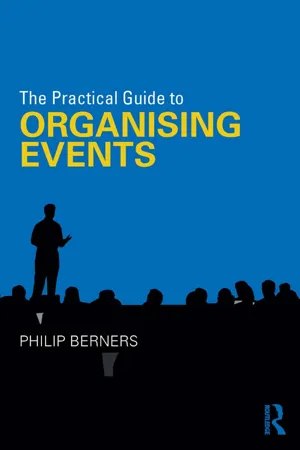
The Practical Guide to Organising Events is a short, accessible and practical guide on how to successfully plan and organise a variety of event types in a wide range of contexts. The core sections of the text are logically structured around the key stages of event management – pre-event, on-site and post-event – offering essential practical insight and guidance throughout the whole process. Topics covered include proposal writing, budget, funding and sponsorship, health and safety, security and evaluation. This is a fundamental resource for all events management students running and organising an event as part of their degree programme. It is also a book for anybody who just happens to be tasked with organising an event such as an office party, a social networking event, Christmas party or family wedding. Based on experience, using real-life case studies and anecdotal examples, The Practical Guide to Organising Events ultimately makes the business of events management appealing, understandable and achievable.
- 212 pages
- English
- ePUB (mobile friendly)
- Available on iOS & Android
eBook - ePub
The Practical Guide to Organising Events
About this book
Trusted by 375,005 students
Access to over 1.5 million titles for a fair monthly price.
Study more efficiently using our study tools.
Information
Topic
Negocios y empresaSubtopic
Hostelería, viajes y turismoPART 1
Introduction
Chapter 1
The culture of events
1.1 Developed markets
In developed markets, events management has evolved as an industry in itself and provides clients and corporations with services, facilities and management for putting on an event.
For anybody who has an event to run, there are directories that provide listings of event organisers, production companies, event services, caterers, venues, theme companies, prop hire, and music and entertainment.
Competition is fierce in developed markets: venues are vying for business and event organisers compete for clients. There is much overlap and anybody outside the events industry could be confused by the difference between an event management company, a production company or a public relations (PR) company.
1.1.1 Event management company
An event management company will provide its expertise for creative and themed events, such as parties, product launches and celebrations. They organise most elements for the running of an event, such as theme and decoration, creative concepts, budget management, venue sourcing, and liaison with suppliers and contractors. They take care of guest lists and will be there on the day of the event to provide operational management.
1.1.2 Production company
A production company specialises in events that require detailed technical elements, such as business conferences (projection, visuals and presentation speakers) and concerts (sound, light and special effects).
1.1.3 Public relations company or marketing company
These PR and marketing specialists provide the client with ideas and strategies that fit the promotional goals and brand fit of the organisation. The PR or marketing company would then employ the services of an event management company or a production company to execute the event.
The key identifier here – in regard to a developed event industry – is the employment of specialist companies to perform specialist tasks. The first mistake (which is endemic in undeveloped and developing markets) is using the wrong company for the wrong task – employing a marketing company to produce an event, say.
Confusion about the events industry is further driven because a large and complex event would necessitate the services of an event management company, a production company and a public relations company working alongside each other to achieve the goal of producing a successful event. The event management company will control the logistics and perform operational management at the event; the production company will take care of the technical requirements, such as staging and projection; and the PR or marketing company will send out invitations, draw up table plans, collate guest responses and manage the guest lists on the door at the event.
Consequently, there is a lot of crossover in the events industry and lines do get blurred as to who is responsible for which parts of an event (see Figure 1).

Figure 1 Interaction of event organisers at one event
The events industry in developed markets can be likened to the medical profession. An optometrist does the eyes and a dentist does the teeth. You do not want the wrong one to do the other thing and you do not want one to do both!
Put simply, it is essential to recruit the correct specialist for the right job.
In many cases, larger charities and large corporations have a need to organise many events. Rather than continuously outsourcing events management expertise, they have found it necessary to establish their own in-house events department that fits alongside the sales, marketing and PR functions, in which case the in-house head of events takes the responsibility for managing an event instead of the marketing manager.
It can be seen how events management in developed markets has become a recognised and established career path, and universities offer specialised courses to meet the demand.
1.2 Undeveloped and developing markets
In undeveloped and developing markets, the structure of the events industry is noticeably flat. At best, events are a responsibility added to the duties of an already overworked assistant in the marketing department. At worst, somebody can be tasked with the difficult job of organising an event, simply because ‘they get on with people and are good at that sort of thing’.
In undeveloped and developing markets, few, if any, specialised event companies exist. Those that do exist have limited or no access to quality training and quality experience in the art of managing events, so the way they organise events evolves in a local fashion, which most often cannot achieve professionalism.
Furthermore, in undeveloped and developing markets event organisers are bereft of international experience. This can lead to their belief that they are managing events in the right manner, but without benchmarks to evidence this belief.
The lack of international experience is double-edged. On one side the event organiser will not understand how to approach international standards, and on the other side they may be contracted by a domestic client needing their services to produce an event abroad.
The absence of international expertise also presents the question of how undeveloped and developing markets can reach – even understand and appreciate – international levels of events management. Thus, a second tier of events management is created in these countries, which could be substandard in relation to international expectations. This causes problems when international clients – and guests – do not have their expectations met.
In most undeveloped and developing markets, the task of organising an event is outsourced to PR and marketing companies that are not event specialists. This drives an ‘I do it all’ culture where promises are made that may or may not be fulfilled. But, never mind the consequences because the priority is to secure the client’s business, regardless. In this case, the factors of reputation and client retention do not appear to matter.
Training in the specialism of organising events in undeveloped and developing markets is limited to personal experience of the individual, which can be narrow, half-hearted or even wrong. But, this is all they know.
In such markets a career in event management can follow a haphazard pathway and will often occur by accident. This is where the study of events management meets experience: experienced event organisers can teach how to organise events.
Interestingly, events are vital in both developed and developing markets – it appears to be the career opportunities that differ. So, the professionalism and creativity of events differ vastly also. There simply is not the ability to create amazing events in undeveloped and developing markets and it is easier to follow the norm. The attitude tends to be ‘this is the way we have always done it’.
But, all markets are increasingly global, not domestic, which means international standards are necessary to achieve.
The trend for events is becoming national, international and global: take for example the Euro 2012 football tournament hosted by Poland and Ukraine; Azerbaijan hosting the Eurovision Song Contest; the Brazil Olympics; the Qatar World Cup …
AUTHOR’S VOICE BOX
In a developing market, I know of a successful fashion designer who organises every detail of his own catwalk shows.
At one event, the bar was placed in the wrong location at the venue – it was not visible to guests, which was a wasted opportunity. But, also the drinks sponsor lost the exposure of their products to the audience.
When I pointed out this logistical error to the talented designer at a meeting a week or so after his show, he took personal offence because he had decided where the bar should be positioned.
But, how could a fashion designer know the complexities and pitfalls of organising events such as where a bar should be placed – and why should he need to know?
This situation underlines the point that expertise in events is necessary. After all, as an event organiser, I would not attempt to design a dress.
International audiences have expectations of experience, quality, standards and safety. Low standards equate to high risk, and this is no longer good enough for the global audience.
1.3 Sustainable events
With the growth in the number of events happening in both developed and developing markets, coupled with the growth in the size of actual events, sustainability is a growing issue also.
Guests and visitors possess an increasing expectation when attending events that are designed to provide them with an experience, that it is also a good experience for the environment.
Where social events such as music festivals attract young and socially aware visitors, there is demand for socially aware practices. It is becoming increasingly unacceptable to offer a guest-experience at the cost of the environment.
So, the event organiser must meet guest demands and expectations – as always. This requires sourcing innovative and forward-looking solutions for the legacy of an event and the impact it leaves behind.
Where massive events now happen, the key sustainable areas to consider are waste clearance; distance of travel necessary for both visitors to the event and the suppliers so as to lessen carbon impact; land recovery; and power sources. The latter should be solar and wind-generated where possible. Temporary toilet facilities can be sawdust-based to absorb fluid waste instead of needing to transport large quantities of raw waste to external processing sites.
The motivation to create an environmentally friendly event is led by guest demands and expectations. But this alone is not enough. It is easy to employ marketing tactics to pretend sustainability and the guests will never know the true ‘cost’ to the planet.
Legislation is the true motivator, but the law on sustainable events is lacking. Finally, then, the motivating factor to produce a sustainable event is that of reducing costs. Financial incentives are helping to deliver sustainability and event organisers are sourcing cheaper alternatives for the provision of power and the disposal of waste, which is drawing the event industry towards sustainable solutions.
Chapter 2
The structure of events
What is an event?
An event is any live happening.
There it is: the definition of an event in just three words.
A hurricane is an event: a live happening defined as being a weather event. An earthquake is a live happening: a natural event. A train crash is a live happening: defined as being a catastrophic event.
Event management, therefore, is about managing a live event so that it does not turn out to be a train wreck.
This book is about the management of live happenings.
If we could manage a hurricane, an earthquake or a train wreck, we would. ...
Table of contents
- Cover
- Half Title
- Title Page
- Copyright Page
- Dedication
- Table of Contents
- List of contributors
- Preface
- Acknowledgements
- Part 1 Introduction
- Part 2 Management pre-event
- Part 3 Management on-site: operational event management
- Part 4 Management post-event
- Appendices
- Glossary of technical terms
- Index
Frequently asked questions
Yes, you can cancel anytime from the Subscription tab in your account settings on the Perlego website. Your subscription will stay active until the end of your current billing period. Learn how to cancel your subscription
No, books cannot be downloaded as external files, such as PDFs, for use outside of Perlego. However, you can download books within the Perlego app for offline reading on mobile or tablet. Learn how to download books offline
Perlego offers two plans: Essential and Complete
- Essential is ideal for learners and professionals who enjoy exploring a wide range of subjects. Access the Essential Library with 800,000+ trusted titles and best-sellers across business, personal growth, and the humanities. Includes unlimited reading time and Standard Read Aloud voice.
- Complete: Perfect for advanced learners and researchers needing full, unrestricted access. Unlock 1.5M+ books across hundreds of subjects, including academic and specialized titles. The Complete Plan also includes advanced features like Premium Read Aloud and Research Assistant.
We are an online textbook subscription service, where you can get access to an entire online library for less than the price of a single book per month. With over 1.5 million books across 990+ topics, we’ve got you covered! Learn about our mission
Look out for the read-aloud symbol on your next book to see if you can listen to it. The read-aloud tool reads text aloud for you, highlighting the text as it is being read. You can pause it, speed it up and slow it down. Learn more about Read Aloud
Yes! You can use the Perlego app on both iOS and Android devices to read anytime, anywhere — even offline. Perfect for commutes or when you’re on the go.
Please note we cannot support devices running on iOS 13 and Android 7 or earlier. Learn more about using the app
Please note we cannot support devices running on iOS 13 and Android 7 or earlier. Learn more about using the app
Yes, you can access The Practical Guide to Organising Events by Philip Berners in PDF and/or ePUB format, as well as other popular books in Negocios y empresa & Hostelería, viajes y turismo. We have over 1.5 million books available in our catalogue for you to explore.