- 164 pages
- English
- ePUB (mobile friendly)
- Available on iOS & Android
eBook - ePub
About this book
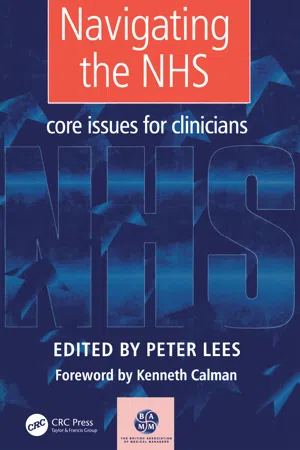
* What is NHS purchasing and where is it going? * What are the resource implications of shared care policies? * Why are casemix and clinical coding important in pricing contracts? * What should be the role of marketing in the NHS? * Where should a medical director's loyality lie? These are the sort of questions which clinical staff at all levels in today's NHS are expected to grasp. Navigating the NHS provides the answers. The full range of current management issues is explored, and each topic is presented clearly and concisely by authors with expert knowledge and experience. Navigating the NHS is written for the uninitiated, who need to absorb the central arguments rapidly. It is ideal for those seeking promotion. But the calibre fo the contributions is such that clinicians who already have considerable managerial responsibilities and even health service managers themselves will find it fascinating, challenging and enlightening.
Information
1 Introduction
Peter Grime
On the road to Damascus
Several years ago I made a decision to pursue a career in hospital medicine, not as a physician (affectionately referred to in our unit as the ‘clever doctors’) but as a simple surgeon. I made a list, as is my custom when I have a decision to make: ‘the advantages and disadvantages of achieving consultant status’. I did not, indeed could not, at that time list any disadvantages, but my list of advantages was long and positive: a consultant post was for life, I would be my own boss, run my own department and be free to run things as I decided. The financial rewards would be excellent: good salary, good fringe benefits and good private practice potential. Although it was going to take some considerable time with a lot of hard work to get where I wanted to go, I have never been afraid of hard work and knew that I had the talent to succeed. I could expect that, when I achieved consultant status, my work intensity would decrease and the hours of ‘hands -on’ work would diminish. There would be enough junior staff to do the necessary routine work and that would free me to concentrate on ‘higher things’. The amount of ‘boring’ clinical work would go down, and I would be free to choose the service that I provided. I viewed management in simple terms. Hospital administrators (managers) would be there to facilitate the success of my department and minimize any inconvenience to both myself and my staff. I would make the decisions (manage) but have little to do with the day-to-day implementation (administration).
A classical hospital medical or surgical training reinforces the belief that you are correct, that you know best. This ‘apprenticeship’ is long and hard and produces like-minded survivors: egotistical, arrogant, single minded, determined, to name but a few of the ‘surgical’ personality traits that one requires to succeed. One had, and still has, to be careful of the ‘old boy’ network, which has great power to ensure either a smooth progression through the ‘ranks’ of the ‘King's Own Scalpels’ or a rapid demobilization! The ability to perform surgery and manage patients should be an advantage, but one's main duty is to toe the party line, kiss the occasional frog, never get romantically entangled with a consultant's daughter or wife and never, ever do anything to interfere with the smooth running of the boss's private practice! Taking all things into consideration, I could smell the sweetness of success.
Unfortunately things did not go quite the way I wanted them to. I managed to fall foul of ‘the system’. For some inexplicable reason I began to think independently or to be more honest. I began to speak and act more independently and committed a heinous crime. I suffered ‘opinions’, probably borne out of a frustrated development, and deviated from the accepted path of behaviour. When the time came to move from registrar to senior registrar, interviews came and went, and subsequently dried up! I was facing a crisis in my personal and professional life. As a consequence I did what I always do when difficult decisions have to be made; I reverted to self-analysis and made my lists again. Analyse, conclude, act! What is wrong with me? Why does nobody want me? I am good at my job, enthusiastic, hard working, innovative; my curriculum vitae is excellent. How could anybody not want me? The list contained personal good points, perceived bad points, points for going on, points for career change. Do I really want to be a consultant now? I revised my list of the advantages and disadvantages of achieving consultant status in the health service. On this occasion I could not list any advantages, yet the list of disadvantages was long and of considerable concern.
By this time the White Paper1 had arrived and the ‘new-style’ National Health Service (NHS) management was born: proactive rather than reactive (to the medical profession) management; passive administration; rolling contracts with poor job security and a decreasing salary in real terms (perhaps under the guise of performance-related pay); an increasing work intensity because of an emphasis on work-load targets; the decreasing number of junior staff with their limited hours ‘on call’ and fewer consultants (probably redesignated more simply as ‘specialists’) than would be needed to fill ‘the gaps’; less clinical freedom and more market-oriented practice; income generation; internal markets; management growth with an unwelcome ‘interference’ in clinical matters; audit and information technology (number crunching par excellence); the Patient's Charter; low staff morale; attacks on private practice and associated media hype implying poor consultant performance; a decrease in status, with consultants perceived as ‘just another employee – easily replaced!’
I began to view management in a different light, something that had been taken away from, and turned against, the profession. The worm had turned! The oppressed administrator, sick to death of arrogant, self-opinionated doctors, grasped the opportunity to strike back under the guise of ‘NHS reform’.
It appeared that my potential job, if indeed there was to be one, was not worth bothering about, an understandable attitude given rationalization of thought for self-preservation.
Unfortunately I had reached the stage at which a career change was impractical: not at my age and with a young family to support. I had to go on and make the best of it! After a number of interviews, when I really felt that the end was nigh and I was about to sink without trace, I finally convinced an appointments committee to give me a chance and (gratefully) got on with it. Once in the lifeboat I did not want to reach the point of applying for consultant posts before revising my attitude, giving serious thought to future practice and the role of a consultant in the ‘new NHS’; after all I still needed to reach dry land.
Looking back I could see two superficially different, yet deeply similar, unproductive approaches to the consultant role (in both clinical practice and management). My first deliberations were positive and rather self-focused. I suspect, but cannot be sure, that I assumed an intention to play my part in the NHS to the best of my ability. Surgical practice in the NHS would be clinically and financially rewarding to me. I saw myself in a dominant, quasi- managerial role, in control, making decisions for implementation by someone else. My revised, later, list was extremely negative, although still self-focused, and my attitude to the perceived loss of management control was reactive, a somewhat paranoid view (‘It is not fair, they are out to get me. Resist all change, do not co-operate’), a view devoid of rational thought for a supposedly intelligent, well-educated professional. ‘What do they know about health care and managing patients? I know best, and I should be making the decisions’.
The NHS had changed for the worse because I was not going to get an awful lot out of it! To be frank I am now appalled, as I hope you the reader are appalled, at this negative behaviour. I have never considered myself to be a negative person. I had not even recognized, until it was pointed out to me, that both lists were devoid of one important sentiment. Not once had I ever mentioned the ‘patient’ (the customer). I appeared to see everything in terms of me and what I wanted and never in terms of what the patient needed or wanted. What was I going to get out of it? I could see myself as part of the problem rather than the solution.
Clinical education and training teaches us to listen, observe, examine, investigate, conclude, act, review and change opinion if necessary. If we are honest, the provision of health care in this country has been haphazard and sometimes illogical, too often based on personal opinion rather than proven value. The management of acute and emergency problems has generally been first class, unlike the care in chronic disease, the management of which is all too often less than desirable. Changes in management have to be both clinical and administrative if we are to get the best value from available resources.
I needed, indeed wanted, to review my attitude to health care and my role in the provision of services. What would I do if I were managing (running) my own business? How would I go about providing health care? I sat down and produced the following list of questions: What do my patients (customers) want? What do they need? Do I want to increase the range of services I provide? Am I in a position to change and respond quickly, as required? Can I provide the goods now? Do I have the appropriate skills? Do I have the ability to develop skills, and even if I do, do I actually want or need to develop them? Do I need to buy in skills? What facilities do I need? What facilities do I have at the moment, and do I want or need to develop those facilities accordingly? Can I afford to do that, and if I go ahead, will I be able to meet the needs and the demands that those extra facilities will generate? Can I increase my income without incurring extra costs (in other words can I reduce unit cost and liberate income?) Could I generate income from loans, get enough business to repay them and still provide myself with enough personal income? Would I actually get more customers if I made these changes, and where would they come from? What is the competition doing that I am not? What could I provide that the competition is not? Whether or not they need it, would my customers actually want it? What would I charge? Would it be enough to cover my expenses, or would I price myself out of the market? Do we have adequate representatives in the ‘field’, and are we reaching all our potential customers?
Encouraged by my efforts I made another list of questions, assuming I would be running the business for someone else: What do our customers want and need now? What will our customers want and need in the future? Is our organization geared up to providing those wants and needs at a competitive price and acceptable quality? If it is not, what do we need to do to correct the situation? Do we need more staff? Can we get better facilities? Become more efficient? What can we do to help the business to succeed?
In order to make decisions (manage), I would need information. I could not make decisions, nor answer the inevitable questions posed by customers, without the relevant facts and figures. The customers would be expected to enquire about ‘results’ and I would expect to produce evidence of my ability to provide a ‘quality’ service. (Customers expect a reasonable service at a competitive cost.) I would need to provide my customers with the goods they wanted and to deal with them in a quiet and efficient manner, responding to their comments and criticisms. The business would operate to a set of reasonable standards, of which my customers would be made aware. That, after all, is the business way.
What became very evident to me was that this ‘business approach’ differs from the archetypal ‘medical management’ typified by the character of Sir Lancelot Spratt in the ‘Doctor’ series by Richard Gordon and by my own early aspirations. The traditional medical approach is almost exclusively self- focused: ‘I know best, you get what I provide and like it! I am the most important person and deserve the biggest income’. The business way is predominantly customer-focused, given that the questions asked should lead to the provision of a service that the customer needs or wants rather than that which the doctor wishes to provide. Salaries paid to all employees reflect availability and maintenance of the work-force: employers will only pay what is needed to keep staff and get the job done (without dropping to unacceptable standards).
Looking at the questions posed I recognized an all too familiar scenario – aspects of the NHS reforms – not in ‘management’ jargon but in ‘plain speak’. I recognised audit (what are we doing, how are we doing?); research and development (what should we be doing, how do we improve on the present?); marketing (what does the customer want?) or customer focusing (providing for the needs of the customer); information technology (computer-oriented gathering of vital facts and figures); quality control (service to a satisfactory standard); resource management (getting the best out of staff, equipment and facilities and keeping the costs down) or value from resources; efficiency gains (reducing unit costs to release capital); contracting (guarantees of work and control, therefore of income and, to some extent, expenditure); The Patient's Charter (working to a set of reasonable, published standards of business practice and a declaration of intent to provide a satisfactory service).
Ask yourself the question, how would you run a business with an annual turnover exceeding £70 million (the annual budget of an ‘average’ NHS Trust)? It makes good business sense to budget for income and expenditure, to cut the cloth according to the purse. Devolving budgets to individual units, departments or directorates encourages self-reliance and promotes inventiveness, providing that the degree of central control remains unobtrusive. Changes in practice can lead to efficiency gains and liberation of finances to spend on better, or more extensive, services. Without the ability to generate true income, however (the ‘pot’ is a fixed size), there must be a limit to what can be achieved. With ‘winners’ there will always be ‘losers’; one directorate may grow as another contracts, one area may benefit as another suffers. To that end not all the NHS reforms are desirable, and I do not suggest that the medical profession embraces any philosophy without question. We are one of the key guardians of patient welfare and must remain so. It is our responsibility, however, to ensure the provision of the best service possible from given resources and that can only be achieved by working within the system, by placing ourselves in a position to influence policy in the widest sense. It is difficult for a reasonable person not to respond to a well-reasoned argument. The medical profession has been handed a golden opportunity, through the reforms, to influence health care in a manner not previously possible. The reforms will not go away and neither should we assume that further reform will not take place.
Perhaps the medical profession has already failed the NHS, just as consultants of the past have failed those of the future by burying their heads in the sand and hoping it will all go away, by bleating about change that any sensible profession should have instituted long ago under proper selfregulation, and by failing to grasp the initiative, relinquishing a managerial role to non-medical personnel.
I am thankful that my early misfortune to be cursed with a ‘bad attitude’ has opened my eyes and my ears and closed my mouth to ill-conceived words. I wish that my change in attitude had come about through maturity and wisdom rather than the threat of unemployment, yet I believe with a passion felt only by the converted. The health service has the potential to be better than it has ever been. The foundations are being laid for the future with the birth of evidence-based medical practice.
Change inevitably has its price, and perhaps it should not be unexpected that those who lived with the old system cannot live with the new. For those prepared to be involved, to co-operate (doctors can and will make good managers) a fulfilling career will be realized. I implore you, the reader, to pursue a similar exercise to my own, to read and digest the contents of this book. We, as a profession, need good managers and all of us should have a working knowledge of how to manage. Join us!
Reference
1. Department of Health (1989) Working for Patients (Cmnd 555). HMSO, London.
2 Where are we now? The NHS in the mid-1990s
Tim Scott
Trying to describe the current NHS is not a leisurely activity to be undertaken on a Sunday afternoon. This is no quiet country meadow, where one can set up easel, mix paints and depict a harmonious, tranquil setting. People working in the NHS feel their situation to be much more akin to white water rafting the Colorado river. Any thought of describing a particular bend in the river, with its treacherous swirls and eddies, is lost in the need to try to spot the shoals under the water ahead and keep the raft from hitting the side walls of the canyon.
To talk about a high degree of change in the NHS is to dilute the reality with management jargon; there are few givens, the language changes as fast as the structural framework, and no-one, least of all government, has a clear understanding of where it will all take us.
Even to attempt to discuss the so-called NHS reforms introduced by the White Paper Working for Patients (1989)1 is to suggest that there was somehow a steady-state NHS before the reforms and a modified NHS some time afterwards. The reforms were in fact a further major and radical reshaping of an NHS already subject to a variety of change factors.
NHS management from 1983
Where then should we start the story? In 1974 with the area health authorities? In 1982 with the abolition of those area health authorities? Each intervention has added its own momentum and created its own language. One starting point might be the famous Griffiths NHS management enquiry. On 6 October 1983, the late Sir Roy Griffiths reported in a letter to the Secretary of State on the review of NHS management that he had been asked to undertake in February of that year. He pointed out that ‘surprisingly, given the welter of the reports on almost every aspect of the NHS over the past thirty years, there has been no major review of the internal management of the hospitals since the Bradber report of 1954’. He then proceeded with a series of recommendations on how the whole thing should be actively managed rather than passively administered. In this report, which was seized on and implemented by government, we see many of the seeds of the subsequent reforms.2 In particular the introduction of general management was the most visible aspect of Griffiths’ desire to see a more business-like environment permeating the NHS.
One of Griffiths’ recommendations was the creation of the NHS Advisory Board (subsequently reshaped as the NHS Policy ...
Table of contents
- Cover
- Half Title
- Title Page
- Copyright Page
- Contents
- List of contributors
- Foreword
- Preface
- Acknowledgements
- 1 Introduction
- 2 Where are we now? The NHS in the mid-1990s
- 3 An introduction to priority setting in the NHS
- 4 What is NHS purchasing, and where is it going?
- 5 Marketing in the NHS
- 6 Casemix, coding and contracting: a beginner's guide
- 7 Shared care or integrated care? Managing clinical services for chronic disease across the interfaces
- 8 Managing quality through outcome measurement and audit
- 9 Towards evidence-based practice: the role of research and development, training and education
- 10 Continuing medical education: a fundamental balancing act
- 11 Management arrangements in NHS Trusts
- 12 The medical director: corporate player, not representative role
- 13 The clinical director: poacher turned gamekeeper?
- 14 The future
- Index
Trusted by 375,005 students
Access to over 1.5 million titles for a fair monthly price.
Study more efficiently using our study tools.
Frequently asked questions
Yes, you can cancel anytime from the Subscription tab in your account settings on the Perlego website. Your subscription will stay active until the end of your current billing period. Learn how to cancel your subscription
No, books cannot be downloaded as external files, such as PDFs, for use outside of Perlego. However, you can download books within the Perlego app for offline reading on mobile or tablet. Learn how to download books offline
Perlego offers two plans: Essential and Complete
- Essential is ideal for learners and professionals who enjoy exploring a wide range of subjects. Access the Essential Library with 800,000+ trusted titles and best-sellers across business, personal growth, and the humanities. Includes unlimited reading time and Standard Read Aloud voice.
- Complete: Perfect for advanced learners and researchers needing full, unrestricted access. Unlock 1.5M+ books across hundreds of subjects, including academic and specialized titles. The Complete Plan also includes advanced features like Premium Read Aloud and Research Assistant.
We are an online textbook subscription service, where you can get access to an entire online library for less than the price of a single book per month. With over 1.5 million books across 990+ topics, we’ve got you covered! Learn about our mission
Look out for the read-aloud symbol on your next book to see if you can listen to it. The read-aloud tool reads text aloud for you, highlighting the text as it is being read. You can pause it, speed it up and slow it down. Learn more about Read Aloud
Yes! You can use the Perlego app on both iOS and Android devices to read anytime, anywhere — even offline. Perfect for commutes or when you’re on the go.
Please note we cannot support devices running on iOS 13 and Android 7 or earlier. Learn more about using the app
Please note we cannot support devices running on iOS 13 and Android 7 or earlier. Learn more about using the app
Yes, you can access Navigating the NHS by Peter Lees in PDF and/or ePUB format, as well as other popular books in Medicine & Service Industry. We have over 1.5 million books available in our catalogue for you to explore.