- 208 pages
- English
- ePUB (mobile friendly)
- Available on iOS & Android
eBook - ePub
About this book
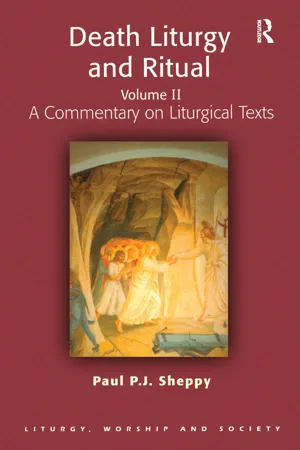
Death Liturgy and Ritual is a two-volume study of Christian funerary theology and practice, presenting an invaluable account of funeral rites and the central issues involved for compilers and users. Paul Sheppy writes from direct experience of conducting funerals and of drafting liturgical resources for others. In Volume II: A Commentary on Liturgical Texts, reviews a wide range of current Christian funeral rites and examines how they reflect both the Church's concern for the death and resurrection of Christ and the contemporary secular demand for funerals which celebrate the life of the deceased. The companion volume, Volume I: A Pastoral and Liturgical Theology, proposes that the Church ought to construct its theological agenda in dialogue with other fields of study. Sheppy argues for a Christian statement about death that finds its basis in the Paschal Mystery, since human death must be explained by reference to Jesus' death, descent to the dead, and resurrection. Using the three phases of van Gennep's theory of rites of passage, the author shows how the Easter triduum may be seen as normative for Christian liturgies of death.
Information
Topic
Theology & ReligionSubtopic
Christian MinistryCHAPTER 1
Introduction to Volume II
A brief recapitulation
In Volume I (pastoral and liturgical theology), I sought to trace some of the contemporary issues which Christian funerary liturgy faces. We might summarise the discussion thus far as having identified two main areas requiring our response: the nature of death and human existence and the social observance of death and bereavement. To put it another way, death and dying raise questions of individual and social anthropology.
I have suggested that Christian funeral rites ought first to display a Christological response to death. To questions of what it means to be human, what it means to die, and how we ritualise death, Christian answers begin with the life, death and resurrection of Jesus. The way in which we formulate our answers will shape what we do in our funeral rites.
An agenda for Volume II
In Volume II, we shall consider a number of liturgical texts currently in use in a variety of Christian traditions and geographical locations. As well as describing these texts, I shall want to ask how what is written and enacted handles the nature of death and the passage of the dead and of the bereaved into the Paschal Mystery, which (as I have argued earlier) is the location of God’s great and final word against death.
The questions we need to ask of the texts cover such issues as:
— What kind of anthropological view does the rite take?
— Does the text suggest a rite of passage, or does it simply mark a closure? Does it suggest that the rite takes a retrospective or a prospective view of the occasion? Is death seen as the end or as a gateway?
— How is the balance held between expressing the common nature of our mortality and the individuality of this particular human life now ended?
— Is judgement or hope the principal eschatological note?
— Where does the priority of focus lie between deceased and bereaved? Does the text suggest or exclude the idea that something is being transacted for the one who has died?
— How does the text reveal a Christological response to these questions?
The limits of Volume II
These questions arise from the central argument of Volume I: death raises a primary question about God, and the death of Jesus offers the best way of approaching that question. It is hardly right to subject to those criteria rites which do not share that faith. We shall, therefore, look only at Christian rites.
Moreover, we shall only look at those rites that exist in a written tradition; this is in full knowledge of the fact that Christian funerary practice exists far beyond that compass. In many ways I regret this self-imposed limitation, since it eliminates the black churches.1 Many of their rites demonstrate a very keen sense of separation, transition and incorporation and a strong sense of journeying into glory. However, in the context of a liturgical and ritual approach, a vast study of the ritual components of a huge number of funerals would be needed to produce a choreography that might correspond to more formal ways of encoding liturgy. Such an approach is beyond the scope of this book.
I have selected rites that are in current (or recent) use. The historical tradition is not without interest; indeed, it has drawn attention from scholars from across the world. To attempt to add to their work here would, in my view, be impertinent.
I have drawn largely from liturgies in the Western Church. The Orthodox tradition is represented by one text and I attempt an explanation for this limitation when I deal directly with that text. I have tried to draw from texts across the world; apart from the English Free Church tradition (which has its own unique flavour), there are three texts from Britain, three from North America, three from Oceania, three from India and two from Africa.
The structure of Volume II
The commentary will begin with that Orthodox text. Its distinctiveness will make an effective contrast with the subsequent commentary which begins by looking at the English language rites of the oldest continuing Western tradition – that of the Roman Catholic Church. We shall then consider various rites of the Anglican Communion. The commentary will move to rites from what we might call Churches of the Reformation: Lutheran, Presbyterian and Free Churches. A final section will include the rites of ecumenical groupings.
The book concludes with some general reflections and questions arising from the work.
_______________
Note
1 By “black churches”, I mean not the ancient churches of Africa or India, but those churches arising from the European/American slavery market that carried the African experience into the New World.
CHAPTER 2
The Orthodox
Introduction
To suggest that in the compass of a few pages one can describe the funeral rites of the Orthodox churches is folly of the highest order. Leaving aside the fundamental division between Chalcedonian and non-Chalcedonian churches, each Orthodox Church is, in effect, a national church. While the central core of the rites stretches back to the liturgies of Basil and Chrysostom, the national and regional customs modify it in countless ways.
What this commentary attempts, therefore, is a review of just one text published in The Great Book of Needs by the St. Tikhon’s Seminary Press in 1999. Moreover, the commentary looks only at the rites used at the funeral of a lay-person. The variations for monks, priests and bishops are indeed of the greatest interest, but the text here under consideration is (for obvious reasons) the most commonly used and what is used at these other rites is additional to what occurs in the lay-person’s rites. In these is found the core.
For Orthodox Christians, death is viewed through the lens of the resurrection of Christ and the promised resurrection of all the departed. It is not, therefore, an end; rather, it is a time of repose – a dormition (sleeping). In the funeral service two things are believed to happen. The prayers of the living bring joy to the departed; the prayers and hymns provide a means of expressing grief and faith in the promise of eternal life through Christ Jesus. The funeral ends as the faithful take the departed to their rest in the anticipation of that day when the Lord will awaken them from their donnition.
The Orthodox pay great attention to the preparation of the body for burial.1 And it is burial that the Orthodox choose. The Church’s canon law declares that the body of a deceased Christian must be returned to the earth. This is not simply about the example of Christ’s burial, there are other concerns. Not least among these is the understanding that the Christian, who in the Holy Liturgy has received Christ, is thereby sanctified. The body of that Christian in burial sanctifies in its turn the ground where it is laid, signifying and making real the salvation of the whole earth. The sealing of this is effected by the grave marker or monument which bears the image of the Cross.
The Funeral Service may be preceded by the Office of the Parting of the Soul from the Body, if the family or close friend of those who are dying can summon a priest (and a cantor) to the bedside.2 After the Funeral Service the Panichida or Lite may be observed.3 The days of observation are: the ninth, the fortieth and the year’s end.
The Great Book of Needs (1999)
The Funeral Service is essentially the Matins service, with the canon and other hymns selected from the Matins for Great Saturday (Holy Saturday) – the day of Christ’s burial.
At the House
The rites begin with a service at the house. The priest censes the body and begins in the customary manner:
Blessed is our God, always, now and ever, and unto the ages of ages.
Those present respond by singing the Amen and Holy God. The Reader says the remainder of the opening, concluding “for Thine is the Kingdom”.
They then sing to tone 4 several troparia, beginning
With souls of the righteous departed, give rest to the soul of Thy servant, O Saviour, preserving it in the blessed life which is with Thee, O Lover of Mankind.
and concluding
O Virgin, who only art pure and undefiled, who didst bear God without seed: Do thou pray that this his (her) soul may be saved.
The deacon then says the Litany as the singers respond to each petition with a threefold “Lord, have mercy”, and after the last petition “Grant it, O Lord”. The priest then secretly says the prayer, “O God of spirits and all flesh”, finishing with ...
Table of contents
- Cover
- Half Title
- Title Page
- Copyright Page
- Dedication
- Table of Contents
- Acknowledgements
- 1 Introduction to Volume II
- 2 The Orthodox
- 3 The Roman Catholic Church
- 4 The Anglican Communion: Selected Rites1
- 5 Churches of the Reformation
- 6 Ecumenical Churches
- 7 Some Conclusions
- Select Bibliography
- Index of Scripture Passages
- Index of Names
- General Index
Trusted by 375,005 students
Access to over 1.5 million titles for a fair monthly price.
Study more efficiently using our study tools.
Frequently asked questions
Yes, you can cancel anytime from the Subscription tab in your account settings on the Perlego website. Your subscription will stay active until the end of your current billing period. Learn how to cancel your subscription
No, books cannot be downloaded as external files, such as PDFs, for use outside of Perlego. However, you can download books within the Perlego app for offline reading on mobile or tablet. Learn how to download books offline
Perlego offers two plans: Essential and Complete
- Essential is ideal for learners and professionals who enjoy exploring a wide range of subjects. Access the Essential Library with 800,000+ trusted titles and best-sellers across business, personal growth, and the humanities. Includes unlimited reading time and Standard Read Aloud voice.
- Complete: Perfect for advanced learners and researchers needing full, unrestricted access. Unlock 1.5M+ books across hundreds of subjects, including academic and specialized titles. The Complete Plan also includes advanced features like Premium Read Aloud and Research Assistant.
We are an online textbook subscription service, where you can get access to an entire online library for less than the price of a single book per month. With over 1.5 million books across 990+ topics, we’ve got you covered! Learn about our mission
Look out for the read-aloud symbol on your next book to see if you can listen to it. The read-aloud tool reads text aloud for you, highlighting the text as it is being read. You can pause it, speed it up and slow it down. Learn more about Read Aloud
Yes! You can use the Perlego app on both iOS and Android devices to read anytime, anywhere — even offline. Perfect for commutes or when you’re on the go.
Please note we cannot support devices running on iOS 13 and Android 7 or earlier. Learn more about using the app
Please note we cannot support devices running on iOS 13 and Android 7 or earlier. Learn more about using the app
Yes, you can access Death Liturgy and Ritual by Paul P.J. Sheppy in PDF and/or ePUB format, as well as other popular books in Theology & Religion & Christian Ministry. We have over 1.5 million books available in our catalogue for you to explore.