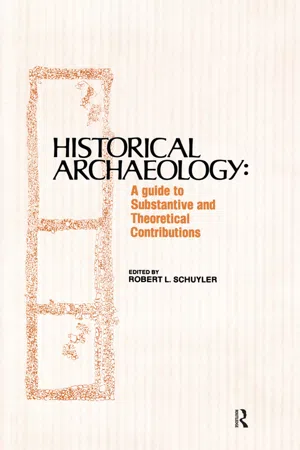
eBook - ePub
Historical Archaeology
A Guide to Substantive and Theoretical Contributions
- 304 pages
- English
- ePUB (mobile friendly)
- Available on iOS & Android
eBook - ePub
Historical Archaeology
A Guide to Substantive and Theoretical Contributions
About this book
A sourcebook devoted to historical archaeology, a significant field of study which blends together the theories and methods of anthropology, history, and archaeology.
Information
Part 1
Emergence and Definition of a New Discipline
Introduction
In 1620 a Pilgrim exploratory party discovered several Indian mounds on Cape Cod. Surface deposits of mats and corn indicated that the burials were recent but when one of the more elaborate graves was opened an unexpected collection of artifacts was revealed. Grave goods had been buried with the dead but aboriginal items were intermixed with European objects—white glass beads, an iron knife, even a pair of breeches (Young 1841:109–110). Thus one of the first recorded excavations in America could equally serve as one of the earliest examples of either prehistoric or historical archaeology. There were a number of similar excavations, including work at European colonial sites, during the 18th and 19th centuries, but, unlike prehistoric studies, Historical Archaeology as an organized and accepted scholarly discipline is a mid-20th century phenomenon.
There could be no archaeology of Europeans in the New World until historic remains and monuments were perceived as artifacts and potential archaeological sites. Such recognition depended on cultural differentiation. A rapid succession of different European cultures in one region could produce the needed variation and a number of the isolated, early instances of archaeological excavations were encouraged by English and Spanish occupation of former French colonies. More generally, however, the passage of time was the essential stimulus. Normal stylistic and technological change within Angloamerican, or other European derived, material culture enabled scholars to view the recent historic past as an archaeological subject.
Recognition did not immediately produce a scholarly discipline. In fact, the very context of the recognition erected several obstacles that impeded the growth of the field. These fundamental problems are seen as three themes that run through the seven essays in Part I. The first three selections represent an earlier historicalist answer to these basic questions, while the last four articles, in contrast, propose an anthropological solution.
1. Why excavate sites dating from periods that have a full documentary record?
Harrington, in his classic statement, Fish, and Russell all represent the historicalist position. They tended to avoid or circumvent the question by concentrating on the weakest segments of the archival record—frontier situations or other circumstances that produced a dearth of written accounts. The value of archaeology was enhanced only by default. Their approach was influenced in part by their theoretical position but equally important was the social and economic context of their work. The first thirty years of the emergence of Historical Archaeology was simultaneously spurred and held back by a desire to preserve or reconstruct famous historic sites such as Williamsburg, Jamestown, Fort Vancouver, and the various Spanish missions in the West. Even Fish, who was certainly precocious in his 1910 statement, foreshadowed the pattern when he limited all his examples to non-excavated materials and architecture. This powerful preservation-restoration influence elevated practical and political objectives over purely scholarly goals (Schuyler 1976) and reduced archaeology to a supplemental technique in the service of architecture, narrow, specific historical questions, and the National Park Service. In contrast, Cotter, Fontana, and Griffin see archaeology as primarily concerned with the creation of cultural images of the past that are more complete and to some degree different than those generated from documentary history alone. Indeed Fontana and Griffin clearly expose the negative impact of preservation and restoration on the growth of a field that should have scholarly and not technical, specific goals as its raison d’être.
2. What potential does Historical Archaeology have for advancing general scholarship?
This question is still a point of debate among archaeologists. The essays outline the evolution of this debate by splitting into a conservative and a more optimistic group. The historicalist approach, particularly as seen in Harrington, views archaeology as basically providing only data. The anthropologists see archaeology as an equal partner with traditional history in creating more replete culture histories or cultural reconstructions. Cotter’s essay is of interest (beyond the fact that he correctly predicts the name of the Society for Historical Archaeology and its journal) in that its 1958 date puts him in the transitional position of endorsing both sides of the debate. It should also be noted that most of the authors, irrespective of their orientations, do not discuss the explanation of past cultural patterns, only the scholarly creation of those patterns. A processual perspective is not evident except in the last two articles. My own emphasis on comparative studies, which John Griffin also noted in some of his early writings, will be returned to in Part 5. My advocacy for the retention of Harrington’s term “Historic Sites Archaeology” proved to be ineffective. “Historical Archaeology” has triumphed as both a general and specific appellation in America.
3. Is Historical Archaeology a subfield of American history or anthropology?
Some researchers consider this question to be artificial but its significance is clearly seen in all the essays. Fish, Russell, and Harrington saw archaeology as a natural handmaiden to history. On the practical level they urged the training of historical archaeologists in academic departments of history. Nevertheless, they were all frustrated by the repeated indifference or open hostility of historians toward archaeology. Examination of Woodward’s article, written in the 1930’s, indicates the actual future course for the discipline. Because archaeologists in America, with the exception of Classicists, were anthropologists, the first historical archaeologists had to come from an anthropological background. They were drawn into Historical Archaeology along two routes. An interest in American Indians moved some of them, like Woodward, toward the study of historic trade goods found on native sites. A larger group became involved more artifically when the Great Depression created a large number of jobs for archaeologists at historic monuments under the National Park Service. Oddly it took another 30 years for anthropological archaeologists to bring their theoretical perspective to bear on historic assemblages and sites. In part this lag was related to the fact that most prehistoric archaeologists were doing prehistory until the rise of processual archaeology in the 1960’s.
In 1977 Historical Archaeology is a recognized and established field of research in the United States and Canada. It is a subfield of general anthropology with almost all its practitioners trained in that science. With a few exceptions professional historians are not involved in the discipline and they tend to ignore the findings produced by hundreds of excavations (cf. Wilderston 1975).
The question of disciplinary affiliation is concerned not only with the fortuitous historical events that influenced the rise of Historical Archaeology but also with important points of theory. Part 4 will detail these debates.
References Cited
SCHUYLER, ROBERT L. 1976 Images of America: the Contribution of Historical Archaeology to National Identity. Southwestern Lore, Vol. 42, No. 4, pp. 27–39.
WILDERSTON, PAUL W. 1975 Archaeology and the American Historian: an Interdisciplinary Challenge. American Quarterly, Vol. XXVII, No. 2, pp. 115–132.
YOUNG, ALEXANDER 1841 Chronicles of the Pilgrim Fathers. Boston.
Chapter 1
Archaeology as an Auxiliary Science to American History
When starting to assemble material for this paper, I intended to review the accomplishments of so-called “colonial” or “historical” archaeology in this country and to furnish specific annotated references to all major contributions in this field. Such an approach would have been possible ten years ago. In fact, at that time it would have been essential to intelligent participation in any discussion of the subject by either anthropologists or historians. But the situation has changed considerably since the end of World War II, for a great deal of digging has been done during the last few years at sites associated with the history of white men in North America. A bibliography of published reports alone would consume the space allowed for this paper; and the many important projects for which published reports have not yet appeared would deserve mention in any such list. The two summaries of activities in this field, published in American Antiquity (17:78–81; 18:287–88), although not all-inclusive, cover the subject quite adequately through 1952. (See also Preface by Heizer and McCown in Bennyhoff and Elsasser 1954.)
So comprehensive a title for a paper of this length calls for some delimitation. The discussion will be limited to the employment of archaeological methods in the study of the history of peoples of European origin in the area of the United States and Canada, from the time of the earliest explorations to the present day. Of course, the broad and proper concept of American history would not exclude the aborigine, for the historian, as well as the anthropologist, is concerned with the meeting of two such disparate racial and ethnic groups and in the cultural processes resulting from such contacts. The importance of archaeology in ethnohistorical studies has been convincingly demonstrated by the work of the Amerind Foundation at contact sites in Arizona and New Mexico (DiPeso 1953). This line of investigation, however, important as it can be to anthropologists as well as to historians, is not what I am concerned with here; nor will I include the related but more limited interest of the archaeologist who uses data secured from white sites for help in establishing chronology at Indian sites occupied during historic times.
It will probably be most useful if we consider the projects in respect to objectives, or the use to which the data have been put, because the objectives of most historic site excavations have had a definite bearing on the contributions of these projects. Objectives have, on the whole, been rather limited, and the effects of those objectives are reflected in the selection of sites to be explored, in the scope of the projects, in the nature of the interpretations, and in the publication of reports. Objectives have also, to a limited extent, affected field methods.
By far the majority of archaeological projects undertaken at historic sites have had as their primary, and often sole, purpose the securing of data for use in interpreting the sites to visitors. In a few cases the goal has been a full-scale reconstruction of the entire scene. The best known, as well as the most ambitious, project of this kind is Colonial Williamsburg (Wertenbaker 1954). As at most historic sites, the archaeological evidence, although extensive, served largely to supplement the documentary. But archaeology did permit more authentic reconstruction, and it furnished considerable data which contributed directly to a more accurate and a more realistic interpretation of conditions in eighteenth-century colonial Virginia.
Results of archaeological investigations at many other sites have been employed in a more limited manner than at Williamsburg although for the same purpose, namely, “to make the past live again” or, as Williamsburg more wistfully expresses it, “so that the future may learn from the past.” Partial or full reconstruction is planned for other sites, but the development has seldom been carried to completion. Examples are the iron-making communities at Saugus in Massachusetts and Hopewell Village in Pennsylvania; the Yorktown battlefield in Virginia; the Sonoma Mission in California; the mid-nineteenth-century village of Appomattox Courthouse in Virginia; and Fort Necessity in Pennsylvania, scene of the first battle in the French and Indian War.
Excavations were carried on at Fort Necessity by the National Park Service in 1952–53. Although the data were subsequently used in reconstructing the fort, the project was initiated for the purpose of determining the exact location and shape of the 1754 structure. Historical research and earlier excavating had presented evidence interpreted as showing a rather large fort of peculiar shape. The recent explorations produced quite positive evidence for a much smaller fort, with outlying entrenchments, and provided many details of the fort’s construction (Harrington 1954).
In some cases reconstruction is not contemplated at present. The data have been, or are to be, used along with documentary evidence to interpret the site or event through museum exhibits, books and pamphlets, dramatizations, and other devices. Many of the historic sites administered by the National Park Service fall in this category, such as Jamestown in Virginia, Fort Frederica in Georgia, and Fort Vancouver in Washington. At the latter site, center of the Hudson’s Bay Company’s nineteenth-century fur trade activity in the Pacific Northwest, excavations were carried on under the direction of Louis R. Cay wood in 1947 for the express purpose of locating the fort site. Not only was the site located, but considerable information came to light regarding its original appearance, as well as the activities that centered there for a quarter of a century (Caywood 1955).
Although most digging at historic sites has been done with on-site interpretive development in mind, there have been a few projects in which development of the site for visitors has not been anticipated. One group includes “salvage” excavating, such as the emergency work at sites of nineteenth-century frontier settlements and army posts which are endangered by construction or flooding incident to water control projects. These excavations have provided considerable information on the physical histories of the sites themselves, as well as data which should contribute directly to broader historical studies. In view of their unique position in respect to Indian cultures, such sites should also provide data of use in acculturation studies. To my knowledge, however, no attempt has been made to use the data from these projects in research of this type, either in respect to the white culture involved or that of adjacent Indian tribes.
Other projects in this general class are some in which attempts have been made to supply information for specific and limited historical reasons. A good example is the work at the old stone tower in Newport, Rhode Island. This ruin has been a favorite, and often heated, subject of discussion for many years. Although there is very little documentary evidence relating to its origin and use, there have been some very firm contentions concerning it—a Viking structure, an English colonial windmill, a colonial watch to wer, a church, and an office building! Excavations carried out by William S. Godfrey in 1948 and 1949 were not conclusive, but they furnished data which not only fairly well dispose of a Norse origin but make the English colonial watchtower-mill theory much more convincing (Brgfndsted 1954:382–91; Godfrey 1951).
A slightly different problem was involved in the search by the University of California Archaeological Survey for the site associated with Sir Francis Drake’s explorations along the California coast in 1579. Work on this project has been carried on intermittently over the last several years at Drake’s Bay, Marin County, California, beginning with Robert F. Heizer’s excavations in 1940. Thus far seven sites have been explored (Heizer 1950; Meighan 1950). The problem here was to locate the exact site, although the dating of these shell mounds would be extremely valuable in the study of the Indian culture of the late period in central California. Thus far, no positive evidence has been found which would identify Drake’s landfall, although sufficient artifact material of the period has been recovered to support the earlier conclusion that the site is in the general locality of Drake’s Bay.
The third kind of nondevelopment project I have in mind is that which has been undertaken primarily for the purpose of extending other fields of research but which has involved excavation of hist...
Table of contents
- Cover
- Half Title
- Title
- Copyright
- Dedication
- CONTENTS
- Preface
- Contributors
- Acknowledgements and Sources
- PART 1 Emergence and Definition of a New Discipline
- PART 2 Subfields of Historical Archaeology
- PART 3 Substantive Contributions
- PART 4 Theoretical Positions
- PART 5 Future Trends
Trusted by 375,005 students
Access to over 1.5 million titles for a fair monthly price.
Study more efficiently using our study tools.
Frequently asked questions
Yes, you can cancel anytime from the Subscription tab in your account settings on the Perlego website. Your subscription will stay active until the end of your current billing period. Learn how to cancel your subscription
No, books cannot be downloaded as external files, such as PDFs, for use outside of Perlego. However, you can download books within the Perlego app for offline reading on mobile or tablet. Learn how to download books offline
Perlego offers two plans: Essential and Complete
- Essential is ideal for learners and professionals who enjoy exploring a wide range of subjects. Access the Essential Library with 800,000+ trusted titles and best-sellers across business, personal growth, and the humanities. Includes unlimited reading time and Standard Read Aloud voice.
- Complete: Perfect for advanced learners and researchers needing full, unrestricted access. Unlock 1.5M+ books across hundreds of subjects, including academic and specialized titles. The Complete Plan also includes advanced features like Premium Read Aloud and Research Assistant.
We are an online textbook subscription service, where you can get access to an entire online library for less than the price of a single book per month. With over 1.5 million books across 990+ topics, we’ve got you covered! Learn about our mission
Look out for the read-aloud symbol on your next book to see if you can listen to it. The read-aloud tool reads text aloud for you, highlighting the text as it is being read. You can pause it, speed it up and slow it down. Learn more about Read Aloud
Yes! You can use the Perlego app on both iOS and Android devices to read anytime, anywhere — even offline. Perfect for commutes or when you’re on the go.
Please note we cannot support devices running on iOS 13 and Android 7 or earlier. Learn more about using the app
Please note we cannot support devices running on iOS 13 and Android 7 or earlier. Learn more about using the app
Yes, you can access Historical Archaeology by Robert L Schuyler,Robert Schuyler in PDF and/or ePUB format, as well as other popular books in Social Sciences & World History. We have over 1.5 million books available in our catalogue for you to explore.