- 176 pages
- English
- ePUB (mobile friendly)
- Available on iOS & Android
eBook - ePub
About this book
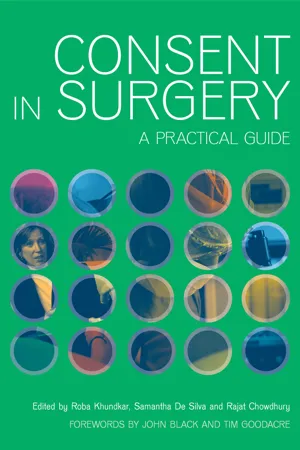
Surgeons have a duty to provide accurate information before asking for consent for surgery, and patients are increasingly interested in obtaining as much information as possible regarding their procedures. Consent in Surgery addresses these vital areas, outlining the consent process for common surgical procedures, including indications, benefits, risks/complications, alternative treatment options, a brief description of each procedure and summaries of the relevant scientific evidence. It contains procedures from subspecialties including cardiothoracic surgery, neurosurgery, general surgery, paediatric surgery, plastic and reconstructive surgery, trauma and orthopaedic surgery, otolaryngology and urology. The procedures included fall within the Intercollegiate Surgical Curriculum Project and MRCS syllabi, and are assessed during higher specialist training, making the book an essential revision and interview preparation tool. 'Helpful to all surgeons in their general approach to this issue and to those in each of the specialties with regard to specific operations.' - From the Foreword by John Black 'A welcome guide, written by authoritative voices and of digestible length. This volume on consent should be in every ward library, close to hand for the ever more rapidly changing teams managing surgical patients.' - From the Foreword by Tim Goodacre
Information
1
Introduction to consent
For treatment to be provided lawfully to a competent adult patient, he or she must consent.
1.1 Legal background
Failure to obtain consent may result in the doctor being sued for battery or negligence.
Battery: if one person touches another without consent, this may constitute battery for which damages could be awarded.
Negligence: for informed consent to be obtained a patient requires information regarding the procedure (see below). Failure by a doctor to give the patient certain relevant information may result in that doctor being considered negligent.
1.2 Who can obtain consent?
• The doctor providing treatment or undertaking the investigation.
• A person who is suitably trained and qualified and has sufficient knowledge of the proposed investigation or treatment, and understands the risks involved.
1.3 When is consent not required?
• If a patient is unable to consent (see below) and would come to harm if a procedure or intervention was not done.
• Treatment for mental illness under the Mental Health Act.
• Children (see below).
1.4 Valid consent: assessment of capacity
For consent to be valid, the patient must be:
I Informed
II Competent/have capacity
III Not be coerced
I Information
• The nature and effect of a proposed treatment must be communicated.
• Sufficient detail must be stated to enable the person consenting to understand in broad terms what is to be done.
• A doctor has a duty of care to inform a patient of risks about which any competent medical practitioner undertaking such treatment would warn a patient.
• The GMC guidelines suggest that these risks should include side effects and complications of the potential treatment options, and failure of the intervention to achieve the stated aim.
• There is also a duty to warn of any possible serious adverse outcome, even if it is rare, and of less serious complications if they occur frequently (common practice is to inform of risks which occur in 1% or more of cases).
• A doctor is not negligent if s/he has acted in accordance with a practice accepted as proper by a responsible body of medical professionals skilled in that particular art (the ‘Bolam test’).
II Competence/capacity
Clinicians use the term competence; the legal term for this is capacity.
Capacity consists of the ability to:
• Understand information about the decision to be made, including what the decision is, why it needs to be made and the likely consequences of making or not making the decision.
• Retain information relevant to the decision.
• Weigh the information in order to reach a decision.
• Communicate his decision.
Communication of consent may be written or oral or by conduct (e.g. extending an arm to a doctor about to take blood, provided the doctor has explained to the patient what he wishes to do).
A patient lacking any of these abilities will lack capacity to consent to treatment.
Remember, capacity is decision-specific and time-specific. Repeated assessments of capacity may therefore be necessary if a long time has elapsed since the procedure/operation was discussed with the patient.
III Lack of coercion
Consent is not valid if it is obtained:
• By fraud, e.g. a fundamental deception regarding the nature of the act or the identity of the person who is to provide the treatment.
• By duress: consent cannot be validly obtained from a person not acting under his or her own free will.
1.5 Refusal/withdrawal
Provided the patient is competent, a refusal may be for any reason, good or bad, or for no reason at all.
A patient possessing capacity may withdraw consent at any time before the authorised treatment has been given.
If consent is withdrawn after treatment has started, the doctor must stop but cannot leave the patient in an unacceptable state.
1.6 Advance directives
A patient may express present intention to refuse treatment in specified circumstances.
Doctors are bound to comply with such statements if certain conditions are fulfilled:
• The patient must have capacity to refuse medical treatment.
• There must have been no other influence, e.g. duress, undue influence or fraud.
• The scope and effect of the refusal must have intended to cover the circumstances actually prevailing at the time when the need for treatment arises.
• The patient must be in possession of knowledge of the nature and effect of the decision being taken.
1.7 Consent in patients under 18 years old
The law is not always clear in this area.
• 16-and 17-year-olds are presumed to have capacity and therefore may consent. However, if they refuse consent, then those with parental responsibility or a court may give consent for a treatment in the patient’s best interests.
• Under-16-year-olds are presumed not to have capacity.
– Those who satisfy health professionals that they do possess capacity are termed ‘Gillick competent’ and may consent.
– If a Gillick competent patient refuses consent, the situation is as for 16/17-year-olds above.
– For children who are not Gillick competent, someone with parental responsibility (see below) should give consent.
– If the parent refuses to give consent for a procedure that a doctor believes to be in the patient’s best interests, the courts should be involved.
• The following people have parental responsibility as outlined in the Children Act 1989:
– The child’s parents if married to each other at the time of conception/birth.
– The child’s mother, but not the father if they were not married, unless the father has acquired parental responsibility via a Court Order or a parental responsibility agreement, or the couple subsequently marry. Recent amendment: the father of a child born on or after 1 December 2003 has parental responsibility if his name appears on the birth certificate.
– The child’s legally appointed guardian, appointed either by a court, or by a parent with parental responsibility in the event of their own death.
– A person in whose favour a court has made a Residence Order concerning the child.
– A Local Authority designated in a Care Order in respect of the child.
– A Local Authority or authorised person who holds an Emergency Protection Order in respect of the child.
1.8 Consent in patients lacking capacity
Capacity refers to a person’s ability to perform a specific act and not a global state.
Examples of when this might be impaired include:
• cognitive impairment, e.g. dementia, delirium
• intellectual impairment
• a psychiatric condition, e.g. depression, mania
• in the event of coercion
• temporary incapacity, e.g. unconsciousness.
If possible, a doctor should try and enable patients to gain capacity to make decisions, e.g. through treatment of a psychiatric disorder.
• For adults without capacity, no other person has any power to consent or refuse treatment on their behalf (in England), unless they have appointed a Lasting Power of Attorney.
• The doctor remains under a duty of care to provide whatever treatment is in the patient’s best interests.
• In...
Table of contents
- Cover
- Half Title
- Title Page
- Copyright Page
- Table of Contents
- Foreword
- Foreword
- Preface
- List of contributors
- 1 Introduction to consent
- 2 Generic procedures
- 3 Cardiac surgery
- 4 General surgery
- 5 Neurosurgery
- 6 Otolaryngology
- 7 Paediatric surgery
- 8 Plastic surgery
- 9 Orthopaedic surgery
- 10 Urology
- Appendix A: Department of Health consent forms
- Appendix B: Laparoscopy and laparotomy
- Index
Trusted by 375,005 students
Access to over 1.5 million titles for a fair monthly price.
Study more efficiently using our study tools.
Frequently asked questions
Yes, you can cancel anytime from the Subscription tab in your account settings on the Perlego website. Your subscription will stay active until the end of your current billing period. Learn how to cancel your subscription
No, books cannot be downloaded as external files, such as PDFs, for use outside of Perlego. However, you can download books within the Perlego app for offline reading on mobile or tablet. Learn how to download books offline
Perlego offers two plans: Essential and Complete
- Essential is ideal for learners and professionals who enjoy exploring a wide range of subjects. Access the Essential Library with 800,000+ trusted titles and best-sellers across business, personal growth, and the humanities. Includes unlimited reading time and Standard Read Aloud voice.
- Complete: Perfect for advanced learners and researchers needing full, unrestricted access. Unlock 1.5M+ books across hundreds of subjects, including academic and specialized titles. The Complete Plan also includes advanced features like Premium Read Aloud and Research Assistant.
We are an online textbook subscription service, where you can get access to an entire online library for less than the price of a single book per month. With over 1.5 million books across 990+ topics, we’ve got you covered! Learn about our mission
Look out for the read-aloud symbol on your next book to see if you can listen to it. The read-aloud tool reads text aloud for you, highlighting the text as it is being read. You can pause it, speed it up and slow it down. Learn more about Read Aloud
Yes! You can use the Perlego app on both iOS and Android devices to read anytime, anywhere — even offline. Perfect for commutes or when you’re on the go.
Please note we cannot support devices running on iOS 13 and Android 7 or earlier. Learn more about using the app
Please note we cannot support devices running on iOS 13 and Android 7 or earlier. Learn more about using the app
Yes, you can access Consent in Surgery by Roba Khundkar,Silva Samantha De,Rajat Chowdury in PDF and/or ePUB format, as well as other popular books in Medicine & Medical Theory, Practice & Reference. We have over 1.5 million books available in our catalogue for you to explore.