- 244 pages
- English
- ePUB (mobile friendly)
- Available on iOS & Android
eBook - ePub
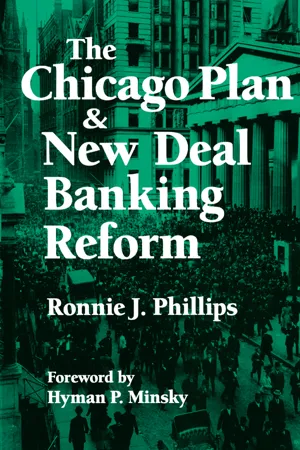
The Chicago Plan and New Deal Banking Reform
About this book
This work presents a comprehensive history and evaluation of the role of the 100 percent reserve plan in the banking legislation of the New Deal reform era from its inception in 1933 to its re-emergence in the current financial reform debate in the US.
1
A History of Currency and Banking in the United States
The history of currency and banking in the United States is a long and often complicated story. The basic fact to remember is that the power to print money is the power to appropriate the real resources (or wealth) of an economy. The Constitution gives the federal government the exclusive power to “coin money.” The authorization for a fiat currency was expressly forbidden.1 However, the federal government, usually in times of fiscal difficulties, has been compelled to issue currency with a promise of redemption and then renege on that promise to a greater or lesser extent. As a result, the costs of fighting wars, from the time of the Revolution through the Civil War, were to a large extent paid for through the direct printing of currency—which promised redeemability at some point in the future upon the cessation of military conflict.
The political struggle over monetary reform has been between those who advocated a strong, centralized monetary authority and those who were against centralization and the concentration of government power (Wilson 1991). The prevailing understanding of banking, and the role of monetary and fiscal policy, often contributed negatively to the debates. Because the introduction of a medium of exchange was frequently tied to the need of the government to finance fiscal expenditures, or on the basis of a loan, there is understandably a great deal of confusion over the distinction, or lack of, between money and credit. This confusion is found through the entire financial history of the United States (and other countries as well no doubt).
Though it is not possible to give a detailed history of the evolution of currency, banking, and fiscal policy in the United States, an understanding of the basic evolutionary trend is important for this study. That trend is one that moves away from a money redeemable in specie on demand to a fiduciary money, that is, one that represents the dual sides of entry on a financial balance sheet.
The Colonial Experience
As Steven Russell notes, many of the most important features of the American monetary system were based on English models (Russell 1991, 41). The Bank of England was given a monopoly in the issuance of a currency convertible into gold and this principle played an important role in the evolution of the American monetary system. Scholars have generally agreed that the problem in the colonies was a species shortage. Numerous studies have examined the nature and cause of this shortage (Calomiris 1988). During the 1650s, the Massachusetts Bay Colony attempted to allay the shortage by operating its own mint (Russell 1991, 44). The British government viewed this activity as usurping a British government prerogative and forced the closure of the mint.
Though there was a need in the colonies for a more convenient means of payment, evidently the introduction of government paper currency was motivated by the fiscal needs of the colonial government (Russell 1991, 44). This motivation for the creation of a government currency was to be used repeatedly in U.S. history.
By the 1730s bills of credit had become the principle currency of the American colonies. These bills were initially issued in anticipation of future taxes. The value of these bills was directly connected to the fact that they would be redeemed in commodity money (gold or other metal coins) at some point in the future. Such bills of credit were unlikely to be inflationary because of their fiscal backing (Calomiris 1988). However political upheavals and financial incentives for the colonies to violate their commitments led to considerable fluctuations in the value of these bills.
Subsequently some colonies began to issue bills of credit that could be lent to individuals who were able to provide land or other sorts of property as collateral. During the first half of the eighteenth century, these so-called loan office or land bank issues became increasingly popular (Russell 1991, 44).
Not surprisingly, currency depreciation became a significant problem for the colonies. This depreciation was compounded by the fact that the colonies typically gave their bills of credit legal tender status. Such laws compelled creditors to accept these bills at face, or par, value (Russell 1991, 44).
The Currency Act of 1751 deprived the New England colonies of the right to issue legal tender bills and virtually eliminated their ability to issue any kind of paper currency. The Act of 1764 extended this prohibition to all of the colonies (Russell 1991, 45). Russell notes that by the time of the Revolutionary War, the colonies appeared to be moving in the direction of a system of nonlegal tender land bank currency (Russell 1991, 45). Continuing to circulate as media of exchange were the coins produced in England, Spain, The Netherlands, Portugal, and France. The “money supply” of the colonies at this time was thus a maze of coins and paper currencies.
The Continental Congress
As the revolutionary war approached, one of the most immediate problems was the question of how to finance wartime expenditures for troops, ammunition, food, and so on. Since there was no federal government, and no powers of taxation, the option utilized was the creation of a fiat currency issued by the Continental Congress. The “Continentals” were issued beginning in May 1775 on the well-known principle of redemption in anticipation of future taxes. Since there was no federal government to provide the taxation backing, the delegates to the Continental Congress pledged joint liability on behalf of the colonies, and each colony was expected to create a good faith sinking fund to redeem the Continentals at their nominal value in specie. This strategy seemed to work until about mid-1776 (Calomiris 1988, 55).
As Charles Calomiris notes, many factors contributed to the fluctuation in the value of the Continentals, including success or failure on the battlefield, the French alliance, and later by changes in the redemption value. Though the Continental Congress experimented with other means of finance, roughly 40 percent of the total cost of the Revolutionary War—about $38 million in specie equivalent—was financed by issuance of Continental currency (Calomiris 1988, 58). By mid-1781 Continentals had ceased to circulate, and Congressional power and credit were at an all-time low (Calomiris 1988, 59).
During the period of time from the end of the Revolutionary War in 1783 to the ratification of the Constitution in 1789, the newly independent states reorganized their finances and several states issued, or seriously considered issuing, bills of credit in anticipation of taxes or on loan (Russell 1991, 46). Calomiris concludes that the experience of the American Revolution created distrust of government money, which contributed to the prolonged inadequacy of financial institutions in the United States (Calomiris 1988, 64).
The Beginnings of Banking in the United States
The first bank established in the United States was the Bank of North America founded in 1781. Within ten years there were three private state-chartered banks in the country. In the early post-colonial days, these banks were viewed chiefly as beneficial in providing a convenient source of currency and, subsequently, in the taking of deposits (Miller, 1927, 11). The importance of banks in the availability of credit was also later recognized (Miller, 1927, 17–18). A considerable debate about the proper functions of banks ensued and is reviewed in detail by Miller (1927).
Since it was widely recognized that banks serve a dual function—providing money and credit—the debate centered on how to achieve these goals most effectively. The basic dilemma for banking is that achieving this dual function requires that a given dollar in money balances be held by more than one person simultaneously. In the commodity money system, as prevailed at the time, the bank note represented a claim on gold or silver held by the bank. However the bank, at any point in time, did not hold enough gold or silver to redeem its bank notes in full without calling in the loans it had made. This led to a theory of banking which at first impression seems eminently reasonable. In fact, the theory confuses regulation of credit with regulation of the money supply. The theory is known as the “commercial loan theory of credit” or the “real bills doctrine.” Lloyd Mints provides a succinct statement of this theory:
Thus the real-bills doctrine runs to the effect that restriction of bank earning assets to real bills of exchange will automatically limit, in the most desirable manner, the quantity of bank liabilities; it will cause them to vary in quantity in accordance with the “needs of business,” and it will mean that the bank’s assets will be of such a nature that they can be turned into cash on short notice and thus place the bank in a position to meet unlooked-for calls for cash. (Mints 1945, 29)
The real bills principle is based on liquidating credit obligations and makes sense in that regard, because it is the idea that credit extended which is then repaid is removed from the balance sheet. Though this is a sensible theory of credit, it is not a principle for providing automatic regulation of the money supply. Mints points out that the fundamental flaw in the real bills doctrine when applied as a regulator of the money supply is the instability that results:
whereas convertibility into a given physical amount of specie (or any other economic good) will limit the quantity of notes that can be issued, although not to any foreseeable extent (and therefore not acceptably), the basing of notes on a given money’s worth of any form of wealth—be it land or merchant’s stocks—presents the possibility of unlimited expansion of loans, provided that the eligible goods are not unduly limited in aggregate value. (Mints 1945, 30)
Expressed another way, a fall in nominal income would lead to both a fall in the demand for money as well as the supply of money, and thus a potentially unstable situation is created (Girton 1974, 57–58).
The real bills doctrine is found in the debates surrounding the creation in 1791 (on Alexander Hamilton’s recommendation) of the Bank of the United States (Mints 1945, 63–64). This bank was a national organization with a twenty-year charter that was authorized to accept deposits, issue notes, and make loans. The First Bank of the United States had a special relationship with the federal government because all government revenues were deposited in it, and its currency was accepted in payment for all government disbursements and receipts (Timberlake 1965, 162). Though this bank issued a currency that could be used throughout the country, opposition by the states and the state-chartered banks led to its demise. The bank was generally regarded as serving an important function for the government, but little was understood about its role in the regulation of credit. As Miller noted, the theories of banking in the United States prior to 1820 were “wretchedly primitive” (Miller 1927, 3).
After the demise of the Bank of the United States, a second bank was chartered in 1816, again for twenty years. The structure of the Second Bank was similar to that of the First Bank, and it served the same function for the government. It was under Nicholas Biddle that the Second Bank began to function as a central bank. The bank would regulate the private banks through its actions of holding and presenting private bank notes for redemption (Timberlake 1965, 164). Though reserve requirements varied for private banks (state chartered at this time), credit could be constrained by presenting bank notes for redemption in species. Banks would have to restrict credit in order to maintain their desired level of reserves. According to Richard Timberlake, these central bank activities were well recognized by 1830 (Timberlake 1965, 166).
Following the demise of the Second Bank, the United States entered the period that is referred to as the “Free Banking Era.” During this period, much of the money stock was privately issued bank notes. This situation, not surprisingly, created a host of problems.2 The bank notes were by law redeemable in gold or silver, and there were heavy penalties imposed for the failure to do so. There was no central monetary authority that would attempt to regulate credit as the Second Bank had done under Biddle. Congress passed legislation in 1835–36 to impose reserve requirements on the banks that held the federal government’s funds, though after “reconsideration” the bill was tabled (Timberlake 1965, 97). Though Congress failed to impose reserve requirements, a number of states did so. The Louisiana Bank Act of 1842 required that deposits and bank notes be backed one-third by specie and the remaining two-thirds by short-term, high quality assets (Timberlake 1965, 98; Pollock 1992).
In 1846, an independent Treasury of the United States was created by legislation. The original plan for the treasury (in 1834) had proposed that it be completely divorced from the banks and that all treasury dealings be conducted on a specie-treasury note basis only (Timberlake 1965, 168). Establishment of the independent treasury eliminated the risks associated with depositing government funds into private banks. The treasury was able to play a stabilizing role during the free banking era. For example, if domestic private sector funding fell, a favorable balance of trade would create an inflow of specie. If the treasury faced a deficit on its budget, it could be financed by issuing securities or notes. During the time period to 1860, the treasury frequently financed its deficit with non-interest bearing notes (Timberlake 1965, 168–69).
Both sides of the Civil War financed part of their fiscal deficits with the creation of legal tender currency. In 1862, Congress passed its first Legal Tender Act to authorize the issuing of “greenbacks.” These were notes issued by the treasury, declared legal tender and redeemable in gold at some unspecified point in the future. The value of the greenbacks fluctuated during the war based on battlefield successes of the Union forces.3
One consequence of the Free Banking Era was the confusing plethora of monies available and the possibility of fraud and counterfeiting. By the 1860s the idea was circulating that the government should provide a currency that could circulate in place of gold. The National Currency Act of 1863 established both a uniform currency and a national banking system (Grant 1992).4
By this act and the National Banking Act of 1864, banks could obtain a national charter. Thus banks could be chartered either by individual states, and subject to their regulations, or by the Comptroller of the Currency, and therefore subject to national bank regulations. Instead of a single national bank, as had been established in 1791 and again in 1816, a system of national banks was created. The national banks could issue notes, but were required to hold $111.11 in government bonds for each $100 of bank notes issued. The national bank notes, though not legal tender, were convertible into greenbacks (McCallum 1989, 318). As Boris Pesek and Thomas Saving note, these conditions made it virtually impossible for the holder of a national bank note to lose in the event of a national bank failure (Pesek and Saving 1968, 398). National bank notes were effectively guaranteed by the federal government since in the event of a bank failure, the Comptroller of the Currency had the right to sell the bonds held as security—and first lien on any remaining bank assets in the event that the bonds did not fully redeem the notes at par (James 1940, 195).
The creation of the dual banking system was supported by Salmon P. Chase, Lincoln’s Secretary of the Treasury, who thought that by providing a model of safety and excellence in services in the national banks, the state banks would naturally follow suit (Pesek and Saving 1968). The act thus intended to enhance the safety of the entire monetary system by providing a government debt backing for a portion of the monetary base. Significantly the original act prohibited national banks from making real estate loans.
Initially banks were slow to turn in their state charters for a national charter. In an attempt to increase conversion and to stop the issuing of bank notes by state banks, Congress imposed a 10 percent tax on any new issue (White 1983, 11). This law led state banks to reduce the issuance of bank notes, and instead expand their offering of checkable deposit accounts, thus circumventing the legislation. The fundamental difference between issuing bank notes and checking accounts is that in the case of bank notes, the denominations are specified, whereas with checking accounts, the denomination is the amount of the check. Since both are fiduciary, bank-created money, it was merely a matter of banks promoting the use of checking accounts instead of bank notes. As a result, by the turn of the century, two-thirds of the banks had state charters (Pesek and Saving 1968, 399). As Cyril James notes, the increasing use of bank checks undermined the National Banking Act for reasons similar to those that had prevented the attainment of the aims of the Currency School under the Bank Charter Act of 1844. Ironically the public began to use bank deposits as a medium of exchange precisely at the time the government had perfected its plan controlling the circulation of bank notes at par value. This was quite similar to what happened to the Bank of England after 1844. The United States, however, did not have a central bank with control over bank deposits (James 1940, 198–99).
The Creation of the Federal Reserve System
Though the history of banking panics and crises may lead one to believe the financial system was cont...
Table of contents
- Cover
- Half Title
- Title Page
- Copyright Page
- Dedication
- Table of Contents
- Foreword
- Acknowledgments
- Introduction: The Quest for Stable Banking
- 1 A History of Currency and Banking in the United States
- 2 Response to the Banking Crisis: Hoover, Congress, and the Economists
- 3 Roosevelt’s Election and the Banking Crisis of 1933
- 4 The March 1933 Chicago Memorandum
- 5 The 100 Days Legislation and the Banking Act of 1933
- 6 The November Chicago Memorandum
- 7 The Banking Reform Agenda: A Federal Monetary Authority and Credit Allocation
- 8 Currie, Eccles, and the Ideal Conditions for Monetary Control
- 9 100% Money: Fisher’s Version of the Chicago Plan
- 10 The Banking Act of 1935
- 11 Academic Views of the Chicago Plan
- 12 The Chicago Plan after the Passage of the Banking Act of 1935
- 13 Financial Instability and Narrow Banking: Simons Revisited
- 14 Conclusion
- Appendix The Chicago Plan for Banking Reform
- Notes
- References
- Index
- About the Author
Trusted by 375,005 students
Access to over 1.5 million titles for a fair monthly price.
Study more efficiently using our study tools.
Frequently asked questions
Yes, you can cancel anytime from the Subscription tab in your account settings on the Perlego website. Your subscription will stay active until the end of your current billing period. Learn how to cancel your subscription
No, books cannot be downloaded as external files, such as PDFs, for use outside of Perlego. However, you can download books within the Perlego app for offline reading on mobile or tablet. Learn how to download books offline
Perlego offers two plans: Essential and Complete
- Essential is ideal for learners and professionals who enjoy exploring a wide range of subjects. Access the Essential Library with 800,000+ trusted titles and best-sellers across business, personal growth, and the humanities. Includes unlimited reading time and Standard Read Aloud voice.
- Complete: Perfect for advanced learners and researchers needing full, unrestricted access. Unlock 1.5M+ books across hundreds of subjects, including academic and specialized titles. The Complete Plan also includes advanced features like Premium Read Aloud and Research Assistant.
We are an online textbook subscription service, where you can get access to an entire online library for less than the price of a single book per month. With over 1.5 million books across 990+ topics, we’ve got you covered! Learn about our mission
Look out for the read-aloud symbol on your next book to see if you can listen to it. The read-aloud tool reads text aloud for you, highlighting the text as it is being read. You can pause it, speed it up and slow it down. Learn more about Read Aloud
Yes! You can use the Perlego app on both iOS and Android devices to read anytime, anywhere — even offline. Perfect for commutes or when you’re on the go.
Please note we cannot support devices running on iOS 13 and Android 7 or earlier. Learn more about using the app
Please note we cannot support devices running on iOS 13 and Android 7 or earlier. Learn more about using the app
Yes, you can access The Chicago Plan and New Deal Banking Reform by Ronnie J. Phillips,Hyman P. Minsky in PDF and/or ePUB format, as well as other popular books in Economics & Business General. We have over 1.5 million books available in our catalogue for you to explore.