eBook - ePub
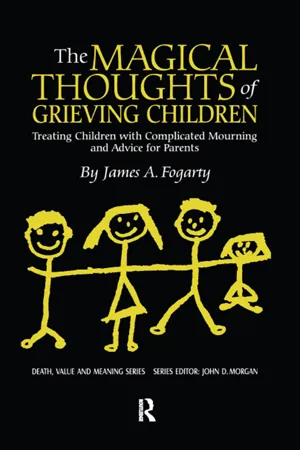
The Magical Thoughts of Grieving Children
Treating Children with Complicated Mourning and Advice for Parents
- 184 pages
- English
- ePUB (mobile friendly)
- Available on iOS & Android
eBook - ePub
The Magical Thoughts of Grieving Children
Treating Children with Complicated Mourning and Advice for Parents
About this book
This book is designed for clinicians, educators, clergy, and nurses - anyone who is assisting children who have experienced the death of a loved one. This work offers a unique framework for helping children heal from the wounds created by the life process of death, a framework that has its defining basis in children's magical thought. Magical thought is motivated by the desire of a child with incomplete cognitive equipment to understand his world. Magical thought helps children develop inaccurate conclusions about many aspects of death and their own personal grief, often suggesting that they or someone else is responsible for the loss.
Information
CHAPTER 1
Children’s View of Grief
The focus of this and the next chapter is to lay a foundation before presenting the Model of Magical Thought. This chapter will offer a brief idea of how children come to realize which adults in their lives are experts about grief. This chapter offers a more extensive discussion of the normal and expected emotions of children’s grief and each grief emotion’s purpose.
HOW TO BE AN EXPERT IN THE EYES OF CHILDREN
Children may not understand the difference between a psychologist, social worker, nurse, or hospice volunteer as these words are too abstract for their comprehension. How do bereaved children determine if the adults assisting them are experts? Often, bereaved children ask helping adults what losses they have experienced. Their questioning helps children determine for themselves if the helping adults are truly experts in the process of mourning. Is it appropriate for professionals and caregivers assisting bereaved children to talk about their own grief experiences and reactions? Each adult would have to answer this question individually. This author advocates that it is valuable to discuss our own losses with children, but this author offers a qualifier. This author believes that it is appropriate for adults to share personal losses with children only if those losses have been well processed. Although training is very important and quite necessary because grief is a very specialized issue, a well processed loss coupled with excellent training in the treatment of grief and complicated mourning are very effective tools for grief therapists and other caregivers who assist bereaved children. This book offers an opportunity for you to not only consider the losses of children you are assisting, but also your own. Well processed grief and a thorough process of mourning offer lessons and gifts that caring adults can offer to children who are mourning the death of a loved one.
A NEW LOOK AT THE NORMAL EMOTIONS OF CHILDREN’S GRIEF
What are the healthy and normal grief emotions that children are expected to experience when a close loved one has died? What are the purposes of each of the healthy and normal grief emotions that children experience?
Emotions are like everything else that exists in this world; they have a purpose and a reason for being. One purpose of emotions is that they offer messages as well as lessons for children to learn. Another purpose of emotions is that emotional expressions from one person elicit emotional reactions in other people, which create bonds. This is especially true for the normal grief emotions. This author defines normal grief emotions as the emotions that share the common purpose of helping children to continue on a process of healthy mourning. Most children do not realize that grief emotions are normal and have a healthy purpose. With incomplete cognitive equipment, children often interpret their normal grief emotions inaccurately, resulting in the application of destructive magical thought, which disrupts the normal process of mourning, creating greater opportunity for the development of complicated mourning.
THE NORMAL GRIEF EMOTIONS
The Numb and Stunned Reaction
When I was a child I had a very favorite uncle. This uncle loved horses and he loved children, which made for wonderful weekends on his ranch for many years. Every weekend we would gather at his ranch and joyfully work with him and his horses. He had such an incredible Old Irish personality that he could make cleaning a barn hysterically fun. When I was fourteen years of age, this wonderful old man was unexpectedly killed in a car accident. On a foggy night he apparently thought he was driving over a bridge when he was actually on the side of a bridge in an extended parking area. His car went into the rain-swollen Rock River and he was killed. My very large Irish Catholic family gathered together at my grandmother’s home after we heard of his death. Within this large family gathering was every emotional grief reaction imaginable. Since I was very close to this uncle I thought it was peculiar that I felt no emotional reaction.
Many bereaved children today also have experienced this strange phenomenon that grief therapists know as a numb and stunned reaction. Often children describe their numb and stunned reaction as not being able to remember their dead loved ones’ facial features, the sound of their voice, or the memories of activities they did together. Numb and stunned is a normal and common grief reaction, which offers a defensive and protective barrier, designed to allow children to gradually incorporate their normal grief emotions. Bereaved children do not realize that their numb and stunned reactions are normal and common. Children may only realize that every family member around them is offering a variety of emotional reactions to the death of the loved one, which they do not feel. It is natural for children to try to incorporate their numb and stunned reactions into their thinking by attempting to interpret these reactions. Often, children’s interpretations of normal numb and stunned reactions are self-deprecatory. When asked about their numb and stunned reactions, children will often respond, “I thought something was wrong with me” or “I thought I didn’t care enough.” It is important to note that children experiencing normal grief reactions, such as numb and stunned, also have incomplete cognitive equipment, which advances interpretations that are inaccurate and often self-deprecatory, leading to the potential development of destructive magical thought.
The Purposes of Numb and Stunned
The purposes of bereaved children’s initial numb and stunned reactions are several. Numb and stunned reactions protect bereaved children from being overwhelmed by all of their intense grief emotions related to the loss experience by offering children a gradual incorporation of the loss. Numb and stunned reactions also signal children that something unusual and significant has happened, and that they will need to make adjustments. Typically, children’s emotions are readily accessible to children. The inaccessibility of emotions suggests to children that something unusual has occurred. Numb and stunned reactions are a way children “brace” themselves emotionally following a trauma. It is like the feel of a taunt seatbelt just before a car accident suggesting, “Brace yourself.” Numb and stunned reactions allow children to gather information objectively and observe others. The numb and stunned reaction also allows children to wait until they feel safe before experiencing the more intense emotions of grief and proceeding through a process of mourning.
Although it is difficult for adults to bond with children who are experiencing a numb and stunned reaction, this reaction can enter the mix of family dynamics. For example, a parent who does not have much knowledge about children’s grief reactions may observe a calm and relaxed child shortly after the death of a significant loved one in a different light than a parent who understands the child’s grief. A parent, with knowledge about grief reactions, may conclude that the child is not mourning intensively right now and this parent may appreciate the lack of emotional response from the child, realizing grief reactions may come later. Another parent, without knowledge of grief reactions, may negatively interpret this child’s behavior as obviously not caring much for the dead family member, and send signals to the child that the child is not mourning correctly. Criticisms for not mourning correctly may be supported by parental and family reactions to the child’s lack of emotional response or may also develop within the child’s thinking without parental assistance. This negative interpretation often results in the bereaved child defining a normal grief reaction as abnormal, creating an emotional paradox:
I need to demonstrate grief emotions like everyone else, even though I do not feel any grief emotions.
A mourning child in this paradox may fake emotional reactions, diverting the child from the actual tasks of healthy mourning, which include feeling grief reactions such as numb and stunned. This may result in the bereaved child concluding:
I cannot feel anything about my dead loved one, so I am abnormal.
Bereaved children with this aversive conclusion may start to believe that normal grief emotions (numb and stunned) are abnormal, or they may conclude that they are abnormal. Often children with this aberrant conclusion may attach magical thought, which leads bereaved children away from normal grief reactions, and stops them from progressing through a healthy process of mourning. Consider another possible conclusion bereaved children may have regarding their numb and stunned reactions:
I don’t feel anything, so I obviously did not care enough.
This is a self-judgment that, if it becomes persistent, has the potential to devastate children’s entire personality development. Children’s negative thoughts/conclusions may eventually develop into magical thought creating long-term difficulties and complicated mourning.
Offering children a simple explanation about the normalcy of numb and stunned reactions and their purposes often reduces or eliminates the aversive effects of children’s misinterpretation of their numb and stunned reactions. Numb and stunned reactions need to be explained to children in specific concrete terms.
PARENT SUGGESTION
Parents can offer their children this explanation about numb and stunned reactions:
If you do not feel anything right now, it is okay. Right after someone dies, many children do not feel any emotions for a period of time. That’s normal. It will go away in a while. If it does not go away, make sure you tell us. When it goes away you will have other feelings that do not feel normal, but they usually are. Make sure you tell us about those feelings too.
This explanation allows children to realize that all their grief emotions will come, which is a healthy expectation that may help children feel more normal when other grief emotions occur. Without explanation of numb and stunned reactions, bereaved children have an untrained and bountiful imagination that could create a variety of potentially destructive magical thoughts, that they could attach to their process of mourning creating complicated mourning.
Commotion
Commotion is behavior exhibited by bereaved children based on the combination of the excessive energy, attentional difficulties, tension, and fear that children display when experiencing grief reactions. The word commotion is an appropriate descriptor because many children demonstrate this reaction through very active behavior. Bereaved children exhibiting commotion often appear to resemble children with Attention Deficit Hyperactivity Disorder (ADHD). The following list is a review of the symptoms of ADHD from the Diagnostic and Statistical Manual of Mental Disorders, Fourth Edition. Copyright 1994 American Psychiatric Association. Reprinted with permission.
A. Either (1) or (2)
(1) six (or more) of the following symptoms of inattention for at least six months to a degree that is maladaptive and inconsistent with developmental level:
Inattention
(a) often fails to give close attention to details or makes careless mistakes in schoolwork, work, or other activities
(b) often has difficulty sustaining attention in tasks or play activities
(c) often does not seem to listen when spoken to directly
(d) often does not follow through on instructions and fails to finish schoolwork, chores, or duties in the workplace (not due to oppositional behavior or failure to understand instructions)
(e) often has difficulty organizing tasks and activities
(f) often avoids, dislikes, or is reluctant to engage in tasks that require sustained mental effort
(g) often loses things necessary for tasks or activities
(h) is often easily distracted by extraneous stimuli
(i) is often forgetful in daily activities.
(2) six or more of the following symptoms of hyperactivity-impulsivity have persisted for at least six months to a degree that is maladaptive and inconsistent with developmental level:
Hyperactivity
(a) often fidgets with hands and feet and squirms in seat
(b) often leaves seat in classroom or in other situations in which remaining seated is expected
(c) often runs or climbs excessively in situations in which it is inappropriate
(d) often has difficulty playing or engaging in leisure activities quietly
(e) is often “on the go” or acts as if “driven by a motor”
(f) often talks excessively.
Impulsivity
(g) often blurts out answers before questions have been completed
(h) often has difficulty waiting turn
(i) often interrupts or intrudes on others.
B. Some hyperactive-impulsive or inattentive symptoms that caused impairment were present before age seven years.
C. Some impairment from the symptoms is present in two or more settings (e.g., school and home).
D. There must be clear evidence of clinically significant impairment in social, academic, or occupational functioning.
Commotion resembles ADHD because it has many of the symptoms that are reflected in the above diagnostic criteria for ADHD. ADHD has been well researched and it does exist, but how much of what is diagnosed as ADHD is really ADHD? Is the grief reacti...
Table of contents
- Cover
- Title Page
- Copyright Page
- Dedication
- Acknowledgments
- Table of Contents
- Introduction
- CHAPTER 1 Children’s View of Grief
- CHAPTER 2 Cognition: The Most Definitive Feature of Children’s Grief
- CHAPTER 3 The Model of Magical Thought
- CHAPTER 4 The Tasks of Healthy Mourning Distorted by Destructive Magical Thought
- CHAPTER 5 Action-Focused Techniques to Eliminate Destructive Magical Thought
- CHAPTER 6 Anger and Magical Thought
- CHAPTER 7 A Special Note for Parents
- CHAPTER 8 Magical Thoughts of Adults and Our Society
- CHAPTER 9 Final Thoughts
- APPENDIX A Resources for Action-Focused Techniques
- References
- Index
Trusted by 375,005 students
Access to over 1.5 million titles for a fair monthly price.
Study more efficiently using our study tools.
Frequently asked questions
Yes, you can cancel anytime from the Subscription tab in your account settings on the Perlego website. Your subscription will stay active until the end of your current billing period. Learn how to cancel your subscription
No, books cannot be downloaded as external files, such as PDFs, for use outside of Perlego. However, you can download books within the Perlego app for offline reading on mobile or tablet. Learn how to download books offline
We are an online textbook subscription service, where you can get access to an entire online library for less than the price of a single book per month. With over 1.5 million books across 990+ topics, we’ve got you covered! Learn about our mission
Look out for the read-aloud symbol on your next book to see if you can listen to it. The read-aloud tool reads text aloud for you, highlighting the text as it is being read. You can pause it, speed it up and slow it down. Learn more about Read Aloud
Yes! You can use the Perlego app on both iOS and Android devices to read anytime, anywhere — even offline. Perfect for commutes or when you’re on the go.
Please note we cannot support devices running on iOS 13 and Android 7 or earlier. Learn more about using the app
Please note we cannot support devices running on iOS 13 and Android 7 or earlier. Learn more about using the app
Yes, you can access The Magical Thoughts of Grieving Children by James. A. Fogarty in PDF and/or ePUB format, as well as other popular books in Psychology & Mental Health in Psychology. We have over 1.5 million books available in our catalogue for you to explore.