Promoting Behavioral Health and Reducing Risk Among College Students synthesizes the large body of research on college students' behavioral health and offers guidance on applying evidence-based prevention and early intervention strategies using a comprehensive public health framework. Chapters authored by leading researchers and practitioners address a broad spectrum of important behavioral health issues, interventions, and challenges. Moving beyond a theoretical discussion to strategies for implementation, this book addresses the special issues and potential barriers faced by practitioners as they translate research to practice, such as resource limitations, organizational resistance, challenges to program sustainability, and the unique needs of special populations. This cutting-edge compendium will appeal to both practitioners and researchers involved in providing prevention, early intervention, and treatment services for college students.
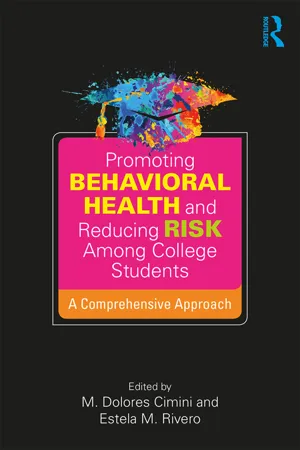
eBook - ePub
Promoting Behavioral Health and Reducing Risk among College Students
A Comprehensive Approach
- 280 pages
- English
- ePUB (mobile friendly)
- Available on iOS & Android
eBook - ePub
Promoting Behavioral Health and Reducing Risk among College Students
A Comprehensive Approach
About this book
Information
Part I
Behavioral Health Risks Among College and University Students
Chapter 1
The Academic Opportunity Costs of Substance Use and Untreated Mental Health Concerns Among College Students
Introduction
In August 2017, a USA Today headline read, “If you smoke a lot of pot, your grades can take a hit” (Touchberry, 2017). The article highlighted the results of several recent peer-reviewed scientific research studies showing the negative relationship between marijuana use and grades among college students. However, the notion that substance use can affect academic performance is not new. As early as the 1970s, Kahn and Kulick (1975) published a study describing the differential dropout rates of college students based on their involvement in drugs during their first year. What has transpired in the four-decade-long interim is a clearer understanding of the extent to which and how substance use affects academic performance, the influence of intervening variables or mediators, and a better appreciation of the importance of covariates and comorbid conditions in the relationship. Most importantly, ideas have emerged regarding how this information should be used for practical purposes to promote the success of young people as they transition to college and as they navigate through their college years and adulthood.
Compared with acute health consequences like alcohol poisoning, overdoses, accidental injury, vandalism, and sexual assault, the connections between substance use and academic performance variables and psychosocial outcomes later in life have received less attention. Given that these outcomes are cornerstones of the mission of educational institutions, intensified consideration of these issues by leaders in higher education is warranted.
Overview of the Prevalence of Alcohol and Other Substance Use and Untreated Mental Health Conditions
While alcohol use among high school students has trended downward during the last decade, only recently have there been signs of corresponding decreases for college students (Johnston, O’Malley, Bachman, Schulenberg, & Miech, 2016). Nationally, in 2015, it was estimated that approximately one-third of college students engaged in binge drinking (Johnston et al., 2016). A new cause for concern among college students is the phenomenon of “high-intensity drinking,” or drinking 10 or more drinks in a session (twice beyond the binge threshold). Between 2005 to 2015, about one in nine young adults (11%) were classified as high-intensity drinkers (Johnston et al., 2016). Interestingly, the prevalence of high-intensity drinking decreased among male college students from 2005 to 2010 and 2011 to 2015, but has remained steady among females (Johnston et al., 2016). Nationally, 11% of college students meet criteria for an alcohol use disorder (AUD), which is slightly higher than estimates for non-college-attending peers (9.6%; [Substance Abuse and Mental Health Services Administration, 2017]). From other studies, estimates of the prevalence of AUD among college student samples range from 20% to 31% (Blanco et al., 2008; Caldeira et al., 2009).
With respect to other forms of substance use, almost one in four college students has used an illicit drug during the past month, with marijuana being the most common (Substance Abuse and Mental Health Services Administration, 2017). One study found that while 38% of college students had tried marijuana before college entry, an additional 25% began using marijuana for the first time after starting college (Pinchevsky et al., 2012). Young adults experience serious problems related to marijuana use, with estimates ranging from 15% to 35% of marijuana-using young adults meeting psychiatric criteria for marijuana use disorder (Hasin et al., 2015; Richter, Pugh, & Ball, 2017). Specifically among college students, researchers found that almost 25% of marijuana-using college students met criteria for marijuana use disorder on one campus (Caldeira, Arria, O’Grady, Vincent, & Wish, 2008). Colleges have experienced new challenges related to the relaxed legislative changes regarding marijuana (National Center for Campus Public Safety, 2016), decreases in perceived risk (Miech, Johnston, O’Malley, Bachman, & Schulenberg, 2015), and increases in THC concentrations (ElSohly et al., 2016).
Nonmedical use of several classes of prescription drugs, including stimulants, opioids, tranquilizers, and sedatives, have complicated the drug use landscape on college campuses. Significant heterogeneity in prevalence estimates exists across campuses and across demographic groups (Johnston et al., 2016; McCabe, Knight, Teter, & Wechsler, 2005; McCabe, West, & Wechsler, 2007; McCabe, West, Teter, & Boyd, 2014). It is well established that rather than occurring in isolation, nonmedical prescription drug use overlaps with excessive drinking and other forms of drug use (Garnier et al., 2009; Kalyanam, Katsuki, Lanckriet, & Mackey, 2017; McCabe, Veliz, Boyd, & Schulenberg, 2017; Messina et al., 2014; Schepis, West, Teter, & McCabe, 2016).
Although it is true that some individuals might “mature out” of drinking and drug use patterns that were established during college, many do not. A recent longitudinal study that tracked the drug use patterns of college students into their young adult years found that alcohol use frequency levels off after college graduation rather than declining (Arria et al., 2016). On average, the low-frequency, high-quantity drinking behavior prevalent during college appears to be replaced with high-frequency, lower-quantity alcohol consumption after graduation. For some, worsening of drinking and drug use problems after college is of course possible, as evidenced by the fact that 32% of adults ages 26 or older who meet criteria for an AUD attained at least a college degree (Substance Abuse and Mental Health Services Administration, 2016) and most likely began drinking earlier in life. The point to be made is that college is an opportune time to identify and intervene with students who might be at risk for persistent or more severe patterns of substance use and untreated mental health conditions because of the institutional structures and professional resources that are inherent to college environments. Intervening might become more difficult later as problems worsen and as the support structures around the individual become more diffuse.
Self-reported feelings of anxiety and prolonged periods of depression among college students are fairly common. National data show that 21% of full-time college students have met criteria for having a mental disorder and 12% have had a major depressive episode during the past year (Substance Abuse and Mental Health Services Administration, 2017). More high school students today, especially those who are college bound, are being diagnosed with mental health problems prior to college entry, perhaps because the options for clinical management are more recognized. The World Health Organization reported that of the 20% of college students with a diagnosis of a mental disorder, the majority (83%) experienced an onset of the disorder prior to matriculation (Auerbach et al., 2016). The increase in the number of students with psychiatric conditions poses challenges for college health and counseling centers (Center for Collegiate Mental Health, 2016) but also creates an opportunity for professionals working in these settings to dually promote mental health and academic success. The scenario that is perhaps even more challenging is when students experience their first onset of psychiatric problems after college entry. Between ages 18 and 25 is a period of heightened risk for the onset of a mental health diagnosis (Kessler et al., 2007), and experiencing new signs of mental health problems can be debilitating to a student, especially in the absence of parental support and supervision. Studies have shown that many students are unaware of the kinds of services available to them, do not perceive need for mental health treatment, have financial barriers, do not have enough time, or think they can handle things on their own or with the help of their social networks (Eisenberg, Golberstein, & Gollust, 2007; Eisenberg, Hunt, Speer, & Zivin, 2011; Marsh & Wilcoxon, 2015; Mowbray et al., 2006; Nordberg, Hayes, McAleavey, Castonguay, & Locke, 2013). For example, only 16.4% of college students with a mental health disorder received any treatment for their condition during the past year (Auerbach et al., 2016).
Academic Potential and the Academic Opportunity Costs of Substance Use
When asked to reflect on the meaning of academic success, college students will often give a fairly narrow answer, with grade point average (GPA) being a key indicator. However, if one broadens the vantage point to academic potential, then other features of success, beyond simply doing well on exams, come to light. The college environment can be an excellent training ground to build communication and critical-thinking skills, gain knowledge, exercise creativity, and enhance social skills. The college years, because of the presence of newfound freedoms and different responsibilities, are a time to learn how to be resourceful, help others, and contribute in productive ways to the community. Challenging learning environments can foster sharpness of focus and give a student the chance to practice important skills, like how to break down and understand complex problems, multi-task, and manage time efficiently. Today’s students have the added challenge of being bombarded with a litany of distractions from social media to streaming video and news, which makes it even more difficult to sustain long-term attention. Setbacks during college, which are experienced in some degree by all students, can offer opportunities to learn how to elicit help from trusted sources and build what is commonly referred to as “grit” or resilience. Building and refining these skills by the end of college creates a strong foundation for later success in the workforce. Alternatively, if one chooses not to enter the traditional workforce, these skills are essential for achieving personal fulfillment by raising a family, caring for aging parents, or having healthy relationships.
A college degree is a valued accomplishment. Most view college as an opportunity to partake in numerous types of constructive activities, gain new professional skills and knowledge, interact with peers with differing world views, and contribute to a collective community that values tolerance and diversity. The pride associated with a child attending college is present for any parent but enhanced among first-generation families and among those who are constrained by their economic circumstances. The latest data from the U.S. Department of Education estimate that 30% of 18- to 24-year-olds are enrolled as a student at a 4-year college and 11% at a 2-year college (Snyder, de Brey, & Dillow, 2016). Approximately 60% of students who begin college at a 4-year school complete a bachelor’s degree within 6 years (Snyder et al., 2016).
The unfortunate news is that when students graduate after completing their degree, they might be unprepared to be a productive member of the workforce. In 2015, it was reported that only about 30% of employers believe that college graduates have the critical-thinking skills needed to succeed in what is becoming an increasingly competitive and complex work environment (Hart Research Associates, 2015).
Some still hold close the notion that excessive drinking and drug use is an integral or “normal” part of the college experience, or a “rite of passage” as some might label it. But this idea has been called into question and its opposition is strengthened by the fact that most students attending college today do not excessively drink or engage in various forms of substance use. Excessive drinking and substance use among college students is increasingly recognized as an opportunity cost to availing oneself of all that college has to offer.
Impact of Substance Use on Cognitive Function
The last two decades have witnessed an explosion of new research studies focused on how substance use affects neurodevelopment, brain structure and function, and cognitive capacities. These studies have demonstrated that substance use, especially when frequent and/or severe, and/or when it begins early in life, can impair several aspects of cognitive function. Excessive drinking is known to cause problems with short-term memory, impede learning and other brain functions, and disturb sleep (Jacobus & Tapert, 2013; Le Berre, Fama, & Sullivan, 2017; Lisdahl, Gilbart, Wright, & Shollenbarger, 2013; Singleton & Wolfson, 2009; Squeglia, Spadoni, Infante, Myers, & Tapert, 2009), which in turn can possibly undermine academic performance.
The acute effects of marijuana intoxication are well recognized and include attention and concentration difficulties, as well as decreased working memory, decision response speed, and information processing (Bat...
Table of contents
- Cover
- Title
- Copyright
- Contents
- Contributor Affiliations
- Editor Biographies
- Preface: Reducing Risk, Increasing Protection, Supporting Success, Changing Culture: A Comprehensive Framework
- Acknowledgements
- Part I. Behavioral Health Risks Among College and University Students
- Part II. Translating Research Into Effective Practice
- Part III. Special Issues
- Endnote: “Nothing About Us Without Us”: Including the Voices of Students in Prevention
- Index
Trusted by 375,005 students
Access to over 1.5 million titles for a fair monthly price.
Study more efficiently using our study tools.
Frequently asked questions
Yes, you can cancel anytime from the Subscription tab in your account settings on the Perlego website. Your subscription will stay active until the end of your current billing period. Learn how to cancel your subscription
No, books cannot be downloaded as external files, such as PDFs, for use outside of Perlego. However, you can download books within the Perlego app for offline reading on mobile or tablet. Learn how to download books offline
Perlego offers two plans: Essential and Complete
- Essential is ideal for learners and professionals who enjoy exploring a wide range of subjects. Access the Essential Library with 800,000+ trusted titles and best-sellers across business, personal growth, and the humanities. Includes unlimited reading time and Standard Read Aloud voice.
- Complete: Perfect for advanced learners and researchers needing full, unrestricted access. Unlock 1.5M+ books across hundreds of subjects, including academic and specialized titles. The Complete Plan also includes advanced features like Premium Read Aloud and Research Assistant.
We are an online textbook subscription service, where you can get access to an entire online library for less than the price of a single book per month. With over 1.5 million books across 990+ topics, we’ve got you covered! Learn about our mission
Look out for the read-aloud symbol on your next book to see if you can listen to it. The read-aloud tool reads text aloud for you, highlighting the text as it is being read. You can pause it, speed it up and slow it down. Learn more about Read Aloud
Yes! You can use the Perlego app on both iOS and Android devices to read anytime, anywhere — even offline. Perfect for commutes or when you’re on the go.
Please note we cannot support devices running on iOS 13 and Android 7 or earlier. Learn more about using the app
Please note we cannot support devices running on iOS 13 and Android 7 or earlier. Learn more about using the app
Yes, you can access Promoting Behavioral Health and Reducing Risk among College Students by M. Dolores Cimini, Estela M. Rivero, M. Dolores Cimini,Estela M. Rivero in PDF and/or ePUB format, as well as other popular books in Psychology & Higher Education. We have over 1.5 million books available in our catalogue for you to explore.