- 272 pages
- English
- ePUB (mobile friendly)
- Available on iOS & Android
eBook - ePub
About this book
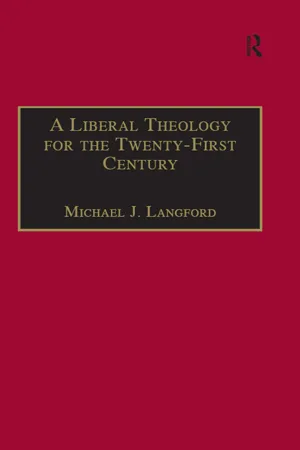
Liberal theology, in its typical form, represents the attempt to approach religion from a rational perspective without denying or belittling the importance of religious experience and religious commitment. Versions of liberal theology can be found in all the great religions. This book is primarily concerned with a Christian tradition that goes back to the second century and reached a high point in the seventeenth. This tradition includes a method of inquiry which, when re-evaluated in the light of recent discussions on the nature of rationality and applied to contemporary issues, reveals that there are versions of materialism, monism and theism that can accord with rationality. While liberal theology cannot demonstrate the truth of theism, it can present it not only as one of the rational options, but as an option that has uniquely attractive characteristics, and when the liberal tradition is taken at its best, it can support a version of Christianity which continues to refer to God as a transcendent 'reality', and which can continue to support recognizable doctrines of incarnation, redemption and Trinity. The liberal theology introduced and advanced in this book can be contrasted with many recent 'radical theologies', and could be called 'liberal orthodoxy'. Students of philosophy, theology and religious studies, as well as clergy and interested lay readers, will find this an accessible insight into liberal theology and to current debates on materialism, atheism and inter-faith dialogue.
Information
Topic
Theology & ReligionSubtopic
ReligionChapter 1
Introduction
A Castle Story
A certain man was desperately concerned with security, so he surrounded his house with a high perimeter fence and installed an expensive burglar alarm. He still was not satisfied, so he made the walls thicker, the windows smaller, and where the roof overhung the front entrance he put battlements from which he could look down on any visitors. When he had finished the alterations his house looked like a miniature medieval castle. Then he read in a history book that many old castles which were too strong to be taken by assault had been captured by treachery and, fearful of this, he resolved never to let any other person into his home, even though it meant he had to do all the cleaning and internal maintenance. Then he heard on the radio of someone who lived in a similarly fortified house being mugged when they went to the local store, so he decided never to go out but to have all his goods delivered through the letter box, which he enlarged for the purpose.
One can think of several instructive ends for this story. According to one of them the man dies through an unforeseen event, such as a virus in the water supply, thereby stressing the impossibility of finding absolute security. The one I prefer allows the man to find a security that succeeds in protecting him from all his fears, but concludes with the neighbours’ comments. They look sadly at their old friend’s home, and they do not call it a castle, but a prison, for indeed that is what it has become.
It often spoils a parable to explain it, but in this case I propose to do so because although the first level of meaning is fairly obvious, there is a second which is less so, and this is the level which relates to the main theme of this book. The first level is found in the moral meaning, centred in the insight that a human life that is happy or good cannot escape some vulnerability. Having friends, let alone family, involves being able to be hurt, either physically or, more often, emotionally. Paradoxically, the capacity to be happy – which depends so much on our relationships with others – is intimately linked with the capacity to be hurt. The higher our defensive walls the more we distance ourselves from other people. In addition to this, being truly happy is intimately concerned with the moral life, for that too is rooted in our relations with other people. The more we avoid every kind of risk the less we are able to leave the world a better place than we find it. In the Christian tradition, the vulnerability that is integral to both happiness and goodness is symbolized in the life of Jesus – in the one who chose to ‘empty himself’ so that he could share human sufferings, even to the point of crying ‘My God, My God, why hast Thou forsaken me’ as he faced death. This level of meaning may well be accepted as helpful by many people who would not consider themselves religious, for the insight that being a loving person involves being vulnerable is not an exclusively Christian insight. It is rather an insight that is specially stressed in the Christian tradition.
The second and less easily discernible level of meaning concerns the invulnerability of some world-views, or philosophical positions. The Logical Positivists, despite all the objections that can be brought against their theory, followed a profound insight when they rejected positions, including religious ones, against which no possible evidence could be offered. The totally impregnable position may be immune to assault, but it pays the price of becoming an intellectual prison in which the castellan is not open to any challenging idea and is imprisoned in a system, not of reality, but of their own creation. The castle walls are a metaphor for a series of assumptions in which everything is interpreted to fit the chosen position. The paradox is that Logical Positivism itself tended to become just such a prison, for it demanded acceptance of a particular theory of meaning, with the result that the prophetic words of others could not be heard.
One contemporary example of this castle is found among many people who have accepted not science – which is a liberating search for truth – but what is sometimes called ‘scientism’, that is, the belief (and belief it is) that the empirical sciences, spearheaded by Darwinian theory, are the key to all understanding.1 The possibility that there might be other levels of reality, and that behind and beyond the world of sense there could be a spiritual world, is not open to serious investigation. The words of the prophets are like arrows that cannot penetrate the shutters that cover the arrow slits. If the walls were really made of stone, then God – if there be a God – could tear them down in an instant; but the hearts and minds of these prisoners cannot be reached by force, only by a response that opens up the chance of being wounded, in the sense that the very foundations of the position one has come to rely on may be shaken. So the soldiers of scientism are condemned to live in the darkened confines of their keep, secure in a methodology that guarantees no dangerous outside light can enter in. No one must open a shutter, let alone put their head out of a window, or they risk a serious wound. Clever people often build intellectual prisons that are like scientific theories, or rather pseudo-theories, which are adjusted to fit any new fact or any new exerience. Up to a point the adjustment of a theory in order to take account of new data can be legitimate, but when the theory is made to fit whatever is experienced, then it is a case of fitting the facts to fit the theory, rather than a case of constructing a theory to explain the facts. On many occasions in the history of science this is what has happened.2
Many religious people have built, and still do build, equivalent prisons, but there is a theological tradition which has always involved a breaking away from any such prison. This tradition stresses the nature of belief rather than knowledge; it admits the role of doubt and stresses the importance of an open dialogue in which all views can be challenged. Within this tradition, there is a legitimate assurance that the religious person may claim, but it is found in the rewarding experience of personal commitment to a way of life, not in a conviction that one particular philosophy can be known to be true with absolute certainty. This tradition is generally known as that of rational or liberal theology, and it is the purpose of this book, first, to explore what it has stood for in the past and, second, to expound a version of it that is suitable for the twenty-first century.
The Need for a Rational and Liberal Theology
The present intellectual climate is full of paradoxes. In many contemporary cultures there is much evidence for a spiritual hunger combined with very little awareness or knowledge of the spiritual traditions that have enriched these cultures in the past. Instead, the traditions are frequently rejected, even though the ideas rejected are likely to be caricatures. In the Western world there is an understandable and commendable interest in Eastern religions, but this is often combined with minimal knowledge of the spiritual traditions of the West. Meanwhile in China, the Communist elite tend to combine a fascination with one Western tradition (namely Marxism) with a woeful ignorance of their own, extremely rich spiritual traditions. Another, and related, paradox has been illustrated by the parable of the castle. A general acceptance of scientific claims is often combined with very little understanding of what contemporary science is really like and little openness to explore, first hand, the relatively modest claims actually made by most of those in the forefront of scientific work. As a result, many people are imprisoned within a world-view that is pseudo-scientific. More generally, there is a widespread belief that in order to follow reason we should discard religion, while at the same time, not only is there no clear understanding of what ‘reason’ means, but many things are believed on authority rather than on any reasoning process. In other words, the irrationalism that used to infect many (but not all) religious people has been replaced by an irrational rejection of religions that have never been examined and, quite often, an irrational acceptance of other beliefs. In the context of the widespread spiritual hunger, which many of the great religions – when experienced at their best – could respond to, the situation is not only paradoxical, but tragic.
Unfortunately, when we turn to those who teach theology, or who preach in the churches, we often find that a rational approach to religion, which has been one hugely important tradition within Christianity, is often sidelined, with the result that the sceptic’s suspicion that religion reflects the approach of a bygone age is confirmed. Many of the churches either preach a version of fundamentalism that cannot stand up to rational analysis, or a Barthian gospel that is only alleged to make sense once one is within the circle of faith.3 In consequence, there is an urgent need for a reappraisal of the tradition of ‘liberal theology’, a tradition which no one who is truly rational can afford to ignore, even if they end up rejecting it. It can be thought of as part of the ‘human enterprise’. Let me explain why this is so.
In human beings, we find a strange mixture of passion and reason. It is in the blending of these two elements that we find the essence of humanity in contrast with animals on the one hand – who often have something akin to passion but, at best, only the rudiments of reason4 – and computers on the other – which have no passion, but a certain kind of rationality. Exactly what we mean by reason is a complex question that I shall address more directly in the next section; however, whatever our account of it may be, it is something that all of us approve. We may have doubts as to how far reason can answer some questions, or how far it is appropriate for guiding some aspects of our lives but, in principle, we always condemn the ‘irrational’ and seek what is ‘reasonable’. Moreover, although passion is often in tension with reason, many people, perhaps paradoxically, have a positive passion to be rational. They wish to extend the boundaries of the rational to as many spheres of life as they can.
As I have indicated, within the history of theological reflection, in Christian and other forms of religious thought, there has been a tradition in which reason has been a central concern. In its typical form, this tradition has not claimed that there is no place for revelation, meaning religious experience that is believed to indicate knowledge or awareness of a spiritual reality, for without reference to such experience we could not appreciate the history of any of the great religions. However, within this tradition, the content or alleged content of any revelation is reflected upon, sifted, compared with other examples and, as far as possible, described within the context of a general philosophy of life. If we have only a spark of the ‘passion for reason’, and if we acknowledge that some religious questions are of fundamental importance with respect to what we should believe and how we should live, then this tradition should be of vital interest.
The claim that liberal theology is of importance can be strengthened when we observe the way in which fundamental positions in religion are often caricatured, so that what is attacked or rejected, is not, say, Christianity as many Christians would recognize it, but some strange distortion of it. In the context of partisan debates in which the participants are more concerned with winning than with discerning truth, alternative positions are often painted in grotesque colours. Religious people are often guilty of this irrationalism, for example, in the way they describe the religious views of others, or in claims that only religious people can be morally good. Equally, those who are anti-religion tend to select bad examples of religion (of which, of course, there are many), and then make general conclusions that are quite unjustified. Even normally intelligent and fair-minded people often rely on caricatures. An example is provided by a chapter in Jeremy Paxton’s Friends in High Places in which a gloomy picture of the Church of England is presented.5 Here there is an amusing, if one-sided, account of what is said to go on in the upper echelons of the church, but absolutely no reference to the dynamic life of many ordinary parishes. It is as if one were to evaluate an army by going to dinner parties at the officers’ mess, while never seeing the regular troops in training or action!
Similar to the problem of caricature is the problem of grave misunderstanding, often within the thought of highly intelligent people. For example, when the scientist and Nobel Prize winner Francis Crick describes his boyhood movement towards becoming ‘an agnostic with a strong inclination toward atheism’, he describes how he increasingly found certain religious claims untenable, such as fundamentalist statements about the age of the world. He adds: ‘if some of the Bible is manifestly wrong, why should any of the rest be accepted automatically?’6 This attitude is of a piece within a commonly received picture of religious people retreating, stage by stage, as one claim after another must be abandoned in the face of new scientific discoveries, and the God of the Gaps is seen to be less and less relevant.7
There are two important misunderstandings here. The first is the failure to distinguish central religious assertions – in the Bible or elsewhere – from factual claims, that in many cases have no essential importance for religion. With regard to the factual claims Crick is quite right. It is unfortunate that again and again many religious people and many churches, especially from the time of Copernicus and Galileo, have made factual assertions that cannot be defended in the light of later discoveries in modern science. (There are some factual claims, such as the historical existence of Jesus of Nazareth which are central for the historical religions, and some of these will be discussed in Chapter 7.) Within the liberal tradition, once Darwin’s theory became generally understood, it was soon realized that the question of whether or not animals and humans evolved over a long period of time was irrelevant to the question of whether or not there was a loving creator behind the creative process. No Christian thought that the gradual development of the baby in the womb entailed that God was not the creator of the individual person it became, so why should the gradual development of a whole species entail that God was not the creator of the species? The distinction between the scientific examination of a process and the religious significance of a process indicates how the essential religious assertions of the great religions are not factual claims of the kind that science can investigate. In the case of the Bible, the essential assertions include the claim that behind the whole physical creation there is a loving intelligence that is its ultimate source, and that individual humans are known and loved by this intelligence. In later chapters we shall examine the reasons why religious people make these claims, and how rational people may agree or disagree with the validity of these reasons, but the point is that the essential religious claims should not be lumped together with factual assertions that are logically completely independent. It is only with respect to the latter that a systematic retreat can be seen.8
The second misunderstanding is implicit in Crick’s objection to beliefs being ‘accepted automatically’. Within the liberal religious tradition that is explored here, nothing is accepted ‘automatically’. As with many other beliefs, a young child may accept many things purely on trust, but growing to adulthood must include what the Bible calls being ready to give ‘a reason’ for the hope that is in you.9
An illustration may help to illuminate further the difference between the kind of empirical statements that it is the proper business of science to investigate, and what I have called ‘essential’ religious claims. Let us suppose (what I believe to be extraordinarily unlikely) that new scientific evidence showed not only that the famous shroud of Turin dated from the first century of the Christian era, but that the imprint was made in a totally inexplicable manner – though one that had to be in the context of an extraordinary discharge of energy. These scientific findings would be consistent with Christian claims, and psychologically would boost them for many people, but there would be no logical proof of any metaphysical claim about the nature of Jesus. The same point would emerge if we were to have physical proof of Jesus being the product of a virgin birth. This would be extraordinary, perhaps unexplainable, but there would be no logical need for an atheist to say: ‘Jesus is the unique son of God.’ The logical point is that no amount of physical evidence can by itself be a scientific proof for a metaphysical claim of this kind – by its very nature, with the exception of cosmology, empirical scientific evidence is about parts or aspects of the physical universe. Further, even in the case of cosmology, although the nature of the ...
Table of contents
- Cover
- Half Title
- Title Page
- Copyright Page
- Table of Contents
- Acknowledgements
- Chapter 1 Introduction
- Chapter 2 Where to Begin?
- Chapter 3 Materialism
- Chapter 4 Religious Experience and Monism
- Chapter 5 The Meaning of Theism
- Chapter 6 The Traditional Arguments for the Existence of God
- Chapter 7 The Trinitarian Option
- Chapter 8 Some Personal Options
- Appendix 1 Miracles Revisited
- Appendix 2 Three Suggested Creeds
- Appendix 3 A Meditation
- Index
Trusted by 375,005 students
Access to over 1.5 million titles for a fair monthly price.
Study more efficiently using our study tools.
Frequently asked questions
Yes, you can cancel anytime from the Subscription tab in your account settings on the Perlego website. Your subscription will stay active until the end of your current billing period. Learn how to cancel your subscription
No, books cannot be downloaded as external files, such as PDFs, for use outside of Perlego. However, you can download books within the Perlego app for offline reading on mobile or tablet. Learn how to download books offline
Perlego offers two plans: Essential and Complete
- Essential is ideal for learners and professionals who enjoy exploring a wide range of subjects. Access the Essential Library with 800,000+ trusted titles and best-sellers across business, personal growth, and the humanities. Includes unlimited reading time and Standard Read Aloud voice.
- Complete: Perfect for advanced learners and researchers needing full, unrestricted access. Unlock 1.5M+ books across hundreds of subjects, including academic and specialized titles. The Complete Plan also includes advanced features like Premium Read Aloud and Research Assistant.
We are an online textbook subscription service, where you can get access to an entire online library for less than the price of a single book per month. With over 1.5 million books across 990+ topics, we’ve got you covered! Learn about our mission
Look out for the read-aloud symbol on your next book to see if you can listen to it. The read-aloud tool reads text aloud for you, highlighting the text as it is being read. You can pause it, speed it up and slow it down. Learn more about Read Aloud
Yes! You can use the Perlego app on both iOS and Android devices to read anytime, anywhere — even offline. Perfect for commutes or when you’re on the go.
Please note we cannot support devices running on iOS 13 and Android 7 or earlier. Learn more about using the app
Please note we cannot support devices running on iOS 13 and Android 7 or earlier. Learn more about using the app
Yes, you can access A Liberal Theology for the Twenty-First Century by Michael J. Langford in PDF and/or ePUB format, as well as other popular books in Theology & Religion & Religion. We have over 1.5 million books available in our catalogue for you to explore.