Mixed Methods in Ethnographic Research: Historical Perspectives captures the dynamic history and development of mixed methods research in a narrative of personal discovery, growth, and experience. Distinguished ethnographer and methodologist Pertti Pelto, who first called for the integration of qualitative and quantitative research methods nearly half a century ago, establishes a direct line between the earliest examples of ethnographic research and the ongoing mixed method discussions in academic institutions throughout the world. By bringing together such distinct historical perspectives with his own reflections on mixed methods research, Pelto offers a rare and endlessly enriching account that will satisfy the ever-growing need for a better quality of practical data gathering and give researchers a foundation for promoting mixed methods in the future.
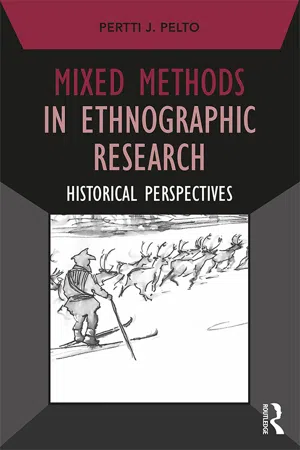
- 336 pages
- English
- ePUB (mobile friendly)
- Available on iOS & Android
eBook - ePub
About this book
Information
1
MIXED METHODS RESEARCH IN ETHNOGRAPHY, QUALITATIVE AND QUANTITATIVE
My aim in this book is to explore some of the features of ethnographic research from the nineteenth century to the present day, with special attention to examples of mixed methods strategies. Ethnography has a complex history, so my explorations in this book, including some of my own ethnographic research and discussion of methodological issues, are not intended to be comprehensive. Ethnography has many pathways and associations in various branches of the social sciences. There are also many different definitions. This book focuses mainly on data-gathering methods in fieldwork, as that is what I consider to be the core meaning of “ethnography,” as contrasted with a broader, more abstract, theory-focused concept: “ethnology.”
In 1857, the Finnish scholar–researcher Matthias A. Castren gave a definition of ethnography based on his own extensive research:
[Ethnography] is a new name for an old phenomenon. It is understood to mean the knowledge of peoples’ religion, social conditions, customs and rites, living conditions, dwellings, in a word, all that belongs to their internal and external lives. Ethnography could be regarded as a part of cultural history, but not all nations possess a history in the higher meaning of the word, and their history consists precisely of ethnography. (Castren, 1857 (IV):8; quoted in Niiranen 1992:23)
In his discussion of the terminology, Niiranen commented that the first use of the term “ethnography” should be credited to W.F. Edwards, “who in the late 1830s founded the first scientific society in this field in Paris. [However] A Leipzig encyclopaedia published in 1833 defines ethnography as part of geography and history: ‘Ethnography, i.e., the science dealing with the folk or peoples (Volkerunde), is the part of geography which deals with the inhabitants of different countries, describes them on the basis of their physical and mental abilities and presents their customs, habits, and special features’” (quoted by Niiranen, p. 23).
In his book, The History of Ethnological Theory (1937), Robert H. Lowie stated in his very first paragraph that: “Ethnography is the science which deals with the ‘cultures’ of human groups. By culture we understand the sum total of what an individual acquires from his society—those beliefs, customs, artistic norms, food-habits, and crafts …” (Lowie, 1937:3). In this book I use the word ethnography as referring especially to “field research” in human groups. It is largely descriptive (inductive) in basic design, although there are ethnographic projects that include deductive, hypothesis-testing operations.
The close relationship between geography and ethnography, in the nineteenth-century definition, is a reflection of the fact that in earlier centuries, both of these scientific activities were heavily invested in explorations in the unknown, or less well-known locations and peoples on Planet Earth. As we will explore further in Chapter 2, the nineteenth century was a time when there were growing numbers of international expeditions, some of them aimed at political and economic exploitation of less developed regions such as Africa, arctic America, Siberia, and others; other expeditions were more intent on expanding geographical, scientific information about the relatively uncharted parts of the world.
Ethnography in Earlier Centuries
I do not intend to review a lot of earlier “proto-ethnography,” but it is useful to keep in mind that in earlier centuries there have been unusual individuals who studied the societies and cultures of “other peoples” in various ways, with the intention of presenting factual information that would be of use to other persons.
Margaret Mead and Ruth Bunzel included some interesting examples of earlier ethnographic reports in their compilation, The Golden Age of American Anthropology (1960). It is of considerable interest to note that Christopher Columbus is included in this discussion of “proto-ethnographers.” Their collection includes a brief, very interesting article by Edward Gaylord Bourne entitled, “Columbus, Ramon Pane and the Beginnings of American Anthropology” (Bourne, 1906: 310–313). Bourne commented that: “Christopher Columbus not only revealed the field of our studies to the world but actually in person set on foot the first systematic study of American primitive custom, religion and folklore ever undertaken” (Bourne, 1960:18). Bourne went on to describe reasons why this aspect of Columbus’s activities has largely been ignored, and then mentions two important documents:
The first [document] contains the discoverer’s own brief summary of what he was able to learn of the beliefs of the natives of Espanola during the period of his second voyage, 1493–96, and the record of his commissioning of Friar Ramon Pane who had learned the language of the islanders, ‘to collect all their ceremonies and antiquities.’ The second is Ramon’s report of his observations and inquiries and is not only the first treatise ever written in the field of American Antiquities, but to this day remains our most authentic record of the religion and folk-lore of the long since extinct Tainos, the original inhabitants of Hayti …” (Bourne, 1960:19)
Al-Biruni: A Remarkable Ethnographer 1000 Years Ago
Al-Biruni stands out as a prolific “proto-ethnographer,” although his scientific achievements are best known in the fields of mathematics and astronomy. His real name was Abu Raihan Muhammad ibn Ahmad, but he is known in the historical literature as Al-Biruni. In addition to his work in mathematics and astronomy, he was a gifted linguist, ethnographer, and all-around scientist. He is believed to have written over 100 books (Saliba, 2015), but the publication of most interest is his extensive description of the people, religious beliefs, caste system, languages, mathematics, and other cultural and social features of Hindu India. His collection of ethnographic descriptions is often known by the shortened title, Kitabu’l Hind (Ahmad, 1983:xvi). Materials from that extensive compendium were translated into English by the German scholar Edward C. Sachau in 1888, in two volumes, with the title Alberuni’s India. That publication was edited into a shorter, one volume edition, entitled India by Al-Biruni, edited by Qeyamuddin Ahmad (1983), a professor of history at the University of Patna in North India.
Al-Biruni was born in A.D. 973 in the Iranian territory of Khwarizm (now in Uzbekistan). He was an Iranian Muslim, best known as an astronomer and mathematician, but deeply interested in Indian (esp. Hindu) society and culture. In addition to his Persian and Arabic languages, he was fluent in Sanskrit and had communication with Indian scholars. The translator/editor, Qeyamuddin Ahmad, wrote that “Al-Biruni was a great linguist and a prolific writer” (Ahmad, 1983:xvii). I am introducing Al-Biruni here because it is quite clear that he intended to present “just the facts,” and that the materials in his book cover a very wide range of cultural information, which must have required many years of study. The editor described that Al-Biruni had contacts with many Hindu people in his home area, and travelled to several parts of India. He lived for some years in the Punjab, in Northern India. At many points in the text, he comments that “Hindu people told me” (various cultural items). However, it appears that much of his research was through careful study of the Sanskrit literature available to him. It is interesting to note that one thousand years ago there was a fairly rich literature in Sanskrit available for gaining extensive information about Hindu culture.
Some of the chapters in the compilation called India: by Al-Biruni include: “On that which especially concerns the Brahmans, and what they are expected to do during their whole life” (p. 223); “On the rites and customs which the other castes besides the Brahmans, practice during their lifetime” (p. 228); “On what is allowed and forbidden in eating and drinking” (p. 237); and, most ominously: “A description of the four yugas, and of all that is expected to take place at the end of the fourth yuga” (p. 175). The abridged version of Al-Biruni’s ethnographic production runs to about 80 chapters! The publication contains many chapters about astronomy, mathematics, and other scientific topics, in addition to the descriptions of cultural practices of Hindu peoples.
One of the most striking pieces of evidence concerning the depth of his knowledge of India is the fact that he described several different alphabets used in the writing of different languages in India (“Notes on the Writing of the Hindus, on their arithmetic and related subjects….” [pp. 79–88]). Of course, he was particularly deeply immersed in learning about Hindu mathematical work, because mathematics and astronomy were his main special areas of scientific interest. One section is called, “On the constellation of the Great Bear” (p. 180).
The editor of the Al-Biruni book, Qeyamuddin Ahmad, took his masters and doctoral degrees at Patna University in northern India (Bihar State), in 1950–1962, and was a professor of history at the University of Patna in the years after completing his doctorate. He noted that “It has been suggested that a feeling of shared adversity brought Al-Biruni and the Hindus close to each other” (p. xix). For that comment he references Sachau, and then goes on to note that “… Al-Biruni was deeply interested in astronomy and mathematics since an earlier period of his life, and he must have taken full advantage of the opportunities of direct contact with Indian scholars during his stay in Ghazni … [also] … while living in Ghazni he got additional opportunities for securing first-hand information by personal contact with Indians and by direct study of Sanskrit sources. As we know, he paid visits to and lived in different parts of the Punjab….”(p. xix)
In the editing of Al-Biruni’s writings, Ahmad was deeply impressed with the scholar’s attempt to understand Hindu culture (and science) from the insider’s perspective. He commented that “Also, very significant is Al-Biruni’s concluding remark that his book was meant for those who wanted to discuss with the Hindus the questions of religion, science or literature, on the very basis of their own civilization.” He goes on to comment that “… Much stress is nowadays being laid by Western scholars to try to understand Oriental cultures on their own terms and on the basis of the indigenous sources. It is a measure of Al-Biruni’s greatness that he made such an attempt, fairly successfully, about one thousand years ago. In fact, it is this discerning and basically appreciative approach to the understanding of an alien culture on its own terms which lifts Al-Biruni’s account much above anything else written on India in the medieval period.” (Ahmad, 1983:xxxi)
We can piece together a loose, composite inventory of the mixed methods utilized by Al-Biruni in producing this impressive ethnography. Certainly he depended to a considerable extent on the large Sanskrit and Arabic literature available to him. Various writers, including Professor Ahmad and other historians, have described Al-Biruni’s life in connection with the Islamic invader forces, giving something of a mixed message: of a privileged, “royal court” lifestyle, yet to some extent a prisoner, with some limits placed on his freedom of movement.
In his first chapter, Al-Biruni discussed at length the difficulties of Sanskrit language, and made it clear that he directed his great linguistic skills to mastery of that language as the key to learning about Hindu culture and society. He wrote that “I do not spare either trouble or money in collecting Sanskrit books from places where I supposed they were likely to be found, and to procuring for myself, even from very remote places, Hindu scholars who understand them and are able to teach me …” (Al-Biruni, 1983:11). He went on to describe that he was not entirely free to come and go wherever he wanted to, but was thankful to Allah for all he was able to accomplish.
His descriptions do not provide any details of his interviewing techniques, and I did not find any mention of his taking notes during travels or attendance at special events. Nonetheless, it is quite clear that across his many years in India he had plenty of opportunities to observe firsthand some of the economic activities, religious ceremonies, geographic features, and other aspects of life in India. There is plenty of tangential evidence that one of his research methods was in working with Hindu astronomical data, and mathematical materials, in order to understand and critique their contents.
I would characterize Al-Biruni’s extensive ethnographic work as an example of QUAL + qual mixed methods research, in which the linguistic component, based on thorough knowledge and use of Sanskrit written materials, was a core methodology. Direct observation of places, people, and events was very much a secondary, supplemental element in his mixed methodology.
Bernardino de Sahagun (1499–1590)
Fray Bernardino de Sahagun is very much a contrast to the Al-Biruni story, in part because he was a Catholic priest in the Franciscan Order. He arrived in Mexico as a young man in 1529, just a few short years after the Spanish armies had conquered the Aztecs in central Mexico. In her introduction to some of Sahagun’s ethnographic products, Ruth Bunzel wrote:
On arriving in Mexico he immediately learned Nahuatl, the language of the people among whom he was to spend his life…. During most of these years [until 1578!] he taught at the Convent of Tlatelulco where he could command the assistance of young bilingual students. He had with him in the pueblo of Tepeapulco, during the period of intensive work, some ten or twelve native Indians well versed in ancient lore, who had lived under the Aztec empire before the conquest. The old men dictated texts in Nahuatl which he wrote out and had interpreted by his young Spanish-speaking informants, former students of the Convent…. He also had his old men write out portions of text in Nahuatl hieroglyphics and had these interpreted. (Bunzel, 1960:47)
The singular ethnographic accomplishment over Sahagun’s lifetime was the massive History of the Things of New Spain. The most famous extant manuscript of [his ethnographic and historical production] … is the Florentine Codex. It is a codex consisting of 2400 pages organized into twelve books, with approximately 2,500 illustrations drawn by native artists using both native and European techniques. The alphabetic text is bilingual in Spanish and Nahuatl on opposing folios, and the pictorials should be considered a third kind of text. It documents the culture, religious cosmology (worldview), ritual practices, society, economics, and history of the Aztec people; and in Book 12 gives an account of the conquest of Mexico from the Tenochtitlan-Tlatelolco point of view. In the process of putting together the Historia General, Sahagún pioneered new methods for gathering ethnographic information and validating its accuracy. The Historia General has been called “one of the most remarkable accounts of a non-Western culture ever composed, and Sahagún has been called the father of American ethnography. (Wikipedia, 2016)
The impressive ethnographic productions of Al-Biruni and Bernardino de Sahagun stand out as exceptionally thorough, important, and informative ethnographic works from earlier centuries. There are, of course, many other interesting ethnographic products from those earlier times, but precious few can match the levels of scholarly and scientific quality of these two exemplars. When we explore the literature we can find a great many detailed narratives from travellers (such as Marco Polo), and some of the early Jesuit missionary studies among North American native peoples. But most of those studies are far less comprehensive, and often less credible, than these two ethnographic products.
Just to mention one more “famous traveller”: perhaps no other world adventurer in earlier centuries can match the total kilometres travelled and number of different peoples visited b...
Table of contents
- Cover
- Half Title
- Series Page
- Title Page
- Copyright Page
- Table of Contents
- Preface
- Acknowledgements
- 1 Mixed Methods Research in Ethnography, Qualitative and Quantitative
- 2 Mixed Methods in Nineteenth-Century Ethnography
- 3 The Developing Discourse of Mixed Methods Research
- 4 Culture and Personality Studies: Plenty of Mixed Methods
- 5 Large Multi-Year, Multi-Site, Multi-Disciplinary Research Projects
- 6 Ecosystems Theory, Adaptation, and New Directions in Research
- 7 Medical Anthropology and Mixed Methods Research
- 8 QUAL + qual and QUAL → qual Studies: Common Practices in Ethnography
- 9 The Development of Quantitative Methods in Ethnographic Research
- 10 Food, Diet, and Nutrition Studies
- 11 The Rise of Community Studies and Ecological Theory: Paradigm Transitions in Finland
- 12 My Explorations in QUAL + quan Research Methodology
- 13 Triangulation and Descriptive Expansion: The Uses of Mixed Methods in Ethnographic Research
- 14 Two Decades of Mixed Methods in South Asia
- 15 Two “Histories” of Mixed Methods Research
- Index
Trusted by 375,005 students
Access to over 1.5 million titles for a fair monthly price.
Study more efficiently using our study tools.
Frequently asked questions
Yes, you can cancel anytime from the Subscription tab in your account settings on the Perlego website. Your subscription will stay active until the end of your current billing period. Learn how to cancel your subscription
No, books cannot be downloaded as external files, such as PDFs, for use outside of Perlego. However, you can download books within the Perlego app for offline reading on mobile or tablet. Learn how to download books offline
Perlego offers two plans: Essential and Complete
- Essential is ideal for learners and professionals who enjoy exploring a wide range of subjects. Access the Essential Library with 800,000+ trusted titles and best-sellers across business, personal growth, and the humanities. Includes unlimited reading time and Standard Read Aloud voice.
- Complete: Perfect for advanced learners and researchers needing full, unrestricted access. Unlock 1.5M+ books across hundreds of subjects, including academic and specialized titles. The Complete Plan also includes advanced features like Premium Read Aloud and Research Assistant.
We are an online textbook subscription service, where you can get access to an entire online library for less than the price of a single book per month. With over 1.5 million books across 990+ topics, we’ve got you covered! Learn about our mission
Look out for the read-aloud symbol on your next book to see if you can listen to it. The read-aloud tool reads text aloud for you, highlighting the text as it is being read. You can pause it, speed it up and slow it down. Learn more about Read Aloud
Yes! You can use the Perlego app on both iOS and Android devices to read anytime, anywhere — even offline. Perfect for commutes or when you’re on the go.
Please note we cannot support devices running on iOS 13 and Android 7 or earlier. Learn more about using the app
Please note we cannot support devices running on iOS 13 and Android 7 or earlier. Learn more about using the app
Yes, you can access Mixed Methods in Ethnographic Research by Pertti J. Pelto in PDF and/or ePUB format, as well as other popular books in Psychologie & Recherche et méthodologie en psychologie. We have over 1.5 million books available in our catalogue for you to explore.