- 320 pages
- English
- ePUB (mobile friendly)
- Available on iOS & Android
eBook - ePub
About this book
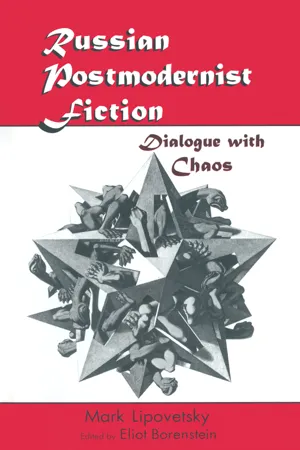
This text offers a critical study of postmodernism in Russian literature. It takes some of the central issues of the critical debate to develop a conception of postmodern poetics as a dialogue with chaos and places Russian literature in the context of an enriched postmodernism.
Information
III.
The Poetics of Chaosmos
6
Context: Soviet Utopia
The works discussed in Part II rise far above the “current” literary process. Clearly, they hark back to “far-off” historical and literary contexts. As often happens, contexts much closer at hand served as springboards for the emergence of the works of Andrei Bitov, Venedikt Erofeev, or Sasha Sokolov, in which postmodernism reached its maturity. In turn, these works were a powerful catalyst for postmodernism’s development as an artistic system.
Postmodernism is characterized by its relativizing, antihierarchical, and playful approach to any and all authoritative discourses. By transforming itself into a pseudoclassical myth, Socialist Realism aesthetically formed the particular metadiscourse that, in turn, served as the ideological foundation of Soviet civilization. In the works of Bitov, Erofeev, and Sokolov, the existential aspect of this discourse was recognized as one of the forms of ontological chaos. But on the level of style, ironic games with this metadiscourse had already begun in the sixties, in a literary movement that would come to be called “Youth Prose.” “Youth Prose” undermined authoritative style through the use of unofficial language, slang, confessional narratives, and a tone that, although still relatively cautious, was increasingly skeptical of the highest authorities.1 Demythologizing irony was even more radical in fiction that was not initially intended for publication; the samizdat and tamizdat2 texts of Abram Tertz, Yuz Aleshkovsky, Vladimir Maramzin, and Alexander Zinoviev were unacceptable to the Soviet regime not only ideologically (like the works of Alexander Solzhenitsyn, Vasily Grossman, or Lidia Chukovskaya), but stylistically. These works attempted to undermine authority through irony, rather than simply shifting the ideological polarities within the framework of an inflexible discourse. Such authors as Vasily Aksyonov, Vladimir Voinovich, Fazil Iskander, Vladimir Vysotsky, and Mikhail Zhvanetsky, who were close to “Youth Prose” but whose inclination toward irony and lack of stylistic inhibitions set them apart, invariably overstepped the bounds of ideological loyalty, and in the seventies and eighties, the best of their works could only be published either abroad or in samizdat.
In her study Russian Experimental Fiction: Resisting Ideology After Utopia (1993), Edith Clowes identifies a single meta-utopian tendency that ironically deconstructs utopian discourse. This tendency encompasses such works as Abram Tertz’s The Makepeace Experiment, Vasily Aksyonov’s The Burn and The Island of Crimea, Vladimir Voinovich’s Moscow 2042, Alexander Zinoviev’s Yawning Heights, Yuz Aleshkovsky’s The Plain Little Blue Scarf and Fazil Iskander’s Rabbits and Boa Constrictors. As Clowes demonstrates, these works are marked by a whole complex of such postmodern qualities as the fictionalization of history, the blurring of boundaries between elite and mass art, the use of parody to subvert the Russian author’s traditional authority over the reader, and the creation of narrative structures founded on semiotic play and directed not only against utopian consciousness but also against any kind of monologism. These structures are skeptical of any given ideological totalities:
Russian meta-utopian writing and discrete trends in recent Western fiction and social thought share a number of features. All play with realized utopian orthodoxies fixed in conventional, popular literary forms. They call for a consideration of the ways in which we limit our collective memory and imagination. And, finally, there is a strong suspicion of binary models of thinking that deny an imaginative middle ground. Taken together, these shared concerns are the hallmark of the “meta-utopian” mentality. (Clowes 1993: 219)
This chapter will examine several strategies within meta-utopian literature, paying special attention to the correlation between its poetics and the postmodern artistic paradigm.
Vasily Aksyonov: Utopia as a Fantasy
One of the properties of the wondertale is that it is based on poetic fiction and is a distortion of reality. In most languages the word tale is a synonym for lie or falsehood. “The tale is over; I can’t lie any more”—thus do Russian narrators conclude their stories.—Vladimir Propp (1984: 79)
Initially, Russian postmodernism was a phenomenon largely of samizdat and tamizdat; we recall that the works of Erofeev, Sokolov, and Bitov discussed in the previous section would not be printed in the Soviet Union until the end of the eighties. It would fall on Vasily Aksyonov, the writer whose sardonic literary portraits of the life of Soviet youth in the early sixties firmly identified him with “Youth Prose,” to be the first to publish a stylistically postmodern work in a Soviet journal: Surplussed Barrelware (Zatovarennaia bochkatara). It was printed in 1968, almost simultaneously with the aforementioned classics of Russian postmodernism. What makes this particular tale remarkable is not only the lack of stylistic inhibition, so unusual for the time, although that was certainly a part of it. Far more important, however, is the tale’s new interpretation of Soviet utopian discourse.
The plot of this story is extremely simple. The driver Volodya Teleskopov is bringing empty barrels (the “surplussed barrelware” of the story’s title) to Koryazhsk, the regional center. Along the way he is joined by Gleb Shustikov, a marine; Irina Valentinova, a schoolteacher; Vadim Afanasievich Drozhinin, a scholar; the retired activist Mochenkin; and others. During their travels, strange things happen to them: All of them have lyrical dreams about a “Good Person,” and all of them grow strangely attached to one another and to the barrelware, without which they cannot even imagine their lives. So when the bureaucrats in Koryazhsk refuse to accept the empty barrels, the group decides to continue their journey with their beloved barrelware, only now they have no apparent destination whatsoever.3 The tale’s style may appear parodic, and, indeed, each of the heroes hyperbolically reproduces a certain typological model of Socialist Realism: the village schoolteacher, the gallant sailor, the old Stalinist who writes denunciations of everyone out of sheer force of habit, the Soviet “refined intellectual” (Aksyonov 1985: 27) who is the best friend of the people of the nonexistent country Khali-Galia, the reckless young man who models himself after the dead poet Sergei Esenin, the old woman who zealously advocates scientific research—each is rendered in an appropriate style. Moreover, their dreams exploit these models in order to distill entire branches of Socialist Realism parodically. “The author of ‘Barrelware’ is a parodist of plenitude, of multiple texts, including his own,” Laura Beraha (1997: 218–19) quite convincingly argues. Thus the dreams of Vadim Afanasievich are rendered in the style of the Soviet political potboiler, whose goal was always to reveal the “ulcerating sores of capitalism”: “Junta appeared, twisting her pale lips in a diplomatic smile. She wore stiletto high heels and a threadbare fox-fur stole around her neck. Everything else on her dripped and oozed dark-blue. Her little clay feet trembled under the weight of her huge body” (Aksyonov 1985: 37). Heroic production novels about the “wind of distant wanderings” find themselves parodied by the dreams of the driver Gleb Shustikov: “Our favorite midshipman Reinvolf—Kozma Yelistratovich, comes in: ‘At ease! At ease! Today, you cream of wheat, is the final tug-of-war competition with submariners. Everybody gets a double portion of butter and meat, a triple of compote.’ ‘Will we get some doughnuts, comrade shipman?’ ‘Atten-tion!’” (ibid., 69). The distinct tones of “Youth Prose” resonate in the speech patterns of the teacher Irina Valentinovna Selezneva: “‘Do you remember the passage in Hemingway? Don’t you recall the place in Druon? As Zhukhovitsky said … you remember, don’t you?’ Goodness me! What impudent rogues—I’m supposed to recall everything just because they bought me a ‘Kamikaze–Mind Blower’ cocktail. But the Polish magazines from countries all over the world came flying down from up above, from up above” (ibid., 39). Moreover, each character is surrounded with his or her own stylistic aura of quotations, not only in the dreams but in the main narrative itself; in this story there is no discourse but the discourse of others. Even apparently neutral descriptions are still stylistically marked, in one way or another corresponding to the discourse of the characters.
Characteristically, even the loud, garish epithets used to describe the barrelware are apparently lifted from newspapers, as the story’s epigraph makes clear: “Having surplussed and surfaced herself in yellow-flower bloom, the barrelware surged and surgeoned at her hoopseams and went sauntering off” (ibid., 26). By contrast, the Good Person who walks through the dew (the image uniting the dreams of all the characters) is the specific, although probably unrecognized, dream of utopian discourse, a dream that acquires the characteristics of each of the protagonists as each one dreams of the Good Person in turn: from the Errant “Knight” in the dream of lab assistant Stepanida Efimovna to the “tasty young and juicy Resume” (ibid., 75) from old Mochenkin’s dream. By the end of the story, even the impersonal narrator blends with the other characters into a single “we”:
Volodya Teleskopov was sitting on the embankment, with his head hung between his knees, and we were looking at him…. “Let’s go,” we said, and jumped down one by one from the platform…. We followed Volodya along a narrow path on the bottom of a ravine, through a carpet of buttercups, ferns, and burdock; at eye-level, tall lilac candles of willow herb were swaying in the glass twilight. Then we caught sight of our truck, which had found shelter under a sandy precipice, and in it was our misfortunate, desecrated, surplussed barrelware. Our hearts sank on account of her alluring tenderness which was dissipating itself with the sunset, at dusk. (Ibid., 89–90)
This transformation can be interpreted within the context of the Socialist Realist utopia, for which the formation of the collective “WE” was always a crucial accomplishment. Similarly significant are the final “rehabilitation” of the good-for-nothing Volodya Teleskopov (“we didn’t recognize the former rowdy in him” [89]); the rehabilitation of the old man Mochenkin, who sends a letter to all the appropriate authorities (“I ask all my reports and denunciations to return in back” [ibid., 89, italics in the original]); and the appearance of the departing Enemy with the cigar and crimson waistcoat, in whom each of the characters once again recognizes his personal enemy, from the Tempter to Señor Siracuzers. And the story’s crowning “Last Common Dream” about the Good Person who “always waits” might also be understood as a sign of utopian moral apotheosis. On the other hand, here one can easily find a typical example of postmodern intertextuality, blurring the boundaries between “self” and “other,” depriving the author of any advantages over his characters.
For the purposes of the present study, it is the intertextual aspect that proves essential, since it lends new meaning to the story’s parodic style. Theoretically, the conflation of the author with his parodic characters emphasizes the characters’ literary nature. They do not represent reality; rather, they are purely linguistic models, simulacra created by Socialist Realist discourse. Thus Gleb Shustikov and old Mochenkin are joined by such characters as “Romance” and “False-Science.”
The absence of a mimetic dimension completely transforms the utopian discourse itself. Utopia always considers its own possible application to reality. In Aksyonov’s novel, the presence of “reality” itself seems problematic. In Aksyonov’s hands, the Soviet utopia turns into a kind of children’s fairy tale.4 The barrelware becomes a magical being, leading the unlikely traveling companions to the magic kingdom;5 in his letter to his girlfriend, Volodya Teleskopov writes: “Simka, you want the truth? I don’t know when we’ll see each other again, because we go not where we want to go but where our dear barrelware wants us to go. Understand?” (ibid., 76) The ups and downs of their journey are identical to the fairy-tale motif of “testing,” and each ordeal concludes with the former enemies making peace with the wandering heroes on the basis of their common love for the barrelware. As in fairy tales, hostile territories are conquered by using only one kind of weapon: moral qualities. The endpoint of the journey, the city of Koryazhsk, where the bureaucrats damage the precious barrelware, is directly associated with the fairy-tale kingdom of evil; for example, the express train in which the main villain departs is depicted as a dragon with a “yellow head, blue mustache, and huge blinkers” (ibid., 89). The repeated dreams of the characters create a special type of fairy-tale chronotope in which all is possible, in which miracles are a matter of course. This, together with the playful style, gives the stories a fairy-tale atmosphere.6
Fairy tales originate from the ruins of myth, the reinterpretation of sacred motifs in a purely playful, fantastic manner—like the tall tale (nebylitsa), the pure fiction. In essence, this same process takes place in the stories of Aksyonov. He basically removes the spell of the Soviet utopian myth by transforming it into belles lettres rather than a “reflection of life.” In this case, the text obeys only the laws of literary play. The completely unrestrained interactions of the text’s simulacra create a playful effect that determines the artistic tonality of the entire tale. This is why Surplussed Barrelware firmly resists any allegorical readings—in the foreground of the tale is the poetics of play, the joy of literary self-sufficiency.7 Aksyonov was one of the first to reveal that Soviet discourse was unreal and that, as a consequence, there is no need to polemicize with it, to oppose it with other discourses; far better simply to play with it, as with any literary model.8
The true distinction between utopian and fairy-tale traditions lies not in the combination of motifs (utopian motifs also occur in fairy tales) but in the motif’s relationship to the proffered model of “reality.” Utopia always proposes a program of transformation in order to achieve universal social happiness. A fairy tale’s ultimate achievements are the result of miraculous, unbelievable adventures, that is, they stem from a reality that is fictional by definition. Vladimir Propp defines the fairy tale as “deliberate and poetic fiction [that] never passes itself off as reality…. In the Russian folktale there is not a single credible plot…. Neither the teller nor the listener treats it as reality…. Nothing is quite improbable here” (Propp 1984: 18–19). The fairy-tale miracle does not demand faith; it requires only imagination. Much of the “confessional fiction” of the sixties, in which Aksyonov got his start, was permeated with a faith in the utopian transformation of life. The unabashed deconstruction of utopian discourse into that of the fairy tale was certainly proof of a crisis in this faith, a “delegitimation” of the final versions of Soviet discourse such as “socialism with a human face” or “Leninist socialism” (Surplussed Barrelware was published in March 1968, five months before the invasion of Czechoslovakia, which dealt a death blow to the Thaw). As Aksyonov remarked in a later interview, “one can only hope for a miracle; there are no logical bases for hope” (Mozeiko, Briker, and Dalgard 1986: 25).
Aksyonov’s In Search of a Genre (first published in 1978) can be seen as a kind of sequel to “Barrelware.” The comparison is suggested not only by the shared theme of the journey but especially by the profession of the primary hero: Pavel Durov is a magician. Yet if fantasy united the author-storyteller with his characters in 1968, ten years later the key to the plot becomes the magician’s public loneliness, the obsolescence of his profession. It is worth noting that In Search of a Genre begins and ends with the hero’s journey to the underworld: In the beginning, Durov, who has spent the night at the highway patrol station, intrudes upon the quiet discussion of the ghostly victims of car crashes, and in the end, Durov, who has been killed by an avalanche, awakens in the Valley of Miracles. Essentially, the fossilized, fairy-tale motif of the journey to the underworld comes alive.9 In Surplussed Barrelware, this motif is completely supplanted by the utopian archetype of the search for happiness, the dreams of the Good Person. In In Search of a Genre, utopian motifs appear only and without exception in relation to death. Thus, after the discussion with the “goners” at the highway patrol station, Durov dreams of a “miraculous time of life, which either was, or is, or will be…. All three sorrows, the past, the present, and the future, combined in this miraculous time of life” (Aksenov 1991: 220). By the end of the novel, this literally realized “afterlife” is presented as the incarnation of a dream of happiness: “The air of love now surrounded us, filled our lungs, straightened out our collapsed bronchia, saturated our blood, and gradually became our world. The air of love” (ibid., 324).
The wanderings of Durov, who is seeking his genre, are doubled by inserted episodes, “scenes” featuring someone who is either Durov or his author-double; they present the “genre” from within. In these “scenes,” the magic “genre” becomes identical to the technique of literary creation (the rhyme in prose, the meditations of the artist, the work on the novel in Venice, etc.); the discussion of “genre” becomes self-referential. Typically, the author rhymes in the scenes about rhyme, and in Venice, he works on a novel about “how he worked on a novel in Venice” (ibid., 291). As Boris Briker puts it, “In Search of a Genre manifestly contains two quests for a genre: the quest, or rather artistic experiment of the author, and Durov’s quest for his genre. Hence, the title of the work [In Search of a Genre] and its generic subtitle [“in search of a genre”], set in a different sized type, coincide. ...
Table of contents
- Cover
- Half Title
- Title Page
- Copyright Page
- Dedication
- Table of Contents
- Guide to Appendix: Biographical and Bibliographical Notes
- Acknowledgments
- Technical Note
- Editor’s Introduction: Postmodernism, Duty-Free Eliot Borenstein
- I. Introduction
- II. Culture as Chaos
- III. The Poetics of Chaosmos
- IV. Conclusion
- Notes
- References
- Appendix: Biographical and Bibliographical Notes
- Index
Trusted by 375,005 students
Access to over 1.5 million titles for a fair monthly price.
Study more efficiently using our study tools.
Frequently asked questions
Yes, you can cancel anytime from the Subscription tab in your account settings on the Perlego website. Your subscription will stay active until the end of your current billing period. Learn how to cancel your subscription
No, books cannot be downloaded as external files, such as PDFs, for use outside of Perlego. However, you can download books within the Perlego app for offline reading on mobile or tablet. Learn how to download books offline
Perlego offers two plans: Essential and Complete
- Essential is ideal for learners and professionals who enjoy exploring a wide range of subjects. Access the Essential Library with 800,000+ trusted titles and best-sellers across business, personal growth, and the humanities. Includes unlimited reading time and Standard Read Aloud voice.
- Complete: Perfect for advanced learners and researchers needing full, unrestricted access. Unlock 1.5M+ books across hundreds of subjects, including academic and specialized titles. The Complete Plan also includes advanced features like Premium Read Aloud and Research Assistant.
We are an online textbook subscription service, where you can get access to an entire online library for less than the price of a single book per month. With over 1.5 million books across 990+ topics, we’ve got you covered! Learn about our mission
Look out for the read-aloud symbol on your next book to see if you can listen to it. The read-aloud tool reads text aloud for you, highlighting the text as it is being read. You can pause it, speed it up and slow it down. Learn more about Read Aloud
Yes! You can use the Perlego app on both iOS and Android devices to read anytime, anywhere — even offline. Perfect for commutes or when you’re on the go.
Please note we cannot support devices running on iOS 13 and Android 7 or earlier. Learn more about using the app
Please note we cannot support devices running on iOS 13 and Android 7 or earlier. Learn more about using the app
Yes, you can access Russian Postmodernist Fiction by Mark Lipovetsky,Eliot Borenstein in PDF and/or ePUB format, as well as other popular books in Literature & Public Law. We have over 1.5 million books available in our catalogue for you to explore.