eBook - ePub
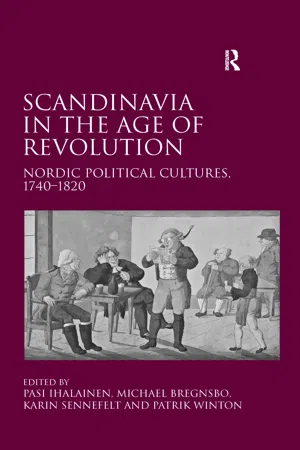
Scandinavia in the Age of Revolution
Nordic Political Cultures, 1740�1820
- 408 pages
- English
- ePUB (mobile friendly)
- Available on iOS & Android
eBook - ePub
Scandinavia in the Age of Revolution
Nordic Political Cultures, 1740�1820
About this book
The 'Age of Revolution' is a term seldom used in Scandinavian historiography, despite the fact that Scandinavia was far from untouched by the late eighteenth-century revolutions in Europe and America. Scandinavia did experience its outbursts of radical thought, its assassinations and radical reforms, but these occurred within reasonably stable political structures, practices and ways of thinking. As recent research on the political cultures of the Nordic countries clearly demonstrates, the Danish, Finnish, Icelandic, Norwegian and Swedish experiences of the late-eighteenth and early-nineteenth centuries offer a more differentiated look at what constitutes 'revolutionary' change in this period compared with other regions in Europe. They provide an alternative story of an incipient transition towards modernity, a 'Nordic model' in which radical change takes place within an apparent continuity of the established order. The long-term products of the processes of change that began in the Age of Revolution were some of the most progressive and stable political systems in the modern world. At the same time, the Scandinavian countries provide a number of instances which are directly relevant to comparisons particularly within the northwest European cultural area. Presenting the latest research on political culture in Scandinavia, this volume with twenty-seven contributions focuses on four key aspects: the crisis of monarchy; the transformation in political debate; the emerging influence of commercial interest in politics; and the shifting boundaries of political participation. Each section is preceded by an introduction that draws out the main themes of the chapters and how they contribute to the broader themes of the volume and to overall European history. Generously illustrated throughout, this book will introduce non-Scandinavian readers to developments in the Nordic countries during the late-eighteenth and early-nineteenth centuries and both complement and challenge research into the political cultures of Europe and America.
SECTION I
The Crisis and Renewal of
Monarchy
1.1
The Crisis and Renewal of the Monarchy: Introduction
Michael Bregnsbo
The eighteenth and early nineteenth centuries brought upheaval and radical political change for European monarchies. Their ideological basis changed from divine right to social contract, and the status of the monarch correspondingly from ruling by grace of God to being the first servant of the state in charge of improving the welfare of his subjects. Furthermore, state administration to a large extent shifted from court nepotism to a meritocratic bureaucracy. Indeed European monarchies experienced an even more serious crisis: the American Revolution demonstrated that state-building was possible without any monarch at all, and the French Revolution not only introduced a new political system but even saw the abolition of monarchy in 1792. The ensuing Revolutionary and Napoleonic Wars meant radical transformations of the European map as many old monarchies and long-established dynasties fell and were replaced by new ones with new names, new territorial extents and new rulers. The chapters in this section deal with the Scandinavian monarchies from different aspects, describing how they were theoretically based and functioned in practice and how they were affected by the above-mentioned developments. This introduction will summarize and put into perspective the main results, and it will make comparisons between the Danish and Swedish monarchies.
Both of these Scandinavian monarchies can be characterized as composite states,1 or conglomerate states,2 meaning that they consisted of different and often economically, socially, legally, administratively, linguistically and culturally heterogeneous territories held together by the person of the monarch and little else. This goes especially for the Danish realm, which consisted of the Kingdom of Denmark and the Kingdom of Norway. The latter had had a common king with Denmark since 1380. Although Norway was administered from Copenhagen during the eighteenth century and had few institutions of its own, it was still a kingdom in its own right. The geographical, economic, social and judicial structures of Norway differed radically from those of Denmark. The former Norwegian north Atlantic dependencies (Iceland, the Faroe Islands and Greenland) also belonged to the Danish state. The King of Denmark was also Duke of Schleswig and Holstein. Furthermore, since 1667 the King of Denmark had been the ruler of the northwest German Duchy of Oldenburg and the County of Delmenhorst. As Holstein, Oldenburg and Delmenhorst were part of the German Empire, the king was in his capacity as the ruler of those German principalities also a German prince and as such represented in the German Diet (Reichstag). However, ducal sovereignty over Holstein (and over Schleswig till 1713/1720) was shared with the dukes of the house of Gottorp, which had married into the Swedish, and later the Russian, ruling families, a fact which caused serious foreign political problems for Denmark. The King of Denmark’s full sovereignty over the whole Duchy of Schleswig had been officially restored in 1721 as a result of the Great Northern War, and in 1773 the same happened for Holstein as part of an exchange treaty with Russia, according to which the Gottorpian parts of Holstein were awarded to the Danish King as a duchy in return for Oldenburg and Delmenhorst. The Duchy of Schleswig was not part of the German Empire but was a fief under the Danish crown.
Unlike Norway, Finland was not and had never been a kingdom in its own right. The territory of present-day Finland consisted of a number of fully equal and integrated Swedish provinces. During its Age of Greatness in the seventeenth century, Sweden had held large possessions on the eastern side of the Baltic and in Germany, but after 1721 only Swedish Pomerania and the city of Wismar in northern Germany remained in Swedish possession. Thus, as Duke of Pomerania and Lord of Wismar, the King of Sweden was also a German prince like his Danish counterpart. Furthermore, in 1730 King Frederick I of Sweden became the ruling landgrave of Hesse-Kassel, also a part of the German Empire. These German areas were not parts of the Swedish realm; they simply had the same monarch as Sweden. Even so, they could cause foreign political conflicts of interest.3
Neither of the Scandinavian monarchies was unaffected by the Age of Revolution and the Napoleonic Wars or remained intact as a result of them. After Sweden’s defeat in the Great Northern War, absolutism was abolished there in 1718. In the ensuing Age of Liberty, royal power was weak as the Diet (riksdagen), made up of four estates (Nobility, Clergy, Burghers and Peasants), and the aristocratic Council of the Realm (riksrådet) were the political centres of gravity: the state authority still lay solely with the king, but he could not govern without the advice and consent of the Council or take any decisions that contravened the privileges and immunities of the Diet. And the powers of the Diet were indeed large, including legislation, the granting of taxation rights and expenditures and an influence on the conduct of foreign affairs as well.
This system was, however, brought to an end with a coup by King Gustavus III in 1772, as a consequence of which royal power was significantly strengthened. The legislative power of the Diet was from then on shared with the king, and, although it was still entitled to grant taxation rights, it had no influence over expenditures, and its foreign policy rights were reduced. With the Act of Union and Security (förenings- och säkerhetsakten) in 1789, the Council was abolished, whereas the Diet was given increased powers over the administration of the public debt. The latter administrative change was directed against the growing aristocratic opposition and supported by the non-noble estates. King Gustavus III was shot at a masked ball at the Stockholm Opera on 16 March 1792 and died 13 days later as a consequence of this attempted murder, organized by a conspiracy of noblemen dissatisfied with his anti-aristocratic policies. He was succeeded by his son Gustavus IV Adolphus, who did not personally rule until he reached his maturity in 1796. The disastrous war with Russia (1808–1809) not only led to the fall of absolutism and the deposition of King Gustavus IV Adolphus but also to the introduction of a new constitution in 1809, which guaranteed the powers of the Diet and even led to the appointment of a new royal dynasty, the Bernadottes.
By comparison with Sweden, the Danish monarchy was characterized by constitutional and dynastic stability. Absolutism prevailed in Denmark uninterrupted between 1660 and 1848, and from 1665 on the state even possessed such a contradiction in terms as an ‘absolutist constitution’ in the form of the Royal Law (Kongeloven), which prescribed that all legislative, executive, judicial and fiscal power was vested in the king. There was no diet or other corporate organ with any say at all. The Royal Law remained in force till 1848. Furthermore, although it had been an elective kingdom up until 1660, Denmark had been ruled by the same royal house since 1448, and since 1533 the throne had uninterruptedly passed from father to son. In 1784, Crown Prince Frederick took power on behalf of his father, the mentally ill Christian VII, and at the death of the latter in 1808 he also became king and ruled until his death in 1839. Denmark thus had the same regent before, during and after the Revolutionary and Napoleonic Wars.4 However, the continuity of Danish politics was a matter of form, not of content, an aspect which is described by Michael Bregnsbo and Ulrik Langen in Chapters 1.4. and 1.5 respectively. By the Treaty of Kiel in January 1814, Norway was ceded to Sweden, while Iceland, Greenland and the Faroe Islands remained under Denmark.5
The two Scandinavian monarchies thus constituted two extremes: the Danish being strictly absolutist whereas the Swedish during the Age of Liberty and again from 1809 on was a monarchy in which the king shared power with the four-estate Diet.
The German historian Horst Dreitzel has presented the following typology of early modern monarchies: the monarchia pura, where the king is the only legitimate state authority, although his power can be either unrestrained or legally circumscribed; the monarchia mixta, where several bodies of state balance each other and administer different parts of the state authority; and the monarchia limitata, where the king is the sole holder of state authority – of sovereignty or majestas – but in governing is obliged to cooperate with various organs. The last mentioned polity assumes that the representative assemblies have surrendered some of their liberties to the prince but still retain certain immunities, that the prince accepts the limitations to his powers that are laid down constitutionally and furthermore that the limitations to the prince’s right to exercise power do not reduce his supreme authority.6 Although these typologies are based on the German Empire, they may also be relevant to Scandinavia. Sweden has traditionally been regarded as a monarchia mixta during the Age of Liberty, but in Chapter 1.2 Jonas Nordin argues that it should rather be seen as a monarchia limitata, which during the Age of Liberty gradually turned into a monarchia mixta and perhaps even into a ‘republican monarchy’ (see also Chapter 2.3) until this development was reversed by Gustavus III in 1772. Denmark would be a monarchia pura, where the only legal circumscription on royal power was the absolutist constitution, the Royal Law.
The very term ‘absolutism’ has been dismissed in historiography, primarily Anglophone and French, as irrelevant and even as a myth,7 as propaganda, as a longed and striven for but never fully realized aim and ambition of monarchs.8 Certainly, if by absolutism we mean that the king should decide and control everything personally, it is easy to demonstrate that things did not function like that in practice. The absolute monarchs could not cope with such a heavy burden of work, and in their governmental practice they had to rely on the support of ministers and civil servants and to cooperate with local power elites. However, absolutism could rather mean that the king did not formally have to consult anyone before making a decision.9 The Swedish monarchies from 1680 to 1718 and from 1772 to 1809 could indeed be regarded as absolutist in this sense. As for Denmark, this kind of absolutism certainly existed and was implemented most consistently, even within the framework of a constitution.
But whether or not the king had absolute power and which type of monarchies should properly be attributed to the Danish and Swedish kingdoms is one thing; another is how they functioned in practice. Were the two monarchies really as different as one might immediately suppose? How did they respond to the ideological, political and cultural challenges brought by the Enlightenment, the French Revolution and the Napoleonic Wars?
In this respect, there was less continuity in Sweden. During the Age of Liberty, the Swedish King was in reality reduced to acting as chairman of the Council. Even so, as Jonas Nordin points out in Chapter 1.2, the monarchy as an institution was indispensable in a number of respects, and nobody thought of abolishing it. Firstly, the king was needed as the guarantor of justice, law and order, secondly as the guarantor of Sweden as an independent state internationally and thirdly he was culturally indispensable for legitimizing the regime in the eyes of the populace generally. Royal power was manifested to the people through the fact that legislation was issued in the king’s name and announced from the pulpits of the Lutheran state church every Sunday. Furthermore, the king’s function as a national symbol was expressed through rites and ceremonies and mass-produced portraits in woodcuts and other kinds of popular prints.10 Despite the limited powers of the king, people of common extraction sometimes seemed to believe that he was more powerful than he really was. From the point of view of the political elites in the Council and the Diet, this was not necessarily a problem. As Jonas Nordin demonstrates in Chapter 1.2, it seems that the coup of Gustavus III in 1772 had widespr...
Table of contents
- Cover Page
- Title Page
- Copyright Page
- Table of Contents
- List of Illustrations
- List of Abbreviations
- Notes on Contributors
- Preface
- PART 1 The Crisis and Renewal of Monarchy
- PART 2 The Transformation of Political Debate
- PART 3 Commercial Interests and Politics in Scandinavia, 1730–1815
- PART 4 The Shifting Boundaries of Political
- Bibliography
- Index
Trusted by 375,005 students
Access to over 1.5 million titles for a fair monthly price.
Study more efficiently using our study tools.
Frequently asked questions
Yes, you can cancel anytime from the Subscription tab in your account settings on the Perlego website. Your subscription will stay active until the end of your current billing period. Learn how to cancel your subscription
No, books cannot be downloaded as external files, such as PDFs, for use outside of Perlego. However, you can download books within the Perlego app for offline reading on mobile or tablet. Learn how to download books offline
Perlego offers two plans: Essential and Complete
- Essential is ideal for learners and professionals who enjoy exploring a wide range of subjects. Access the Essential Library with 800,000+ trusted titles and best-sellers across business, personal growth, and the humanities. Includes unlimited reading time and Standard Read Aloud voice.
- Complete: Perfect for advanced learners and researchers needing full, unrestricted access. Unlock 1.5M+ books across hundreds of subjects, including academic and specialized titles. The Complete Plan also includes advanced features like Premium Read Aloud and Research Assistant.
We are an online textbook subscription service, where you can get access to an entire online library for less than the price of a single book per month. With over 1.5 million books across 990+ topics, we’ve got you covered! Learn about our mission
Look out for the read-aloud symbol on your next book to see if you can listen to it. The read-aloud tool reads text aloud for you, highlighting the text as it is being read. You can pause it, speed it up and slow it down. Learn more about Read Aloud
Yes! You can use the Perlego app on both iOS and Android devices to read anytime, anywhere — even offline. Perfect for commutes or when you’re on the go.
Please note we cannot support devices running on iOS 13 and Android 7 or earlier. Learn more about using the app
Please note we cannot support devices running on iOS 13 and Android 7 or earlier. Learn more about using the app
Yes, you can access Scandinavia in the Age of Revolution by Michael Bregnsbo,Patrik Winton, Pasi Ihalainen in PDF and/or ePUB format, as well as other popular books in History & Early Modern History. We have over 1.5 million books available in our catalogue for you to explore.