![]()
Part one
The importance of marketing in the boardroom
Summary
An unfortunate but familiar scenario frequently plays out in the boardroom.
A marketing team comes up with a breakthrough idea that could not only drive short-term growth but also ensure long-term financial stability. But once in the boardroom it all falls apart, with members exposing cracks in the investment strategy where outcomes have not been clearly outlined or supported with adequate financial projections or relevant data.
Defeat hangs heavy in the room, offset with blank stares and the demand to rewrite plans.
It’s obvious when you think about it.
The Board, charged with the responsibility to protect and manage the company successfully, tends to be analytical, focusing on shareholder value. Optimising the net present value (NPV) of new initiatives, while minimising the risk of projects failing, leads to Board members being risk-aware. Pressure to grow the business now and over time means a more short- to medium-term mindset.
Marketers often enter the boardroom with a naïve appreciation of this, presenting and behaving in ways that reflect their own mindset. They believe a more creative approach is needed to build strong brands, drive successful innovation and create effective marketing campaigns. Risk-taking is important to them – in fiercely competitive markets, they believe risks have to be taken to reap rewards. And brands need time to deliver breakthrough innovation and step-change growth. In the boardroom, this attitude can cost them dearly.
Who’s right and who’s wrong? Should Boards be more appreciative of marketing’s creativity? Should marketing be more appreciative of the need to be commercially credible?
No one is right or wrong – but both parties need to better appreciate and adapt to each other.
The Board needs to understand the importance and value of marketing in driving both short- and longer-term business growth – and in turn cash flow and shareholder value. It needs to applaud marketing’s creativity and risk-taking approach, its ability to think outside of the box to develop marketing campaigns that resonate with both existing and new customers, and its drive to continually innovate with new products and services that delight customers.
Marketers must recognise that the boardroom is not regarded as their territory. Within the boardroom, marketers need to be commercially credible, by thinking and talking more like the Board. They need to demonstrate how their marketing strategies will build shareholder value by delivering profitable returns – and build compelling Board recommendations that the Board will buy into.
Making the most of this book
This book is designed to help marketers have more impact – both in the boardroom and among those that they need to influence as part of their day-to-day business, including upwards within their own managerial line and sideways with cross-functional teams.
It is divided into three parts, each of which can be read as an individual sub-book to hone specific skills, or can be read together in its entirety.
In Part one, we look at why marketers struggle in the boardroom, and what it takes to be a successful marketer and build a successful marketing team.
- In Chapter 1, we address the marketing issue – why marketing is increasingly important to business success and the underlying reasons why marketers underperform in the boardroom.
- In Chapter 2, we look at what it takes to be a successful marketer – including the need to behave in an entrepreneurial way, by building both creative skills and business acumen.
- In Chapter 3, we assess how to build a high-performing marketing team – by working with the business to define what it needs from marketing and building a day-to-day marketing team that incorporates the many and varied marketing skill sets required to meet today’s business challenges.
In Part two, we focus on how to develop marketing strategies that the Board will engage with and buy into, using the 5W framework (Who, What, Why, Where, When) to help the Board choose where to focus their scarce resources to deliver higher returns.
- In Chapter 4, we look at who we should target – specifically which customers will deliver the greatest return for the company.
- In Chapter 5, we focus on what products and brands we should support for growth.
- In Chapter 6, we look at the importance of defining why we are in business – including which attributes we should invest our scarce innovation and communication resources in to build a customer-centric business.
- In Chapter 7, we address where we should sell – defining which distribution channels will enable us to manage and grow our brands as efficiently and effectively as possible.
- In Chapter 8, we look at when we should engage with people – by identifying which touch points and communication channels will have the greatest influence on our core target audience and therefore should be prioritised for growth.
Each of the five chapters explains why the relevant strategies are important to the Board – and includes key questions marketers should consider, as well as one-page analysis frameworks and relevant case study examples, to give marketers practical ideas on how to engage the Board.
In Part three, we look at how to win over the Board’s mind, heart and confidence.
- In Chapter 9, we focus on how to win over the Board members’ minds – by creating a strong Board recommendation with a succinct storyline, a compelling presentation deck and a robust business case.
- In Chapter 10, we look at how to win over the Board members’ hearts – by engaging Board members throughout the problem-solving process from day one, assessing how to handle challenging Board-level conversations, and presenting with the end in mind on the day itself.
- In Chapter 11, we focus on how to win the Board’s confidence and thereby keep the Board on-board once in-market – by learning how to embrace failure as much as success.
So let’s get started.
![]()
Chapter 1
The marketing issue
“Success in dealing with people requires a sympathetic grasp of the other person’s viewpoint.”
Dale Carnegie, How to Win Friends and Influence People
It’s tougher than ever before for companies to grow and survive.
In the past decade alone, we’ve witnessed a number of companies crashing and burning – some of them the bedrocks of our global business landscape – with statistics suggesting that this trend is likely to continue.
To navigate this ever-evolving landscape, it’s not enough for companies to ‘just stand still’. To survive and thrive, companies need to be innovative, while simultaneously protecting their core business. Marketing’s ability to create customer-led growth is clearly pivotal in delivering this.
But it’s no secret that marketing punches below its weight in the board-room. Almost all of the senior managers in Galleon Blue’s 2011 survey said that to be impactful in the boardroom, it was ‘very important’ for marketers to be commercially aware, yet only three-quarters of senior marketing managers, half of middle managers and less than a quarter of junior managers are perceived to be.
In this chapter, we assess:
- Why it’s getting tougher for companies to grow and survive.
- The increasing importance of marketing to business success.
- Why marketers underperform in the boardroom.
In the next chapter, we bring to the fore what it takes to be a successful marketer.
A: Why it’s getting tougher for companies to grow and survive
The statistics speak for themselves. In today’s competitive market, many top companies do not survive.
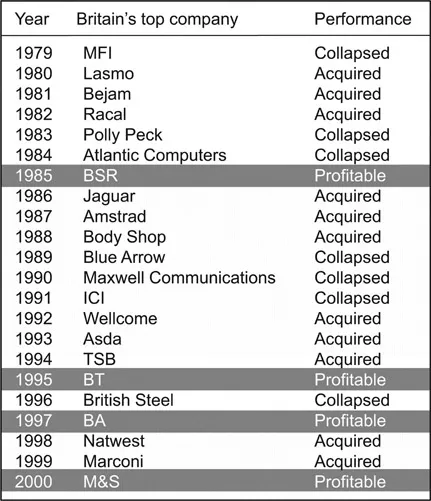
Of the twenty-two UK companies that performed most strongly each year between 1980 and 2001, only four still exist profitably in their original form today. Seven of them have collapsed and eleven have been acquired (Figure 1.1).1
Across the water, in 1982, Tom Peters and Robert H. Waterman Jnr famously talked about forty-three excellent companies in their book In Search of Excellence. But according to Richard Pascale, only six (or 14 percent of them) were still ‘excellent’ only eight years later.2
Figure 1.1 Of the twenty-two top-performing UK companies, only four still exist profitably today
Likewise, Richard Foster, in his book Creative Destruction, writes about how difficult it is for today’s companies to retain their supremacy. Of the top one hundred American companies listed by Forbes in 1917, only thirty-nine still existed seventy years later in 1987 – of which only eighteen still remained in the top one hundred. And these eighteen surviving companies all significantly underperformed the market, achieving a 20 percent lower return during the 1917–1987 period.
Additionally, Foster notes that in the 1920s, the average turnover rate of companies in the S&P 90 was 1.5 percent, with companies expecting to remain in the list for more than sixty-five years. But by 1998, the average turnover of companies in the S&P 500 had increased to 10 percent, implying that companies could only expect an average lifetime of ten years in the list. Extrapolating from past patterns, this rate of change is predicted to continue – illustrating just how quickly established companies can expect to underperform and drop from the top tier elite.3
Why do successful companies go on to fail?
One reason for a company’s demise tends to be a lack of customer-led innovation – a failure to find ways to make the ‘breakthrough leaps’ needed to achieve the level of step-change growth necessary for survival.
New companies typically launch with a radical, market-changing idea, finding new, innovative ways to better meet customer needs. These companies tend to be passionate, driven by a ‘nothing-to-lose’ attitude – comfortable with taking the necessary risks to cut through the market clutter.
These new ideas might centre on new technologies. Take Dyson, with its ‘bag-less’ vacuum cleaner, or Intel’s highly efficient and effective core processors, or Apple with its more ‘flexible’ computer technology.
Or perhaps they offer strong brand propositions, such as Ella’s Kitchen with its range of 100 percent natural food for babies, or Starbucks with its pledge to make coffee just the way you like it, or Vitabiotics’ range of vita-mins that are proven to help prevent and treat specific health issues.
Or maybe they make disparate products and services more accessible. For example, Confetti, the online wedding company that offers an array of products and services for recently engaged couples planning a wedding. Or Amazon, originally launched as the ‘world’s largest bookstore’, which made it possible for people to buy any book they choose 24–7. Or HomeServe, the home emergency repairs business that makes it easy for people to buy insurance cover for, and quickly repair, household appliance breakages.
Or perhaps they find new routes to market that better meet customer needs. For example, EasyJet removing the frills of flying to create a low-cost airline. Or Honda’s lean manufacturing that helps make its production processes more efficient. Or Zara’s trim supply chain that makes it easier to bring in new clothing lines and quickly eliminate those that sell less well.
In Creative Destruction, Foster showed that new companies are increasingly important to overall market growth – with annualised growth rates that are much higher than both the growth rates of older companies within the top one hundred, and their predicted future annualised growth rates. In essence, the proportion of growth generated by these new companies is greater than ever – with the digital age making it increasingly easy for them to break into traditional markets cost-efficiently.
The paradox
As a company grows and becomes successful, it becomes increasingly important to the Board to protect the existing business and share price.
So, how does this play out?
The Board typically protects its existing business by setting up strict ‘financial accounting’ processes for all to adhere to. People are tasked with ensuring that this month’s sales targets are delivered. The company creates growth by leveraging existing technology and business models rather than by investing in new ones. And people need strong business cases an...