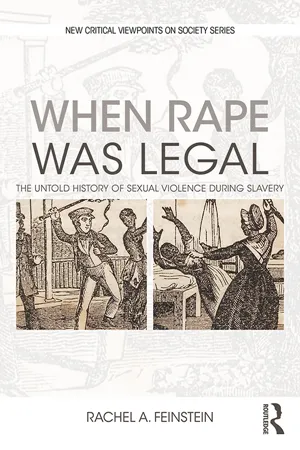
When Rape was Legal is the first book to solely focus on the widespread rape perpetrated against enslaved black women by white men in the United States. The routine practice of sexual violence against enslaved black women by white men, the motivations for this rape, and the legal context that enabled this violence are all explored and scrutinized. Enlightening analysis found that rape was not merely a result of sexual desire and opportunity, or simply a form of punishment and racial domination, but instead encompassed all of these dimensions as part of the identity of white masculinity. This provocative text highlights the significant role that white women played in enabling sexual violence against enslaved black women through a variety of responses and, at times, through their lack of response to the actions of the white men in their lives. Significantly, this book finds that sexual violence against enslaved black women was a widespread form of oppression used to perform white masculinity and reinforce an intersectional hierarchy. Additionally, white women played a vital role by enabling this sexual violence and perpetuating the subordination of themselves and those subordinate to them.
eBook - ePub
When Rape was Legal
The Untold History of Sexual Violence during Slavery
- 90 pages
- English
- ePUB (mobile friendly)
- Available on iOS & Android
eBook - ePub
1
Introduction
My master had power and law on his side; I had a determined will. There is might in each.1Harriet Jacobs
In 1850, Robert Newsom, a successful farmer living in Callaway County, Missouri, travelled to nearby Audrain County to purchase a young girl named Celia. Newsom acquired Celia with clear intentions. He was sixty years old while Celia was aged about fourteen. He raped Celia on his way home from purchasing her, and continued to rape her regularly for the next five years.2
But Celia resisted Newsom’s sexual violence. On June 23, 1855, Celia told him she would hurt him if he came into her cabin that night. However, with his law-backed entitlement, Newsom ignored Celia and entered her cabin anyway. Celia’s children, at least one of whom was the child of Newsom, were in the cabin at the time. Newsom demanded Celia to have sex with him. Instead, she hit him twice over the head with a large stick. He fell to the floor and died.3
Judge Hall, who presided over the 1855 case involving Celia and Robert Newsom, instructed the all-white male jury that self-defense could not be claimed in her case. Overlooking the years of rape that drove Celia to carry out this act of defense and resistance, the jury found Celia guilty of first-degree murder, and she was hanged to death later that year.4
The rape of enslaved black women during the slavery era was commonplace; however, it continues to be a feature of American history which is ignored. Although contemporary scholars increasingly acknowledge the fact that such routine rape occurred, sexual violence against black women by white men remains one of the least examined topics within slavery and the experiences of black women.5 Previous research substantiates that rates of rape can depend heavily on social context.6 The prevalence of rape committed by white men against enslaved black women during the antebellum period and the role that sexual violence played for white men and women during slavery has yet to be thoroughly analyzed. To address these gaps, this book conducts a thorough analysis of sexual violence against enslaved black women by white men in order to understand the way in which rape was used to perpetuate privilege and oppression.
The mixed-race population during slavery provides one way to measure the frequency of “interracial sex,” most of which took the form of sexual violence and rape. Beginning in 1619, when the first Africans were forced into the British colonies of North America, the slave population grew rapidly due to a combination of the slave trade and natural births.7 The first official record of the interracial population in the U.S. was documented by the 1850 census, which determined that 406,000 people were “visibly ‘mulatto’” out of 3,693,000 African Americans, or about 11 percent.8 The term “mulatto” was used to refer to people of mixed African and white descent and is based on the word “mule,” a crossbred animal, thus highlighting the attempt by whites to associate blacks and mixed-race individuals with other animals.9 This term will only be used here when directly quoting other material. Ten years after the 1850 census, about 16 percent of black female-headed households included a white father.10 These demographic records on the mixed-race population during slavery offer insight into the frequency with which white men sexually exploited enslaved black women.
Additional evidence of the prevalence of this sexual violence comes from slave narratives. In one analysis of 514 female slave narratives, 12 percent of the women referred to experiences of “interracial sex” during slavery. Of those narratives, 35 percent included women who either had fathers who were white men or had children with white fathers.11 This “interracial sex” was most often forced and always coerced, due to the inherent power dynamic between a free white man and an enslaved black woman. The rape of enslaved women by white men is considered by historians to be “a routine feature of life on many, perhaps most, slaveholdings”12 with “abundant evidence that many slave owners, sons of slave owners, and overseers … in effect raped the wives and daughters of slave families.”13
Records from sales of enslaved women provide further evidence of the value that white men placed on black women’s sexuality. Some enslaved women were marketed as virgins, thus emphasizing the salience of their sexual experience for future owners. Moreover, the pricing of enslaved women based on skin tones indicated the sexual value of enslaved black women. On the auction block, lighter-skinned enslaved women were sold for an average of five percent more than darker-skinned women; however, skin tone did not influence the pricing of enslaved men.14 Indeed, white men in New Orleans were known to flaunt their wealth in front of other men by putting the highest bids on enslaved women they deemed the most attractive.15 The exploitation of black women’s sexuality for white masculine performances began at least as early as the auction block.
The Law and Rape
Practices like flaunting one’s wealth over the bodies of enslaved black women, and the subsequent sexual violence that was meted out to them, were available to white men because the legal system supported this behavior. Laws on rape, and the practice of law, during slavery enabled the extensive sexual violence against enslaved black women to go unpunished. Failing to criminalize rape of enslaved women and deeming the children of enslaved women to hold slave-status not only enabled rampant sexual violence, but encouraged it.16
Having typical laws on American slavery, Virginia was referred to as the “mother of American slavery.”17 Virginia was one of the first U.S. states to construct legal definitions of race and prohibitions of interracial sex and marriage, and is thought of as a leader in miscegenation laws and the general degradation of blacks.18 In 1662, the Virginia legislature passed a statute stating that “all children borne in this country shalbe held bond or free only according to the condition of the mother, And that if any christian shall committ fornication with a negro man or woman, hee or shee soe offending shall pay double the fines imposed by the former act.”19 As this statute dictates, the children resulting from rape of enslaved women by white men were not considered legally free, nor were they recognized as part of the white family, which enabled free white men to conceal their sexual behavior with enslaved women and avoid responsibility for their actions. The laws dictating that a child’s status follows that of the mother, combined with the high value of enslaved children as property, particularly young healthy boys, ensured that white men who raped enslaved women within their households could profit.20 In addition to enabling white men to rape enslaved black women and conceal their behavior, this statute financially incentivized rape of enslaved women.21
Despite the punishments associated with interracial sex written into the Virginia law, rape of enslaved women was not criminalized nor was legal protection afforded to these women. While the Virginia court did not directly state whether enslaved women had personal rights which rape could violate, no records exist from the 18th-century Virginia courts in which a white man was convicted of raping an enslaved woman.22 Moreover, in 1669, the Virginia legislature explicitly protected whites from slave resistance and guaranteed the right of whites to abuse and kill slaves who attempted to resist them. The legislature passed a statute declaring “if any slave resist his master (or other by his masters order correcting him) and by the extremity of the correction should chance to die, that his death shall not be accompted ffelony, but the master (or that other person appointed by the master to punish him) be acquit from molestation.”23 Enslaved black women could not legally resist sexual violence due to laws protecting white slave owners’ rights to kill those who did.
While Virginia’s slave laws reflect a lack of legal protection for enslaved women and set a standard for many other slave states, laws did vary between the states. Mississippi represents one of the harshest and most direct laws against any protection of slave rights regarding rape.24 In 1859, Mississippi explicitly stated in George v. State, 37 Miss. 316, 318–20, “that rape of a female slave under the age of ten by a slave was not a crime because English common law did not recognize slavery and thus recognized no rights of slaves and Mississippi extended no such rights through legislation; all rights in slave rested with master.”25 The defense attorney in this case argued that “The crime of rape does not exist in this State between African slaves … their intercourse is promiscuous.”26 In Mississippi, rape of enslaved women was not a crime, regardless of the status of the offender. The justification for failing to criminalize the rape of enslaved men and women was based on the notion of sexual promiscuity of blacks. This stereotype continues to be used in attempts to justify sexual abuses against black women today.27 Despite the variations in Virginia and Mississippi law on rape, the outcome for enslaved women who were victims of rape was similar, with no record of legal protection from this sexual violence.
General consensus exists among historians that enslaved black women had few, if any, opportunities to use the courts to defend themselves from sexual violation from any men until the end of the Civil War.28 This conclusion resulted from the legal statutes as well as the conditions of slavery which hindered access to the courts, and various tactics used by whites to discourage black women from filing charges.29 Not only did the lack of legal protection from sexual violence significantly shape the daily experiences of enslaved black women and white men, but it provided the backbone for a comprehensive “system of gendered racism” which is entrenched into the fabric of the United States.30 Laws that refused to recognize the rape of black women as a crime while granting white men the right to kill those who resisted them, supported the routine rape of enslaved black women by white men. Moreover, laws dictating the condition of children to follow that of their mother enabled white men to conceal their sexual violence against enslaved women and to benefit from the profit generated from children born out of rape and into slave-status.31 Interactions between whites and blacks and the meaning of these racialized identities in the United States were deeply intertwined not just with slavery, but also with rape, shaping the continuous devaluation and sexualization of blacks today and the associated myths of white purity and virtue.32
Challenges to Studying Rape
Studying the role of rape historically presents some challenges in part because of the evolving definition of rape, legally and culturally.33 During the slave era, force was considered a normal part of sex and women were expected to resist. Rape only occurred when a white man forced himself on a white woman and she gave up resistance, ultimately charging that she was raped. The norms around sex and rape in the 19th century reflect the privilege of white men and the difficulty even for white w...
Table of contents
- Cover
- Half Title
- Title Page
- Copyright page
- Dedication
- Table of Contents
- Acknowledgements
- Foreword
- 1. Introduction
- 2. The Voices of Black Women and Men: Why Sexual Violence by White Men was Rampant during Slavery
- 3. White Masculinity and Sexual Violence against Enslaved Black Women
- 4. White Women’s Role in Sexual Violence against Enslaved Black Women
- 5. The Power of Language: White Women’s Divorce Petitions
- 6. Racialized and Gendered Sexual Violence Today
- Index
Trusted by 375,005 students
Access to over 1.5 million titles for a fair monthly price.
Study more efficiently using our study tools.
Frequently asked questions
Yes, you can cancel anytime from the Subscription tab in your account settings on the Perlego website. Your subscription will stay active until the end of your current billing period. Learn how to cancel your subscription
No, books cannot be downloaded as external files, such as PDFs, for use outside of Perlego. However, you can download books within the Perlego app for offline reading on mobile or tablet. Learn how to download books offline
Perlego offers two plans: Essential and Complete
- Essential is ideal for learners and professionals who enjoy exploring a wide range of subjects. Access the Essential Library with 800,000+ trusted titles and best-sellers across business, personal growth, and the humanities. Includes unlimited reading time and Standard Read Aloud voice.
- Complete: Perfect for advanced learners and researchers needing full, unrestricted access. Unlock 1.5M+ books across hundreds of subjects, including academic and specialized titles. The Complete Plan also includes advanced features like Premium Read Aloud and Research Assistant.
We are an online textbook subscription service, where you can get access to an entire online library for less than the price of a single book per month. With over 1.5 million books across 990+ topics, we’ve got you covered! Learn about our mission
Look out for the read-aloud symbol on your next book to see if you can listen to it. The read-aloud tool reads text aloud for you, highlighting the text as it is being read. You can pause it, speed it up and slow it down. Learn more about Read Aloud
Yes! You can use the Perlego app on both iOS and Android devices to read anytime, anywhere — even offline. Perfect for commutes or when you’re on the go.
Please note we cannot support devices running on iOS 13 and Android 7 or earlier. Learn more about using the app
Please note we cannot support devices running on iOS 13 and Android 7 or earlier. Learn more about using the app
Yes, you can access When Rape was Legal by Rachel A. Feinstein in PDF and/or ePUB format, as well as other popular books in History & African American History. We have over 1.5 million books available in our catalogue for you to explore.