eBook - ePub
Cooperatives and Local Development
Theory and Applications for the 21st Century
- 344 pages
- English
- ePUB (mobile friendly)
- Available on iOS & Android
eBook - ePub
Cooperatives and Local Development
Theory and Applications for the 21st Century
About this book
First Published in 2004. The market economy has changed profoundly over the past two centuries. In the nineteenth century, business enterprises were largely single-product ventures, managed directly by the owners and rooted within national economies. In the twentieth century, firms employed managers who were not owners. Firms also evolved into multiproduct, multiunit entities that could employ thousands of workers. In the twenty-first century, many firms operate on a global scale, taking advantage of free trade policies and rapidly evolving computer and telecommunications technologies. Given this potential, it is crucial that producers, consumers, economic developers, and researchers realize how co-ops can promote local economic and community development. Hence, this book includes the perceptions of experts on a variety of cooperative issues, including the challenges involved in starting a co-op and in understanding its impact on surrounding communities. This book can be especially useful because it provides the theoretical foundations and practical applications of cooperative behavior.
1
Introduction: Cooperative Theory and Its Applications for the Twenty-First Century
Christopher D, Merretf and Normon Walzer
We live in paradoxical times. On the one hand, laissez-faire policymakers advocate the expansion of global markets through free trade agreements (Cohen 1995; Hufbauer and Schott 1992), which necessarily exposes local communities and national economies to intensified economic competition (Harvey 1989). Consequently, local producers and workers must increase their efficiency and scale of operations to compete (McMichael 1996).
In rural areas, farm producers have been pressured to either get big or get out, prompting the vertical integration of production, mergers, and the concentration of agribusiness ownership (Goodman and Watts 1997; Heffernan, Gronski, and Hendrickson 1999). In urban areas, grocery stores, pharmacies, and other locally owned enterprises have been forced by the same market pressures to expand their operations or face bankruptcy. Large discount stores, home improvement centers, and drugstore chains threaten neighborhood grocers, pharmacists, and other community-based entrepreneurs (Williams 2002; Wrigley 2001).
On the other hand, advocates of free markets also tout the merits of personal responsibility, community, and local control (Shuman 2000). These conflicting policy prescriptions confront community and economic developers with a conundrum. How can communities comprised of family farms, locally owned enterprises, and place-bound consumers survive in the face of increasingly intense global economic pressures that corrode community relations?
This book argues that individuals in rural communities can achieve economic and social objectives as a group that they could not achieve as sole producers, workers, or consumers. The case is made as authors in this edited volume review classic texts, current literature, and case studies relevant to co-ops and community-based economic development. The rest of this chapter details the objectives of the book. It then provides an overview of each chapter, and concludes with a brief section describing where further research is needed in cooperative theory and development.
Objectives of the Book
One might wonder why a book on cooperative theory matters at the beginning of the twenty-first century. Some might view the co-op as an inefficient anachronism—a prisoner of its eighteenth-century origins (Booth 1987). Commentators have described a series of internal inefficiencies in the cooperative model, such as the free rider problem, that have undermined the ability of coops to compete in a capitalist economy (Cook 1995; Fulton 2001). During the twentieth century, the number of agricultural co-ops steadily declined, roughly proportionate to the declining number of farms (Sexton 1986, 1170).
Producer and consumer co-ops have restructured in several ways in order to cope with increasing market pressures. Some co-ops merged or were forced to form alliances with investor-owned firms (IOFs) to survive. Other co-ops were purchased by IOFs outright. For example, members of Blooming Prairie (2002), an organic and natural product distributor based in Iowa City, Iowa, and Mounds City, Minnesota, with an annual sales exceeding $130 million, recently voted to sell the co-op to United Natural Foods—a publicly traded IOF with sales exceeding $1 billion. Other co-ops simply went out of business because they could not adapt to economic change (North Farm Cooperative 2002).
At the dawn of the twenty-first century, some writers suggest that the globalization of markets and the increasing reliance on flexible production processes further undermine the ability of producer and consumer co-ops to compete (Cooke and Morgan 1994). Elster (1989) captures the essence of the skeptic's view when he asks, "If cooperative ownership is so desirable, why are there so few cooperatives?" (93).
By this logic, one might assume that the number of co-ops has declined so much that they no longer have a significant role to play in the twenty-first century. It is true that many producer and consumer co-ops have struggled. Not surprisingly, however, so have many IOFs in a range of economic sectors. As Joseph Schumpeter (1950) noted, capitalism is a process of "creative destruction" (81). As economic change occurs, new firms emerge that can profit in the new business environment, while companies such as Polaroid and Pan American Airlines have filed for bankruptcy or no longer exist.
New firms and products emerge in the niches created by bankrupted businesses, as is exemplified by Southwest Airlines and the expanding digital camera business. This same process also affects the cooperative business model. Some co-ops fail while others restructure to cope with change. New cooperative structures emerge that are better adapted to the new economic conditions. This book sheds light on recent innovations in the theory and application of the co-op model.
Proponents of the cooperative enterprise approach justify its continuing importance by pointing to the significant economic and community development roles it has played over the past two centuries (Cheney 1999; Fitch 1996; Wilkinson and Quarter 1996). These roles can be readily seen by looking at how the co-op as a formal business entity emerged in the nineteenth century during the Industrial Revolution (Melnyk 1985). Underpaid English factory workers could not afford to purchase enough food to keep their families from going hungry. In 1844, one enterprising group of workers formed the Rochdale purchasing co-op to buy food in bulk (Melnyk 1985). By doing so, these consumers lowered the unit costs of buying groceries, enabling them to purchase more for their hard-earned wages. In the early twentieth century, farmers in the United States confronted monopsonistic market conditions. The concentrated ownership of commodity processors and distributors meant that farmers did not receive a fair price for their commodities (Fulton 2001; McLaughlin 1996). Hence, American farmers and their political supporters were spurred to action, culminating with the passage of the federal Capper-Volstead Act in 1922. This legislation has been described as the "Magna Carta" for cooperative development because it permits small-scale farm producers, consumers, and workers to achieve economies of scale through co-ops, protecting them from charges of anti-trust behavior (Williams and Merrett 2001, 150). In many instances, family farms, community grocery stores, or local factories could not survive if they had not incorporated cooperative principles into their daily operations.
At the beginning of the twenty-first century, co-ops still have an enormous impact on the North American and global economy, even though the contributions that co-ops make have changed in qualitative and quantitative ways over the past two centuries, as the following figures reveal. To see the dynamic nature of the cooperative sector, note how many co-ops began and how many existing co-ops closed each year during the past four decades (Figure 1.1). Clearly, the overall number of farmer co-ops has declined due to the overall declining number of farmers who can participate as co-op members, as well as the aforementioned mergers, acquisitions, and bankruptcies (Figure 1.2).
Offsetting this somewhat negative news is the fact that agricultural coops report growing net profits. In 1954, an estimated 10,072 farmer co-ops generated $332 million in net income. By 1996, the number of co-ops had declined to 3,884, but they collectively earned over $2.2 billion in net income ($380 million in real terms) (USDA 1998, 67).
Figure 1.1 Co-ops Organized and Discontinued in the United States, 1960 to 1996
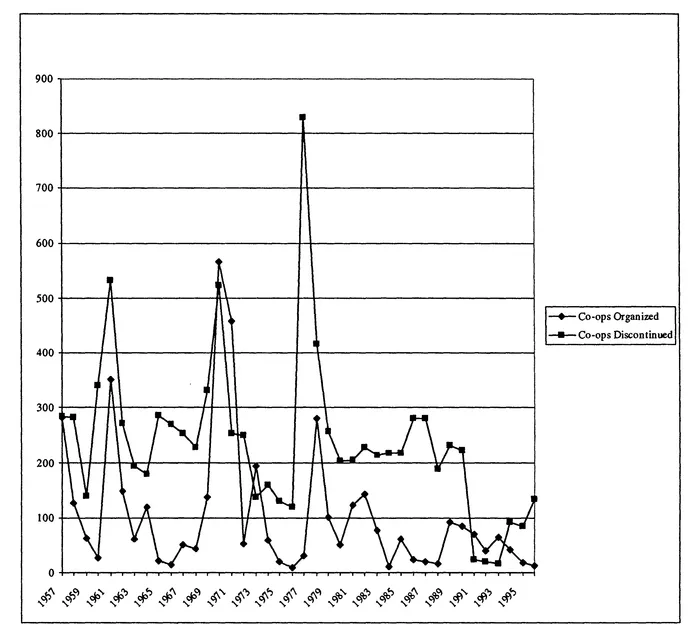
Source: USDA (1998), 48–51.
Farmer co-ops also play a substantial role in the commodity market. In 1998, co-ops accounted for 27 percent of all farm marketings in the United States (Kraenzle 2001, 7). An examination of specific commodity sectors confirms the extent to which farmer co-ops contribute to the U.S. economy. For example, the USDA estimates that co-ops earned 90 percent of cash receipts from milk sales in the United States (Table 1.1). Agricultural co-ops also have a growing international role. In 1995, co-ops produced 12.3 percent of U.S. agricultural exports, which is worth an estimated value of $5.6 billion (USDA 1997).
Consumer co-ops also play a major role in the United States. For example, credit unions are a form of cooperative savings and loan enterprise, where depositors are also partial owners. In 2001, there were 9,984 federally insured credit unions in the United States, representing 79.4 million members, holding assets worth $501.6 billion (NCUA 2001, 7). In short, almost one-third of the American population belonged to a cooperative enterprise.
Figure 1.2 Farms and Farmer Cooperative Memberships in the United States, 1930 to 1995
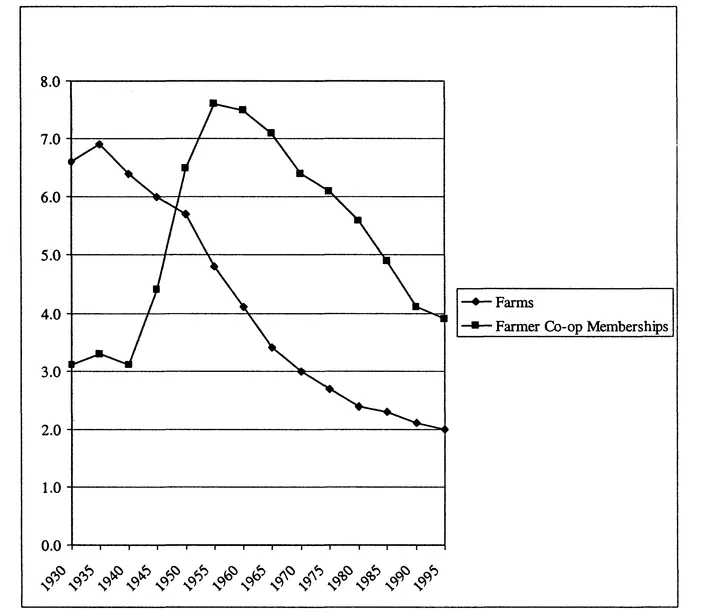
Source: USDA (1998), 17.
Consumer food co-ops have a much smaller presence in the United States than farmer co-ops or credit unions, but even here, the numbers are impressive. The National Cooperative Grocers Association (NCGA 2002) serves 80 cooperative grocery stores with 200,000 members across 26 states. These stores generate more than $400 million in annual sales.
Consumer food co-ops have a much larger market presence in many Western European countries. Co-ops represent 25 percent of the consumer food market in Norway and 30 percent in Denmark (United Nations 1996). In Switzerland, co-ops constitute 50 percent of the consumer food market (United
Table 1.1 Cooperative Share of U.S. Farm Marketings, 1999
| Commodity group | Percentage of U.S. cash receipts |
| Milk | 89 |
| Grains and oilseeds | 34 |
| Cotton and cottonseed | 29 |
| Fruits and vegetables | 18 |
| Livestock and wool | 13 |
| All other (including poultry and eggs, dry edible beans and peas, nuts, rice, tobacco, sugarcane, sugar beets, honey, and other commodities) | 12 |
| Total (all farm commodities weighted by value) | 27 |
Source: Kraenzle (2001, 7).
Nations 1996). The broader point is that at the beginning of the twenty-first century, co-ops are, in many ways, more relevant than ever.
Overview of the Book
This volume has at least two intended audiences: (1) researchers and (2) policymakers. First, it targets researchers interested in the debates about cooperative theory and applications. Existing reviews focus on narrowly defined topics such as agriculture (e.g., Cobia 1989; Leistritz 1997; Royer 1994), a specific geographic region such as Europe (e.g., Schilthuis and Van Bekkum 2000), a special type of co-op such as New Generation or worker (e.g., Fairbairn 1989; Fulton, Popp, and Gray 1998; Merrett and Walzer 2001; Schaffner 1995; Torgerson 1970), or reference manuals and reviews designed for community developers or the general public (Nadeau and Thompson 1996; NCFC 1999). In contrast, this volume focuses on a broad range of cooperatives.
Second, this volume provides information to help political and economic leaders make informed public policy decisions by educating them about the role that co-ops might play in promoting economic and community development. The aim is to recognize the important research that has been completed in the past, while embracing the fact that in a globalizing economy, business forms can be expected to emerge, including new cooperative forms and new applications of existing cooperative models.
A discussion of the theoretical underpinnings of cooperative behavior will be augmented by case studies of cooperative ventures. In order to accomplish these goals, the book is divided into five broad sections: (1) Understanding Cooperative Theory, (2) Public Policy Issues, (3) Management Issues, (4) Cooperatives in Economic Development, and (5) Cooperatives in Community Development.
Understanding Cooperative Theory
In order to provide a context for the book, the first section includes three chapters that discuss the history and underlying theory of cooperative behavior. In chapter 2, Brett Fairbairn argues that co-ops have had an important and long-standing role in the economic development of both the United States and Canada. He begins by tracing the origins of the cooperative movement to the eighteenth-century Age of Enlightenment. With its appeal to reason and individualism, this social and intellectual ferment gave birth to two social organizations: the voluntary association and the business enterprise. The co-op represents an amalgam of these two entities.
During the next two centuries, the cooperative model evolved to cope with changing socioeconomic conditions. Fairbairn documents the role of co-ops in colonial North America and in nineteenth-century agriculture. He further explores the legislation that expanded the role of co-ops during the twentieth century before plunging into a discussion of credit unions and consumer co-ops. The chapter concludes by revisiting the theme of economic change. Economic hardship during the depression prompted many working-class individuals to join co-ops. The economic crisis of the 1970s and the social movements unleashed during this period sparked social change within co-ops as well.
In chapter 3, Kim Zeuli builds on the historical perspective by presenting an overview of cooperative theory. She begins by arguing that co-ops come in myriad forms...
Table of contents
- Cover
- Half Title
- Title
- Copyright
- Dedication
- Contents
- List of Tables, Figures, and Boxes
- Preface
- 1. Introduction: Cooperative Theory and Its Applications for the Twenty-First Century
- Part I. Understanding Cooperative Theory
- Part II. Public Policy Issues
- Part III. Management Issues
- Part IV. Cooperatives in Economic Development
- Part V. Cooperatives in Community Development
- About the Contributors
- Index
Trusted by 375,005 students
Access to over 1.5 million titles for a fair monthly price.
Study more efficiently using our study tools.
Frequently asked questions
Yes, you can cancel anytime from the Subscription tab in your account settings on the Perlego website. Your subscription will stay active until the end of your current billing period. Learn how to cancel your subscription
No, books cannot be downloaded as external files, such as PDFs, for use outside of Perlego. However, you can download books within the Perlego app for offline reading on mobile or tablet. Learn how to download books offline
Perlego offers two plans: Essential and Complete
- Essential is ideal for learners and professionals who enjoy exploring a wide range of subjects. Access the Essential Library with 800,000+ trusted titles and best-sellers across business, personal growth, and the humanities. Includes unlimited reading time and Standard Read Aloud voice.
- Complete: Perfect for advanced learners and researchers needing full, unrestricted access. Unlock 1.5M+ books across hundreds of subjects, including academic and specialized titles. The Complete Plan also includes advanced features like Premium Read Aloud and Research Assistant.
We are an online textbook subscription service, where you can get access to an entire online library for less than the price of a single book per month. With over 1.5 million books across 990+ topics, we’ve got you covered! Learn about our mission
Look out for the read-aloud symbol on your next book to see if you can listen to it. The read-aloud tool reads text aloud for you, highlighting the text as it is being read. You can pause it, speed it up and slow it down. Learn more about Read Aloud
Yes! You can use the Perlego app on both iOS and Android devices to read anytime, anywhere — even offline. Perfect for commutes or when you’re on the go.
Please note we cannot support devices running on iOS 13 and Android 7 or earlier. Learn more about using the app
Please note we cannot support devices running on iOS 13 and Android 7 or earlier. Learn more about using the app
Yes, you can access Cooperatives and Local Development by Christopher D. Merrett,Norman Walzer in PDF and/or ePUB format, as well as other popular books in Economics & Business General. We have over 1.5 million books available in our catalogue for you to explore.