eBook - ePub
Design of Experiments
A No-Name Approach
- 432 pages
- English
- ePUB (mobile friendly)
- Available on iOS & Android
eBook - ePub
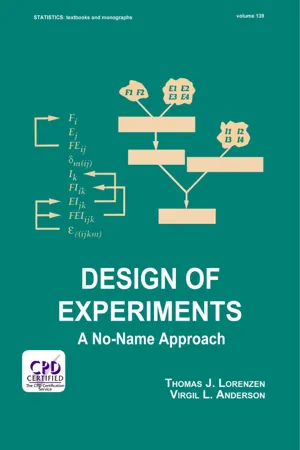
Design of Experiments
A No-Name Approach
About this book
Presents a novel approach to the statistical design of experiments, offering a simple way to specify and evaluate all possible designs without restrictions to classes of named designs. The work also presents a scientific design method from the recognition stage to implementation and summarization.
Information
The glory and the nothing of a name.
GEORGE NOEL GORDON, LORD BYRON
ON SIR WINSTON CHURCHILL'S GRAVE
1
A Scientific Approach to the Design of Experiments
1.0 INTRODUCTION
Experiments are performed by people in nearly all walks of life. The basic reason for running an experiment is to find out something that is not known. By their very nature, experiments are designed to draw inferences about an entire population based on a few observations.
If experiments were perfectly repeatable and the important factors were perfectly separable, it would be easy to analyze and interpret the results. However, experiments are often run so that the effect of one factor is unknowingly confounded with the effect of a factor not considered in the experiment. Even with the best of experimental control, results vary from trial to trial. These reasons, and many more, add to the difficulty in analyzing the data from an experiment.
The role of statistics in experimental design has been to separate the observed differences into those caused by various factors and those due to random fluctuation. The classical method used to separate these differences is analysis of variance, or ANOVA. In general, the method consists of looking at the total variation in the data, breaking it into its various “accountable for” components, and running statistical tests in an attempt to find out which components influence the experiment.
The specific ANOVA heavily depends on the design of the experiment. If two different experiments have the same factors but are laid out and run differently, the variation components will be broken apart differently. The information available on the effects of some factors will increase, others will decrease, and still others may disappear completely. As a result of this drawback, specific designs have been developed to accomplish different tasks with different efficiencies.
A number of designs in common use today have grown out of the agricultural field. Generally, a design is associated with a specific name and the resulting ANOVA performed according to rules specific to the design. One disadvantage of this method is a lack of “feeling” about the design and an inability to extend the design to any other circumstance. To counteract this disadvantage, mathematical models have been developed that “describe” the design and the corresponding analysis. Hopefully, through the use of these models, the experimenter (or student, statistician, etc.) can visualize the layout and perform the ANOVA to draw conclusions.
Unfortunately, it has been shown in textbooks that designs can have the same mathematical model even if the layout is entirely different. (See Anderson, 1970, for an example.) This means the mathematical model does not adequately describe the layout of the experiment. Despite this drawback, these mathematical models are in wide use today. Quite frequently, the name associated with a given design is supposed to key the experimenter to the exact layout and eventually to the analysis without the experimenter ever knowing the meaning of the design or even the appropriate mathematical model.
The authors of this text do not believe it is correct to associate a layout with a name and then analyze the data in a fashion specific to that name. In the first place, there is no reason to force an experiment into a design that may have been constructed for other purposes. At best, we place undue restrictions on the experiment and may even lose valuable information. Even if information is not lost, we may be able to gain more information on the effect of factors of interest by using some non-named design.
Secondly, and more importantly, names are not needed! The problem with the classical approach is simply a deficiency in the mathematical model. With the inclusion of a few additional terms, the model serves as an understandable intermediary step, both describing the layout and serving as the basis for a rigorous analysis of the data. Instead of presenting many specific models, a few concepts will be presented. If these concepts are understood, all of the named designs as well as any other design can be comprehended.
Chapter 2 considers one factor designs, introducing the ANOVA terminology, listing the assumptions of the mathematical model, and giving a few statistical techniques. Chapter 3 presents the factorial concept and gives general methods for analyzing the collected data. Because it deals with both design and analysis, it is the longest chapter. Chapter 4 presents the nesting concept. Chapter 5 presents the concept of restrictions on randomizations. Chapter 6 reviews Chapter 1 from a more informed perspective. Experience has indicated that the material in Chapter 1 is not thoroughly understood until the mathematical framework in Chapters 2 through 5 has been presented. Chapter 7 presents the concept of fractionation for two level experiments. This concept applies for both fixed and random factors, whether the experiment is completely randomized or there are restrictions on the randomization. Chapter 8 extends the fractionation concept from two level to prime level experiments, presents methods useful for non-prime level and mixed level experiments, gives some orthogonal main effect plans, and discusses some non-orthogonal plans. Chapter 9 presents other ideas useful when designing for a specific form of a regression model.
1.1 THE SCIENTIFIC APPROACH
Thus far we have focused on the statistician’s role in the design of experiments. Seldom do statisticians actually run the experiment. That part is almost always the responsibility of the experimenter involved. If experiments are to be run, and they most assuredly will be run, a scientific approach to designing them is needed. The following is an ordered list of requirements for scientific experimentation. The significance of each requirement will be discussed in detail in the remaining sections of this chapter.
• Recognition that a problem exists.
• Formulation of the problem.
• Specifying the variable to be measured.
• Agreeing on the factors and levels to be used in the experiment.
• Definition of the inference space for the problem.
• Random selection of the experimental units.
• Layout of the design.
• Development of the mathematical model.
• Preliminary evaluation of the design.
• Redesigning the experiment.
• Collecting the data.
• Analyzing the data.
• Conclusions.
• Implementation.
1.2 RECOGNITION THAT A PROBLEM EXISTS
In many industrial plants the accountants are able to show which areas are having problems by arraying the costs in various departments (sometimes called a Pareto diagram). Problems are indicated when the relative costs in these areas either have changed recently or are large with respect to some criteria.
In other plants the foreman may recognize trouble and bring it to the attention of a superior. Or a new technique may be considered to replace an existing technique. Or customers may be complaining about a specific defect. In any event, at least one area always seems to need attention, and alert management recognizes that a problem exists.
In research departments of universities or industries, people are continually encountering problems that cannot be solved analytically but can be attacked successfully using scientific experimentation. The recognition phase in these cases is usually short.
Many companies have a mission to continually improve products and processes. The problem here is to identify the causes of variation and experiment with different techniques to reduce variation.
1.3 FORMULATION OF THE PROBLEM
Cross-functional teams are the most successful means of formulating the problem after management agrees that a problem exists. The word action is important because the members of the cross-functional team for attacking a problem must be the ones who know the technical parts involved and be willing to state their thoughts. A person who knows the requirements for scientific experimentation and keeps the thoughts flowing is the best moderator for such a group. There must never be reticence by any participants, even if one’s ideas are in conflict with those of a supervisor who may be present. Hence, a moderator from outside the plant who stimulates thought and prevents conflicts is usually preferred to a knowledgeable in-plant participant.
Usually this discussion period lasts from two to eight hours with all team members having a chance to express their views. Frequently forty to fifty possible causes of the problem will be put forth. The next step for the moderator is to get the participants to reduce these to a reasonable number of causes. Hopefully, the list will be reduced to eight or ten; preferably to four or five. Rarely is the ultimate list only two or three. Of course, the greatest difficulty in the actual formulation of the problem is to get the team members to agree on the ultimate causes to be tried in the forthcoming experiment.
When the number of possible causes is large and there is not enough knowledge about the process to narrow the list down, a two-staged approach must be used. The purpose of the first stage is to find the most important factors in the list. The second stage will study these factors in more detail.
To illustrate the formulation of a problem, consider an investigation related to the fabrication of men’s synthetic felt hats. The manufacturer had experienced extreme difficulty in producing these hats so the flocking appeared on the molded rubber base in a uniform fashion—simulating real felt hats. In order to approach this problem, a cross-functional team was formed consisting of a development engineer, a manufacturing foreman, a chief operator, a sales representative, and a statistician. The statistician’s job was to obtain all possible causes of imperfect hats. Factors which were possible causes were: thickness of the foam rubber base, pressure of molding, time of molding, viscosity of the latex used to glue the flocking to the molded rubber base, age of the latex, nozzle size of several different spray guns, direction of spraying, condition of the flocking, speed of drying, and location within the drying furnace.
After considerable discussion, the cross-functional team decided that the most serious problems were probably connected with the nozzle size and the pressure under which the latex was sprayed. In arriving at these various factors the team essentially forced a review of the entire production process. This in itself led to a better understanding of the production process and an eventual solution to the problem.
1.4 SPECIFYING THE VARIABLE TO BE MEASURED
One of the most difficult things in certain types of industrial experimentation is the specification of the variable to be measured (usually referred to as the dependent variable or simply y). Usually it is quite obvious what the dependent variable should be but the means of measuring it is sometimes quite difficult. In ideal cases, the value of the dependent variable is measured by some inspection tool. In other cases, it is a value that is almost impossible to measure and has to be graded by one or more inspectors. In a new class of problems defined by Taguchi (1987), the goal is to minimize the effect of production variation and customer use on the performance of a product. In this class of problems, y is a measure of variation over different production and customer use settings.
An ideal dependent variable is continuous, easily and accurately measurable, and directly related to the customer’s perception of quality. Selection of the proper dependent variable(s) is the responsibility of the cross-functional team, not the statistician. However, the statistician has the responsibility to see that proper effort is put into finding the ideal dependent variable(s).
As one can imagine, the measuring of product quality in our synthetic hat example was quite difficult. It was decided that three dependent variables should be used: the hungry appearance of the flocking, the starchy appearance of the flocking, and the appearance of the brim. During the course of the investigation, the three dependent variables were found to be essentially independent of each other and consequently could be treated as three separate analyses. The standards for these variables were again arrived at through team action and resulted in a visual display board that gave the inspectors a realistic way to grade each dependent variable.
1.5 AGREEING ON THE FACTORS AND LEVELS TO BE USED IN THE EXPERIMENT
Like the dependent variable discussed in the previous section, the factors to be used in the experiment must either be measurable or distinguishable. In addition, the factors must be controllable, at least within a laboratory setting. This is because the design will tell exactly which combinations of the various factors should be run and in which order. This is determined by the needs of the experimenter.
Likewise, the number of levels of each factor will be determined by the needs of the experimenter. Sometimes the levels of a factor are predetermined and cannot be changed. Other times, the number of levels is optional and determined by trading off the experimental eff...
Table of contents
- Cover
- Half Title
- Title Page
- Copyright Page
- Dedication
- Table of Contents
- 1. A SCIENTIFIC APPROACH TO THE DESIGN OF EXPERIMENTS
- 2. ONE FACTOR DESIGNS
- 3. FACTORIAL DESIGNS
- 4. NESTED DESIGNS
- 5. RESTRICTIONS ON RANDOMIZATION
- 6. PLAY IT AGAIN, SAM
- 7. TWO LEVEL FRACTIONAL DESIGNS
- 8. OTHER FRACTIONAL DESIGNS
- 9. RESPONSE SURFACE DESIGNS
- APPENDICES
- INDEX
Trusted by 375,005 students
Access to over 1.5 million titles for a fair monthly price.
Study more efficiently using our study tools.
Frequently asked questions
Yes, you can cancel anytime from the Subscription tab in your account settings on the Perlego website. Your subscription will stay active until the end of your current billing period. Learn how to cancel your subscription
No, books cannot be downloaded as external files, such as PDFs, for use outside of Perlego. However, you can download books within the Perlego app for offline reading on mobile or tablet. Learn how to download books offline
Perlego offers two plans: Essential and Complete
- Essential is ideal for learners and professionals who enjoy exploring a wide range of subjects. Access the Essential Library with 800,000+ trusted titles and best-sellers across business, personal growth, and the humanities. Includes unlimited reading time and Standard Read Aloud voice.
- Complete: Perfect for advanced learners and researchers needing full, unrestricted access. Unlock 1.5M+ books across hundreds of subjects, including academic and specialized titles. The Complete Plan also includes advanced features like Premium Read Aloud and Research Assistant.
We are an online textbook subscription service, where you can get access to an entire online library for less than the price of a single book per month. With over 1.5 million books across 990+ topics, we’ve got you covered! Learn about our mission
Look out for the read-aloud symbol on your next book to see if you can listen to it. The read-aloud tool reads text aloud for you, highlighting the text as it is being read. You can pause it, speed it up and slow it down. Learn more about Read Aloud
Yes! You can use the Perlego app on both iOS and Android devices to read anytime, anywhere — even offline. Perfect for commutes or when you’re on the go.
Please note we cannot support devices running on iOS 13 and Android 7 or earlier. Learn more about using the app
Please note we cannot support devices running on iOS 13 and Android 7 or earlier. Learn more about using the app
Yes, you can access Design of Experiments by Thomas Lorenzen, Virgil Anderson, Thomas Lorenzen,Virgil Anderson in PDF and/or ePUB format, as well as other popular books in Mathematics & Probability & Statistics. We have over 1.5 million books available in our catalogue for you to explore.