eBook - ePub
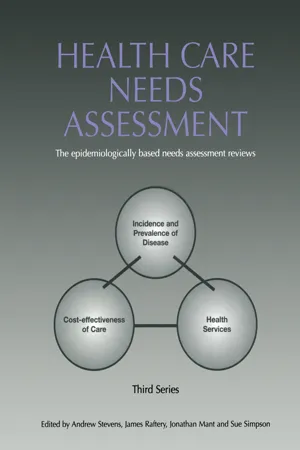
Health Care Needs Assessment
The Epidemiologically Based Needs Assessment Reviews, v. 2, First Series
- 960 pages
- English
- ePUB (mobile friendly)
- Available on iOS & Android
eBook - ePub
Health Care Needs Assessment
The Epidemiologically Based Needs Assessment Reviews, v. 2, First Series
About this book
This new resource in the series provides vital perspectives across entire new disease and service areas not previously covered in other volumes. The books of the first and second series are well established as the key sources of data on needs assessment. Together, they describe the central role and aim of health care needs assessment in the National Health Service. The epidemiological approach to needs assessment is explained thoroughly, and is then applied to the effectiveness and availability of services. This definitive guide is ideal for all those involved in commissioning health care. It is invaluable for public health professionals, epidemiology and public health academics, and students of public health and epidemiology. Key reviews of the First Series: "An excellent balanced account...the definitive resource" - "Journal of the Association for Quality in Healthcare". "Excellent...it should be delved into deeply" - "Pharmaceutical Times". "This excellent work moves us closer to implementing a market in health care" - "British Medical Journal".
Information
1 Adult Critical Care
1 Summary
Introduction
Adult critical care is an important, high-profile and high-cost area of modern healthcare provision. This chapter aims to provide an objective synthesis of evidence available from published and other sources that can inform debate on the planning of critical care services.
Definition of critical care
The term critical care has been defined as:
care for patients who have potentially recoverable conditions who can benefit from more detailed observation (with or without invasive treatment) than can be provided safely in an ordinary ward.1
Background to the development of critical care services
Critical care services are atypical in the wide heterogeneity of their patients. This is in part a reflection of the way in which these services have evolved.
The progress of intensive care in the UK has been described as ‘haphazard’, consisting of ‘largely unplanned and unevaluated’ developments that occurred in reaction to changes in surgical and medical practice.
There has been debate about the configuration of critical care services, fuelled by a perception that there are not enough beds in some parts of the country and that existing beds are not in the right places.
During the late 1990s, the NHS Executive established a National Expert Group to review adult critical care services in the UK and to produce a national Framework for future organisation and care delivery. As a result, in May 2000 a critical care modernisation plan was announced.
Scope of this chapter
Throughout this chapter, we present and discuss both UK and international research findings on adult critical care services. Data on the profile of service provision, utilisation and associated costs relate to England and Wales unless otherwise stated.
Critical care services have previously been differentiated into intensive care and high-dependency care. The critical care modernisation plan announced in May 2000 introduced the notion that adult acute care should be seen as a spectrum, classified across four levels, much as paediatric critical care is organised. The four levels are:
•Level 0 – normal acute ward care
•Level 1 – acute ward care, with additional advice and support from the critical care team
•Level 2 – more detailed observation or intervention
•Level 3 – advanced respiratory support alone, or basic respiratory support together with support of at least two organ systems.
Sub-categories
In contrast with needs assessments for disease groups, where disease classification is central to the discussion and is relatively straightforward, in critical care practice it is difficult to classify and group clinical data into defined categories or hierarchies. Healthcare Resource Groups (HRGs) or Diagnosis Related Groups (DRGs) are used to categorise patients on the basis of diagnosis; but this approach is not applicable in critical care, where there is wide heterogeneity within diagnostic groups.?
Patients can be categorised by severity of illness; on the basis of demographic characteristics; on more precise measures of severity of illness; or according to the organ systems needing monitoring or support.
Epidemiology of critical care
Age and gender
There is evidence that critical care patients are mostly males and that a high proportion are elderly.
Intensive Care National Audit and Research Centre (ICNARC) data show that 4.8% of admissions are in the age range 0–17, and that 46.5% of admissions are of people aged 65 years or over. The mean age of patients is 57.3 years.
Types of admission
Intensive care
There is evidence that the greatest proportion of admissions to ICUs are for medical emergencies (41%), followed by planned admissions from elective surgery (25%) and emergency surgical admissions (18%). There are more recent data suggesting that the proportion of non-surgical admissions to ICUs is increasing.
The most common source of admission to intensive care is theatre or recovery in the same hospital (44.1%), followed by a ward in the same hospital (22.3%) and A&E in the same hospital (17.1%).
High-dependency care
There is little information available on the types of admission and diagnostic categories of patients in HDUs in the UK, but the Augmented Care Period (AGP) dataset, introduced in 1997, will go some way towards addressing this.
Several studies have examined the potential for using HDU beds to alleviate some of the demand on ICU beds, by differentiating between those patients requiring high-dependency care and those requiring intensive care.
The reclassification of critical care into three levels, announced in the critical care modernisation plan in May 2000, will lead to a better reflection of severity in activity data.
Indications for admission
One study reported that over 70% of admissions to ICUs were in the cardiovascular or respiratory categories. Other data show that the ten most frequent reasons for admission are:
•Aortic or iliac dissection or aneurysm – surgical
•Acute myocardial infarction – non-surgical
•Pneumonia, with no organism isolated – non-surgical
•Bacterial pneumonia – non-surgical
•Septic shock – non-surgical
•Primary brain injury – non-surgical
•Large bowel tumour – surgical
•Left ventricular failure – non-surgical
•Asthma attack in a new or known asthmatic – non-surgical
•Non-traumatic large bowel perforation or rupture – surgical.
The most common condition admitted made up only 6.5% of admissions, and the top ten conditions made up only 26.8% of admissions.
The ten conditions that use the grea...
Table of contents
- Cover
- Title Page
- Copyright Page
- Table of Contents
- Preface
- List of contributors
- 1 Adult Critical Care
- 2 Continence
- 3 Dyspepsia
- 4 Black and Minority Ethnic Groups
- 5 Hypertension
- 6 Obesity
- 7 Chronic Pain
- 8 Mental III Health in Primary Care
- 9 Peripheral Vascular Disease
- 10 Pregnancy and Childbirth
- 11 Health Care in Prisons
- Index
Trusted by 375,005 students
Access to over 1.5 million titles for a fair monthly price.
Study more efficiently using our study tools.
Frequently asked questions
Yes, you can cancel anytime from the Subscription tab in your account settings on the Perlego website. Your subscription will stay active until the end of your current billing period. Learn how to cancel your subscription
No, books cannot be downloaded as external files, such as PDFs, for use outside of Perlego. However, you can download books within the Perlego app for offline reading on mobile or tablet. Learn how to download books offline
Perlego offers two plans: Essential and Complete
- Essential is ideal for learners and professionals who enjoy exploring a wide range of subjects. Access the Essential Library with 800,000+ trusted titles and best-sellers across business, personal growth, and the humanities. Includes unlimited reading time and Standard Read Aloud voice.
- Complete: Perfect for advanced learners and researchers needing full, unrestricted access. Unlock 1.5M+ books across hundreds of subjects, including academic and specialized titles. The Complete Plan also includes advanced features like Premium Read Aloud and Research Assistant.
We are an online textbook subscription service, where you can get access to an entire online library for less than the price of a single book per month. With over 1.5 million books across 990+ topics, we’ve got you covered! Learn about our mission
Look out for the read-aloud symbol on your next book to see if you can listen to it. The read-aloud tool reads text aloud for you, highlighting the text as it is being read. You can pause it, speed it up and slow it down. Learn more about Read Aloud
Yes! You can use the Perlego app on both iOS and Android devices to read anytime, anywhere — even offline. Perfect for commutes or when you’re on the go.
Please note we cannot support devices running on iOS 13 and Android 7 or earlier. Learn more about using the app
Please note we cannot support devices running on iOS 13 and Android 7 or earlier. Learn more about using the app
Yes, you can access Health Care Needs Assessment by Andrew Stevens,James Raftery,Jonathan Mant,Sue Simpson in PDF and/or ePUB format, as well as other popular books in Medicine & Epidemiology. We have over 1.5 million books available in our catalogue for you to explore.