eBook - ePub
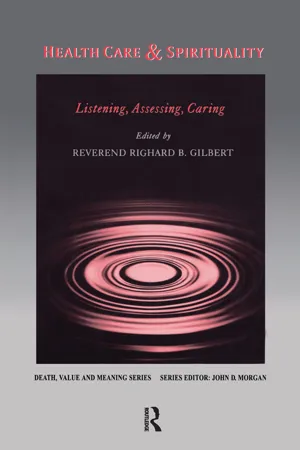
Health Care & Spirituality
Listening, Assessing, Caring
- 314 pages
- English
- ePUB (mobile friendly)
- Available on iOS & Android
eBook - ePub
About this book
Few areas in life have experienced the rapid pace of change that has been the experience of health care. It's an area where nothing feels "safe" and everything is threatened with reexamination and redefinition. Accompanying this situation is a new appreciation for the human spirit and the gift of things spiritual, including the soul of the work place. Addressing this situation is a vital new book "Health Care and Spirituality: Listening, Assessing, Caring" an anthology of the human predicament, the health care professional's story and the health care work place. "Health Care and Spirituality" explores this area that is continually being introduced to new treatments, new challenges, new people, new regulations, new expectations, and new time limits.
Information
SECTION 1:
HEALTH CARE AND SPIRITUALITY: PROFESSIONAL PERSPECTIVES
Introduction
“Divide and conquer” may be an appropriate strategy in war games, but it has become an all too common dynamic in contemporary health care. Today’s health care litany, “Managed care, limitations, legislation, downsizing,” unfolds as we swing from pillar to post trying to respond to this rapid fire change. These are adjustments that often occur despite our inability to discern their wisdom and often they are perceived as in conflict with our professional standards and workplace goals. We experience a diminished capacity to negotiate effective change that both understands and upholds our professional and spiritual values.
Change is occasionally welcomed when we feel we have some control over the intrusion of change and its outcome. The rude awakening in health care is that change has snuck in the back door like an unwelcomed intruder, a sudden burst of wind that has knocked us off the foundations of our values and standards.
The question becomes, “Who is in charge here?” as patients continue to ask, “Will you take care of me?” We lash out in every and any direction because there is no one person or power to blame. The federal government? The legislators? Doctors? The Board of Directors? Insurance companies? Patients? God? Death? No place here to hang our hats, so we divide and conquer to protect our own interests, ambitions, and commitments.
In the midst of all of this is the patient, surrounded by loved ones and friends and cared for by an enormous array of professionals and volunteers. All have something to give us and all demand something from us. It is not we versus them, but all of us, in tandem, a team, working together for the common good of the patient and the workplace.
This section offers chapters that approach the book’s themes through the perspectives of several professional disciplines. We see the unique challenges of identifying, molding, and, at times, healing the organizational culture, with special mention of the spiritual dynamics present and the role of the chaplain in identifying those needs for the patients. Cynthia Russell opens this section with a strong statement on the role of the nurse in tending to the holistic needs of patients. Chaplain Richard Stewart, retired supervisor of chaplains for the United Methodist Church and a past president of the Association of Professional Chaplains, offers an historic overview of the professional development of chaplains, serving as a foundation for an expanded discussion of who chaplains are, what they do, and how they work as team members in the care of the patients and the providers.
The historic perspective continues with a contemporary and future perspective offered by Chaplain Richard Gilbert.
While this book is not about chaplains alone, it is an important reminder from a group of professionals who often go quietly about their work and do not take the needed time to articulate their story. It is a preliminary look at the unique place for both spiritual care and pastoral care, and how they must come together for quality health care. In the final contribution, David Adams and Rick Csiernik offer a timely study that serves as their preliminary evaluation of their spiritual survey of health care professionals and a growing awareness of the spiritual needs of the professionals called upon to face working in the contemporary health care setting.
CHAPTER 1
A Nurse’s Perspective
He said to her, “Daughter, your faith has healed you. Go in peace and be freed from your suffering” [Mark 5:34].
William was sixty-four years old and had battled his demons for nearly all of those years. Unfortunately, at this time the demons were prevailing. For some reason he told himself his mental illness was easier to oppose when he was younger. The latest wonder drug to combat schizophrenia did not stop what he referred to as “the pressure in my head.” He viewed himself as “old” and felt that he would never again find relief from his agony. William had lost all hope. Yet, as I held William’s hand in mine, I felt blessed to be in his presence. Tortured though it might be, William allowed me to touch his spirit, the essence of his being. As we sat together surrounded by the activity of the psychiatric unit, there was a connection. I sensed an individual of great integrity and depth, a fine and caring soul. Though the medication had not been able to quell the pain, the human connection had allowed him a few moments of peace. William reported that he felt somewhat better as he left to attend group therapy.
Far from the life and death drama of an emergency room or intensive care unit, where spiritual connectedness might be expected, the above scenario illustrates a more routine nurse-patient experience. With more than 2.2 million nurse colleagues in the United States alone, this chapter represents but one voice on the subject of spirituality and nursing. One voice, however, in a sea of voices. Nursing is one of a select group of disciplines, including medicine and the ministry, which is permitted to routinely connect with the human spirit. An almost universal premise, nurses care for the physical, emotional, intellectual, social, and spiritual needs of people. These are the parts of the whole person; all interconnected and inseparable. This translates into the holistic practice of nursing.
However, in this world of advanced technology in health care, pressured by cost-containment activities, the connection of nurses with the spirit of those in our care is at risk of extinction. This is an unacceptable loss to “high-tech” clinical environments, managed care, and down-sizing. It puts not only the patient but also the essence of the nursing profession in grave peril.
This chapter will explore the link between spirituality and nursing. A framework for better understanding nursing’s connection to care of the spirit is considered. Actual nurse-patient interactions will illustrate this association. The chapter concludes with a brief look at the consequences of a “spirit-less” system of nursing care and considers “spirit-enhancing” opportunities for nurses that exist in today’s health care environment.
SPIRITUALITY AND NURSING
From the Latin “spiritus” or breath, spirit is described as the vital principle or animating force traditionally believed to be within living beings [1]. The term “vital” identifies the spirit as a necessary aspect of being human. “Animating force” presents the image of being filled with life. Spirit is also recognized as the essential nature of the person, the soul. It is clear from its roots: the spirit is at the central core of human existence.
Recognizing the universal presence of spirit, spirituality is a broad concept that includes values, meaning, and purpose [2]. Nagai-Jacobson and Burkhardt identify spirituality as that which gives meaning and purpose to life [3]. According to Burkhardt, spirituality is described as an unfolding mystery, harmonious interconnectedness, and inner strength [4]. Unfolding mystery deals with life’s uncertainties and the discovery and struggles with finding meaning and purpose in one’s life. Related-ness to self, others, and God or Higher Being reflects harmonious interconnectedness. Inner strength includes one’s inner resources, consciousness, and sacredness.
Noted psychotherapist Victor Frankl refers to a person’s search for meaning as the primary motivation of life [5]. Tensions may be aroused in search for life’s meaning. Frankl believes that these tensions facilitate our journey toward health and are the key to our survival. Frankl cr...
Table of contents
- Cover
- Title Page
- Copyright Page
- Foreword
- Preface
- Table of Contents
- Introduction
- Transversing Purgatory (Poem)
- Section 1: Health Care and Spirituality: Professional Perspectives
- Section 2: Health Care and Spirituality: Belief System Perspectives
- Section 3: Health Care and Spirituality: Ethnic and Gender Perspectives
- Section 4: Health Care and Spirituality: Patient Perspectives
- Contributors
- Index
Trusted by 375,005 students
Access to over 1.5 million titles for a fair monthly price.
Study more efficiently using our study tools.
Frequently asked questions
Yes, you can cancel anytime from the Subscription tab in your account settings on the Perlego website. Your subscription will stay active until the end of your current billing period. Learn how to cancel your subscription
No, books cannot be downloaded as external files, such as PDFs, for use outside of Perlego. However, you can download books within the Perlego app for offline reading on mobile or tablet. Learn how to download books offline
Perlego offers two plans: Essential and Complete
- Essential is ideal for learners and professionals who enjoy exploring a wide range of subjects. Access the Essential Library with 800,000+ trusted titles and best-sellers across business, personal growth, and the humanities. Includes unlimited reading time and Standard Read Aloud voice.
- Complete: Perfect for advanced learners and researchers needing full, unrestricted access. Unlock 1.5M+ books across hundreds of subjects, including academic and specialized titles. The Complete Plan also includes advanced features like Premium Read Aloud and Research Assistant.
We are an online textbook subscription service, where you can get access to an entire online library for less than the price of a single book per month. With over 1.5 million books across 990+ topics, we’ve got you covered! Learn about our mission
Look out for the read-aloud symbol on your next book to see if you can listen to it. The read-aloud tool reads text aloud for you, highlighting the text as it is being read. You can pause it, speed it up and slow it down. Learn more about Read Aloud
Yes! You can use the Perlego app on both iOS and Android devices to read anytime, anywhere — even offline. Perfect for commutes or when you’re on the go.
Please note we cannot support devices running on iOS 13 and Android 7 or earlier. Learn more about using the app
Please note we cannot support devices running on iOS 13 and Android 7 or earlier. Learn more about using the app
Yes, you can access Health Care & Spirituality by Richard Gilbert,Richard B. Gilbert in PDF and/or ePUB format, as well as other popular books in Medicine & Medical Theory, Practice & Reference. We have over 1.5 million books available in our catalogue for you to explore.