eBook - ePub
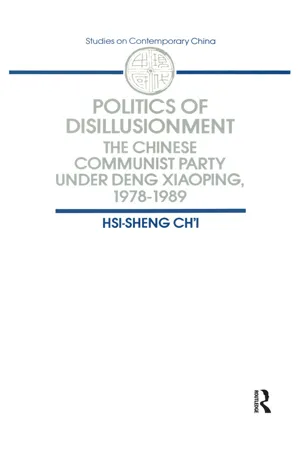
Politics of Disillusionment
Chinese Communist Party Under Deng Xiaoping, 1978-89
- 352 pages
- English
- ePUB (mobile friendly)
- Available on iOS & Android
eBook - ePub
About this book
An analysis of the Chinese Communist Party from the time of Deng Xiaoping's return to power in 1978 to his resignation from his last major party post in the wake of the 1989 Tiananmen crisis, this work traces the evolution of Deng's grand strategy to create unity and stability so that he could launch his ambitious programme to modernize China by the year 2000. The author examines the impact of Deng's goal on the events of spring 1989.
Information
1
Deng’s Rise to Power and His Agenda
POLITICAL events in China unfolded in a dramatic manner after the death of Mao Zedong in September 1976. Hua Guofeng, a relatively junior member of the old hierarchy, quickly became the new leader. Within a month of Mao’s death, the most powerful figures in Chinese politics during the Cultural Revolution years were deposed in a bloodless coup and branded as antiparty elements by a coalition of the party’s old guard in collusion with key military leaders.
But the new leadership was immediately confronted with the problem of a breakdown of social order in many provinces. Widespread labor unrest, sabotage of production and transportation, and even open armed conflicts between rival factions may have led to the loss of as many as 45,000 to 50,000 lives throughout the country. These incidents certainly occupied much of the attention of the new leaders, and it was only in mid-1977, after harsh measures were adopted, that public order was restored.1
In spite of the overthrow of the Gang of Four, Hua Guofeng basically wanted to maintain the continuity of the Maoist legacy. Ideologically, Hua continued to uphold the validity of the Cultural Revolution, the authority of Mao Zedong’s Thought, and the policies of the entire Maoist era. He not only endorsed the radical thoughts and practices of the Cultural Revolution, the thesis of continuous revolution under the dictatorship of the proletariat, and the insistence on class struggle as the party’s basic principle, but introduced the even more extreme doctrine of total and blind acceptance of everything associated with Mao. On February 7, 1977, in a joint editorial carried by the People’s Daily, Hongqi, and the People’s Liberation Army Daily, Hua announced the doctrine of “two whatevers” (liangge fanshi), which asserted that “we will resolutely support whatever decisions Chairman Mao made; we will unflinchingly obey whatever instructions Chairman Mao issued.” This famous slogan was Hua’s direct answer to the popular demands to exonerate the participants in the Tiananmen incident of 1976, and to reassess the meaning of the Cultural Revolution.2
Hua’s position on personnel questions was only slightly more flexible. He was willing to remove only those leaders who had very close personal or factional ties with the Gang of Four, and to rehabilitate a small number of disgraced leaders whom Mao had not personally denounced. Thus, for example, personnel changes involving the State Council and provincial party first secretaries between late 1976 and mid-1977 included only a modest number of rehabilitated leaders.3
But Hua Guofeng’s total identification with Mao’s ideology and policies not only posed serious obstacles to the correction of many of the excesses that had caused mass discontent in China, but also hampered the process of exonerating many important leaders accused as anti-Maoists, including Deng Xiaoping. By insisting that Mao had not made any mistakes during his last years of life, Hua was rejecting the popular demand for the return of Deng to the party’s leadership. Consequently, serious ideological and political confusion continued in 1977 and 1978.
Return to Power
Amid this fluid situation, a coalition of Politburo members and provincial leaders began to exert pressure in the spring of 1977 for the rehabilitation of Deng Xiaoping. Hua finally gave in to their demands and sanctioned Deng’s rehabilitation, which was officially announced by the Third Plenum of the Tenth Congress, convened during July 16–21, 1977.4 In August the CCP’s Eleventh Congress elected Hua Guofeng as the party’s chairman and Wang Dongxing as its vice-chairman. In February 1978, the Fifth National People’s Congress elected Hua premier.
Although at the time of his rehabilitation Deng promised never to “overthrow the political verdict,” Hua’s doctrine of “two whatevers” posed a serious problem for Deng’s political career. Many party leaders still opposed Deng and accused him of “cutting down” Mao’s Thought. Deng himself realized that if the “two whatevers” were rigidly applied, his own rehabilitation could not be justified.5 Deng’s defense was that his opponents were guilty of holding onto fossilized thoughts, and of rigidly and unquestioningly accepting everything Mao had said. In May 1978, Deng’s supporters suggested that “practice should be the only criterion to validate truth,” which was another way of saying that all acceptable ideological lines must correspond to social, economic, and political realities.6 At the Military Political Work Conference held on June 2, 1978, Deng used the same argument to counter the criticism of his opponents and to argue that the basic tenet of Mao’s Thought was respect for facts (shishi qiushi). Hua and his associates were increasingly criticized as the “whatever faction” (fanshipai).
Deng’s strategy of regaining power was through a circuitous route: eschewing a frontal bid for power, he set out to use his supporters to whittle away the ideological foundation of the Hua regime and to create a political atmosphere that enhanced his own prestige.
During the next four months, the dispute over the norm of truth dominated Chinese politics. Deng’s new position received strong support from the PLA through the Jiefangjun bao (PLA news) in an editorial on August 1, 1978, and through provincial papers throughout the whole country. By October, it was clear that Deng had been able to undermine Hua’s leadership position by using Maoist doctrines as a weapon. Deng’s approach was to suggest that not everything that Mao had said or done was necessarily always right. In this fashion, Deng was able to imply that in governing China, it was more important to apply ideologies flexibly than to adhere dogmatically to Maoism. Pragmatism became more significant than dogmatism in judging political issues. In early December 1978, Deng set the tone of the forthcoming Third Plenum of the Eleventh Party Congress by stating, “If a party, a country, a nation approaches everything dogmatically, applies rigid thought, and is superstitious, then its vitality will stop. The party and the state will collapse.”7
At the Third Plenum, held from December 18 to 22, 1978, Deng scored a major victory on several fronts. First, he achieved success in personnel and organizational control by sending three more supporters to the Politburo (Deng Yingchao, Hu Yaobang, and Wang Zhen). Although Hua Guofeng was still the party’s chairman, the vice-chairmen now included Ye Jianying, Deng Xiaoping, Li Xiannian, Chen Yun, and Wang Dongxing. Deng’s supporters also gained control over the party’s General Office, and over the departments of organization, propaganda, and united front work. The party created a Central Discipline Inspection Committee, with Chen Yun as first secretary.8
Second, Deng became increasingly effective in setting the party’s agenda and the tone of discussion. He criticized the theme of the “two whatevers,” affirmed the principle that practice was the only reliable criterion to evaluate truth, and asserted that it was also the only way to liberate thoughts and correct erroneous thinking. The plenum also set the precedent of rehabilitating leaders who had been personally vilified by Mao. Peng Dehuai and Tao Zhu were exonerated posthumously, and several other surviving leaders (including General Huang Kecheng and Chen Zaidao) were readmitted to the Central Committee as full members.9
The year 1979 saw even more dramatic gains for Deng. While constantly criticizing the leaders who had risen to power during the Cultural Revolution, Deng did not press for their immediate removal. In return, he was able to add his own supporters to the Politburo and the Central Committee. Deng also pushed through changes that facilitated the expansion of his power base. The party’s Secretariat, Deng’s old stronghold in the 1950s and 1960s, was revived, and Hu Yaobang was given control over the daily operation of the party. At the recommendation of Chen Yun, a Central Discipline Committee was created. With Chen as its first secretary, the committee was empowered not only to enforce discipline among party members but also to review cases of political oppression involving veteran cadres.10 In September 1979, at the Fourth Plenum of the party’s Eleventh Congress, Deng scored more victories in extending his power base. Twelve more recently rehabilitated leaders who had been disgraced during the Cultural Revolution were admitted as members of the Central Committee. Two important allies, Zhao Ziyang and Peng Zhen, were also elevated to the Politburo.11
Throughout 1979–80, Deng continued to wage an unrelenting ideological battle against Hua as he believed that it was extremely important to settle this theoretical point as a foundation for his policies.12 By early 1980, Deng had gained enough organizational control to allow him to take on his opponents. At the Fifth Plenum, convened at the end of February 1980, Hu Yaobang and Zhao Ziyang were promoted to the Standing Committee of the Politburo. More important, Deng finally succeeded in removing from the Politburo the four major figures who had benefited in the Cultural Revolution—Wang Dongxing, Wu De, Ji Dengkui, and Chen Yonggui. With these moves, Deng had gained a clear majority in both the Politburo and its all-powerful Standing Committee, isolating Hua Guofeng in both organs.13 In addition, Deng acquired extensive control over the party organization when the plenum appointed Hu Yaobang as the general secretary of the party, and Deng’s men filled the ranks of the Secretariat.14 Shortly afterward, Zhao Ziyang replaced Hua Guofeng as premier. With its power in the Politburo greatly strengthened, the Deng group was in a much better position to promote its reform package.
Meanwhile, the Deng group made great efforts to reorganize the leadership from the ministerial to local levels. In the early spring of 1980, the commanders of China’s eleven military regions were either replaced or reassigned, an important move that disrupted the military’s domination of regional politics and gave Deng’s forces direct control over local leaders. Finally, in December 1980, Hua’s loss of power became complete when he yielded his party chairmanship to Hu Yaobang, and his Military Affairs Committee chairmanship to Deng. The Politburo also adopted a resolution criticizing Hua’s doctrine of the “two whatevers.” Deng had basically fulfilled his plan to regain power on the national level.15
Immediate Challenges
Deng’s journey back to power spanned about forty months, from July 1977 to December 1980. For the first fifteen months, Deng’s strategy was to lie low, to make his return unobtrusive, to make himself useful, but to betray no political ambitions.16 Meanwhile, he quietly regrouped his supporters and used proxies to create an ideological atmosphere unfavorable to Hua. He scored his first major organizational victory at the Third Plenum in December 1978 by putting his supporters into key party positions, which increased his strength in an incremental way. He scored his second victory at the Fifth Plenum of February 1980 by driving some major opponents (the radicals, beneficiaries of the Cultural Revolution) from office, which led to the increasing isolation of Hua, culminating in Hua’s own removal from power in December 1980. In a sense, Deng’s political power play bore a close resemblance to the CCP’s military strategy of surrounding the cities from the countryside. It also conformed to the dialectical principle of achieving many small victories, thereby fundamentally changing the power equation and rendering the opponent impotent.
It should be remembered, however, that the path of Deng’s return to power was not free of all obstacles. His attention and energy could not be directed entirely to top-level political maneuvers. His political astuteness was tested by major challenges along the way. Deng’s ascension was facilitated by his demonstrated ability to fend off challenges from without, and to consolidate power from within. In those years, four major issues affected Deng’s prospects of regaining power. These were the dissidents’ protests, the trial of the Gang of Four, the rehabilitation of old cadres, and the proper evaluation of Mao and Maoism.
Defending the Party Against Outsiders: The Democracy Wail
During Deng’s return to power, one threat to the party was the agitation by dissidents, primarily educated youths, from outside the party. Deng and other Communist leaders had always believed in the premise of one-party dictatorship. According to this premise, the ruling party had the obligation to impose stringent requirements upon its members to strengthen ideological training and organizational control and assure the fulfillment of its mission. The party would never allow its authority or the validity of its ideology to be questioned by anyone outside the party. Only the party had the capacity to rectify its own mistakes, and only the party had the authority to interpret the ideology.
This premise came under severe criticism as soon as Deng returned to power. The immediate cause for the outburst of dissension was the popular demand for the exoneration of participants in the Tiananmen incident of April 5, 1976, which the party had condemned as a counterrevolutionary activity. In early October 1978, Wu De was removed from the Beijing municipal party leadership. Then, on November 15, 1978, the Beijing Municipal Party Committee officially excused the incident and exonerated its participants.17 Although the exonerations were originally intended to placate the abused cadres, they actually provoked more fundamental criticisms from educated youths outside the party in the form of big-character posters, which appeared in an area in Beijing that subsequently came to be called the “Democracy Wall.” The posters and discussions along the Democracy Wall often drew daily crowds of several thousand people.
On December 5, 1978, Wei Jingsheng posted an article on the wall entitled “The Fifth Modernization.” In it he argued that the party’s four modernizations program was viable only when accompanied by a concomitant political modernization. His article triggered a torrent of criticisms against the party, its ideology, and its leadership. As the boldness of the attacks on fundamental and sensitive political issues increased, so did the number of publications and the size of the following among the youths.18
Confronted with such vehement criticism, Deng Xiaoping’s initial reaction was to counsel calm by the party. In a speech of December 13, 1978, Deng argued that there was no need to be unduly alarmed by a few discontented people making trouble at “Democracy Wall.” He expressed the confidence that approval of the Tiananmen incident could only increase the party’s popularity among the people. He said that the masses should be allowed to express their opinions or criticisms without provoking overreaction from the government. He criticized those who were eager to conduct political investigations of the critics, as...
Table of contents
- Cover
- Half Title
- Series Page
- Title
- Copyright
- Dedication
- Contents
- Tables
- Preface
- Acknowledgments
- 1 Deng’s Rise to Power and His Agenda
- 2 The Party’s Emergent Crises
- 3 The Change of Leadership
- 4 Major Attributes of the Third Echelon
- 5 The Recruitment Drive to Improve Quality and Relations with Intellectuals
- 6 Recruitment of Youths
- 7 The Party’s Crisis in Discipline
- 8 Factors Impeding the Rectification Campaign
- 9 The Rural Party’s Special Problems
- 10 Conclusion
- Notes
- Selected Bibliography
- Index
Trusted by 375,005 students
Access to over 1.5 million titles for a fair monthly price.
Study more efficiently using our study tools.
Frequently asked questions
Yes, you can cancel anytime from the Subscription tab in your account settings on the Perlego website. Your subscription will stay active until the end of your current billing period. Learn how to cancel your subscription
No, books cannot be downloaded as external files, such as PDFs, for use outside of Perlego. However, you can download books within the Perlego app for offline reading on mobile or tablet. Learn how to download books offline
Perlego offers two plans: Essential and Complete
- Essential is ideal for learners and professionals who enjoy exploring a wide range of subjects. Access the Essential Library with 800,000+ trusted titles and best-sellers across business, personal growth, and the humanities. Includes unlimited reading time and Standard Read Aloud voice.
- Complete: Perfect for advanced learners and researchers needing full, unrestricted access. Unlock 1.5M+ books across hundreds of subjects, including academic and specialized titles. The Complete Plan also includes advanced features like Premium Read Aloud and Research Assistant.
We are an online textbook subscription service, where you can get access to an entire online library for less than the price of a single book per month. With over 1.5 million books across 990+ topics, we’ve got you covered! Learn about our mission
Look out for the read-aloud symbol on your next book to see if you can listen to it. The read-aloud tool reads text aloud for you, highlighting the text as it is being read. You can pause it, speed it up and slow it down. Learn more about Read Aloud
Yes! You can use the Perlego app on both iOS and Android devices to read anytime, anywhere — even offline. Perfect for commutes or when you’re on the go.
Please note we cannot support devices running on iOS 13 and Android 7 or earlier. Learn more about using the app
Please note we cannot support devices running on iOS 13 and Android 7 or earlier. Learn more about using the app
Yes, you can access Politics of Disillusionment by Hsi-Sheng Chi in PDF and/or ePUB format, as well as other popular books in Politics & International Relations & Chinese History. We have over 1.5 million books available in our catalogue for you to explore.