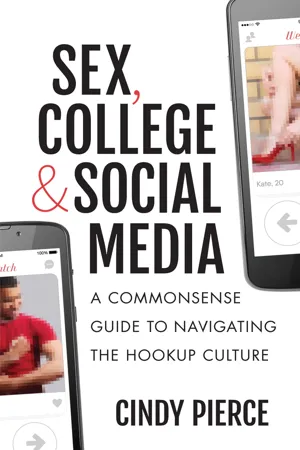
eBook - ePub
Sex, College, and Social Media
A Commonsense Guide to Navigating the Hookup Culture
- 240 pages
- English
- ePUB (mobile friendly)
- Available on iOS & Android
eBook - ePub
About this book
Sex in college has never been simple. And with modern technology, the rising rates of sexual assault and STDs, and an increasingly ambiguous hookup culture, it is getting ever more complex. Sex, College, and Social Media: A Commonsense Guide to Navigating the Hookup Culture is a compassionate, funny, and well-researched primer for the modern college student, both male and female. It covers a range of topics, including: * How improved communication can make sex better for everyone * Ways that porn and the media have warped our expectations * Trustworthy information about STDs and contraception * How to have a healthy relationship with alcohol and drugs * What terminology is appropriate and respectful to use for all things LGBTQ * The facts about sexual assault on campus, and what to do if you or someone you know is assaulted * Consent * and much more Based on author Cindy Pierce's experience talking to college students and on extensive social and medical research, Sex, College, and Social Media provides trustworthy answers for pressing questions about all aspects of the college social scene. It will prepare entering freshmen for their new environment and continue to provide helpful and supportive guidance through senior year and beyond.
Information
1
The Misinformation Age
How the Media Warps Expectations
Today's omnipresent media has had a major impact on what we are conditioned to expect from our bodies, our sexual relationships, and ourselves. This has landed us in what I like to call the "misinformation age"—we are all so overwhelmed with conflicting messages and impossible expectations that it has become very difficult to get to the truth. Many of the questions I have received from students over the years stem from this growing mountain of misinformation; in this chapter, I'll provide answers to some of the most common questions I hear.
Why Is Body Image Such a Problem?
Body image issues continue to grow as the culture feeds messages to consumers at a faster pace through more media than ever before. The relentless messaging that you, whether you are male or female, are not enough—not attractive enough, not hot enough, not endowed enough, and so on—is a marketing ploy that continues to sell products. According to a study done in conjunction with the Dove Campaign for Real Beauty, only 4 percent of women around the world consider themselves beautiful, 72 percent of girls feel tremendous pressure to be beautiful, and 80 percent of women agree that every woman has something about her that is beautiful but do not see their own beauty.1
There is particular pressure on girls that starts very early in life, picks up intensity in middle school, and persists well into adulthood. A major aspect of social currency for girls and women continues to be rooted in physical appearance, including clothing and accessories designed to enhance a certain look. Peers, marketing campaigns, social media, fashion magazines, and tabloids fuel the pressure on girls and women by giving them constant reminders of what they could and should look like. The primary intention of many mainstream products and marketing campaigns is to convince people that they are not enough and need the product to improve their appearance. This is further exacerbated by modern hyperconnectivity, which pushes girls and women to constantly compare themselves with others, reinforcing the notion that the way they look is somehow wrong. Rather than existing comfortably in their own skin, many women engage in what Dr. Caroline Heldman, professor of politics at Occidental College, calls "habitual body monitoring":
What is habitual body monitoring? We think about the positioning of our legs, the positioning of our hair, where the light is falling, who's looking at us, who's not looking at us.... In fact, in the five minutes that I've been giving this talk, on average, the women in this audience have engaged in habitual body monitoring ten times. That is every thirty seconds. Eating disorders are much more prevalent with those who see themselves as sex objects, as well as suffer from body shame and depressed cognitive functioning. If we're engaging in habitual body monitoring, it simply takes up more mental space that could be better used completing a math test, completing your homework. It just sucks our cognitive functioning.2
Body image is an issue for boys and men as well, but they are reluctant to complain openly, often because they are expected to be emotionally unaffected and strong. Pressures surrounding body image are mainly unspoken and unacknowledged among guys who are friends. Being athletic, muscular, and well-endowed are three attributes that give boys and men more social currency, particularly among other guys. While there aren't as many products on the market directed at males, the message that you must look a certain way is conveyed through bodybuilding websites, popular video games, marketing, movies, and Internet porn.
"Because I was constantly disappointed about how I looked in middle and high school (overweight, not muscular), I've subconsciously developed the twisted belief that physical appearance is the most important factor when it comes to overall success in life. My current bodybuilder-like physique and weightlifting habits are a result of that belief."
—Male, age twenty
Promoting Healthy Masculinities
Mark Tappan, Professor of Education and Human Development, Colby College
There is much talk these days, in the popular and academic press, about the so-called "boy crisis." Primarily this is a concern about the decline in academic performance and engagement of boys and young men in elementary, middle, and high schools, as well as in colleges and universities. Concerns, however, focus also on nonacademic issues involving boys and young men, including, most significantly, the perpetration of sexual violence.
There is mounting evidence that adherence to traditional masculine norms and stereotypes (e.g., emotional stoicism, toughness, autonomy, aggression/violence) is academically, psychologically, and socially harmful, and may be responsible, at least in part, for the challenges and problems that boys and young men currently face. Some boys and young men, however, reject these traditional norms and, instead, embrace what might be called "resistant" or "healthy" forms of masculinity (e.g., expressing emotional vulnerability, valuing intimacy/interdependence, renouncing aggression/ violence). Most importantly, recent research suggests that such resistance to traditional forms of masculinity leads to increased educational success, as well as to positive psychological and social outcomes.3
Given these promising research results, I have been working with my students at Colby College, a small liberal arts college in Waterville, Maine, to develop strategies to promote healthy forms of masculinity, and to encourage boys and young men to work for gender equity, and to prevent sexual violence. These strategies are intended to go beyond bystander intervention and other models of sexual violence prevention, to move toward primary prevention efforts that seek to challenge and change broader cultural assumptions about masculinity, male privilege, and male entitlement.
One of these initiatives entails students from my Boys to Men class, working in coed pairs, leading weekly discussion groups with elementary and middle school boys. The goal of these groups is to support the development of healthy forms of masculinity by constructing "hardiness zones" for boys,4 that help boys to resist the most debilitating pressures of conventional masculinity, to develop a critical perspective on the culture in which they live, and to form genuine and meaningful relationships with both peers and adults. Group leaders work with a common curriculum, which includes team building, media literacy, and social justice activities. Groups also undertake an end-of-the-semester social action project, designed to identify an issue of unfairness/injustice in their schools, and to enable boys to gain skills as activists and change agents.
Another initiative entails work with Mules Against Violence (MAV), a student organization whose mission is to work with male-identified athletes to raise awareness about the prevalence of sexual violence in the college community, as well as to challenge gender norms and stereotypes. As president of MAV, Eric Barthold ('12) developed a curriculum for facilitated conversations on masculinity, male privilege, sexual assault, and sexual health that were conducted with all of Colby's male sports teams. These conversations aim to spark peer-to-peer discussions and amplify the healthy voices within the male student–athlete population, which inherently holds a great amount of social power on campus. Since graduating from Colby in 2012, Eric has adapted these conversations, now titled "Man Up"and Open Up (manupandopenup.com), in order to bring them to high school and middle school groups around New England and even South Africa.
A third initiative was spearheaded by Jonathan Kalin ('14), who took over the leadership of MAV after Eric graduated. John developed the Party With Consent (partywithconsent.org) movement, which started with the distribution of neon tank tops emblazoned with the "Party With Consent" slogan, and quickly grew into affirmative-consent-themed memes, music, and parties, all designed to bring the discussion about consent out of the dark and into the mainstream. Another successful initiative was Date Week, a week of highly publicized discounts at local restaurants if students showed up with a date. These efforts were designed to simultaneously create space for men (and women) to think critically about the current campus culture around consent, sexual relationships, and gender dynamics, and to provide options for them to act and interact in more healthy and empowering ways.
Working with committed and courageous young men like Eric and John (and many others) is absolutely inspiring, and it makes all of the hard work worthwhile. Disrupting traditional, unhealthy forms of masculinity and replacing them with healthy masculinities is a task that is challenging, ongoing, and never ending. But it is also exciting and energizing, and it holds the potential to help us move toward a world in which justice, compassion, and mutual respect are the hallmarks of all intimate relationships.
What Is a Normal Penis Size?
Anxiety levels are high among young men about penile adequacy, including length, shape, diameter, and general appearance, as well as about whether or not they are circumcised. Men are eager to know if they fit the norm. According to many porn-consuming men, porn makes you question whether your penis is adequate. The average size of a penis in porn is more than eight inches. When a guy is repeatedly exposed to anaconda-sized penises while watching porn, he is at risk of becoming worried about his own penis. Having spoken to many heterosexual women about this issue, I can tell you that most women are relieved that you don't have an anaconda-sized penis. And if you are one of the rare fellas who does, bring a tube of lube!
• According to the British Journal of Urology International, approximately 85 percent of women report being "satisfied with their partners' penile size," but only 55 percent of men reported satisfaction with the size of their own penis.5
• The same article in the British Journal of Urology International, which was a meta-analysis of various studies performed on men of a variety of nationalities, ages, and sexual orientations, reported the following measurements as average for penile size across groups:
Flaccid: Length 12-13 cm (4.7-5.1 in)
Girth 9-10 cm (3.5-4 in)
Erect: Length 14-16 cm (5.5-6.3 in)
Girth 12-13 cm (4.7-5.1 in)6
• The average depth of a vagina when the woman is in a state of arousal is only 4.25 to 4.75 inches. Your penis is probably plenty long!7
"My 'figuring out' was done by trial and error and looking online. When I was thirteen, I was very self-conscious about my penis size and hesitant to receive a hand job. I thought girls expected a penis to be around six inches long. On a good day I was pushing three and a half inches at the time. Worrying about my penis size during a sexual encounter in high school led to anxiety about getting an erection."
—Male, age twenty-two
Why Do Many Young Guys Suffer from Erectile Dysfunction?
Male college students e-mail me privately about erectile dysfunction (ED) concerns more than anything else. The fact that 5 percent of men in their twenties report having ED indicates that it is more of an issue for younger men than many people think.8 Angst around getting an erection, fumbling with a condom, antidepressant medication, obesity, drugs, and alcohol all contribute to ED in younger men.9 While some articles and research claim there is no link between porn and ED, anecdotal evidence and studies like the one conducted by the Society of Andrology and Sexual Medicine (SIAMS), which surveyed twenty-eight thousand men, are convincing. Over the past eleven years, I have consistently heard from young men who report that their erectile dysfunction issues subsided when they quit viewing porn. These kinds of experiences are echoed in an extensive number of personal stories contributed to websites designed as resources for young men seeking support and perspective. If you want to read personal stories of young guys who have had issues with porn, you will find an overwhelming number of perspectives on the website Your Brain on Porn (yourbrainonporn.com).10
Dr. Tyger Latham, a Washington, D.C., psychologist, found himself convinced by personal reports from his clients, as well as accounts on dozens of websites and message boards, that ED is the result of a complicated combination of physiological and psychological factors. Reports that porn does not impact the sexual experiences of young men are not particularly convincing. Many habitual porn consumers report that taking a break from porn helped them get back on track when they struggled with sexual anxiety, including ED. The results from a study of twenty-eight thousand Italian men align with what I hear from a number of college men: researchers found "gradual but devastating" effects of repeated exposure to pornography over a long period of time. The head of the study, Carlos Forsta, reports that the problem "starts with lower reactions to porn sites, then there is a general drop in libido and in the end, it becomes impossible to get an erection."11
In older men, ED may be caused by underlying medical conditions such as heart disease, or can be a side effect of some medications. Among younger men, however, the causes are more often psychological. There are rare cases of what is called primary ED, in which a man has never been able to have an erection, but the majority are secondary cases, in which the man has had normal erectile function in the past but is now facing problems. The psychological causes in these cases include:
- Depression
- Stress or anxiety about a nonsexual problem
- Performance anxiety
- Relationship problems that make sex undesirable or not pleasurable
And, of course, there's the one we're all familiar with: whiskey dick, a man's inability to get an erection after consuming alcohol or another substance.
To better understand ED, let's take a quick look at the physical mechanics of erection. The penis contains "chambers" made of spongy erectile tissue, which flood with blood when a man becomes aroused. The Cornell Medical College Department of Urology explains it as follows: when a man is stimulated (whether physically or mentally), "chemicals are released in the brain that cause signals to pass down the spinal cord and outward through special nerves (nervi erigentes) into the penis. These nerves release another chemical (nitric oxide) that causes the aforementioned smooth muscle to relax and blood rushes into the erectile bodies, causing erection."12 That is to say, an erection depends on the brain releasing certain chemicals that trigger a chain response and results in those erection chambers filling up. When a man is stressed or anxious, however, those initial brain signals get repressed, making it impossible for him to get hard. Point being, there's nothing wrong with the guy or his penis—the brain just thinks something is happening in the outside world that would make this a bad time to get an erection (ironically, it often seems to think that at just about the only time when it would be good to have one).
Why Do Women Go Out with Guys Who Are Dicks?
It's a perplexing situation: many women claim that they want a nice guy but then go out with a guy who acts like a dick. I know you young people get tired of hearing adults in committed long-term relationships telling you to take the high road because it will pay off. If you interviewed a lot of happy, committed couples, you would hear stories about people who landed in excellent relationships after they grew up, figured things out, and emotionally woke up. But the short term is more your concern. What many young guys are asking is: Why are so many assholes getting laid and finding girlfriends? It is maddening, and has been for generations. There is no clear answer; th...
Table of contents
- Cover
- Half Title
- Title
- Copyright
- Dedication
- Contents
- Introduction
- 1. The Misinformation Age: How the Media Warps Expectations
- 2. Connecting: Navigating the World of Texting, Twitter, and Tinder
- 3. Unplugging: Relating to Something Other Than Your Phone
- 4. Porn: How Pornography Impacts Your (Real-Life) Sexual Relationships
- 5. Better Sex: How to Find Pleasure and Connection
- 6. Alcohol: How to Have a Smarter Relationship with Substances in College
- 7. Sexual Assault: Knowing the Facts and Advocating for Change
- 8. LGBTQ: Getting Informed and Showing Respect
- 9. Safer Sex: What You Need to Know About STIs and Contraception
- A Final Word
- Resources
- Acknowledgments
- Notes
- References
- Index
- About the Author
Trusted by 375,005 students
Access to over 1.5 million titles for a fair monthly price.
Study more efficiently using our study tools.
Frequently asked questions
Yes, you can cancel anytime from the Subscription tab in your account settings on the Perlego website. Your subscription will stay active until the end of your current billing period. Learn how to cancel your subscription
No, books cannot be downloaded as external files, such as PDFs, for use outside of Perlego. However, you can download books within the Perlego app for offline reading on mobile or tablet. Learn how to download books offline
Perlego offers two plans: Essential and Complete
- Essential is ideal for learners and professionals who enjoy exploring a wide range of subjects. Access the Essential Library with 800,000+ trusted titles and best-sellers across business, personal growth, and the humanities. Includes unlimited reading time and Standard Read Aloud voice.
- Complete: Perfect for advanced learners and researchers needing full, unrestricted access. Unlock 1.5M+ books across hundreds of subjects, including academic and specialized titles. The Complete Plan also includes advanced features like Premium Read Aloud and Research Assistant.
We are an online textbook subscription service, where you can get access to an entire online library for less than the price of a single book per month. With over 1.5 million books across 990+ topics, we’ve got you covered! Learn about our mission
Look out for the read-aloud symbol on your next book to see if you can listen to it. The read-aloud tool reads text aloud for you, highlighting the text as it is being read. You can pause it, speed it up and slow it down. Learn more about Read Aloud
Yes! You can use the Perlego app on both iOS and Android devices to read anytime, anywhere — even offline. Perfect for commutes or when you’re on the go.
Please note we cannot support devices running on iOS 13 and Android 7 or earlier. Learn more about using the app
Please note we cannot support devices running on iOS 13 and Android 7 or earlier. Learn more about using the app
Yes, you can access Sex, College, and Social Media by Cindy Pierce in PDF and/or ePUB format, as well as other popular books in Medicine & Business General. We have over 1.5 million books available in our catalogue for you to explore.