eBook - ePub
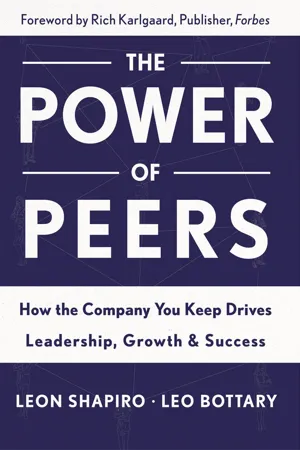
Power of Peers
How the Company You Keep Drives Leadership, Growth, and Success
- 208 pages
- English
- ePUB (mobile friendly)
- Available on iOS & Android
eBook - ePub
Power of Peers
How the Company You Keep Drives Leadership, Growth, and Success
About this book
Birds of a feather flock together. We're all in the same boat. Great minds think alike. While just figures of speech to some, they reflect a simple truth--it's the company we keep that often determines the level of personal growth and professional success we achieve in life. Business leaders exchange information and ideas. They network to make deals and build partnerships. They work together to optimize best practices, and they reach out to leaders outside their companies to accelerate growth. Simply put, CEOs and business leaders provide value to one another that they can't find anywhere else. In The Power of Peers, authors Leon Shapiro and Leo Bottary introduce peer advantage, a concept that transcends peer influence. This is what CEOs and business leaders experience when they are more selective, strategic, and structured in the way they engage their peers. Peer advantage gives CEOs the insights to compete and the courage to act. The Power of Peers features stories of business leaders from a range of industries to illustrate the five essential factors for peer advantage, how it impacts personal growth and why it has proven so effective in helping leaders identify future opportunities and challenges. It's what top, growth-oriented executives have relied upon for decades to be successful in business and in life.
Information
Part I
Peer Influence in a Complex World
1
Are You a Peerless Leader?
CEOs are faced with a singular reality: there are very few people they can rely upon for impartial advice. It’s just not that easy to find individuals who know precisely what it’s like to sit in the CEO’s chair. We’ll introduce you to CEOs—from a range of industries and from companies of various sizes—who have turned to their peers to help them become better leaders and build stronger companies. Meet Paul Caskey.
In 1983, a year after receiving his bachelor of science degree in chemical engineering, Paul Caskey joined CCP, Inc., a contract manufacturer of hair bleaching powders for the cosmetic industry. Located in northern New Jersey, the company had just $640,000 in sales, employed ten people, and had never turned a profit. Paul was named general manager and reported directly to owners who were not active in the business.
Within a few short years, Paul grew the company to $4 million in sales and was named CEO. With more than 90 percent of its revenues derived from hair bleach products, the company continued at a pace of slow, steady growth. Having begun at CCP pretty much right out of school, Paul realized that, as leader of a growing company, he would soon test the limits of his knowledge and experience. Paul understood that—with absentee owners, a lack of exposure to industries outside his own, and no one in the organization who knew what it was like to sit in the CEO’s chair—he needed help.
Lonely at the Top
Paul’s situation was not unlike that of many CEOs, whether they are new to the position or have served as a CEO in the past. As we touched on in the introduction, a study conducted by the Center for Leadership Development and Research (CLDR) at Stanford Graduate School of Business, Stanford University’s Rock Center for Corporate Governance, and The Miles Group revealed that many CEOs struggle with isolation and a sense that they are “lonely at the top.”1 Nearly two-thirds of CEOs do not receive outside leadership advice, while 100 percent of respondents stated that they would be open to making changes based on feedback. Stephen Miles, CEO of The Miles Group, stated, “Even the best-of-the-best CEOs have their blind spots and can dramatically improve their performance with an outside perspective weighing in.”
The idea that being a CEO is a solitary pursuit is a misapprehension. Author and founder of Virgin Group Richard Branson once said, “Many people think that an entrepreneur is someone who operates alone, overcoming challenges and bringing his idea to market through sheer force of personality. This is completely inaccurate. Few entrepreneurs—scratch that: almost no one—ever achieved anything worthwhile without help.”2
To address the feeling of isolation that can be so limiting and constraining for anyone leading an organization, CEOs typically draw from a broad range of resources including coaches, consulting companies, industry events, and executive education. These are all worthwhile and effective pursuits, and according to CEOs we interviewed from myriad organizations of varying sizes, they are among the most popular ways CEOs learn, grow, and address being lonely at the top. Paul tried something different.
How CEOS Teach One Another
Paul filled the gaps he believed could limit his ability to successfully lead CCP, Inc., into the future by joining a local CEO advisory group. The group was made up of a dozen of his peers from various industries. Initially, Paul questioned how such a diverse group could help meet his unique needs, thinking, “How will CEOs who know nothing about my specific business or my industry help me?” Also, given the size of the group, he wondered, “How much time are we really going to spend on issues that impact my company?”
Similar to Team In Training, a sports training program in which people who want to complete a marathon or other endurance event surround themselves with others who share the same goal, a typical CEO advisory peer group is made up of high-performing CEOs who want to grow as leaders and build thriving organizations. By coming together, CEOs help one another realize their respective individual goals. Rather than learning by reading case studies, they work in real time on actual business issues. Being part of a group provides each CEO a broader range of perspectives than she would likely receive from the people at her company.
CEO peer groups also provide another important benefit. Once CEOs become exposed to the value that comes from engaging with their own peers, they begin to see their organization horizontally as well as vertically. They pay more attention to the power of peers in their organizational structure and start to tap into the key influencers more frequently. This peer power, when channeled properly, serves as a wellspring for driving organizational excellence.
Solving a Seasonality Problem
Paul’s CEO advisory group meetings typically started with a check-in, during which group members offered brief updates on what was happening in their lives personally and professionally. One August morning, when it was Paul’s turn to talk about what was going on at his company, he briefly shared a situation that he dealt with each year during the summer months. Paul explained that when it comes to manufacturing hair bleaching powders, the amount of moisture in the air matters. A lot. Think of the chemistry of hair bleaching powders as similar to that of solid rocket propellant—the substance can react violently with moisture. Therefore, it was too dangerous to manufacture the bleaching powders during the humid summer months, and Paul’s company had to cease production. This resulted in a 25 percent underutilization of the company’s facility during that period.
When Paul finished offering his overview, he assumed the next person would take her turn. Instead, one of the members asked, “Why is that acceptable? Isn’t there anything else you could be doing instead?” Having grown up in the hair bleach business, Paul had never considered alternatives that could resolve the issue of seasonality.
When Paul returned to his company, he asked himself why the situation was acceptable and began to explore his options. First, he and his team identified items that could be produced using equipment the company already had in place. Knowing that it is easier to gain additional business from existing customers than to attract new ones, he focused on items that his current customer base would need. Soon after, CCP embarked on a line of bath salts, fragranced talcum powders, and drawer sachets, all of which could be manufactured with no modifications to existing equipment and would be purchased by CCP’s existing customer base. While these products are produced year round, their production tends to be heavily weighted in the summer months to gear up for the Christmas/Hanukkah holiday season. Furthermore, these products were not hazardous and they carried higher profit margins because the formulas were developed at CCP.
Within a year, CCP added $4 million in sales at higher profit margins, which doubled the business, dramatically increased profitability, and removed the seasonality problem. Within five years, CCP grew to $12.5 million in sales, with 120 employees producing numerous items for the hair, bath, and body markets, and Paul eventually moved on.
Paul suggested that the real value from this peer advisory experience didn’t come from peers answering his questions; rather, it came from CEOs questioning his answers. As Paul reflected on his group experience, he noted several other major benefits he would not have received anywhere else:
■ Impartiality—Employees and board members, regardless of their espoused objectivity and true sincerity, have a personal stake in the outcome of business decisions. Fellow CEOs are not burdened with that extra layer of consideration—they have no agenda other than to help one another. They can ask the hard questions and challenge assumptions without regard for sacred cows, personal relationships, or other organizational/ industry blinders. It’s an eye-opening experience for many CEOs when peers look at a specific challenge through a completely impartial lens.
■ Shared challenges—While the CEOs in peer groups may serve entirely different types of customers in widely varying industries, they share common challenges regarding employees, growth, profitability, executive development, technology, and uncertainty, to name just a few. In fact, their diversity enhances the group’s learning by the breadth and depth of their background and experience. The more they talk, the more they realize how much they have in common and how much they can learn from one another.
■ Learning—While they share challenges, the myriad industries they represent, the size of the organizations they lead, and the depth of their experience set the table for rich conversations about proven practices for effective leadership. Sharing ideas across industries, differing stages of growth, and changing business challenges enriches the learning experience. By helping one another through this process, these CEOs will also share their personal triumphs and failures. This display of trust creates an environment in which the CEO can be truly vulnerable, open to learning and growing. And unlike one-to-one executive coaching, which can be a rich complement to the peer advisory experience, peer advisory groups harness the unique power of the group dynamic.
■ Empathy—If you’ve never been a CEO, it’s nearly impossible to put yourself in a CEO’s shoes. It’s difficult for most of us, regardless of how much we care or how objective we believe we are in offering counsel to our CEOs, to imagine what that’s really like. Fellow CEOs are looking at the whole picture because that’s what they do every day— they can identify with their fellow CEOs. The empathy that one CEO shares with another is felt not only professionally but personally as well.
■ Owning the solution—Unlike consulting firms, which offer recommendations, peer advisory groups help individual members come to their own conclusions about the actions they are prepared to take to achieve a particular goal. The dynamic of owning your own solution versus implementing a recommendation that’s been imposed on you can make all the difference in the world when it comes to effective execution.
Paul recalled that when he started at CCP there were only ten employees. During his tenure, the number of employees grew to 120. Paul credits the peer-to-peer experience he gained in his CEO group with enlightening him to the power of peers and the way it factors into building a winning team. Not surprisingly, Paul credits his people for the role they played in driving organizational excellence at CCP.
Communities of Practice
In 1991, Etienne Wenger-Trayner and Jean Lave coined the term communities of practice,3 which was described a decade later as “Groups of people who share a concern, a set of problems, or a passion about a topic, and who deepen their knowledge and expertise in this area by interacting on an ongoing basis.”4 The structural characteristics of a community of practice include having a domain that involves a common knowledge base around a shared purpose, a community willing to collaborate, and a practice with a shared set of approaches, language, and tools. All of these elements are present in a CEO peer advisory group.
Those who lead these CEO communities of practice do so by:
- ■ Using open-ended questions to promote active problem solving
- ■ Creating social interdependence and setting clear goals through collaboration
- ■ Creating an environment of trust, confidentiality, and transparency
- ■ Utilizing tools that help participants organize their knowledge
- ■ Playing the role of facilitator rather than coach
When we talked to Etienne and Beverly Wenger-Trayner, who today are active researchers, consultants, and authorities on the topic, they explained that communities of practice have been around since the dawn of human existence, but once they had a name and a common language, it became easier to talk about them and cultivate them intentionally.
While studying historical cases of apprenticeship with anthropologist Jean Lave, Etienne recalled, “Initially, we were studying apprenticeship as a way to rethink learning. We found that an apprenticeship is often not just a relationship between a master and a student. We noticed this whole community around the master that acts as a learning curriculum for the apprentice. A lot of the learning interactions were not with the master, they were with one another. This is essentially where the term communities of practice comes from.”
In an article cowritten by Etienne and William Snyder for Harvard Business Review in 2000, they noted that communities of practice were common in classical Greece, where “corporations” of craftsmen had both a social purpose and a business function.5 The members trained one another and worked together to share innovations. During the Middle Ages, guilds offered a similar resource for artisans.
Mastermind Groups
In early American history, Benjamin Franklin organized a group of twelve friends called the Junto to provide an ongoing forum for structured discussion.6 The group’s original members included printers, surveyors, a cabinetmaker, a cobbler, a clerk, and a merchant. They met on Friday evenings to talk about morals, politics, and natural philosophy. Franklin stated, “Our debates were to be under the direction of a president, and to be conducted in the sincere spirit of inquiry after truth, without fondness for dispute or desire of victory.”
In 1743, the Junto would become the American Philosophical Society, created “to promote useful knowledge in the colonies” and still active to this day.7
In business, Napoleon Hill’s book Think and Grow Rich described the advent of the mastermind group and how both Andrew Carnegie and Henry Ford credited their mastermind groups for much of their success. Hill regarded these groups as the secret to the success of all great men and foundational to all outstanding personal achievements. A mastermind group called the Vagabonds included Henry Ford, Thomas Edison, President Warren G. Harding, and Harvey Firestone—a pretty formidable collection of peers!8
Millennials Seek Connections
While it may be fascinating to imagine being in a peer group with Henry Ford and Thomas Edison, or the interesting conversations Ben Franklin must have led during Junto meetings, the richer conversation may lie in the role peer advisory groups will play in the future. This is particularly important because, as of 2015, millennials represented 45 percent of employees in the workforce—and 28 percent of them served in management roles.9
While 82 percent of hiring managers regard the millennial generation as more technically adept than previous ones, this generation is also characterized as caring a great deal about their work colleagues.10 They may have grown up in a digital world, but they are hungry for in-person experiences as well. And because many of these employees have experienced group work as part of their educational experience, their inclination to collaborate rather than compete is already translating into the workplace. Best-selling author and business advisor Chris Brogan added, “There is a big appetite for face-to-face meetings, particularly when it comes to closing a deal. I’m also seeing a trend toward young people engaging more deeply with smaller affinity groups as...
Table of contents
- Cover
- Half Title
- Title
- Copyright
- Dedication
- Contents
- Foreword
- Introduction: You Don't Have to Go It Alone
- PART I Peer Influence in a Complex World
- PART II The Five Factors for Peer Advantage
- PART III Leading with Peer Advantage
- Afterword
- Acknowledgments
- Notes
- References
- Index
- About the Authors
Trusted by 375,005 students
Access to over 1.5 million titles for a fair monthly price.
Study more efficiently using our study tools.
Frequently asked questions
Yes, you can cancel anytime from the Subscription tab in your account settings on the Perlego website. Your subscription will stay active until the end of your current billing period. Learn how to cancel your subscription
No, books cannot be downloaded as external files, such as PDFs, for use outside of Perlego. However, you can download books within the Perlego app for offline reading on mobile or tablet. Learn how to download books offline
We are an online textbook subscription service, where you can get access to an entire online library for less than the price of a single book per month. With over 1.5 million books across 990+ topics, we’ve got you covered! Learn about our mission
Look out for the read-aloud symbol on your next book to see if you can listen to it. The read-aloud tool reads text aloud for you, highlighting the text as it is being read. You can pause it, speed it up and slow it down. Learn more about Read Aloud
Yes! You can use the Perlego app on both iOS and Android devices to read anytime, anywhere — even offline. Perfect for commutes or when you’re on the go.
Please note we cannot support devices running on iOS 13 and Android 7 or earlier. Learn more about using the app
Please note we cannot support devices running on iOS 13 and Android 7 or earlier. Learn more about using the app
Yes, you can access Power of Peers by Leon Shapiro,Leo Bottary in PDF and/or ePUB format, as well as other popular books in Negocios y empresa & Negocios en general. We have over 1.5 million books available in our catalogue for you to explore.