eBook - ePub
Project Sponsorship
An Essential Guide for Those Sponsoring Projects Within Their Organizations
- 256 pages
- English
- ePUB (mobile friendly)
- Available on iOS & Android
eBook - ePub
Project Sponsorship
An Essential Guide for Those Sponsoring Projects Within Their Organizations
About this book
The role of project sponsor is critical in large projects during the development of the business case, for governance and assurance and as the person who decides that the project should continue or close at any stage. Yet in many organizations the skills of the sponsor are often assumed; he or she will be a senior manager who may well have no practical project experience at all. David West explains the roles and skills that lie at the heart of effective sponsorship. The sponsor acts as a lynch-pin between the Board and the Project Manager, communicating and translating requirements downwards and resource needs, progress and constraints back upwards. An over-zealous sponsor may be tempted to assume some of the project manager's responsibilities, whilst an ineffective sponsor may be invisible, leaving the project manager uninformed by, and unrepresented to, the Board. Project Sponsorship includes exercises, examples and case histories from the real world of projects. It is an essential guide for anyone assuming the important role of managing the business case of the project and will help you ensure that the organization is 'doing the right things' as well as 'doing things right'.
PART 1
THE NATURE OF PROJECT SPONSORSHIP AND SPONSORS
CHAPTER 1
THE VALUE OF PROJECT SPONSORSHIP TO THE ORGANIZATION
In this chapter we will explore the value of project sponsorship to an organization by reviewing three elements:
- The value of a project to the organization
- The role of the Project Sponsor
- The value of the Project Sponsor.
The Value and Risk of Projects
There are innumerable changes and aims that organizations seek to achieve through projects. For example, a company may wish to change its accounting systems. It may wish to do this in order to provide better management information or achieve efficiencies, or both. A car manufacturer may need to upgrade an old model or relocate manufacturing to a country with lower labour costs in order to increase sales and profits. NASA undertook the Apollo space programme to fulfil President John F. Kennedy’s aim of landing a man on the moon. The very nature of projects is that they are almost all unique and different from the everyday business of the organization. A car manufacturer’s business is making cars. Planning and building a new factory in a different country is a major undertaking, dramatically different to its everyday business. Manufacturing cars is a continuous production line process: building a new factory starts with, perhaps, a competitive need to reduce costs and an idea of how to go about it. The project concludes when the new factory is built and commissioned, staff hired and trained and the enterprise is turning out cars. If the cost of planning, designing and building the new factory has been in accordance with the budget set when the project was approved by the board, and if the costs of labour and materials in the new country are as budgeted, and if the cost of shipping is also as forecast then all looks set to deliver the value that the project was designed to achieve. That value stems from production costs which are lower than in the organization’s existing facilities. However, the attentive reader will have noticed a number of ‘ifs’. Projects are fraught with risk. Responsibility for managing this risk and delivering a project that adds value to the organization, or aborting the project if it will not, rests with the Project Sponsor.
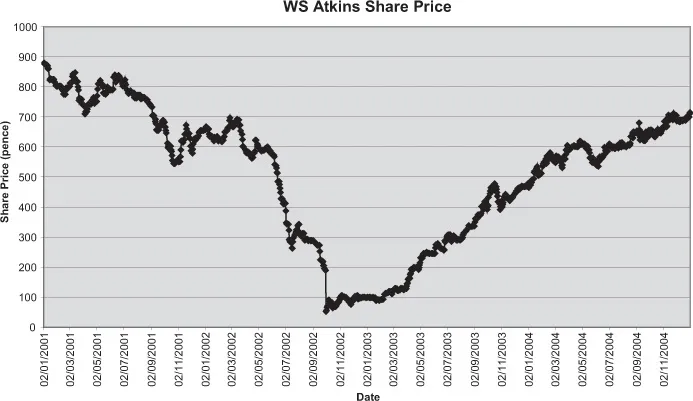
If we look again at the example of an organization that wishes to change its accounting system, this might on the face of it seem a much less daunting prospect than relocating manufacturing facilities overseas. However, in 2002 W.S. Atkins, ‘one of the world’s leading providers of professional, technologically-based consultancy and support services’1 suffered a dramatic nosedive in its fortunes. In its 2001 annual report it stated ‘During the year the Group commenced a major initiative to put in place a global knowledge management system, the core systems for Finance and Human Resources for the UK Operations will also be replaced in 2002.’ This involved investment in a ‘Shared Service Facility’ in Worcester which was to open in January 2002, but this project did not go entirely according to plan. Failures in the new Worcester facility resulted in late invoicing of £20m–25m of work and debt rocketed. The Daily Telegraph reported that W.S. Atkins ‘stunned investors in October with a howitzer of a profits warning’.2 The effect on the share price was catastrophic as shown below.
W.S. Atkins was then, and continues to be, a strong, reputable and growing company and it recovered from the setback, as Figure 1.1 shows, but for a few months it lost almost all of its value on the stock market. Some in the engineering industry who knew the underlying strength of the company made a killing on the shares, but there were casualties at board level and it can’t have been an enjoyable experience for those there at the time. If a problem of this nature can befall ‘one of the world’s leading providers of professional, technologically-based consultancy and support services’ it is a salutary lesson to all of us.
Coming more up to date, at the time of writing, Terminal 5 at London’s Heathrow airport has recently been opened. It is an architectural and engineering masterpiece. However, in the first few days of its operation failures in the baggage handling system resulted in masses of cancelled and delayed flights, attracting widespread criticism in the press and real distress for many passengers. There is hardly a comedy sketch writer that is not sincerely grateful to British Airways (BA) and the British Ariports Authority (BAA) for this source of new material (except those actually travelling of course). The problem with Terminal 5 was not due to late delivery or cost overrun but with putting this magnificent new facility into operation. It was the interface between the project and the existing organization that failed, and this is the crux of project sponsorship.
Figure 1.1 W.S. Atkins’ share price
Given the obvious risks of such dramatic change to their operations, one might wonder why companies like Atkins and BA embarked on these changes. The simple fact is that they had to. The business environment is dynamic. Competitors are constantly improving and customers continually demand better value. If you don’t change you probably will not survive and you certainly won’t grow.
Technology is also an ever more important driver of change. Consider for example the impact that technological advance has had on the music industry. I am 48 years old. When I was a boy, music was sold on vinyl records. You played singles at 45 rpm and long playing records (LPs) at 331/3 rpm. My parents had a record cabinet full of 78s, which had been the standard media for musical recordings from 1898 until the late 1950s. Vinyl records made 78s and the gramophones used to play them obsolete. They also made the production line for 78s obsolete. The music industry was dominated by 78s for around 60 years: vinyl records dominated for not much more than 20 years. They competed for much of that time with magnetic tape in cassette and cartridge formats of various sizes. One advantage of magnetic tape over the vinyl record was that a record player was very sensitive to movement. Consequently only cassette or cartridge formats were suitable for in-car entertainment. Sony brought out their Walkman in 1979 and it was by the standards of the day a very small portable cassette player suitable for clipping on your belt and going jogging. Around 1982 compact discs emerged. By 1985 Dire Straits’ Brothers in Arms became the first CD to sell a million copies and vinyl was in near-terminal decline. Walkman-style CD players replaced the cassette Walkman players. In 1999 MP3 players started to appear. My iPod goes everywhere with me. It has my entire CD collection on it as well as all my digital photographs, innumerable podcasts, videos etc. Just think about the research and development projects, new factories, new distribution channels and marketing projects that each of these step changes in technology have generated. The transition from film to digital photography is a similar example of technological change matching and stimulating customer demand and in the process completely changing the status quo of an industry.
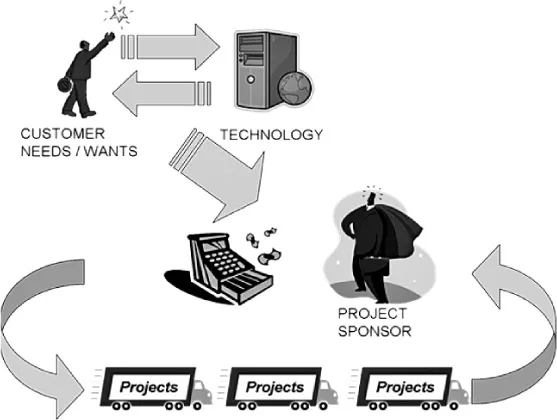
The matching of a customer’s needs and wants with appropriate, developing technology is a business opportunity which drives the necessity for change and consequently projects. As seen in the music industry, the pace of developing technology is accelerating and major strategic change is occurring with ever greater frequency.
The Project Sponsor is increasingly vital to an organization’s very survival. The pace of technological change grows ever faster, and, as customers, the more we get, the more we want. The translation of new technology into new products requires projects and these projects make demands on the organization’s finances which may have long payback periods. It is the Project Sponsor’s primary role to manage the business case of the projects and ensure that the organization is ‘doing the right things’ as well as ‘doing things right’.
Figure 1.2 The project production line
So change projects are fundamentally vital to any organization’s survival and growth. But there are huge risks involved in making these changes to your organization which, if you get them wrong, can threaten the organization’s very existence. Whilst it is possible to manage change within your organization successfully it is not possible to manage the dynamic business environment whilst your organization stands still. You must change, but you must also successfully manage that change. An obvious point perhaps, so why does it go wrong so often? Project management is a well-established discipline with many thousands of qualified, experienced and competent practitioners. Nobody is perfect however, and sometimes projects fail because of project management failures. We will explore some of the important causes of these failures later and arm the Project Sponsor to avoid them. More often though, projects fail at the interface between the project and the organization, and this brings us to the role of the Project Sponsor.
The Role of the Project Sponsor
Project sponsorship is an active senior management role, responsible for identifying the business need, problem or opportunity. The sponsor ensures the project remains a viable proposition and that benefits are realised, resolving any issues outside the control of the project manager.3
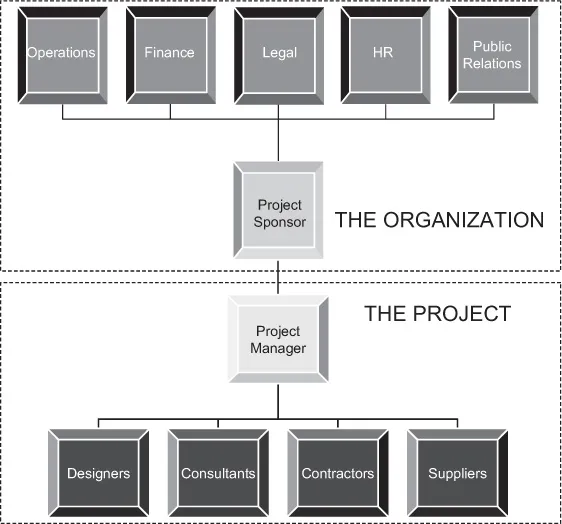
The secret of a successful project is in the relationship between the Project Sponsor and the Project Manager. I liken the relationship to an hourglass in which the Project Sponsor and the Project Manager both fit in the neck of the hourglass. The Project Sponsor manages the top half of the hourglass, which contains all the relevant parts of the organization with a stake in or role to play in the project. The Project manager manages the bottom half of the hourglass which contains all the consultants, designers, contractors, manufacturers and so on, with a role in delivering the project. Figure 1.3 illustrates this relationship.
The roles of the Project Sponsor are essentially fourfold:
- Identifying business need, problem or opportunity
- Owning the business case
- Hiring the project manager
- Translation.
We will now address each of these in turn.
Figure 1.3 The hourglass
Identifying Business Need, Problem or Opportunity
As we have already said, organizations need to change in order to survive and grow. Before we can change we need to know why we must change and into what. To do this we must identify a business need, problem or opportunity, analyse it and come up with an outline of the requisite change.
The identification of a business need, problem or opportunity may initially come from any level within the organization. If it is a significant project it will require sufficient definition to put forward a board paper before further development is sanctioned...
Table of contents
- Cover Page
- Title Page
- Copyright Page
- Contents
- List of Figures
- List of Tables
- Preface
- Introduction
- PART 1 The Nature of Project Sponsorship and Sponsors
- PART 2 Core Project Sponsor Duties and Skills
- PART 3 Understanding Project Management
- Index
Trusted by 375,005 students
Access to over 1.5 million titles for a fair monthly price.
Study more efficiently using our study tools.
Frequently asked questions
Yes, you can cancel anytime from the Subscription tab in your account settings on the Perlego website. Your subscription will stay active until the end of your current billing period. Learn how to cancel your subscription
No, books cannot be downloaded as external files, such as PDFs, for use outside of Perlego. However, you can download books within the Perlego app for offline reading on mobile or tablet. Learn how to download books offline
Perlego offers two plans: Essential and Complete
- Essential is ideal for learners and professionals who enjoy exploring a wide range of subjects. Access the Essential Library with 800,000+ trusted titles and best-sellers across business, personal growth, and the humanities. Includes unlimited reading time and Standard Read Aloud voice.
- Complete: Perfect for advanced learners and researchers needing full, unrestricted access. Unlock 1.5M+ books across hundreds of subjects, including academic and specialized titles. The Complete Plan also includes advanced features like Premium Read Aloud and Research Assistant.
We are an online textbook subscription service, where you can get access to an entire online library for less than the price of a single book per month. With over 1.5 million books across 990+ topics, we’ve got you covered! Learn about our mission
Look out for the read-aloud symbol on your next book to see if you can listen to it. The read-aloud tool reads text aloud for you, highlighting the text as it is being read. You can pause it, speed it up and slow it down. Learn more about Read Aloud
Yes! You can use the Perlego app on both iOS and Android devices to read anytime, anywhere — even offline. Perfect for commutes or when you’re on the go.
Please note we cannot support devices running on iOS 13 and Android 7 or earlier. Learn more about using the app
Please note we cannot support devices running on iOS 13 and Android 7 or earlier. Learn more about using the app
Yes, you can access Project Sponsorship by David West in PDF and/or ePUB format, as well as other popular books in Business & Business General. We have over 1.5 million books available in our catalogue for you to explore.