eBook - ePub
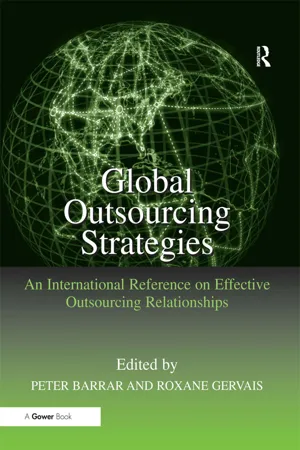
Global Outsourcing Strategies
An International Reference on Effective Outsourcing Relationships
- 346 pages
- English
- ePUB (mobile friendly)
- Available on iOS & Android
eBook - ePub
Global Outsourcing Strategies
An International Reference on Effective Outsourcing Relationships
About this book
One of the most significant techniques to which companies and organizations have turned to improve service delivery and reduce costs has been outsourcing. Over the last 10 years, almost any process has been successfully outsourced. But during that period there have been failures too; projects that never realised their objectives or that had unforeseen impact on business. Global Outsourcing Strategies is a state-of-the-art guide to the best lessons to be learned for successfully implementing and outsourcing projects, or for revisiting existing operations. The 22 chapters explore some of the new areas for outsourcing, after traditional targets such as IT and finance. Information is provided on the different facets of the outsourcing process, such as contract negotiation, the risks involved in outsourcing, the need for service level agreements, the critical requirements needed to build and sustain outsourcing relationships, and ethical supply chain issues. There are also sections exploring the impact of outsourcing on organizational structures; the long term effects; legal issues; management control and inter-firm relationships; as well as case studies from both the public and private sector on the practical side of outsourcing. The book will appeal to practitioners and researchers alike. This is a must-have guide for any organization approaching outsourcing as a global (or local) strategy and for those organizations now reviewing or developing their outsourcing partnerships.
Part1
The Nature of Outsourcing and its Present State
As few attempts have been made to adequately define what is outsourcing and how it is changing within the dynamic state of the work economy it has become necessary to examine whether or not one of the main economic and organizational processes of the last 20 years has stayed as a static process or has evolved to assimilate more easily into the ways in which companies progress and advance their working practices. Part 1 of this volume will therefore address the current state of outsourcing in the working environment and those factors and considerations that may impact on its development in the future.
The opening chapter of Part 1 presents an overview of the benefits that could be gained from outsourcing, as well as the costs associated with the process. The authors, Steven Globerman and Aidan Vining, examine the concept of outsourcing from a firm’s perspective with a focus on its specific governance costs. They also discuss four potential outsourcing situations that centre on the dynamics of product complexity and asset specificity, with suggestions for dealing with each scenario. They conclude by outlining the benefits that outsourcing can bring to organizations.
Matthew Gilley, Abdul Rasheed and Hussam Al-Shammari are responsible for outlining the nature of outsourcing. Their chapter defines outsourcing and lists those major theoretical perspectives that researchers have used in studying the process. They end the chapter with advice on areas and concepts that may prove useful in advancing future research on outsourcing.
Chapter 3 defines the drivers that have been a part of the outsourcing experience within the business environment. In this chapter Ronan McIvor examines the effect that these drivers, such as globalization and a more demanding consumer, have had on both the public and private sectors. The examination of outsourcing across both of these sectors reveals that it is a non-restrictive process. Finally, McIvor suggests what future trends may impact on the way in which outsourcing may develop and the directions that it may take.
Tony Kelly and David Poole, in Chapter 4, investigate the ways in which outsourcing has evolved, including the change in outsourcing from a traditional to a transformational process, as well as offshoring and new technologies. These factors have refined, and continue to refine, outsourcing, and the authors provide examples of these changes within companies.
Part 1 concludes with a chapter by Andrew Kakabadse and Nada Korac-Kakabadse examining the recent developments in global information technology (IT) sourcing. The authors explore the impact that offshoring has had on outsourcing and the reservation that has surfaced in recent times towards global outsourcing. Finally, they propose those best-practice factors that could lead to a better outsourcing relationship.
Chapter1
The Outsourcing Decision: A Strategic Framework
The growth of outsourcing
Firms as diverse as Sun Microsystems, IBM, Mattel, Boeing and Calvin Klein all engage in extensive outsourcing. Sun, for example, currently purchases around 75 per cent of its components from external suppliers (Domberger, 1999). Estimates currently put the market value of outsourcing in the United States (US) at between US$200 and US$300 billion (Dun and Bradstreet, 2000). As outsourcing continues to grow in importance, its nature and focus is evolving. Historically, most outsourcing took place in manufacturing industries, but it is now spreading rapidly within service industries. It is also becoming increasingly cross-national and global: for example, it is estimated that only approximately 40 per cent of the production value of a North American-made automobile now comes from the US, and much of this offshore supply is outsourced.
The nature of outsourcing is diverse. Some firms now outsource core production activities so extensively that they no longer engage in production, as traditionally understood. Inbound and outbound logistics are being extensively outsourced also (Knemeyer et al., 2003; Zsidisin, 2003). Other firms are extensively outsourcing secondary value-chain activities such as information technology, accounting systems, distribution, aspects of human resources management and R&D (Johnson and Schneider, 1995; Lacity and Willcocks, 1998; Odagiri, 2003; Ono, 2003).
Despite its increasing importance, many firms do not have a clear understanding of the benefits and costs of outsourcing (Smith et al., 1998). Yet, the outsourcing firm is inevitably placing at least part of its destiny in the hands of other firms that are seeking to maximize their profits. Thus, while outsourcing is often described as an ‘alliance’, the contracting parties inevitably have conflicting interests (Lacity and Hirschheim, 1993). The strategic objective of outsourcing decision makers should seek to maximize the net benefits of outsourcing relative to the in-house provision of value-chain activities. In practice, this can often be simplified to minimizing the total costs of any given quantity and quality of outsourced good or activity. However, costs must be viewed comprehensively. Costs consist of expenditures for the good itself and the costs associated with ‘governing’ the outsourcing transaction. This raises a number of fundamental questions relating to governance costs. How can the firm assess ex ante the potential governance costs that arise with outsourcing? How, and under what circumstances, can governance costs be reduced?
In this chapter first we present a framework for assessing outsourcing benefits and costs from the firm’s perspective; second, we identify the specific governance costs associated with outsourcing; third, we delineate the three major determinants of outsourcing governance costs: product/activity complexity, contestability and asset specificity; fourth, we present four standard potential outsourcing situations and suggest appropriate responses for each; and, finally, we present some brief conclusions relating to the contingent nature of the potential net benefits of outsourcing.
The benefits from outsourcing
Investors expect outsourcing to create value for shareholders (Hayes et al., 2000). The purpose of outsourcing is to: (1) lower the purchase price of some input by taking advantage of external suppliers’ lower costs, or (2) improve the quality of some input by purchasing some superior capability from an external supplier. In either case, the supplier’s advantage will be one that is not easily imitable. If the firm could easily imitate the cost or capability advantage of outside suppliers, it could produce the activity ‘in-house’. The acquisition of superior capabilities can also be thought of in cost-saving terms – superior capabilities could only be produced at the same quality within the firm at higher cost. However, it is usual in the business strategy literature to analyse each activity on the value chain in terms of the firm’s ability to lower cost or to improve quality (or, more broadly, to in some way differentiate their production process). We follow that distinction in the following discussion of the potential benefits of outsourcing.
Cost-Reducing Rationales For Outsourcing
The costs of outsourcing must be compared to the costs of internal production of the activity. Production costs are those directly generated by the opportunity costs of the resources used to produce the good. Clearly it is impossible to design firms to take advantage of economies of scale for all inputs – even the largest global pharmaceutical firms do not manufacture their own computers. Many inputs are inevitably outsourced. Therefore, outsourcing is really only a further step on the continuum from purchasing and procurement.
There are a number of production cost rationales for outsourcing. The most basic is that internal production of the activity entails production at levels that are too low to be efficient – that is, to achieve minimum efficient scale (Lyons, 1995). Many goods and services for which the organization has low unit demand exhibit significant cost ‘lumpiness’ (McFarlan and Nolan, 1995). The most significant economies of scale may relate to secondary value-chain activities such as administrative and information systems, knowledge and learning, access to capital markets and marketing (Veugelers and Cassiman, 1999). Similarly, economies of scope are becoming a rationale for outsourcing. With the advent of flexible manufacturing, the potential for economies of scope has increased dramatically (Pine, 1993). Firms that can utilize the same production equipment for a range of products have a significant cost advantage compared to smaller, specialized firms (Besanko et al., 2001). Another cost advantage is the potential to change large fixed capital costs into variable costs (Quelin and Duhamel, 2003). Other cost-based rationales for outsourcing include superior external supplier economies of learning (Hayes and Wheelwright, 1984), superior ability to introduce new product generations quickly at low cost, and greater capacity utilization (Morrison, 2003).
There are also organizational cost factors that can motivate outsourcing. Most importantly, especially in large multi-unit organizations, internal units are often price-inefficient. Inefficient internal prices can arise for two reasons. First, the internal production unit may be an efficient low-cost producer, with price as a monopolist (Vining, 2003). Second, the production unit may not have the correct incentives to achieve the minimum feasible production costs, resulting in too high internal prices (Button and Weyman-Jones, 1994). Competition is normally the crucial driver in forcing production costs to their lowest level, but internal production units may not be subject to much competition (although firms can try to induce competition by making internal units bid against each other for production rights). This rationale for outsourcing may be more important than minimum efficient scale issues, especially for larger, bureaucratized firms.
Finally, cost savings can result from altering obligations that a firm faces under government laws and regulations or agreements with unions. For example, firms may be obliged to pay healthcare benefits to workers classified as ‘full time’, whereas part-time workers are not entitled to the same level of benefits (Abraham and Taylor, 1996). Outsourcing specific activities may enable firms to ‘re-hire’ the same workers from external suppliers as temporary employees. Certainly, if labour markets are reasonably competitive and not segmented, such cost savings may prove to be only temporary.
There is some evidence that outsourcing can reduce production costs (Kakabadse and Kakabadse, 2002; Lacity and Hirschheim 1993; McFarlan and Nolan, 1995; Quelin and Duhamel, 2003) but, as noted by Leiblein et al. (2002), such evidence is surprisingly limited. Nevertheless, Ang (1998) found that a large sample of banks that outsource primarily considered production cost savings in their decisions, and there is some evidence to suggest that this finding is generalizable (Benson and Ieronimo, 1996; Lyons, 1995; Saunders et al., 1997; Walker and Weber, 1987). Much of the best empirical evidence comes from outsourcing by government to private suppliers where production cost savings are approximately 20 per cent, especially if competitive bidding is used (...
Table of contents
- Cover
- Half Title
- Title
- Copyright
- Contents
- List of Figures
- List of Tables
- List of Abbreviations
- About the Editors
- About the Contributors
- Part 1 The Nature Of Outsourcing And Its Present State
- Part 2 The Impact Of Outsourcing On Organizational Structures
- Part 3 The Long-Term Effects Of Outsourcing As An Organization-Driven Process
- Part 4 Outsourcing: Legal Issues, Control And Relationships
- Part 5 The Practical Side Of Outsourcing: The Case-Study Approach
- Index
Trusted by 375,005 students
Access to over 1.5 million titles for a fair monthly price.
Study more efficiently using our study tools.
Frequently asked questions
Yes, you can cancel anytime from the Subscription tab in your account settings on the Perlego website. Your subscription will stay active until the end of your current billing period. Learn how to cancel your subscription
No, books cannot be downloaded as external files, such as PDFs, for use outside of Perlego. However, you can download books within the Perlego app for offline reading on mobile or tablet. Learn how to download books offline
Perlego offers two plans: Essential and Complete
- Essential is ideal for learners and professionals who enjoy exploring a wide range of subjects. Access the Essential Library with 800,000+ trusted titles and best-sellers across business, personal growth, and the humanities. Includes unlimited reading time and Standard Read Aloud voice.
- Complete: Perfect for advanced learners and researchers needing full, unrestricted access. Unlock 1.5M+ books across hundreds of subjects, including academic and specialized titles. The Complete Plan also includes advanced features like Premium Read Aloud and Research Assistant.
We are an online textbook subscription service, where you can get access to an entire online library for less than the price of a single book per month. With over 1.5 million books across 990+ topics, we’ve got you covered! Learn about our mission
Look out for the read-aloud symbol on your next book to see if you can listen to it. The read-aloud tool reads text aloud for you, highlighting the text as it is being read. You can pause it, speed it up and slow it down. Learn more about Read Aloud
Yes! You can use the Perlego app on both iOS and Android devices to read anytime, anywhere — even offline. Perfect for commutes or when you’re on the go.
Please note we cannot support devices running on iOS 13 and Android 7 or earlier. Learn more about using the app
Please note we cannot support devices running on iOS 13 and Android 7 or earlier. Learn more about using the app
Yes, you can access Global Outsourcing Strategies by Roxane Gervais, Peter Barrar in PDF and/or ePUB format, as well as other popular books in Business & Business General. We have over 1.5 million books available in our catalogue for you to explore.