- 192 pages
- English
- ePUB (mobile friendly)
- Available on iOS & Android
eBook - ePub
About this book
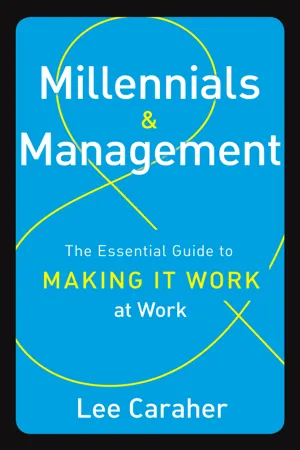
As management ages and prepares to work longer than previous generations and Millennials join companies at steady rate, companies are suffering through tension and dissonance between Millennials and Boomers, and realizing that they can't just wait for management to age out to fix it. Finding productive ways to work across the generation gap is essential, and the organizations that do this well will have significant strategic advantages over those that don't. Millennials & Management: The Essential Guide to Making It Work at Work addresses a very real concern of large and small businesses nationwide: how to motivate, collaborate with, and manage the millennial generation, who now make up almost 50% of the American workforce. The key is to change Boomer attitudes from disbelief and derision to acceptance and respect without giving up work standards. Using real world examples, author Lee Caraher gives leaders data-driven steps to take to co-create a productive workplace for today and tomorrow.
Part 1
Millennials & Management
Today’s Dynamic
1
Boomer Reality
Boomers are so bitter.
—Ted, age twenty-eight
I've got nothing good to say." That's the answer I got when I asked a senior executive in a large Saint Louis marketing firm to talk with me about his experience with Millennials in his workplace, where more than fifty out of the 120-person staff are between twenty-two and thirty years of age. While it's perhaps a bit extreme, this executive's attitude sums up the general feeling I've encountered from Baby Boomers (born 1946–1964) and late Gen Xers (born 1965–1979) as I explored ways to bridge the gap that seems to exist everywhere between older management and Millennials (born 1980–2000), particularly the younger of the cohort.
A quick Internet search on working with Millennials, also known as Generation Y, gives the impression that bitter feelings about the younger generation are a new phenomenon and that Baby Boomers are the first generation to deal with the "ungrateful youth" around them. Ha!
Thousands of years ago Plato wrote in Socrates' voice,1 "The children now love luxury; they have bad manners, contempt for authority; they show disrespect for elders and love chatter in place of exercise. Children are now tyrants, not the servants of their households. They no longer rise when elders enter the room. They contradict their parents, chatter before company, gobble up dainties at the table, cross their legs, and tyrannize their teachers." Sounds pretty current, although I'm not sure I've ever had a "dainty."
Generational Definitions2
Millennials: The generation born 1980–2000
Generation X: The generation born 1965–1979
Baby Boomers: The generation born 1946–1964
Silent Generation: The generation born 1925–1945
Generation X: The generation born 1965–1979
Baby Boomers: The generation born 1946–1964
Silent Generation: The generation born 1925–1945
The Greatest Generation: The generation born before 1901- 1924
The Bible is full of stories of generational discontent; the Middle Ages progress from one contentious generation gap to another over a period of five hundred years (finally, my degree in medieval history is applicable!); characters in Jane Austen's Regency novels comment on "young men these days;" and, of course, Paul Lynde in Bye Bye Birdie summed it all up when he sang, "What's the matter with kids today?" Generational divides are nothing new: but now we're the ones who have to deal with it, so it feels like a new, heavy, and more important dilemma.
While I generally dislike generalizations, I think many Baby Boomers and Gen Xers have talked themselves into bitter discontent about the Millennial in their workplaces based on (1) the reality Boomers and Xers face in their own lives and careers and (2) a set of misappropriated myths that perpetuate complaint. These two dynamics combine to create a negative point of view for many Boomers and Xers as they enter the last decade, or more likely decades, of their careers. And we've got a long way to go; the vast majority of Boomers can't just retire their way out of working with younger generations. If you're anywhere between forty and sixty, you may have ten to thirty-five years left in your working life. Now is the time to find a way to work more productively with the younger cohort; to ignore this opportunity is to consign yourself to misery.
My own plan to retire by age fifty was a pipe dream to start with, and it is nowhere near a possibility today—and not only because that birthday passed in March. Part of this change in plan is because of the way my husband and I have chosen to educate our children; part of this is having a special needs child and the unplanned costs associated with that; part of this is the reality of entrepreneurship; but most of this is because I've had to recover large losses in my conservatively invested savings four times since I started working after college, and my salary stalled at points during trying economic times over the last twenty-five years.
Boomer Story: Gail, sixty-seven
"I opened up my statement in October 2008 and found that I'd lost 40 percent of my retirement fund. Forty percent. Forty percent, two months before I was supposed to retire at sixty-two," shares Gail, a recently retired health-care administrator. Gail knew right then that she would not be able to fulfill her retirement plans, and renegotiated with her employer to stay on; she retired five years later, at sixty-seven, in September 2013.
Boomer Reality
And I am not alone—Boomer after Boomer shared with me stories of having to work longer because they have not saved enough and because they lost so much of their retirement savings in the downturn of 2008 and 2009. People are living longer and need more money than they had planned. Health care is expensive, and with our longer lives we can expect that health-related expenses will grow larger than anyone had anticipated. Housing is finally starting to catch up to pre-2007 valuation drops, but according to Zillow, at least 20 percent of all U.S. homeowners are still either underwater, recovering from foreclosure, or catching up from selling short. As Paul Taylor describes in The Next America, "more than 10,000 Baby Boomers are retiring every single day, most of them not as well prepared financially as they'd hoped."3 A 2013 Gallup Survey showed that "more than a third of workers expect to retire after sixty-five, up significantly from 14 percent in 1995 ... and only a quarter of adults are hoping to retire before age sixty-five, down from 49 percent in 1995."4 What looked sweet and possible in the prosperous 1990s is a distant and misconstrued memory.
If the full retirement age moves from sixty-seven as the age at which standard Social Security Benefits can be taken for people born in 1960 or later to seventy, as is currently under discussion in certain corners of Congress, the issue will be compounded. "Everyone is going to have to run faster and faster to stay in place at work, and that makes it more difficult for us to remain employed," explains Sara Rix, PhD, senior strategic policy advisor at AARP. And once older people leave their longtime jobs, she adds, "In this economy, it's pretty tough to find something else."
If you're a woman bringing home the bacon for your family, as more and more women are today, the fact that you will likely earn seventy-seven cents5 to eighty-two cents6 on the dollar, depending on the report, compared with men in the same position makes the picture a bit bleaker. Employed women will need to work even longer than men, or save a higher percentage of their income every year, to build the nest egg they will need to retire and not need financial support from their families in their later years.
The forty-nine-to-sixty age group is a really "tricky spot to be in," says Ted, forty-eight, the general manager of a large international enterprise software company. "You can see people get pushed to the sidelines. They've reached their peak or slowed down, and it can be both demotivating and scary to everyone around them. They're constantly on the watch to being replaced or displaced."
Boomer Story: Chris, age fifty-four
"I have two sets of friends. The smaller group who has made it on Wall Street or in real estate and been lucky with their timing have retired early and are enjoying life—they're all good. But the much larger group of my peers and friends don't have near enough to retire, see that the world is changing, and realize that they need to hang on until retirement, because if they have to change jobs, they might not get one, since the jobs we're qualified for are going to smart, younger, less expensive folks."
One Millennial posted in the comments section of an online story about why Millennial are unhappy: "Now hurry the hell up and retire ... it's time to make some god damn room for a ... generation that's clambering to find a decent entry level job but can't because you're holding all the cards."7
In response, a late Baby Boomer put this issue in perspective by posting back, "A lot of us STILL haven't gotten where we were heading. Regardless of our education level, if we didn't have powerful family connections, we had to work at McJobs and build our resumes on volunteer work before we got our first 'real' jobs that had anything to do with the degrees we earned. Many of us are still not where we wanted to be, and we're pushing retirement age, so we can't just step aside."
Personally, I'm anticipating needing to work at least another fifteen years to earn what my family needs for retirement, and so are so many millions of fifty-year-olds across the country. That means I need to be productive and consistently relevant in the workplace for a long time to come. I believe nothing will keep me more relevant than being recognized for understanding Millennials and optimizing my working relationship with them.
What About Generation X?
With most Boomers anticipating longer working futures and Millennials growing in sheer numbers and percentages in the office, the squeeze is on for Generation X. The smallest cohort in the workplace, Xers find themselves in the tough position of waiting for Boomers to exit and/or in the hugely opportunistic position of creating a bridge between the two generations on either side of them.
For the GenX man ready to step into Gail's position when she first anticipated her retirement in 2008 before she lost 40 percent of her retirement fund, and for many others like him, advancement was delayed for more than five years. And with the delay came less compensation, less opportunity, and less security for millions of GenXers waiting to fulfill their careers.
In 2012, Dimensional Research, a provider of technology market research, found that "Gen X is the most demanding age group" in the global workplace. Gen X employees are more likely than either Millennials or Baby Boomers to ask for higher job titles, promotions, off-cycle bonuses or salary increases, flexible hours, reduced hours, and flexible work locations.8
Delayed salary increases or job interruptions due to the Great Recession coupled with financial responsibilities such as children and aging parents are definitely creating a squeeze for Gen X. "We've all waited to be able to get what the Baby Boomers had and now the Millennials are demanding benefits and salaries that we had to wait for," wrote an anonymous Gen X woman in my survey. "No wonder Millennials are driving us crazy."
The opportunity for Generation X is to become an effective bridge between Boomers and Millennials. The first step is to understand the dynamics on both sides of the bookends, and to grasp and master the mind-set of Millennials, who are products of a different environment, culture, education, and upbringing.
2
Kids These Days
You can't argue that they have great qualities, and that they have lots to offer, even if they drive you crazy.
— Ciara, age forty-eight
According to Pew Research,1 there are more than seventy-seven million Millennials, born since 1980, who in 2014 are between twenty-two and thirty-four years of age. This generation eclipses Generation X's forty-six million by almost 68 percent, and generally equals the size of the Baby Boomer generation which the U.S. Census Bureau counts at 76.4 million (Population Reference Bureau).
It's important to remember that Millennials are not all alike. Derek Thompson, senior editor at the Atlantic, notes that the Millennials born between 1980 and 1986 "landed in the cradle during an awful recession, learned to walk during the Reagan recovery, came of age in the booming 1990s, and entered the labor market after the Sept. 11 attacks and before the Great Recession, the two tragedies of the early 21st century."2 Millennials born between 1986 and 1992 have entered—or tried to enter—the job market during or at the tail end of the Great Recession. Those born since 1992 are now in school and facing a decidedly different reality than those born at the beginning of the generation. And the huge size of the cohort tells you that we can expect Millennials to have the same type of dynamic and sweeping impact on American culture that the Baby Boomers have had in the last twenty years (and will continue to have, in a different way, as they age). What the size doesn't tell you is the key differences between this generation and those that came before it.
Millennial Insight: Liz, age thirty
"I've heard all the negative stuff about Millennials—that we're lazy, want life–work balance more than is reasonable, use technology too much—and I really don't identify with that. But then I took the Pew Millennial test and I scored a 96, so I guess there's more to it than the bad stuff."
Since 2008, a set of bitter myths about Millennial have emerged and been perpetuated to the point that they have taken on a life of their own. I count six prevalent myths:
Myth #1: Millennials are entitled.
Myth #2: Millennials expect rewards and promotions just for showing up.
Myth #3: Millennials don't work hard.
Myth #4: Millennials can't get anything done and don't take initiative.
Myth #5: Millennials are casual and disrespectful.
Myth #6: Millennials aren't willing to pay their dues, and want freedom, flexibility, and work-life balance from the outset.
Most of these myths are false, a couple are plausible, and one is true. Behind each myth is a gap in understanding that we must bridge in order to deal with management's frustration and start harnessing the incredible talent Millennial bring to the party. For Millennial, understanding why their older colleagues are frustrated is the first step they can take to help make the workplace better... for everyone. Before we explore these myths, it's important to review a few differences in the way Millennials see the world compared with Boomers and Gen-Xers.
My Own Experience: A Tale of Two Millennials
In a moment of particular weakness in 2011, I hit the speakerphone on the table where I was giving an informational interview to the daughter of a former colleague, and dialed him. The woman had just declared that her dad had "told me you have a job for me." I apologized to my former colleague, the young woman's father, if there was a misunderstanding, but no, I did not "have a job for" his daughter. Silence ensued, and I could hear the father swear under his breath before he...
Table of contents
- Cover
- Half Title
- Title
- Copyright
- Contents
- Introduction
- PART 1 Millennials & Management: Today’s Dynamic
- PART 2 Making It Work at Work
- Conclusion: Putting It All Together: Making It Work at Work
- Notes
- References
- Index
- Acknowledgments
- About the Author
Trusted by 375,005 students
Access to over 1.5 million titles for a fair monthly price.
Study more efficiently using our study tools.
Frequently asked questions
Yes, you can cancel anytime from the Subscription tab in your account settings on the Perlego website. Your subscription will stay active until the end of your current billing period. Learn how to cancel your subscription
No, books cannot be downloaded as external files, such as PDFs, for use outside of Perlego. However, you can download books within the Perlego app for offline reading on mobile or tablet. Learn how to download books offline
Perlego offers two plans: Essential and Complete
- Essential is ideal for learners and professionals who enjoy exploring a wide range of subjects. Access the Essential Library with 800,000+ trusted titles and best-sellers across business, personal growth, and the humanities. Includes unlimited reading time and Standard Read Aloud voice.
- Complete: Perfect for advanced learners and researchers needing full, unrestricted access. Unlock 1.5M+ books across hundreds of subjects, including academic and specialized titles. The Complete Plan also includes advanced features like Premium Read Aloud and Research Assistant.
We are an online textbook subscription service, where you can get access to an entire online library for less than the price of a single book per month. With over 1.5 million books across 990+ topics, we’ve got you covered! Learn about our mission
Look out for the read-aloud symbol on your next book to see if you can listen to it. The read-aloud tool reads text aloud for you, highlighting the text as it is being read. You can pause it, speed it up and slow it down. Learn more about Read Aloud
Yes! You can use the Perlego app on both iOS and Android devices to read anytime, anywhere — even offline. Perfect for commutes or when you’re on the go.
Please note we cannot support devices running on iOS 13 and Android 7 or earlier. Learn more about using the app
Please note we cannot support devices running on iOS 13 and Android 7 or earlier. Learn more about using the app
Yes, you can access Millennials & Management by Lee Caraher in PDF and/or ePUB format, as well as other popular books in Business & Business General. We have over 1.5 million books available in our catalogue for you to explore.