eBook - ePub
Using Technology to Create Value
Designing the Tools for the New HR Function
- 138 pages
- English
- ePUB (mobile friendly)
- Available on iOS & Android
eBook - ePub
Using Technology to Create Value
Designing the Tools for the New HR Function
About this book
How can technology enable effective delivery of the HR service, and how can this technology be selected and implemented into your organization successfully? Beginning with an overview of the key roles within HR and how technology can support them, Using Technology to Create Value, part of the Gower HR Transformation Series, provides a step-by-step guide detailing how to identify your requirements, develop a compelling business case and ensure that the design of the selected technology solution addresses your HR and business priorities. The book includes suggestions on the skills required to implement HR technology (HRT) effectively along with case studies to illustrate the types of issues and decisions that need to be taken, and shows solutions that have been developed within other organizations. About The Gower HR Transformation Series: The Human Resources function faces a continuing challenge to its role and purpose, in many organizations it has suffered from serious under-representation at strategic, board level. Yet, faced with the challenges of globalism, the need to innovate, manage knowledge, attract and retain the very best employees, organizations need an HR function that can lead from the front. The process of transforming the function is complex and rarely linear. It involves applying and managing technology to manage risk, knowledge and communication. All of which involves a highly complex and, often painful, process of change. The Gower HR Transformation Series will help; it uses a blend of conceptual frameworks, practical advice and global case study examples to cover each of the main elements of the HR transformation process. The books in the series follow a standard format to make them easy to read and reference. Together, the titles create a definitive guide from one of the leading specialist HR transformation consultancies; an organization that has been involved in HR transformation for clients as diverse as Bombardier Transportation, Marks & Spencer, Barnardo's, Oxfam, Schroders, UnitedHealth Group, Nestlé, BP, HM Prison Service, Transport for London and Vodafone.
1 HR Roles and Their Technology Needs
INTRODUCTION – HUMAN RESOURCES HAS CHANGED
The development of the Human Resources (HR) function is bound inextricably to the technologies that support it and the pace of change in HR has often been dictated by the ability of technology solutions to service the function effectively. Recent improvements in the speed of technology implementation and the capabilities of IT solutions have now presented HR with new opportunities to improve the way in which it delivers services to the business.
Delivery of an effective HR service is typically dependent on the capabilities of the organisation structure, development of a streamlined end-to-end process and the integration of effective technology. However, the organisation structures typically found within HR functions today are increasingly different to those in place when the majority of technology solutions were first designed and the ability to use HR technology effectively is dependent on a clear understanding of how the new model for HR works and the demands of the various roles within it.
AN EVOLVED HR
It is important to remember that while technology is a key enabler in the modern HR function, technology cannot take the credit for the evolution of HR from the role of traditional record keeper and personnel administrator to that of a strategic business partner. Much of the impetus for this change is credited to the work of David Ulrich and others.
Ulrich’s model emphasised the need for HR to be a strategic partner to the business and to become much more business and customer-focused, cost efficient, innovative and structured in such a way that it could respond quickly to changing priorities. Ulrich proposed that HR should focus efforts in three key areas of activity; the Strategic Business Partner; the administrative expert within a Shared Services Environment and the HR expert within the Centre of Expertise (See Figure 1.1). Collectively these roles enable HR to deliver high value, efficient and effective people services to the organisation when adequately supported by the right technology tools.
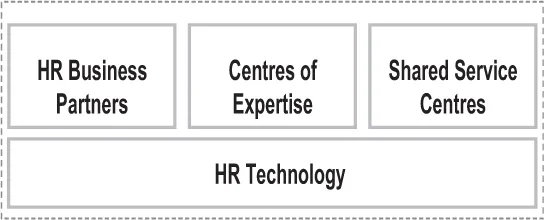
Figure 1.1 The ‘New’ HR model
If technology is to support HR in delivering an effective service to the business, it must cater to the specific requirements of these three roles. It is critical first to examine how these roles operate in practice and the requirements each has for HR information.
ROLES WITHIN THE EVOLVED HR TEAM
The HR Business Partner (HRBP) role represents a shift away from the generalist HR manager, towards a role that is more closely aligned with the business objectives. The role frequently involves physically locating within business units to maintain a close understanding of the business’s needs and objectives.
While there is still the need to deploy a broad range of technical HR knowledge as a Business Partner, the main responsibility is to add value through delivering people interventions that are directly geared to support the achievement of business objectives. The ability to influence strategy, as opposed to merely executing against it, is fundamental to this process.
To operate effectively, Business Partners need:
- The credibility to engage with the business.
- To be integrated into the management team to enable them to understand the strategic objectives of the business and to influence key people related decisions.
- The ability to challenge effectively, and to ‘think outside the box’.
- Deep influencing, change and transition management skills.
- Access to the right support, both technical and administrative, to enable them to deliver.
Shared Service Centres (SSC) typically manage all transactional activities between employees and HR through a coordinated set of channels. Although the scope of the SSC will depend on the nature of the organisation (that is, size, complexity, location, market), the key to SSC success is the development of administrative excellence through standardisation and centralisation and the ability to leverage economies of scale by handling large transactional volumes.
The Shared Service Centre is pivotal in ensuring other parts of HR are able to focus on value- added activities, by dealing with all administrative transactions and filtering enquiries rapidly to the appropriately skilled resource.
The Centre of Expertise (CoE) comprises team members with specialist skills that are not widely distributed across the organisation and which may be centralised to drive economies of scale.
Activities covered by the CoE will vary according to the nature of the challenges faced by the business, its size, complexity and geography. For example, in Retail Banking those responsible for handling serious disciplinary and grievance cases will typically reside in the CoE. In a manufacturing environment, employee relations specialists will travel to local sites to provide hands-on advice and support to managers. Activities are included in the scope of the CoE if they require deep process and technical knowledge.
The Centre of Expertise is predominantly about providing specialist technical and professional support as distinct from the high volume, service orientated transactional capabilities of the SSC. The adoption of a CoE generates a number of benefits:
- Experience in specialist areas (pay and benefits, pensions, performance management, employee relations, and so on) easily accessible by the whole organisation.
- Learning shared across the experts.
- Greater consistency in interpreting policy for the business.
- Expert staff more efficiently deployed.
HOW DOES TECHNOLOGY ALLOW HR TO ACHIEVE ITS MANDATE?
It is both the strength and the weakness of HR systems that they carry a high degree of functionality, are generally available to all and are easy to acquire. It is easy therefore to create an illusion of progress by going out and buying software without truly understanding how the application will be used by the business.
To make an intelligent start on the assessment of technology needs, a review of current technology failings can provide insight into the issues that constrain the HR function in different ways (see Figure 1.2).
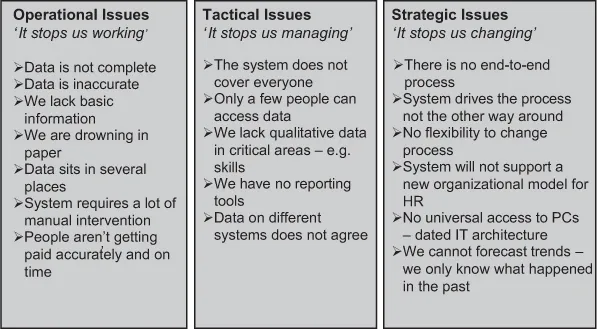
Figure 1.2 Typical issues reducing the impact of technology on the HR function
For the Shared Service Centre, the key considerations will converge on supporting the revised end to end process in the operations centre. This will be coupled with a need to drive new types of management information to monitor service performance and financial re-charging.
For the HR Business Partner, key considerations at this stage will be how these types of issues impact clients within the business and how the HR solution will have the potential to help them. The lack of critical qualitative data is likely to be a key issue for senior managers and a key consideration for the Business Partner when defining their toolset requirements.
Access to ‘key people indicators’ relating to pay, benefits and performance are likely to be high on the shopping list for the Business Partner’s clients. But good management information will be irrelevant if HR cannot underpin this with robust core processes relating to pay, resourcing and development, particularly if they are an essential element of senior management strategy. Failure to deliver in these areas, either now or in the future, is always going to be a major barrier to the overall credibility of HR.
The Centres of Expertise, as the primary guardian of policy and policy interpretation, need to be able to communicate policy effectively to team members, other HR staff and the organisation as a whole. The ability to share new information quickly and easily is critical if timely updates to policy are to be implemented.
Figure 1.3 illustrates how the defined roles in the HR organisation create a mix of needs ranging from transactional requirements that focus on streamlining processes and automating operations to demands for sophisticated workforce analytics to extrapolate organisational trends and plan future policy and strategy.
While technology can offer huge benefits, the use of modern HR technologies frequently represents a radical departure from historic wa...
Table of contents
- Cover Page
- Title Page
- Copyright Page
- Contents
- List of Figures
- List of Tables
- Introduction
- 1 HR Roles and Their Technology Needs
- 2 Defining What You Really Need
- 3 Making the Case for Technology
- 4 Selecting the Right Vendor
- 5 Designing and Implementing the Service
- 6 Top 10 Tips for Success
- Gower HR Transformation Series
Trusted by 375,005 students
Access to over 1.5 million titles for a fair monthly price.
Study more efficiently using our study tools.
Frequently asked questions
Yes, you can cancel anytime from the Subscription tab in your account settings on the Perlego website. Your subscription will stay active until the end of your current billing period. Learn how to cancel your subscription
No, books cannot be downloaded as external files, such as PDFs, for use outside of Perlego. However, you can download books within the Perlego app for offline reading on mobile or tablet. Learn how to download books offline
Perlego offers two plans: Essential and Complete
- Essential is ideal for learners and professionals who enjoy exploring a wide range of subjects. Access the Essential Library with 800,000+ trusted titles and best-sellers across business, personal growth, and the humanities. Includes unlimited reading time and Standard Read Aloud voice.
- Complete: Perfect for advanced learners and researchers needing full, unrestricted access. Unlock 1.5M+ books across hundreds of subjects, including academic and specialized titles. The Complete Plan also includes advanced features like Premium Read Aloud and Research Assistant.
We are an online textbook subscription service, where you can get access to an entire online library for less than the price of a single book per month. With over 1.5 million books across 990+ topics, we’ve got you covered! Learn about our mission
Look out for the read-aloud symbol on your next book to see if you can listen to it. The read-aloud tool reads text aloud for you, highlighting the text as it is being read. You can pause it, speed it up and slow it down. Learn more about Read Aloud
Yes! You can use the Perlego app on both iOS and Android devices to read anytime, anywhere — even offline. Perfect for commutes or when you’re on the go.
Please note we cannot support devices running on iOS 13 and Android 7 or earlier. Learn more about using the app
Please note we cannot support devices running on iOS 13 and Android 7 or earlier. Learn more about using the app
Yes, you can access Using Technology to Create Value by Allan Boroughs,Cat Rickard in PDF and/or ePUB format, as well as other popular books in Business & Business General. We have over 1.5 million books available in our catalogue for you to explore.