- 292 pages
- English
- ePUB (mobile friendly)
- Available on iOS & Android
eBook - ePub
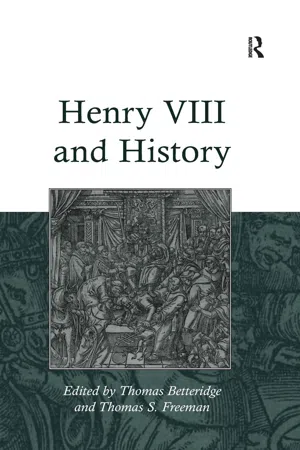
Henry VIII and History
About this book
Henry VIII remains the most iconic and controversial of all English Kings. For over four-hundred years he has been lauded, reviled and mocked, but rarely ignored. In his many guises - model Renaissance prince, Defender of the Faith, rapacious plunderer of the Church, obese Bluebeard-- he has featured in numerous works of fact and faction, in books, magazines, paintings, theatre, film and television. Yet despite this perennial fascination with Henry the man and monarch, there has been little comprehensive exploration of his historiographic legacy. Therefore scholars will welcome this collection, which provides a systematic survey of Henry's reputation from his own age through to the present. Divided into three sections, the volume begins with an examination of Henry's reputation in the period between his death and the outbreak of the English Civil War, a time that was to create many of the tropes that would dominate his historical legacy. The second section deals with the further evolution of his reputation, from the Restoration to Edwardian era, a time when Catholic commentators and women writers began moving into the mainstream of English print culture. The final section covers the twentieth and twenty-first centuries, which witnessed an explosion of representations of Henry, both in print and on screen. Taken together these studies, by a distinguished group of international scholars, offer a lively and engaging overview of how Henry's reputation has been used, abused and manipulated in both academia and popular culture since the sixteenth century. They provide intriguing insights into how he has been reinvented at different times to reflect the cultural, political and religious demands of the moment; sometimes as hero, sometimes as villain, but always as an unmistakable and iconic figure in the historical landscape.
1
Harry’s Peregrinations: An Italianate Defence of Henry VIII
Historians and literary critics have caught glimpses of Elizabeth I’s private feelings toward her family: she purportedly carried a girdle book featuring her brother Edward VI’s death-bed prayer, and regarding her father Henry VIII, her version of a devotional text by Marguerite de Navarre displays mistranslations and gender-reversed pronouns that some, writing from this side of the age of analysis, would call simply, ‘suggestive’.1 If Elizabeth’s private feelings toward her father were complicated and conflicted, her public association with Henry VIII was usually far clearer, more affirming. During her royal progress through London on the eve of her coronation (her first great occasion for political theatre), she was repeatedly associated with Henry, as in the opening tableau’s multi-story, Tree-of-Jesse-like Tudor genealogy. From the red and white roses of the first stage, ‘two branches gathered into one, which were directed upward to the second stage or degree wherein was placed one representing the valiant and noble prince King Henry the eighth … and … the right worthy Lady Queen Anne, … and two tables surmounting their heads wherein were written their names and titles’.2 Richard Mulcaster, likely the author of the printed account of the progress The Quenes majesties passage (1559) reinforced such moments of royal association by including late in the narrative a rare moment of Elizabeth’s interaction with the London crowd:
In Cheapside her Grace smiled, and being thereof demanded the cause, answered for that she had heard one say, ‘Remember old king Henry the Eighth.’ A natural child, which at the very remembrance of her father’s name took so great a joy, that all men may well think that as she rejoiced at his name whom this realm doth hold of so worthy memory: so in her doings she will resemble the same.3
The passage emphasizes the most politically important aspect of Henry’s and Elizabeth’s relationship – the royal blood inheritance from Tudor father to daughter. Elizabeth was Henry’s ‘natural child’. And if it was natural for her to take great joy in her father’s name, the passage also promises that the new queen will resemble her father not only in consanguinity but also in monarchical action and achievement.
These Henrician associations should come as no surprise.4 The character, faith, and royal legitimacy of Elizabeth’s mother Anne Boleyn were all highly contested following her beheading, becoming most extremely negative during Mary I’s reign. Such denigration cast shadows upon Elizabeth Tudor’s possible claim to the throne and her Protestant sympathies resembling her mother’s. Her father’s behaviour as king, of course, caused a great range of reactions, some adoring and some deploring, then as much as now, but he was a genuine Tudor monarch and provided Elizabeth with a ready model for valid, powerful rule.5 Beginning with the coronation progress, Henry VIII would frequently be to Elizabeth what Shakespeare’s Cranmer, at the climax of King Henry VIII, prophesies she herself would become: ‘A pattern to all princes living with her / And all that shall succeed’ (Act V, scene 4, ll. 22–3).6 Henry as subject matter or parallel figure could elicit from citizens a sense of national pride and reassurance in a young female monarch.
William Thomas’s Peregryne: Key Features and Contexts
Elizabeth was hardly the first successor of Henry’s to encounter and encourage such a programmatic set of images and texts, ones supporting Tudor legitimacy, royal supremacy and diverse doctrinal, ecclesiastical, and political alterations experienced during early phases of reformation. The disgraced Henrician servant, Italianate exile-author-translator-traveller, and eventual Edwardian Privy Council clerk William Thomas composed one of the earliest of these treatments of Henry VIII, and one less known today. Thomas almost certainly presented his dialogue, entitled Peregryne or Pelegrin’, to Edward VI sometime after the young king’s accession in 1547, and most likely in or shortly after 1550.7 Multiple manuscript copies suggest its circulation at court, and an Italian translation, printed in 1552 as Il pellegrino inglese, indicates an even broader audience for this royal defence. Its modern audience has been smaller, however, and Thomas’s minor status and the absence of a critical edition have led to a general neglect of this fascinating Tudor dialogue.
Peregryne features an English traveller who in February 1546 (that is, 1547), we are told in the opening paragraph, arrived in ‘Bononye’ (that is, Bologna), ‘wheare in companie of certen gentlemen’ and:
known to be an Englisheman, I was earnestlie appoased of the nature, qualitie, customes of my cuntrey, and specially of diverse perticuler thinges toucheng thestate of our Kinges Majestie Harry the Eight, who than newely was departed out of this present lief.8
The English speaker is clearly a doppelganger for Thomas, who at this time was also travelling in Italy. The Englishman resolves to ‘saye myne opinion’ regarding his Italian hosts’ important questions (175). He has put the resulting discourse in writing, he explains, not only to provide a ‘private defence of that noble prince whose honor hath been wrongefully tooched, but also ffor the generall satisfaction of them whose eares may happen to be occupied with unjust and false rumors’. In other words, Thomas’s care in articulating a royal, reformed position is not only for the sake of Henry VIII’s posthumous reputation, but also for a living audience, one possibly swayable or needing a catalogue of rebuttals. Thomas’s persona soon has ample occasion to present such a catalogue, the points of which he will delineate and amplify for the vast majority of Peregryne. This occurs when one of the more vehement Italian interlocutors, repeatedly identified only as ‘my contrarie’, attacks Henry directly, first for his greed and then for diverse other ‘proceadinges of Englande’ (183). The king is impugned for his violent, faithless personal behaviour as a husband, his rebellion against the Mother Church as a heretic, and his abuses of political power as a tyrant. This adversary soon identifies fourteen points for disputation, all objections against Henry VIII and his reign. The English speaker agrees dutifully to take up these points. One thing remains clear throughout the debate: as the Italian host critical of Henry VIII declares to Thomas’s persona, ‘you are earnest in your Kinges favor’ (182), an allegiance the author was keen to broadcast.
Peregryne is thus variously identifiable – as overview and explanation of England and its customs; as treatment of recent political events; as extended anti-papal polemic, and largely as eulogy for the recently deceased Henry VIII, who in his lifetime, according to Thomas’s speaker, ‘was much more hable in dede to justifie himself ageinst all the worlde, then I nowe after his death am hable to defende him with my penne’ (176). Studied more carefully, Thomas’s dialogue also begins to resemble a shrewd case of image rehabilitation on the part of its author, as well as a helpful manual, or a political brief full of argumentative strategies, for Edward VI. The new king was determined to extend Henry’s initial religious reforms, and in Thomas’s dialogue he would have encountered many positions agreeable to him, as well as arguments worth studying. He also found here a version of Henry VIII simplified – exonerated from diverse cruelties and excesses, and cleansed of various ambiguities and later retractions that had bitterly disappointed more committed reformers.9 Here, instead, we find an independent monarch and hero of reformation whom Edward could both celebrate and imitate.
William Thomas’s challenging personal circumstances made him an unlikely provider of a model monarch for Edward. He returned to court by 1549, after spending three years travelling in Italy, and was soon gaining political influence and financial advantages under the ascendant John Dudley’s patronage. Thomas wasted no time in communicating the ethos of an Italianate counsellor, a reputation he formed through the composition, translation, and publication of a handful of pertinent manuscripts and books, among which was included Peregryne. He began this writing during his sojourn in Italy, or at least began to compile notes on the various Italian cities he visited, along with Italian books from which he would at times borrow wholesale. We can more firmly verify, by a preface or ‘occasion’ to one work, his early self-positioning as an instructor. After he ‘had been about three yeres in Italie’, Thomas was sought out by his travelling countryman John Tamworth, ‘who beeyning desirouse to learne the tongue, intreated the saied William Thomas, to draw him out in Englishe some of the principall rules, that might leade him to the true knowlage therof’.10 The resulting book was the first Italian grammar in English and the first Italian–English dictionary. Other works by Thomas feature paratextual materials that likewise convey the air of the textbook, and rhetorically he sometimes addresses his recipient or readers in hortatory ways. ‘This I write in compfortyng you to pursue a laudable ende of your good beginnyng’, he writes to Tamworth (aiiiiv). At these moments, he most sounds like a sort of humanist coach, or even television pitchman: Thomas had necessarily built his new identity on the foundation of a valued Italianate knowledge, and he wished for others to value it, too.
Certain didactic flourishes occur in Peregryne as well, always in the voice of his doppelganger. Presenting details about English life or current events, or correcting his Italian guests on some misunderstood view of Henry VIII’s rule, these moments rhetorically constitute a consistent type of textual self-representation. Thomas’s service under the king’s privy councillors must have helped to corroborate his developing image as a shrewd political advisor who knew the workings of council and court. Indeed, as the council’s secretary he was responsible for the minutes and thus cognizant of sensitive information and decisions. Eventually Thomas substantiated this largely rhetorical role when he became a personal advisor to Edward VI. A kind of one-man humanist subscription service, Thomas enjoyed a direct relationship with the young king. (His fortunes turned yet again, however; when Mary I assumed the throne, Thomas was implicated in Wyatt’s Rebellion and executed in 1554.) Read in this context, the dialogue Peregryne begins to appear most crucially as a mixed text, blending the promotional and didactic. It is a passionate, patriotic display of knowledge, allegiance and potential usefulness on Thomas’s part, and his persona’s defence of his kingdom and national church before a group of intimidating Catholic Bolognesi presented him in a most positive light. For Edward, the dialogue would have been pleasingly full of reformed tenets as well as one-off insults and more sustained attacks on the pope and his whorish church. More seriously for Edward, Peregryne is akin to a speculum principis, whereby Henry VIII is presented as a triumphant, fearless Protestant king (one still adored at home) – a pattern for his son and successor to follow.11
Peregryne has been framed most prominently through the centuries as a ‘defence’ of Henry VIII or at least a work centrally devoted to him; such language appears in the title or subtitle of some of the five manuscripts, two printed versions (both much later), an early Italian translation and in later descriptions in sale catalogues.12 There is good reason for this emphasis, for Thomas’s own prefatory epistle and framing narrative say as much. The single-word title in the Additional manuscript is followed by a couplet that serves as thematic epigraph: ‘He that dyeth with honor lyveth for ever / And the defamed deade recovereth never’ (173). Next, Thomas declares in his epistle, which curiously is dedicated to ‘Mr. Peter Aretyne’, that he has composed Peregryne in defence of Henry’s honour, and then proclaims that ‘noe man with right can sklannder hym’.13 He also mentions the ‘honorable legacie’ Henry VIII left Aretino, while admitting that the king’s ‘enemies pretend’ that the gift ‘proceeded of the feare that he had least you shouldest after his death defame hym with thy wonted ill speache’. The dismissal of ‘pretend’ notwithstanding, this continued focus on defamation after death resonates with that opening couplet. Later in the letter, Thomas says he has compiled ‘such successes as have happenid unto him in his liffe daies’ so that if ‘anie person shuld repugne against it’, then Aretino, with this mountain of natural reasons, will have ‘matter sufficient’ to defend both the truth and the good memory that Henry deserves from the Italian writer (174). The dialogue’s opening passage, entitled ‘Pelegrine unto the Reader’ in the Additional manuscript, similarly explains that Thomas has put this conversation in writing for Henry’s ‘private defence’. These notes of spirited defense would have made Peregryne a fine gift for Edward VI, and a perfect opportunity for Thomas, too: his English traveller proves to be, of course, unfailingly courteous (as a humanist dialogue required), exceedingly eloquent and quite persuasive.14
That said, a more robust description of Peregryne would be broad apologia or even encomium rather than a narrow defence of a single monarch, for truly its description and evaluation of Henry VIII’s reign and earlier cases of royal prerogative provide Edward with many past examples of pious kingship. In the letter to Aretino, Thomas vows to ‘open also unto the parte of his worthy and gloriouse doinge’ (174). Henry, as Thomas’s persona describes him, rightly defends royal supremacy, prudently seeks counsel, and insists on eradicating wickedness and usurpation (especially among clerics) and restoring English independence and right belief. The king makes all of these determinations based on Christ- and Gospel-centred determinations. Most ambitiously, Thomas the author seeks to dramatize the legitimacy of the new king’s Protestant convictions, and the undertakings they arguably dictated. Edward VI was poised to continue the reformation project; here, Thomas presents him with the most idealized view of what had transpired so far, and indirectly advises him on a future course of action.
On the other hand, Peregryne presents a reforming Henry VIII in inevitably selective fashion. Thomas’s patriotic mouthpiece in effect offers a convenient...
Table of contents
- Cover Page
- Title Page
- Copyright Page
- Contents
- Dedication
- Abbreviations
- Notes on Contributors
- 1 Harry’s Peregrinations: An Italianate Defence of Henry VIII
- 2 From Perfect Prince to ‘Wise and Pollitike’ King: Henry VIII in Edward Hall’s Chronicle
- 3 ‘It is perillous stryvinge withe princes’: Henry VIII in Works by Pole, Roper, and Harpsfield*
- 4 Hands Defiled with Blood: Henry VIII in Foxe’s ‘Book of Martyrs’*
- 5 Fallen Prince and Pretender of the Faith: Henry VIII as Seen by Sander and Persons
- 6 ‘It is unpossible to draw his Picture well who hath severall countenances’: Lord Herbert of Cherbury and The Life and Reign of King Henry VIII*
- 7 Henry VIII in History: Gilbert Burnet’s History of the Reformation (v. 1), 1679
- 8 ‘Unblushing Falsehood’: The Strickland Sisters and the Domestic History of Henry VIII*
- 9 Ford Madox Ford’s Fifth Queen and the Modernity of Henry VIII
- 10 The ‘Sexual Everyman’? Maxwell Anderson’s Henry VIII
- 11 Drama King: The Portrayal of Henry VIII in Robert Bolt’s A Man for All Seasons
- 12 ‘Anne taught him how to be cruel’: Henry VIII in Modern Historical Fiction
- 13 Booby, Baby or Classical Monster? Henry VIII in the Writings of G. R. Elton and J. J. Scarisbrick
- 14 Through the Eyes of a Fool: Henry VIII and Margaret George’s 1986 novel The Autobiography of Henry VIII: With Notes by His Fool, Will Somers
- Index
Trusted by 375,005 students
Access to over 1.5 million titles for a fair monthly price.
Study more efficiently using our study tools.
Frequently asked questions
Yes, you can cancel anytime from the Subscription tab in your account settings on the Perlego website. Your subscription will stay active until the end of your current billing period. Learn how to cancel your subscription
No, books cannot be downloaded as external files, such as PDFs, for use outside of Perlego. However, you can download books within the Perlego app for offline reading on mobile or tablet. Learn how to download books offline
Perlego offers two plans: Essential and Complete
- Essential is ideal for learners and professionals who enjoy exploring a wide range of subjects. Access the Essential Library with 800,000+ trusted titles and best-sellers across business, personal growth, and the humanities. Includes unlimited reading time and Standard Read Aloud voice.
- Complete: Perfect for advanced learners and researchers needing full, unrestricted access. Unlock 1.5M+ books across hundreds of subjects, including academic and specialized titles. The Complete Plan also includes advanced features like Premium Read Aloud and Research Assistant.
We are an online textbook subscription service, where you can get access to an entire online library for less than the price of a single book per month. With over 1.5 million books across 990+ topics, we’ve got you covered! Learn about our mission
Look out for the read-aloud symbol on your next book to see if you can listen to it. The read-aloud tool reads text aloud for you, highlighting the text as it is being read. You can pause it, speed it up and slow it down. Learn more about Read Aloud
Yes! You can use the Perlego app on both iOS and Android devices to read anytime, anywhere — even offline. Perfect for commutes or when you’re on the go.
Please note we cannot support devices running on iOS 13 and Android 7 or earlier. Learn more about using the app
Please note we cannot support devices running on iOS 13 and Android 7 or earlier. Learn more about using the app
Yes, you can access Henry VIII and History by Thomas S. Freeman, Thomas Betteridge in PDF and/or ePUB format, as well as other popular books in History & Early Modern History. We have over 1.5 million books available in our catalogue for you to explore.