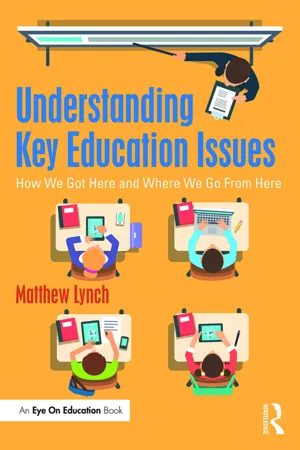
In this age of education innovation and reform, schools must evolve and react to current policy trends. This accessible book offers research-based insights into six key educational trends and issues that are impacting K–12 learning today: year-round schooling, assessments, educating minorities, anti-intellectualism, issues of social promotion and retention, and school design. Each chapter unpacks research and policy issues relating to these topics and provides administrators with practical advice on how they should approach these issues to improve learning in their schools. The ideas and strategies in Understanding Key Education Issues will help educators across the country achieve greater efficiency, better results, and a higher purpose.
The state of the American school system: What do our schools look like to an outside observer?
The birth of the American public school: The European origins of our school system and the one-room schoolhouse.
The Mann reforms to public education: Horace Mann’s nineteenth-century advancements, which continue to influence educational policy.
Public education as national requirement: The first public schools and how they operated.
Unified, then divided, public schools: Unity following the World Wars soon dissolved.
A nation of public-school students at risk: The realization that America was no longer on top of the world, and the attempts to rectify that.
Minority education in America: A look at the horrific legacy of disenfranchised students, which continues to the present day.
A melting pot of educational ideology: A look at the present cacophony of ideas and programs, and a glance toward the future.
Innovation has always driven Americans and continues to be a driving force today. It’s what has simultaneously given us the labels of “crazy” and “genius,” and is what makes Americans a global power to be reckoned with. The Wright brothers, Thomas Edison, George Washington Carver, Henry Ford, Steve Jobs … the list of world-changing thinkers and inventors is long. Without the many Americans who have stepped outside the lines to better their own ways of life and those of their fellow citizens, this nation would not be considered the greatest on the globe.
That creative spirit is born in our public schools. The students who will dream up tomorrow’s major inventions and come up with plans to improve the American way of life and fill every job in between are in our K-12 classrooms today. In spite of all their problems, public schools remain a steadfast reminder of all that is great and inspirational about the American way.
As America has grown in its nearly 250 years of existence, its public-school system has adjusted with the times (Urban and Wagoner 2009). Various theories on properly educating our future generations have been introduced, tested, established, and then thrown out. Each new evolution of the public-school systems in the United States—from the one-room schoolhouse to compulsory education to opening the doors of education for all citizens—has built upon the lessons of the ones before (both good and bad).
The State of the American School System
What do our school systems look like from an objective perspective? If you base your knowledge of the nation’s public schools on news headlines alone, you might have a bleak perception of what is happening in the K-12 classrooms funded by our tax dollars. A report issued by the US Department of Education in April of 2014 showed that high school seniors did not show any signs of improvement in math and science scores from 2009 to 2013 (Nation’s Report Card 2014). When compared with other developed countries, US students lag seriously behind in areas such as math and science, too. The students who are bringing down the national averages are not just from underprivileged areas. A Washington Examiner report found that more than half of fifteen-year-olds from homes with well-educated parents are not proficient in at least one of the three key subject areas: reading, math, and science (Peterson 2014).
Despite these and numerous similar reports, US high school seniors are graduating at a record rate of 80 percent (Hefling 2014). This is a statistic that should no doubt be celebrated, but it does raise a question mark: How are so many US students lagging behind in so many vital academic areas, yet graduating from our schools at record rates?
The truth is complicated. Standards for exactly what students should be learning at every step of their educational journey have never been more stringent. The No Child Left Behind (NCLB) legislation enacted in 2001 heightened educator accountability systems and put stricter assessment processes in place to measure the true learning outcomes of students (Klein 2015). Teacher accountability was in place before NCLB, and so were state assessment tests, but the legislation placed both on a pedestal that many schools are still unable to attain. By setting blanket benchmarks for the entire nation, based on limited testing materials, teachers were essentially stripped of their free will when it came to educating and were forced to begin “teaching to the test.” For many educators, NCLB marked an end to learning for learning’s sake in classrooms. For some, it meant dumbing down materials to ensure all students scored well on those vital assessments.
Fast forward twelve years to the recent enactment of the Common Core Standards in forty-four states and the District of Columbia, and accountability and assessments have even more to contend with. Tied to President Obama’s federal funding program Race to the Top, Common Core benchmarks were determined by the National Governors Association. States could choose to opt in or out, with pressure to conform enhanced by the promise of plentiful funds. Like NCLB legislation (which still exists alongside Common Core requirements), the new set of initiatives seeks stronger student outcomes in areas such as math, science, and technology (Core Standards 2016).
In theory, Common Core Standards should work: Place more focus on the subjects where American students need extra help, attach some money as an incentive, and then watch the test scores rise. The true effectiveness of these standards remains to be seen, but it is hard to imagine that placing greater concentration on a narrower range of subjects will end up assisting this generation of K-12 students (Mathis 2010).
Assessments and teacher accountability tethered to funding are just the tip of the iceberg when it comes to the issues holding back the actual process of learning in our public schools. Overcrowding and inequality of resources, as well as a cultural shift toward anti-intellectualism, weigh heavily on the schools within our borders.
By identifying the major trends and issues that hinder the effectiveness of the public schools of our nation, we can start a journey that will lead us toward better outcomes for future generations. It is not a task reserved for educators alone, however. To bring about the necessary changes, it will take the involvement every parent, business owner, and community member. But in order to understand where we are going and avoid the mistakes of the past, we first need to take a look at the history of education in America, focusing on the anti-intellectual trends.
The Birth of the American Public School
There were public schools in America as far back as the mid-1600s, in the Massachusetts Bay Colony, but the precursors of the modern public school began appearing in Pennsylvania at the end of the eighteenth century. Even the poorest of citizens was welcomed through those schoolhouse doors and offered a public education. (Note, however, that African Americans and Native Americans were not considered citizens at that time.) The New York Public School Society was established in 1805, and by 1870 all states had at least a minimal public program in place to educate students en masse. These programs were mostly voluntary, however—compulsory education would not become widespread until the beginning of the twentieth century (Urban and Wagoner 2009).
What was taught in these early schools varied by region but was grounded in a basic set of rules. Public education was meant to unite American families through a common interest: raising educated children who would soon be at the helm of the nation’s future. Basic education was not something reserved for the elite. Reading, writing, and basic arithmetic were necessities of living as Americans and were important when it came to guiding the young nation (Urban and Wagoner 2009).
The learning resources of early America were understandably limited. There was not much variety in American-made textbooks or other learning tools. Much of what was used in these schools were texts developed in England and repurposed for American pursuits. Educators recognized the need for purely American educational texts, though, and slowly they began to take shape (Urban and Wagoner 2009).
In the 1780s, Noah Webster set out to create a textbook that would teach children the realities of spelling in the new land. Until that point, spelling textbooks were primarily imports from England that sought to teach kids the most unusual and difficult, yet least used, words in the English language. Webster saw the impracticality of this and set out to change it. The American Spelling Book became a staple for learning in homes and in the few organized educational schoolrooms that existed. In accomplishing this, Webster established the first systematic method for learning in the young country. It was practical, easy to navigate, and widely used. As late as 1866, after many other spelling books had been written and updated, Webster’s original version was still selling nine million copies annually (Svobdny 1985; Webster 1783).
From the outset, public education in the United States was about moving students collectively in the direction the nation wanted to go. Individualism and customized learning were certainly not common terms, and the choices for education were slim. The accepted curriculum for one American was deemed good enough for another. This base learning was rooted in the need to not only obtain knowledge, but to use education as a way to build up a nation that was still teetering dangerously on the edge of failure. Parents did not encourage their children to learn spelling or arithmetic so they could have a better life, but so they could continue to have a free one. Education was a means of survival, and banding together with the same education goals, at least when it came to common people, was a way to build the entire nation up. Certainly there was some educational elitism through private schooling and university systems, but when it came to the public institutions of learning, every student encountered the same knowledge set (Unger 2007).
As the country continued to expand, both in population and land mass, public education became more segmented. Until the 1840s, public schools were under local control, with little input from the state and virtually no federal oversight. Attendance was rising, however. The US Census from 1840 shows that 3.68 million children from ages five to fifteen attended school, representing about 55 percent of the population in that age bracket. Around this time the idea of one-room schoolhouses took shape, with the older students acting as helpers for the younger ones. There was no formal credentialing for teachers. This was why young single women often filled the roles: Unlike young men, who were toiling on the farms, young women were available, so they served as teachers until they got married (Unger 2007).
The Mann Reforms to Public Education
The first attempt at regulating exactly what American students were learning in those early schoolhouses came in 1837 from education reformer Horace Mann. When he took over the role of Secretary of Education in Massachusetts, he set out to create a common way of teaching educational content, particularly to elementary students. For the most part, he adapted his ideas from a Prussian model that stressed training for educators (Messerli 1972).
Along with shared content, Mann’s reforms brought about the first age-grade systems where students were promoted based on age, not academic aptitude. While this led to greater concentration on subjects that increased in difficulty as students grew older, it also planted the notion that American students should be passive learners, as opposed to active ones. The idea that each student should master by a certain time content based on broadly accepted criteria was established as a way to keep students moving through the public-education system (Messerli 1972).
States rushed to duplicate Mann’s ideas in their own schools and multiage classrooms disappeared in the coming decades. As the American population rose, it made sense to accommodate students in a more segmented way. Age-grading was meant to improve efficiency of classrooms and the entire public-education system. The more students who could be passed through the public schools, the better. It made economic sense and, in the minds of reformers such as Mann, it would lead to a more highly educated public (Messerli 1972).
Though Mann’s system for age grading was introduced over 175 years ago, it remains the primary form of organization in American schools today. While some students are retained (or held back) when they do not master the material at hand, the idea of socially promoting students based solely on their ages is more popular than one might think. It is difficult to measure exactly how many students are passed on to the next grade based more on age than academic merit, because teachers are obviously not keen to admit it. Retaining students is simple to measure but only tells half the story. Of the students who are not retained, how many of them should be? (Messerli 1972).
Sending children to school later throws a wrench in the traditional age-grade system. Teachers are often ill prepared to deal with students who are outside the age specifications in their classrooms, and in cases where both a five- and seven-year-old are in the same classroom, there are naturally differences in behavior and maturity. By adhering strictly to an age-grade system for just some, it puts a strain on the others. Teachers who hope to avoid problems for their colleagues in higher grades often take the easier route of age-grading promotion.
Despite the pitfalls engendered by the age-grading system, the positive impact of Mann’s endeavors should not go unnoticed. Along with age-grading, he emphasized the need for mandatory attendance. Mann insisted that public education was not a perk of American life; it was a necessity for the well-being of our nation. He believed that for the nation to truly advance, its youth belonged in classrooms, not just in fields or factories, and that states should implement attendance policies to support this view. While it took some time for his ideas to see mass adoption, his advocacy for mandatory public schools found some resonance. By 1900, thirty-four states had implemented required-schooling laws, thirty of which required students to stay in school until the age of fourteen. Ten years later, 72 percent of the children in the United States went to school. Just a decade after that, every state had required attendance policies. By 1940, half of all young adults in the United States were high school diploma recipients (Wells 1975).
Public Education as National Requirement
By the early 1900s, the idea that every American child had the right to an education had gained mass adoption. Even students destined for a life in the mines or on the railroads deserved basic spelling, arithmetic, and science lessons. Public schools were a place to absorb the common learning priorities that other students were also absorbing throughout the country. This view of public schools gave all (white) children an equitable start in life, at least when it came to actual curriculum presented. From there, the students were free to carve out the lives they wanted, or follow a predetermined path based on family or geographic limitations (Unger 2007).
Just after the start of the twentieth century, a new public-education ideology began to emerge that hinted that schools should be utilized as more than places to memorize facts. According to reformers such as University of Chicago professor John Dewey, public schools needed ...
Table of contents
Cover
Title
Copyright
Dedication
Contents
Preface
Acknowledgments
Meet the Author
1 How Did We Get Here, and What’s Next?
2 Year-Round Schooling: The Unexpected Solution to America’s Education Woes?
3 Examining the Present and Future of K-12 Assessments
4 Black Boys in Crisis: What Can We Do?
5 Combating Anti-Intellectualism and Academic Disengagement
6 Responding to Social Promotion and Retention
7 Rethinking School Design for Better Learning Outcomes
Trusted by 375,005 students
Access to over 1.5 million titles for a fair monthly price.
Study more efficiently using our study tools.
Frequently asked questions
Yes, you can cancel anytime from the Subscription tab in your account settings on the Perlego website. Your subscription will stay active until the end of your current billing period. Learn how to cancel your subscription
No, books cannot be downloaded as external files, such as PDFs, for use outside of Perlego. However, you can download books within the Perlego app for offline reading on mobile or tablet. Learn how to download books offline
Perlego offers two plans: Essential and Complete
Essential is ideal for learners and professionals who enjoy exploring a wide range of subjects. Access the Essential Library with 800,000+ trusted titles and best-sellers across business, personal growth, and the humanities. Includes unlimited reading time and Standard Read Aloud voice.
Complete: Perfect for advanced learners and researchers needing full, unrestricted access. Unlock 1.5M+ books across hundreds of subjects, including academic and specialized titles. The Complete Plan also includes advanced features like Premium Read Aloud and Research Assistant.
Both plans are available with monthly, semester, or annual billing cycles.
We are an online textbook subscription service, where you can get access to an entire online library for less than the price of a single book per month. With over 1.5 million books across 990+ topics, we’ve got you covered! Learn about our mission
Look out for the read-aloud symbol on your next book to see if you can listen to it. The read-aloud tool reads text aloud for you, highlighting the text as it is being read. You can pause it, speed it up and slow it down. Learn more about Read Aloud
Yes! You can use the Perlego app on both iOS and Android devices to read anytime, anywhere — even offline. Perfect for commutes or when you’re on the go. Please note we cannot support devices running on iOS 13 and Android 7 or earlier. Learn more about using the app
Yes, you can access Understanding Key Education Issues by Matthew Lynch in PDF and/or ePUB format, as well as other popular books in Education & Education General. We have over 1.5 million books available in our catalogue for you to explore.