eBook - ePub
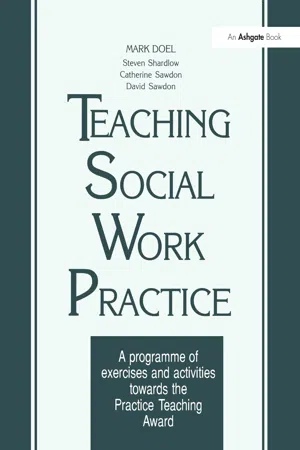
Teaching Social Work Practice
A Programme of Exercises and Activities Towards the Practice Teaching Award
- 224 pages
- English
- ePUB (mobile friendly)
- Available on iOS & Android
eBook - ePub
Teaching Social Work Practice
A Programme of Exercises and Activities Towards the Practice Teaching Award
About this book
Teaching Social Work Practice is a lively, practical guide to developing your knowledge and skills as a teacher of social work practice in an agency setting. Social work students learn to practise in college and agency settings, and this book will help to integrate the student's experience of learning. Teaching social work is different from practising social work, and this book is designed to help practitioners to develop their teaching abilities with students. The author uses a combination of exercises, activities, notes and further reading to guide and encourage the reader through seven 'modules', which include Anti-oppressive practice teaching, Models of adult learning, and Methods of practice teaching. Each module is designed to help you learn how to teach social work practice. There is an emphasis on self-directed learning and active teaching. The book also gives advice on collecting evidence of your developing abilities, and examples of how to demonstrate this in a portfolio. This is especially useful to people who are studying for the Practice Teaching Award. Finally, Teaching Social Work Practice provides useful digests of the relevant literature in the area of practice teaching and learning - helpful pointers for busy practitioners. Teaching Social Work Practice will be of interest to social workers who are considering practice teaching as well as those existing practice teachers who want to continue to develop their skills. College-based teachers and trainers will also find useful material. In addition, the book has much to offer social work managers who wish to develop their skills in staff and supervision and staff-development.
Information
Part 1 Context of Practice Teaching
1 Models of practice teaching
About Activity 1 To supervise or to practice teach?
To supervise or to practice teach? is an introduction to four different models of teaching social work practice. Of course, there are overlaps between each of the four models, but they are presented as a start to thinking about your own experiences as a learner of practice. In general, this book uses the structured learning approach, while not discarding the best of the other models.
Purpose
To gain an understanding of different approaches to teaching and learning social work practice, and familiarity with some of the changes in practice learning over recent years. These changes mean that your own experience of learning practice might be different from current expectations of the role of the practice teacher.
Method
- Consider how the four models presented in To supervise or to practice teach? relate to your own experiences as a practice learner.
- What do you think are the advantages and disadvantages of each of the approaches?
- Thinking of your present interest in practice teaching, what approach most attracts you?
Variations
You might find it helpful to look at Activity 1 on your own and then in a small group of other practice teachers, to broaden the discussion. Don’t forget to keep some notes for your portfolio about these issues.
Activity 1 To supervise or to practice teach?
Growth and development
| Apprenticeship
|
Philosophy
| Philosophy
|
Structured learning
| Managerial
|
Philosophy
| Philosophy
|
Thinking back to your own student days, what were your own experiences of supervision and practice teaching, in relation to these four approaches?
- What do you think are the advantages and disadvantages of each of these approaches?
- Where would you locate your own approach to practice teaching, and where would you like to locate your approach to practice teaching?
Notes for practice teachers
There have been many changes in the way students are expected to learn the practice of social work. It is important to become acquainted with these changes because expectations are likely to be different from the way in which you experienced your own learning. You will need to consider carefully whether practice teaching is something you can and want to do.
The change of terminology from ‘student supervision’ to ‘practice teaching’ reflects a change in emphasis and style. Whereas student supervision has generally drawn more from theories of therapeutic involvement, practice teaching is developing more from theories of learning, with an emphasis on curriculum development.
This book uses a framework derived from the structured learning model described in Activity 1. It will help you to develop a planned curriculum, with a systematic use of various teaching methods and agreed criteria for assessment; at its heart is an emphasis on both you and your student as adult learners.
Other authors have identified different categories to describe models or approaches to practice teaching. For example, Bogo and Vayda (1987) identify these six approaches to ‘field instruction’ (the North American term for practice teaching):
- apprenticeship model
- growth-therapeutic approach
- role systems approach
- academic approach
- articulated approach
- competency-based approach
Yet another way to draw categories is to think of the different functions of practice teaching — for example, educative/learning, supportive/helping and administrative/managing (Butler and Elliott, 1985:14).
In pinning our colours to the mast of structured learning, it is important not to lose sight of the valuable elements which are found in the other three models of practice outlined in Activity 1. The individualized nature of the growth and development model, the hands-on directness of apprenticeship, and the accountability to the people who use the service in the managerial model are all factors which can be incorporated into the structured learning approach. It is also necessary to be aware of the possible dangers of this approach; relegating an individual student’s needs to the demands of a curriculum, fragmenting the student’s experience, etc. These pitfalls can be avoided, but only if their potential is acknowledged.
To supervise or to practice teach? is an opportunity for you to reflect on your past experiences and current practices. You may not have been conscious of using a particular model of learning or teaching social work practice, but when you review the four models as briefly described, some aspects will feel more familiar than others. Where would you locate your own approach to practi...
Table of contents
- Cover Page
- Half Title
- Title Page
- Copyright
- Preface
- Introduction
- Preface and acknowledgements
- Part 1 Context of Practice Teaching
- 1 Models of practice teaching
- 2 Prior learning
- 3 Involving others
- Part 2 Organization of the Placement
- 4 Placement profile
- 5 Agreements
- 6 Beginnings and endings
- Part 3 Anti-oppressive Practice Teaching
- 7 Power and oppression
- 8 Anti-racist practice teaching
- 9 Cultural competence
- Part 4 Models of Learning
- 10 Giving and receiving feedback
- 11 Learning styles
- 12 Blocks to learning
- Part 5 Content of Practice Teaching
- 13 Knowledge, values, skills
- 14 Curriculum development
- 15 Theory and practice
- Part 6 Methods of Practice Teaching
- 16 The practice tutorial
- 17 Designing learning activities
- 18 Direct observation and the use of video
- Part 7 Examination of Ability
- 19 The assessment climate
- 20 Criteria for competence
- 21 Ready to practise?
- Part The Portfolio
- 22 The Portfolio
- Suggested core texts
Trusted by 375,005 students
Access to over 1.5 million titles for a fair monthly price.
Study more efficiently using our study tools.
Frequently asked questions
Yes, you can cancel anytime from the Subscription tab in your account settings on the Perlego website. Your subscription will stay active until the end of your current billing period. Learn how to cancel your subscription
No, books cannot be downloaded as external files, such as PDFs, for use outside of Perlego. However, you can download books within the Perlego app for offline reading on mobile or tablet. Learn how to download books offline
Perlego offers two plans: Essential and Complete
- Essential is ideal for learners and professionals who enjoy exploring a wide range of subjects. Access the Essential Library with 800,000+ trusted titles and best-sellers across business, personal growth, and the humanities. Includes unlimited reading time and Standard Read Aloud voice.
- Complete: Perfect for advanced learners and researchers needing full, unrestricted access. Unlock 1.5M+ books across hundreds of subjects, including academic and specialized titles. The Complete Plan also includes advanced features like Premium Read Aloud and Research Assistant.
We are an online textbook subscription service, where you can get access to an entire online library for less than the price of a single book per month. With over 1.5 million books across 990+ topics, we’ve got you covered! Learn about our mission
Look out for the read-aloud symbol on your next book to see if you can listen to it. The read-aloud tool reads text aloud for you, highlighting the text as it is being read. You can pause it, speed it up and slow it down. Learn more about Read Aloud
Yes! You can use the Perlego app on both iOS and Android devices to read anytime, anywhere — even offline. Perfect for commutes or when you’re on the go.
Please note we cannot support devices running on iOS 13 and Android 7 or earlier. Learn more about using the app
Please note we cannot support devices running on iOS 13 and Android 7 or earlier. Learn more about using the app
Yes, you can access Teaching Social Work Practice by Mark Doel,Steven Shardlow,David Sawdon in PDF and/or ePUB format, as well as other popular books in Social Sciences & Teacher Training. We have over 1.5 million books available in our catalogue for you to explore.