eBook - ePub
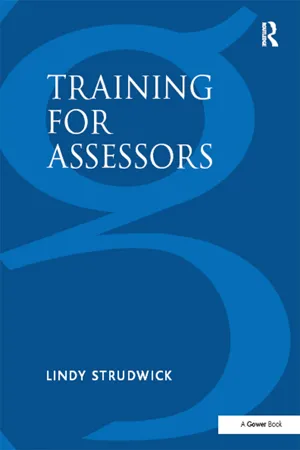
Training for Assessors
A Collection of Activities for Training Assessment Centre Assessors, Roleplayers and Resource Persons
- 384 pages
- English
- ePUB (mobile friendly)
- Available on iOS & Android
eBook - ePub
Training for Assessors
A Collection of Activities for Training Assessment Centre Assessors, Roleplayers and Resource Persons
About this book
Assessment and Development Centres are very resource intensive, both in terms of time and money. Poorly trained assessors, resource people and role players can all have a huge adverse impact on the results of an Assessment and Development Centre. To ensure consistency in the performance of assessors, resource people and role players, they must all be well briefed and properly trained. This manual provides a practical guide, with everything you need to train assessors, resource people and role players. Parts One to Three of the manual deal with the behavioural assessment skills of observing, recording, classifying, summarizing and evaluating (ORCSE). There are exercises for learning and trying out the techniques needed for each stage of the process. There is also a collection of mock simulations, which allow potential assessors to put all of the skills together and practice for real. Part Four covers training for resource persons and role players, an area which is often overlooked. Training for Assessors is an essential resource for anyone running, or planning to run, assessment and/or development centres.
Part One
Training for Assessors: The Background
Sections 1.1–1.6
Purpose
These sections of the manual contain background information that can be used to introduce participants to:
• Assessment Centres
• Competencies
• Simulation exercises
• The role of an assessor
• The ORCSE process
• Assessment Centre documentation.
You are free to choose which sections to include or exclude depending on the existing knowledge and experience of the participants. The delivery method you choose for each section will largely depend on the time available during the training programme.
Participants
All training course participants – group size 1–12.
Suggested timing
Approximately 5 minutes to 1 hour per section depending on the delivery method chosen.
Location
Training room with sufficient space to accommodate participants, trainer and presenters.
Materials and equipment
Suggested:
• Flipchart stand, paper and pens
• OHP and screen or PC with PowerPoint
Required:
• Notepads, pens and pencils for participants
• One folder per participant for notes and handouts
• One copy per participant of Handouts 1.1–1.13 as appropriate
• One copy per participant of competency framework used within the organization
1.1 Introduction to Assessment Centres
Objectives
By the end of this session the participants will:
• Be able to describe what Assessment Centres are and why they are used
• Understand in principle how Assessment Centres are designed
• Know where Assessment Centres fit into the organization’s Human Resource strategy
Key Points and optional delivery methods
Trainer presentation | Open discussion | Syndicate and feedback | Guest Presentation | Reading/ quiet time | |
Introduction to Assessment Centres | • | • | |||
Differences between Assessment Centres and other selection methods | • | ||||
Advantages and disadvantages of using Assessment Centres | • | ||||
Assessment Centre design: – line manager involvement – job analysis | • | ||||
Human Resource strategy | • |
Background
Introduction to Assessment Centres
Refer to Handout 1.1.
It is important that the participants are aware of some of the theory and background to Assessment Centres. This will help them understand and appreciate their role as an assessor and put the assessor training into context. For those interested in acquiring a more detailed knowledge, there is a wide range of excellent texts available covering Assessment Centres, for example:
Assessment and Development Centres (1995) by Iain Ballantyne and Nigel Povah (Gower) Assessment Centres (1993) by Charles Woodruffe (The Chartered Institute of Personnel and Development)
Differences between Assessment Centres and Development Centres
The process of an Assessment Centre – the measurement of performance against defined competencies by participation in simulation exercises – also holds good for Development Centres. In addition, candidates taking part in either type of Centre can be measured against competencies required either for their current role or for a higher level role.
However, whilst the structure, contents and process of running the two types of Centre is very similar, the output differs.
• In a Development Centre the focus is on developing the candidate, either in their current role or for a future role, and the output (reports, feedback, counselling) from the Centre is entirely geared towards this objective. Feedback is often given to candidates after each exercise in a Development centre, which means the candidate is immediately given the opportunity to improve their performance in weaker areas.
• Assessment Centres are used primarily as a selection tool for recruitment or promotion purposes.
For a Centre to truly be a Development Centre there must be no element of selection involved, no question of pass or fail.
Differences between Assessment Centres and other selection methods
Assessment Centre methodology is a ‘multiple-input’ process, whereby, in other words, a group of assessors will observe candidates using a range of simulation exercises, tests or activities, each assessor observing a different candidate in each exercise.
By its nature an Assessment Centre will build up a more balanced and objective set of results than the more traditional method of selection by a single interview, as each candidate is observed and rated by a number of people in a variety of situations. In contrast, an interview conducted by one person, will only elicit the opinion of that person in one situation.
Many organizations today are moving more towards Assessment Centre techniques, sometimes without actually realizing it. As well as conducting an interview, the organization may ask a candidate to complete psychometric tests or give a presentation to the board. Although these processes may not be described as an Assessment Centre, they are certainly showing signs of becoming a ‘multiple-input’ process.
Advantages and disadvantages of using Assessment Centres
Some advantages:
• Assessment Centres are more reliable than other selection methods. Meta-analysis (combining the validities from different studies) has shown Assessment Centres to be a more reliable method of predicting future job performance than many other methods of selection:
Meta-analysis | Validity coefficients |
Assessment Centres (promotion) | 0.65 |
Work sampling | 0.54 |
Ability tests | 0.53 |
Assessment Centres (performance) | 0.43 |
Personality questionnaires | 0.39 |
Biodata | 0.38 |
References | 0.23 |
Interviews | 0.19 |
This analysis shows that using an Assessment Centre will help you to identify the best candidates for promotion 65 per cent of the time, whereas using an Interview will only allow selection of the best candidates 19 per cent of the time.
The above meta-analysis was conducted by Mike Smith from UMIST and based on the findings of Hunter, J E and Hunter R (1984), ‘Validity and utility of alternate predictors of job performance’, Psychological Bulletin, 96, 72–8. Two other studies gave validities of 0.41 and 0.37 for Assessment Centres (see Gaugler, BB et al. (1987), ‘Meta-analysis of Assessment Centre validity’, Journal of Applied Psychology, monograph; and Schmidt N, et al. ‘Met...
Table of contents
- Cover
- Half Title
- Title Page
- Copyright Page
- Table of Contents
- Acknowledgements
- Using the Manual
- Pre-course preparation
- Flowchart of Assessor Activity
- Part One Training for Assessors: The Background
- Part Two Activities for Training in Behavioural Assessment Techniques
- Part Three Assessment Centre Exercises
- Part Four Training Resource People and Roleplayers
Trusted by 375,005 students
Access to over 1.5 million titles for a fair monthly price.
Study more efficiently using our study tools.
Frequently asked questions
Yes, you can cancel anytime from the Subscription tab in your account settings on the Perlego website. Your subscription will stay active until the end of your current billing period. Learn how to cancel your subscription
No, books cannot be downloaded as external files, such as PDFs, for use outside of Perlego. However, you can download books within the Perlego app for offline reading on mobile or tablet. Learn how to download books offline
Perlego offers two plans: Essential and Complete
- Essential is ideal for learners and professionals who enjoy exploring a wide range of subjects. Access the Essential Library with 800,000+ trusted titles and best-sellers across business, personal growth, and the humanities. Includes unlimited reading time and Standard Read Aloud voice.
- Complete: Perfect for advanced learners and researchers needing full, unrestricted access. Unlock 1.5M+ books across hundreds of subjects, including academic and specialized titles. The Complete Plan also includes advanced features like Premium Read Aloud and Research Assistant.
We are an online textbook subscription service, where you can get access to an entire online library for less than the price of a single book per month. With over 1.5 million books across 990+ topics, we’ve got you covered! Learn about our mission
Look out for the read-aloud symbol on your next book to see if you can listen to it. The read-aloud tool reads text aloud for you, highlighting the text as it is being read. You can pause it, speed it up and slow it down. Learn more about Read Aloud
Yes! You can use the Perlego app on both iOS and Android devices to read anytime, anywhere — even offline. Perfect for commutes or when you’re on the go.
Please note we cannot support devices running on iOS 13 and Android 7 or earlier. Learn more about using the app
Please note we cannot support devices running on iOS 13 and Android 7 or earlier. Learn more about using the app
Yes, you can access Training for Assessors by Lindy Strudwick in PDF and/or ePUB format, as well as other popular books in Business & Business General. We have over 1.5 million books available in our catalogue for you to explore.