eBook - ePub
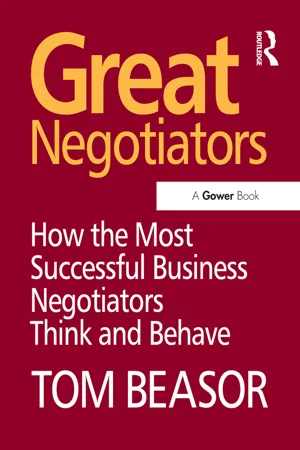
Great Negotiators
How the Most Successful Business Negotiators Think and Behave
- 292 pages
- English
- ePUB (mobile friendly)
- Available on iOS & Android
eBook - ePub
About this book
What is it about the great negotiators? How is it they seem to manage to recover from disadvantageous positions? How do they adapt their approach to turn an unpromising start into a value creating deal? And why is it that they never seem to lose their appetite for negotiation? Some of this may be down to genes. There may genuinely be born negotiators but, as far as the rest of us go, it's down to preparation and knowledge; knowledge of how people think and how they behave. Tom Beasor's Great Negotiators is a collection of techniques that illustrate how the most successful negotiators think and behave. Good negotiators are always well prepared and there is a host of tips to help you prepare your strategy and your thinking before an important negotiation. There are also ideas to help you understand the philosophy behind your negotiating approach; to help you handle international negotiations; and to ensure every negotiation is a potential learning experience. Great Negotiators is a treasure trove of ideas from a highly successful international negotiator and trainer.
Information
1
Practical Hints & Tips
In my years as a consultant I've picked up many tips and handy ideas that I've communicated via my weekly newsletter.
In this first section we have some sensible, simple and practical tips.. .keep these ideas in your mind and you'll not go far wrong.
Always ask...
This is a short tip but it's very powerful. One of the best pieces of advice that I can offer to any negotiator is this:
"If you don't ask... you won't get"
It can't be more simple. Be ambitious...go for the extra and don't be afraid to ask. Be confident and realise that the other party generally won't offer anything unless you ask for it.
Simple but powerful advice.
Thank and bank
This is the most effective script I have taught and seminar delegates routinely tell me that this one move has generated thousands of dollars of value.
When the other party offers you something, never, never refuse it. Even if it's below your expectations, accept it with the following script:
"Thanks for that offer... it's certainly a step in the right direction and I appreciate your flexibility.. .but clearly this is a tough deal and we've still got a long way to go before we can get to an agreement. What else can you put on the table?"
It's bad psychology to refuse anything you're offered and just because you've accepted 5% it doesn't mean that you can't then go for 10% and beyond.
Use lightning rods
One of the tactics that I teach in my classes is the use of Third-Party Authority.
This technique allows you to put all the blame on a third party while ensuring that the relationship that you have personally with the other party doesn't suffer.
Here are a few scripts:
"I'd love to pay that price but the hank will only lend me $5000 and you know what banks are like... "
(It's the bank's fault, not mine!)
I can't get this decision past the suits on the top floor. You know what these executives can he like..."
(I'm on your side and I'm an innocent victim like you.)
"New York will never sign this off..."
(Blame head office...especially if it's a long way away.)
This technique sets up a good lightning conductor to ensure that the blame isn't heaped on you and your relationship doesn't suffer with the other party. You're both innocent victims of a hostile third party.
One word of warning... Don't pick a person like your boss. First they're easy to identify and could be contacted and second it makes you look junior and powerless.
Own up to failures
I know a negotiator who enjoys using this saying "Well, we're just have to go in there and fall on our swords in public and see what we can achieve."
What he means is that when all else fails the best strategy can be brutal honesty...owning up to your failure...throwing yourself on the mercy of the other side.
It can be very disarming if the other side looks you straight in the eyes and says, "Look, I know we fouled up and there's no excuse for it.. we were just incompetent What can we do to put this right and move on from here?"
This can be a whole lot better than trying to come up with whingeing excuses and making yourself look anything other than professional.
So the next time you're in trouble try falling on your sword...it might just work.
Slice and dice
My client discovered 17 places in the supplier's cost breakdown where there seemed to be a discrepancy and a need for explanation.
The supplier had offered a very decent package but was not prepared to do battle on every line and with every number.
Suffice it to say that when the negotiation ended the number of slices in the salami was significantly fewer and each slice a whole lot thinner.
This is one of the best buyer's tactics. Asking a seller to justify and explain every line and number is a great way of unpicking their logic. It shows you can be as expert as they are in the subject field.
If you're a seller don't ever think that the buyer won't be looking at the back of the proposal where the numbers are. Be ready for their questions and get your logic ready.
Sellers love package deals. You can hide a great deal of margin inside package deals but they're always vulnerable to a well-trained buyer's slice and dice routine.
Resist the nibblers
One buyer's tactic that I don't much like is the use of the Nibble. A buyer will nibble and nibble so that you make several visits, produce multiple proposals and use up time and energy...and even then they can't commit until just one more meeting.
Badly used tactics damage business deals. Most sellers know when they are being strung along and when a buyer doesn't really have authority and is just wasting their time.
I like to try to ensure that the negotiator with whom I'm dealing has the authority personally. That way you don't have to meet third parties and suffer referrals to committees that waste time and energy.
If you're a buyer then be prepared to drive in a tough deal and make your decision in a timely way. If the answer is "No" then just say so and everyone can move on to the next piece of business.
Protracted negotiations are expensive and often counter-productive for both sides.
Present the Russian Front
Here is a quote from Baroness Kennedy in the Independent newspaper in the UK on 2 March, 2004. If you didn't really understand what the Russian Front is...well now you'll know.
"The Home Office practice now is to bring forward new legislation which is absolutely abhorrent and totally disgraceful in its abuse of civil liberties and then, when there is uproar, replace it with something only slightly less abhorrent and tell us a a major concession has been made. The concession being made should provide this House with no comfort"
This is a perfect exposition of the Russian Front. If you want to break any bad news start with the worst news. If you want to bring in tough legislation suggest that the legislation will be even tougher and then the voters will be pleased enough with what you originally intended.
Shrewd man, Tony Blair.
Onus Transfer
Recently a client made the following statement: "Tom, I can only pay 50% of what you proposed as a fee. I just don't have the money but I'd like to use you What can we do?"
This tactic is known as Onus Transfer. It requires a negotiator to put down their "WoW' marker right at the beginning of the negotiation. This is quite obviously a very difficult strategy and breaks many 'rules'.
What is does allow is for both parties to discuss 'how' they can get to the target figure rather than 'if. Clearly if I had said "No" then the tactic would have failed.
What we did in this negotiation was to bring into the deal several key variables that enhanced the value of the deal to me even though the upfront price was so low.
This also shows the importance of having creative variables ready to use so that you don't get hung up on price.
I just hope he was telling the truth!
Building blocks
The subject of the Building Block tactic has come up again recently in a couple of programmes I've run.
If you remember it is a simple process for a buyer to use their volume in small instalments rather than to put it all on the table in one go.
So if you need to buy ten computers...ask for a price for four and negotiate strongly. Then add another four to the deal and negotiate again strongly and then make it ten. This gives you three bites at the deal instead of one.
This can only work if you're a buyer in a negotiated environment. It is very tough if not impossible to do this via a tender process.
If you're a seller then jump the buyer at the first sign of a building block to a high volume level and don't give them a chance to put in the intermediate steps.
It's a very powerful buyer's tactic and should be used regularly.
Call your bluff
Negotiators are often faced with a bluff from the other side. The secret is knowing when it's genuinely true or just a pretence.
" We're looking at a variety of vendors," is just plain buyer conditioning. It's not even worth considering as a bluff. It should be ignored or countered with, "Well, that's what I'd expect you to do."
Sellers have been known to say, "You can have until 3pm to make up your mind but I'm seeing someone else then and they have expressed an interest.. "
Few buyers would give in to that crude use of the Standing Room Only tactic.
The basic principle is that if you reward bad behaviour all you'll get in the future is more bad behaviour. If you yield to a bluff you'll get bluffed every time.
After some experience, I find that I'm almost unbluffable. I'll call your bluff often enough just to keep you honest and to stop you trying in the future.
Remember if you do bluff and it's called then you've got a real problem. Do you continue and try to maintain the bluff or give in and lose credibility?
If you move on a 'final offer' you can never make that statement again, ever.
It's a high risk strategy and one that needs to be thought through carefully
Give and receive
One of the most frustrating tactics for a negotiator is known as Fading Glory.
In this tactic one party makes a step forward, let's say they make a concession. The other party 'thanks and banks' and then the first party makes a second concession.
The receiving party then 'thanks and banks' again but reiterates that there's still a long way to go.
It seems that despite the move forward of two concessions the 'giver' is just as far away as ever. And they are!
As quickly as the giver moves forward the receiver moves back and the distance remains the same.
Don't let this happen to you. Remember that if you give something you need something else in return. If you merely give concessions you will be perceived as weak and the receiving party will just increase their expectations.
Flinch
Hardly a week goes past without the subject of the flinch coming up on a training programme.
There can be no doubt that good negotiators are great flinchers!
So just in case you had forgotten, a flinch is the reaction that you give to a set of circumstances in order to show surprise or disappointment in order to condition the other party that they will have to move from their position.
"Is that all?" is a flinch reply to an offer. "I didn't realise it was that bad!" is the plumber's flinch. "Sorry, how much?" is known as the deaf flinch.
What these say is, "I am expecting more than this so you'd better move!"
As always with all these tactics it is for you to decide when and if they are appropriate.
Get close and personal
A delegate on a programme this week took my advice and tried to smile a whole lot more and present a more friendly face to the other negotiator.
It was not surprising that the result was many magnitudes better.
It may seem strange that in the battle of commercial negotiation we concentrate so much oil the ability to smile and present a friendly face. It really is ...
Table of contents
- Cover
- Half Title
- Title
- Copyright
- Contents
- Introduction
- Section 1 Practical Hints & Tips
- Section 2 Planning & Preparation
- Section 3 Negotiation Philosophy
- Section 4 Practical Examples & Good Stories
- Section 5 The International Perspective
- Section 6 The Power of Poker
- Bibliography
Trusted by 375,005 students
Access to over 1.5 million titles for a fair monthly price.
Study more efficiently using our study tools.
Frequently asked questions
Yes, you can cancel anytime from the Subscription tab in your account settings on the Perlego website. Your subscription will stay active until the end of your current billing period. Learn how to cancel your subscription
No, books cannot be downloaded as external files, such as PDFs, for use outside of Perlego. However, you can download books within the Perlego app for offline reading on mobile or tablet. Learn how to download books offline
Perlego offers two plans: Essential and Complete
- Essential is ideal for learners and professionals who enjoy exploring a wide range of subjects. Access the Essential Library with 800,000+ trusted titles and best-sellers across business, personal growth, and the humanities. Includes unlimited reading time and Standard Read Aloud voice.
- Complete: Perfect for advanced learners and researchers needing full, unrestricted access. Unlock 1.5M+ books across hundreds of subjects, including academic and specialized titles. The Complete Plan also includes advanced features like Premium Read Aloud and Research Assistant.
We are an online textbook subscription service, where you can get access to an entire online library for less than the price of a single book per month. With over 1.5 million books across 990+ topics, we’ve got you covered! Learn about our mission
Look out for the read-aloud symbol on your next book to see if you can listen to it. The read-aloud tool reads text aloud for you, highlighting the text as it is being read. You can pause it, speed it up and slow it down. Learn more about Read Aloud
Yes! You can use the Perlego app on both iOS and Android devices to read anytime, anywhere — even offline. Perfect for commutes or when you’re on the go.
Please note we cannot support devices running on iOS 13 and Android 7 or earlier. Learn more about using the app
Please note we cannot support devices running on iOS 13 and Android 7 or earlier. Learn more about using the app
Yes, you can access Great Negotiators by Tom Beasor in PDF and/or ePUB format, as well as other popular books in Personal Development & Business General. We have over 1.5 million books available in our catalogue for you to explore.