- 110 pages
- English
- ePUB (mobile friendly)
- Available on iOS & Android
eBook - ePub
Project-Oriented Leadership
About this book
From the perspective of delivering successful projects, the value of a skilled project sponsor and project manager outweighs many other factors. Projects need leaders who can give them vision, identity, keep the stakeholders and the project team on board and make the difficult decisions that will enable the project to continue (or, if necessary, be terminated). These are human skills that don't necessarily feature large in the project management bodies of knowledge. Ralf Müller and Rodney Turner's Project-Oriented Leadership explains the key leadership models of managerial, intellectual and emotional leadership and shows how they can be applied within projects to lead processes, functions and people, and ensure an ethical and inclusive approach within projects and programs.
CHAPTER 1
INTRODUCTION
TWO BELIEFS
In the project management community, there are two pervading beliefs. At first sight these two beliefs appear to be different, because one ignores the project manager and the other focuses on the project manager. But as we shall see, they are two sides of the same coin.
The first belief is that project management is all about tools and techniques. Anybody who learns the tools and techniques can manage a project. Over the years, many lists of success factors have been produced. The most famous by Jeffrey Pinto and Dennis Slevin (1987) is shown in Table 1.1.
Table 1.1 List of success factors due to Pinto and Slevin (1987)
Success factor |
Description |
1. Project mission |
Clearly defined goals and direction |
2. Top management support |
resources, authority and power for implementation |
3. Schedule and plans |
Detailed specification of implementation process |
4. client consultation |
communication with and consultation of all stakeholders |
5. personnel |
recruitment, selection and training of competent personnel |
6. Technical tasks |
ability of the required technology and expertise |
7. client acceptance |
Selling of the final product to the end users |
8. Monitoring and feed back |
Timely and comprehensive control |
9. communication |
provision of timely data to key players |
10. Trouble-shooting |
ability to handle unexpected problems |
This lists ten success factors of projects, but makes no mention of the project manager. In gathering their data, they asked project managers to say what they thought success factors were on their projects, and perhaps they were all too modest to mention themselves. You might also say that the project manager’s competence is implied by many of the items in the list. The project manager needs to be competent at planning, at communicating with the customer, at trouble shooting. But still, no direct mention is made of the project manager, and his or her competence, including traits and behaviours, and particularly leadership style. This is common with many of the similar lists produced, (Turner and Müller 2005, 2006). An extreme example was an advertisement for a software product in a British project management magazine that said, ‘If you can move a mouse you can manage a project.’ Buy our software product; that is all you need to manage a project. You don’t need to be competent at project management, and you don’t need appropriate traits and behaviours, and you don’t need to lead the project team. Rodney’s daughter aged three could move a mouse, so a three-year-old can be a project manager.
The second belief says that once you have learnt the tools and techniques, you can apply them to any project, regardless of your domain knowledge, your traits and behaviours, your temperament and your leadership style. You can go from managing a computer project to an organizsational change project to the construction of a nuclear power station. All you need is your kit bag of project management tools and techniques. Rodney examined a PhD once where the candidate had investigated six organizational change projects in six different companies. One of the projects was in a large engineering construction company. To manage the project, the company had chosen its two best project managers from the field, two men who were very effective at bullying subcontractors to deliver on time and cost. They were not successful at managing the internal change project, where you must motivate stakeholders to support the change and communicate well with them. The two men who were extremely effective project managers in the field did not have the appropriate temperament for managing organizational change.
These two beliefs are two sides of the same coin. One ignores the project manager, while the other says a project manager can manage any project. But they both imply that project management is all about mastering the tools and techniques. The project manager’s competence does not contribute to project success. Yes the project manager must be competent at applying the tools. But competence is more than just skills at using tools; it also comprises appropriate traits and behaviours, including effective leadership style.
MANAGERS AND LEADERS
In this book we aim to show that successful project management is more than just the effective application of tools and techniques. Successful project management also depends on the leadership competence and the management competence of the project manager. Leadership and management are terms often used interchangeably. There are, however, significant differences between the two. Bennis and Nanus (1985) define the difference as:
To manage means to bring about, to accomplish, to have responsibility for, to conduct. Leading is influencing, guiding in direction, course, action, and opinion. This distinction is crucial. Managers are people who do things right and leaders are people who do the right things.
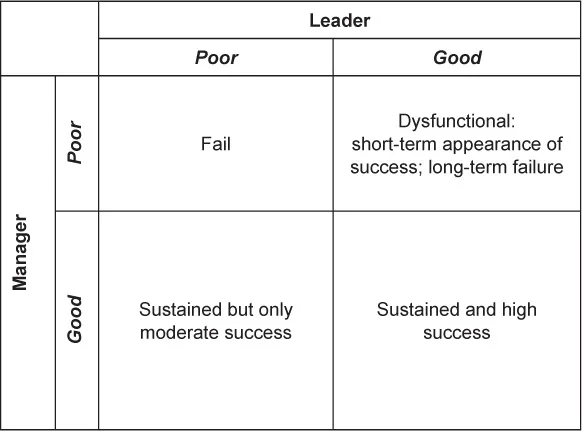
Both management and leadership competences are needed for sustainable success in a management position. A manager (or leader) showing only strengths in one of the two competence areas will find it difficult to maintain a high-performing team in the long run. In a recent interview in Director, the magazine of the UK’s Institute of Directors, Henry Mintzberg said the separation of management and leadership is dysfunctional: leaders who don’t manage won’t know what is going on; management without leadership is demoralizing. Ken Parry (2004) summarizes this in Table 1.2. This shows that that people with good managerial but poor leadership skills can achieve sustainable but only moderate success. People with good leadership but poor managerial success can achieve short-term success but long-term failure. Only good managerial skills combined with good leadership skills can lead to sustainable and high success. If you are good at applying the tools and techniques you can achieve moderate success, but to be truly effective as a project manager you need to be a good leader as well.
Table 1.2 Combining management and leadership for success (after Parry 2004)
This concept is reflected in a model of competence developed by Lynn Crawford (2007), based on the work of Richard Boyatzis (1982). This model will be described fully in the next chapter. She suggests that competence is not just the application of knowledge and skills, the application of the tools and techniques. Competence also encompasses appropriate traits, behaviours and temperament. Yes, a project manager must have what Lynn Crawford calls input competencies, the ability to apply the tools and techniques effectively. But if that is all they can do, it makes them just an adequate manager. To be an inspiring leader (and effective manager) they must also have what Lynn Crawford calls ‘core personality characteristics’, or ‘personal competencies’. In this book we will explain the nature of these personal competencies, and show how they can be developed and improved.
But the nature of these personal competencies is not the same on every project. Somebody who is an effective project leader on one project may not be on another; somebody who is good at bullying subcontractors to deliver on a construction project many not be very good at communicating with and motivating stakeholders on an organizational change project. We aim to describe the nature of different leadership styles appropriate on different types of projects.
There is also the question about whether you are born with these personal competencies or whether they can be learnt. Our view is that you are born with your basic personality profile, but it can be developed, adapted and enhanced. Organizations need to be aware of the types of projects they undertake, and develop project managers with appropriate competency profiles to manage their projects. They should recruit people with a reasonable match, but then through their careers develop those people to become better and better at leading the organization’s projects. Further, as we shall see, larger, more complex projects may require different leadership styles than the simpler projects on which those projects managers are likely to start. Thus, organizations must aim to enhance the profiles of their project managers as they develop through their careers. Likewise, project managers must be aware of the types of projects undertaken by the organizations they work for, and look to develop appropriate competencies.
STRUCTURE OF THE BOOK
In the next chapter, we explore the competence model of leadership, and review what has been written over the past eighty years about the traits and behaviours of effective leaders. We compare the general management and project management literature, and show that whereas in the general management arena people have suggested different leadership profiles are appropriate in different circumstances, that is not the case in the project management field, where people have been constrained by the two beliefs introduced at the start of this chapter into thinking that all project managers can manage all projects. In Chapter 3, we focus on the competence school of leadership. In Chapter 4 we then show how this applies to the managers of different types of project and describe a model for profiling the competency of effective leaders. In Chapter 5 we describe different applications of leadership on projects in practice. Chapter 6 integrates the ideas from the earlier chapters and develops a theory of project performance based on the leadership competencies of the project manager.
CHAPTER 2
MODELS OF LEADERSHIP COMPETENCE
Our proposal is that the projects manager’s competence, including his or her leadership style, contributes to project success, and that different profiles of competence are appropriate for different types of project. In order to explore this proposal, we need to understand what we mean by competence, and investigate what has been written on leadership competence. In a general management context, it has been shown that the manager’s competence, including his or her leadership style, contributes to the success of what they are managing, and different leadership styles are appropriate in different situations, and so we expect that ...
Table of contents
- Cover Page
- Title Page
- Copyright Page
- Contents
- List of Figures
- List of Tables
- 1 Introduction
- 2 Models of Leadership Competence
- 3 Dimensions of Leadership Competence
- 4 Personalities of Leaders
- 5 The Reality of Project Leadership
- 6 Towards a Leadership Competence Theory of Project Performance
- REFERENCES
- INDEX
- Advances in Project Management and Fundamentals of Project Management Series
Trusted by 375,005 students
Access to over 1.5 million titles for a fair monthly price.
Study more efficiently using our study tools.
Frequently asked questions
Yes, you can cancel anytime from the Subscription tab in your account settings on the Perlego website. Your subscription will stay active until the end of your current billing period. Learn how to cancel your subscription
No, books cannot be downloaded as external files, such as PDFs, for use outside of Perlego. However, you can download books within the Perlego app for offline reading on mobile or tablet. Learn how to download books offline
Perlego offers two plans: Essential and Complete
- Essential is ideal for learners and professionals who enjoy exploring a wide range of subjects. Access the Essential Library with 800,000+ trusted titles and best-sellers across business, personal growth, and the humanities. Includes unlimited reading time and Standard Read Aloud voice.
- Complete: Perfect for advanced learners and researchers needing full, unrestricted access. Unlock 1.5M+ books across hundreds of subjects, including academic and specialized titles. The Complete Plan also includes advanced features like Premium Read Aloud and Research Assistant.
We are an online textbook subscription service, where you can get access to an entire online library for less than the price of a single book per month. With over 1.5 million books across 990+ topics, we’ve got you covered! Learn about our mission
Look out for the read-aloud symbol on your next book to see if you can listen to it. The read-aloud tool reads text aloud for you, highlighting the text as it is being read. You can pause it, speed it up and slow it down. Learn more about Read Aloud
Yes! You can use the Perlego app on both iOS and Android devices to read anytime, anywhere — even offline. Perfect for commutes or when you’re on the go.
Please note we cannot support devices running on iOS 13 and Android 7 or earlier. Learn more about using the app
Please note we cannot support devices running on iOS 13 and Android 7 or earlier. Learn more about using the app
Yes, you can access Project-Oriented Leadership by Ralf Muller,J Rodney Turner in PDF and/or ePUB format, as well as other popular books in Business & Business General. We have over 1.5 million books available in our catalogue for you to explore.