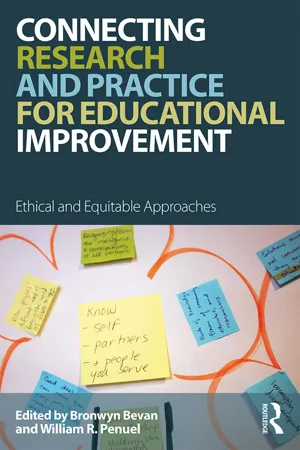
Connecting Research and Practice for Educational Improvement presents powerful arguments and richly illustrated cases for how more collaborative relationships between researchers and educators can yield more relevant research that impacts practice. This book can be useful for anyone teaching or learning about research–practice partnerships, in both school and out-of-school settings. The chapters highlight the different dispositions and skills needed to cultivate ethical relationships and promote equity through partnerships and provide rich frameworks for guiding future work.
eBook - ePub
Connecting Research and Practice for Educational Improvement
Ethical and Equitable Approaches
- 186 pages
- English
- ePUB (mobile friendly)
- Available on iOS & Android
eBook - ePub
Connecting Research and Practice for Educational Improvement
Ethical and Equitable Approaches
About this book
Information
Part I
Rethinking the Relationship Between Research and Practice
1
Democratizing Evidence in Education
In this chapter, we invite readers into a dialogue on how we can collectively democratize the evidence movement in education. Significant strides have been made to build and use evidence in U.S. education over the past 15 years (Tseng, 2016), but these efforts have produced mixed responses to their effectiveness and in the degree of support for them among different stakeholders. Many initiatives have been driven by top-down forces and imperatives, with too little attention provided to the perspectives, expertise, and diversity of people who are concerned with education. All too often, teachers have perceived evidence-based policies as something done to them rather than with them (Finnigan, Daly, & Che, 2013). Educators more broadly have seen research conducted on schools and not with them. Those perceptions have contributed to a distrust of data and research evidence and of policymakers’ efforts to use them to drive change.
A desire to address these issues is already palpable in the education sector, but many of us are grappling with how to make our work more inclusive. Going forward, we believe that the movement for evidence in education could accomplish much more by aligning our efforts with democratic principles. We must aim for a more engaged and evidence-informed “citizenry” in which different stakeholders can meaningfully participate in the production and use of data and research evidence to inform educational improvement.
What would this mean? In a more democratic evidence movement, the power to define research agendas would be shared among a broader cross-section of researchers, practitioners, decision-makers, and communities. In our current context, research questions often arise out of researchers’ discussions and debates with each other in academic journals and at scholarly conferences. Imagine instead a world in which the research questions arose from vibrant back-and-forth exchanges between researchers and educators as they jointly addressed the roadblocks to teaching and learning. Imagine, too, that parents, students, and community stakeholders had a say in determining the unanswered questions that future research should address. And what if the demand for evaluation was not driven primarily and punitively by policymakers but by educators seeking knowledge to enhance their professional work and by parents and community groups invested in improving education? Setting research goals would become less an academic exercise or a policy mandate and more a matter of deliberation, negotiation, and compromise among diverse stakeholders. The process would likely be messier and less efficient, but it would also yield more meaningful agendas.
When it came to evidence-informed decision-making, research and data would not just be a tool for policymakers; evidence would also be accessible to community organizations, parents, students, and the broader public as they seek to drive change in education. There would be a stronger focus on developing a shared understanding of what the research says and what its implications are for practice and policy. Of course, disagreements will remain about values, the proper role of government, and where to direct resources. Data and research evidence cannot resolve those debates, but they can be tools for forging consensus about the problem at hand and the likely outcomes—both intended and unintended—of moving in particular policy directions.
In this chapter, we discuss why it is important to democratize the evidence movement in education and the urgency of tackling it now. We offer our views on what a more democratic evidence system could look like in action by focusing on shared values; redefining relationships, roles, and professional identities; and putting in place new practices and structures. For the purposes of this chapter, we focus intensively on researchers and practitioners, but we see them as only two sets of stakeholders within a broader democratic movement. For work on community stakeholders, we refer readers to Kirshner, Pacheco, Sifuentes, and Hildreth (Chapter 6, this volume).
Why Democratize the Evidence Movement? Why Now?
It is commonly believed that more or better evidence and greater science literacy could settle disagreements. According to recent studies in cognitive and social psychology, however, the primary source of controversies is not a lack of information or a feeble ability to understand it, but differences in people’s “goals and needs, knowledge and skills, and values and beliefs” (National Academies, 2017, p. 3). Taken in this light, how evidence is produced, debated, and communicated is as important—if not more so—than having the right evidence or having sufficient evidence.
Researchers Matthew Feinberg and Robb Willer (2013) found that tapping into people’s preexisting beliefs influences their support for specific policies. In an experiment, they tested whether using images that resonate with conservative values could increase skeptical Republicans’ support for climate change policies. Conservative individuals were shown images of the consequences of climate change; some saw images that tapped into conservative beliefs about purity (e.g., once-pure water contaminated), and others saw images that invoked liberal beliefs about protection from harm (e.g., a coral reef system harmed by global warming). Climate change skeptics who saw images that appealed to their conservative beliefs reported greater support of climate change policies than those who saw images that appealed to liberal beliefs. The alignment of the message with the viewer’s belief system mattered.
Similarly, Dan Kahan and his colleagues (2012) set out to investigate why good evidence isn’t more effective in resolving disagreements. The researchers surveyed the attitudes and beliefs of 1,000 Americans, then administered a test to evaluate their math skills, and finally presented them with various scenarios that required them to use those skills to evaluate information and make a recommendation. When the scenario was related to an issue on which participants did not have strong views, their math skills predicted their answers. That is, participants with stronger math skills were more likely than those with weak skills to make the right recommendation. However, when the scenario was related to an issue for which participants held strong views, math ability ceased to be predictive of how well they did. In fact, people with stronger math skills were less likely to make the correct choice when such a choice conflicted with their beliefs.
Like Feinberg and Willer (2013), Kahan and colleagues (2012) concluded that the problem was not one of needing more information or a stronger ability to judge it. Instead, the researchers attributed this phenomenon to the ways people’s preexisting beliefs influence how they process information. In general, individuals want to avoid the tension that arises when they confront information that conflicts with their beliefs. It is much easier to resolve this tension by changing how you look at a specific piece of evidence rather than by changing your beliefs or how you look at the world.
It might be tempting at times to see the world as divided between those on the evidence side and those outside it, but the studies just discussed suggest that this distinction might be more situational. It depends on the issue at hand, the specific context, and people’s beliefs. Rather than staking out “sides” for or against evidence, we may be better off broadening and opening up the evidence movement to account for real-world complexities and the ways people’s beliefs and values influence their positions on social issues. There must be room for different stakeholders to participate in building and using evidence to improve education.
Evidence as Weapon Versus Evidence for Dialogue
The need for the evidence movement to become more democratic is urgent because of increasing concerns about the political motives behind research and its use:
You know, you can find research to support anything. The problems we have in our society today … People are now using research to say that all the problems are the teacher, and if you can correct the teacher, all our problems go away, which is ridiculous… . The point is research can be slanted to support many different viewpoints.
(Daly & Finnigan, 2011)
This view of research as a political weapon is not inevitable. In Teaching in Context, Elaine Allensworth (2017, pp. 156–157) explains how evidence can also be used to facilitate productive conversations:
In 2009, schools in Chicago started using data on early warning indicators in the ninth grade to help students have a strong transition to high school and keep them on track to graduation. Before this, conversations in schools about issues around dropout often focused on factors other than student course performance. School staff considered dropout and course failure to be problems that were outside of their control, that stemmed from students’ lives outside of the school. By focusing attention on students’ grades and attendance, conversations became about how students were performing in school and what school staff and parents could do to support better attendance and performance in classes, rather than trying to fix problems outside the school, such as crime and teenage pregnancy… . By keeping the focus on data related to outcomes everyone cares about for the student, … conversations can move away from finger-pointing about who is to blame for problems at school (the student, the parent, the teacher) to making plans for improving how students are actually doing in school.
As this example suggests, research evidence can be used as a tool for productive dialogue rather than as ammunition to take down another argument. Research can help different stakeholders come to a shared understanding of the problems that they care about and to jointly determine the productive directions to take and the solutions to try out. But to have these kinds of dialogues, we need to reenvision the relationship between the research community and other stakeholders and we need a different infrastructure for connecting research, policy, and practice (Tseng & Nutley, 2014).
Some might think that this is a particularly challenging time with regard to science. There has been extensive commentary and debate about whether we are in a post-truth, post-fact, post-evidence environment (Brown, 2016; Stewart, Dubow, Hofman, & van Stolk, 2016). These challenges are all the more reason to reflect on where we have been in our evidence work and where we want to go. In this time of uncertainty and reevaluation, a window of opportunity has opened for redefining the role of education research in policy, practice, and broader public discourse. There are related efforts led by organizations around the world, including Sense About Science, Evidence for Democracy, the African Institute for Development Policy, the Alliance for Useful Evidence, and the Scholars Strategy Network. How we come out of this period will depend a great deal on whether we use this as a time to consider alternative ways of thinking and working or whether we retrench.
Democratizing Evidence in Action
What will it take to achieve a more democratic evidence system, where diverse stakeholders have a voice in both the production and use of research evidence? A democratic political system is bolstered when there are respectful relationships, shared values, well-defined roles and identities, and a supportive infrastructure. In the sections that follow, we discuss how we might rethink these same elements to create a more democratized evidence system.
About a decade ago, the second author attended a meeting bringing together district administrators and educators with education researchers to learn about promising school improvement approaches. The meeting started well, at least from the researchers’ perspectives: After all, they were able to present the latest research evidence on school improvement to practitioners. Soon, however, the meeting degenerated into recriminations against the research side and the practice side. The practitioners complained about being dragged to “yet another meeting” at which researchers presented irrelevant studies and then told practitioners what to do. In turn, the researchers expressed frustration and disdain that educators neither read nor used their research. This disagreeable dynamic went on for a day and a half.
This all-too-common story illustrates how important it is to foster productive relationships and to work toward shared values. Educators too often feel like second-class citizens, spoken down to by research “experts” in these mixed-role settings. Researchers who care about education and feel their work could benefit educators are frustrated that they are distrusted. In this environment, the parties are at an impasse, and forward movement is all but impossible.
One of the more important benefits of a democratic system is that it can help a diverse citizenry reconcile differences in a peaceful manner, enabling collective action and progress. To democratize evidence, we must bridge the different perspectives and interests held by various stakeholders in our education system. We need to recognize the interdependencies of different people—teachers, administrators, parents, students, policymakers, and researchers—and the varying roles they play within our education system.
Building Relationships
If researchers disrespect educators—for example, by assuming that they disregard research evidence in their teaching—and, in turn, if educators disparage researchers as “ivory tower” intellectuals who produce nothing of practical value, then we cannot build a system in which evidence informs change. Fortunately, there’s a lot to build on in developing more constructive relationships between educators and researchers.
Across the country, we are witnessing an emerging field of research–practice partnerships (RPPs) in education (Coburn, Penuel, & Geil, 2013). As the recently formed National Network of Education Research–Practice Partnerships describes, these efforts are “long-term mutually beneficial formalized collaborations between education researchers and practitioners” that focus on “producing more relevant research, improving the use of research evidence in decision making, and engaging both researchers and practitioners to tackle problems of practice” (National Network of Education Research–Practice Partnerships, n.d.).
If the key to success in real estate is “location, location, location,” then the key to effective partnerships is “relationships, relationships, relationships” (Barton, Nelsestuen, & Mazzeo, 2014, p. 2). While robust relationships among researchers, educators, and policymakers certainly exist outside of RPPs, these entities have codified some of the relational elements that foster success. Chief among them is mutualism, a commitment to “sustained interaction that benefits both researchers and practitioners” (Coburn et al., 2013, p. 3). Partnerships depart from the typical ways researchers and practitioners work together wherein one group or the other sets the agenda. For example, “collaborative” work often entails researchers reaching out to practitioners because they need a site to conduct their studies or practitioners contracting with a researcher to fulfill specific technical needs. While there may be some negotiation around the work, those adaptations are often made around the edges, and the project goals do not rise to the level of being co-defined. In RPPs, there is a commitment to jointly setting the research agendas and the projects that stem from them (Coburn et al., 2013).
Working Toward Shared Values
Identifying shared values can provide a foundation for productive relationships. Values that we think are necessary to promote a more democratic evidence system fall into three categories: interpersonal (values regarding social interaction), scientific (values that support rigorous research evidence), and civic (values that promote democratic engagement). In the next sections, we discuss these mutually reinforcing values and the relationships they can generate.
Interpersonal Values
Three interpersonal values stand out in building a more democratic system: respect, humility, and curiosity (see also Palinkas, Short, & Wong, 2015, for a discussion of intra- and interpersonal characteristics). Of these three values, mutual respect is perhaps the most fundamental. In a functioning evidence system, researchers and practitioners respect what the other brings to the table. Respect can engender trust, and trust is the glue ...
Table of contents
- Cover
- Title
- Copyright
- Contents
- Contributors
- Preface
- Part I Rethinking the Relationship Between Research and Practice
- Part II RPPs That Impact Practice
- Part III Expanding Models of RPPs
- Part IV Designing for Equity in RPPs
- Index
Trusted by 375,005 students
Access to over 1.5 million titles for a fair monthly price.
Study more efficiently using our study tools.
Frequently asked questions
Yes, you can cancel anytime from the Subscription tab in your account settings on the Perlego website. Your subscription will stay active until the end of your current billing period. Learn how to cancel your subscription
No, books cannot be downloaded as external files, such as PDFs, for use outside of Perlego. However, you can download books within the Perlego app for offline reading on mobile or tablet. Learn how to download books offline
We are an online textbook subscription service, where you can get access to an entire online library for less than the price of a single book per month. With over 1.5 million books across 990+ topics, we’ve got you covered! Learn about our mission
Look out for the read-aloud symbol on your next book to see if you can listen to it. The read-aloud tool reads text aloud for you, highlighting the text as it is being read. You can pause it, speed it up and slow it down. Learn more about Read Aloud
Yes! You can use the Perlego app on both iOS and Android devices to read anytime, anywhere — even offline. Perfect for commutes or when you’re on the go.
Please note we cannot support devices running on iOS 13 and Android 7 or earlier. Learn more about using the app
Please note we cannot support devices running on iOS 13 and Android 7 or earlier. Learn more about using the app
Yes, you can access Connecting Research and Practice for Educational Improvement by Bronwyn Bevan,William R. Penuel in PDF and/or ePUB format, as well as other popular books in Education & Education General. We have over 1.5 million books available in our catalogue for you to explore.