In Powerful Pedagogy, Ruth Powley, Love Learning Ideas blogger and experienced teacher and school leader, debunks teaching and learning myths and shows how the more we know about pedagogy, the more able we are to make informed and efficient choices about our practice, saving ourselves valuable time. Focusing on building sequences of learning rather than one-off lessons, it is an antidote to 'quick fix' books, empowering teachers as professionals in possession of 'powerful' pedagogical knowledge that can be used to improve teaching in a sustainable way.
Powerful Pedagogy draws extensively from a wide range of educational writers and research, offering an accessible synthesis of what really works in the classroom. Together with strategies to put theories and research into practice, each chapter contains a handy list of questions for the reflective practitioner. It explores reasons for the confusion over what constitutes effective pedagogy in recent years and presents practical research-based solutions, outlining successful and efficient:
Modelling of excellence
Explaining for understanding
Practising to fluency
Questioning as assessment
Testing to permanency
Marking for improvement
Effective planning of lessons and curriculum sequences.
Powerful Pedagogy allows teachers to understand how to make the best choices about what works in the classroom, improving the quality of teaching. It is an essential companion for trainee and experienced teachers in all sectors, and for school leaders and educational trainers.
I’m throwing everything at my students and hoping that some of it sticks.
For how many teachers would this be a relatively accurate description of their teaching practice, especially for exam classes? In the modern school, the stakes are high for students and teachers, a fact that some ‘educationalists’ have still failed to grasp. For many teachers and students, the description in Preparing for a Renaissance in Assessment by Sir Michael Barber, proponent of ‘deliverology,’ of “teachers and students enjoying long holidays and short hours that are out of alignment with the working days and hours of their parents and guardians”1 would be fortunate to prompt merely a wry smile. In contradiction of Sir Michael Barber’s view, a report by the Education Policy Institute into Teacher Workload and Professional Development in England’s Secondary Schools, published in 2016, found that teachers in England were working 19 per cent longer than the OECD average, with around a fifth of teachers reporting that they worked 60 hours or more in the week surveyed.2
The high-cost of intervention-loaded teaching
Intervention-loaded teaching and intensive input can work when done well – as Hattie states “almost everything works,”3 but at what cost? How many teachers and schools are adding intervention after intervention to their teaching in a Stakhanovite quest for better and better exam results, exacerbated by the current zero-sum culture of Progress 8 accountability?
This is not sustainable in the long-term for the following reasons.
1. Intervention-driven teaching is based on the premise of ‘more’ rather than ‘better.’
This is not to say that the ‘more’ may not be ‘better.’ In an article on Improving Teaching by Increasing ‘Academic Learning Time’ Fisher et al. suggest that “teachers who allocate more time to a specific content area have students who achieve at higher levels than teachers who allocate less time to the same content.”4 There is much to be said for looking realistically at allocated time rather than requiring intervention ‘top ups’ to get through an overcrowded curriculum. However, there is a difference between a strategic programme of increasing allocated time to enhance learners’ performance, and engaging in ‘life-support machine’ intervention to prop up inefficient teaching or inefficient learning. Given the costs in time, money and energy of intervention, it would be more efficient to take John Tomsett’s advice to “just make the lessons count.”5
In a blog written in 2014 that resonated with many teachers, Tomsett, inspirational headteacher cum blogger at Huntingdon School expressed the problem:
Why do some students think … that ten one hour lessons … held after school when they and their teachers are tired, will suddenly transform them … and make up for their lack of effort in their seven hours of lessons a fortnight over the past 18 months?
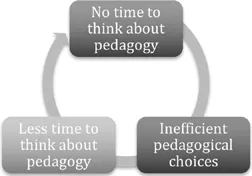
2. Intervention-driven teaching runs the risk of creating a vicious circle of inefficient pedagogy:
Teachers who are over-committed as a result of a heavy programme of interventions have no time to think about pedagogy; therefore they make inefficient pedagogical choices; therefore they have less time to think about pedagogy.
In their study into effective learning techniques, Improving Students’ Learning with Effective Learning Techniques, Dunlosky et al. point out that:
Some effective techniques are underutilized – many teachers do not learn about them, and hence many students do not use them … Also, some learning techniques that are popular and often used by students are relatively ineffective.6
Interestingly, the report into Teacher Workload and Professional Development in England’s Secondary Schools found that, despite working the third longest hours of the 36 countries surveyed, English teachers spent less time engaging with professional development, ranking 30th, and spending just a tenth of the time of Shanghai teachers on professional learning.7
3. Without a clear understanding of effective pedagogy, extra effort can be wasted.
Research sponsored by the Education Endowment Foundation into Increasing Pupil Motivation by using financial incentives found that:
Even when there is a marked improvement in effort in classwork this does not translate into higher GCSE attainment … Future studies should explore why incentives appear to change classwork effort but do not necessarily translate into higher attainment.8
Why did this extra classroom effort not translate into better performance?
4. Heavy workload is the main reason for teachers leaving the profession.
In The School Leadership Journey published in 2016, John Dunford, long-serving school leader and former national Pupil Premium Champion, suggests that retention is “a major problem to be addressed.” His figures state that 25 per cent of state school teachers leave before they have spent five years in the job, with 106,000 qualified teachers under 60 never having taught in a state school. Over 40,000 teachers leave the profession each year – an annual wastage rate of around 10 per cent.9
Powerful Pedagogy
One solution to these problems is what I have termed ‘Powerful Pedagogy.’
The more we know about pedagogy, the more able we are as teachers to make effective and efficient choices about our teaching.
This understanding of pedagogy is ‘powerful’ because:
• It allows us to deliver more powerful instruction.
• It empowers us as teachers to operate as professionals with a deep understanding of our practice, rather than as technicians applying the techniques of others with only a superficial grasp.
• It empowers teaching as a profession in possession of ‘powerful knowledge.’
It also addresses the issues outlined in the introduction: That there is a ‘right’ way to teach – an inbuilt default to the doctrinaire, and that this ‘right’ way is the preserve of some ‘higher power.’
1. It allows us to deliver more powerful instruction
Powerful Pedagogy is not a tick list of ‘silver bullet’ strategies for schools and teachers looking...
Table of contents
Cover
Half Title
Title Page
Copyright Page
Dedication
Table of Contents
Acknowledgments
Introduction: Why don’t we know what effective teaching looks like?
1 What is powerful pedagogy?
2 Four principles of effective learning
3 Six principles of effective instruction
Planning for effective instruction Part 1: Planning effective lessons
4 Modelling of excellence
5 Explaining for understanding
6 Practising to fluency
7 Questioning as assessment
8 Testing to permanency
9 Marking for improvement
Planning for effective instruction Part 2: Designing effective curriculum sequences
Index
Trusted by 375,005 students
Access to over 1.5 million titles for a fair monthly price.
Study more efficiently using our study tools.
Frequently asked questions
Yes, you can cancel anytime from the Subscription tab in your account settings on the Perlego website. Your subscription will stay active until the end of your current billing period. Learn how to cancel your subscription
No, books cannot be downloaded as external files, such as PDFs, for use outside of Perlego. However, you can download books within the Perlego app for offline reading on mobile or tablet. Learn how to download books offline
Perlego offers two plans: Essential and Complete
Essential is ideal for learners and professionals who enjoy exploring a wide range of subjects. Access the Essential Library with 800,000+ trusted titles and best-sellers across business, personal growth, and the humanities. Includes unlimited reading time and Standard Read Aloud voice.
Complete: Perfect for advanced learners and researchers needing full, unrestricted access. Unlock 1.5M+ books across hundreds of subjects, including academic and specialized titles. The Complete Plan also includes advanced features like Premium Read Aloud and Research Assistant.
Both plans are available with monthly, semester, or annual billing cycles.
We are an online textbook subscription service, where you can get access to an entire online library for less than the price of a single book per month. With over 1.5 million books across 990+ topics, we’ve got you covered! Learn about our mission
Look out for the read-aloud symbol on your next book to see if you can listen to it. The read-aloud tool reads text aloud for you, highlighting the text as it is being read. You can pause it, speed it up and slow it down. Learn more about Read Aloud
Yes! You can use the Perlego app on both iOS and Android devices to read anytime, anywhere — even offline. Perfect for commutes or when you’re on the go. Please note we cannot support devices running on iOS 13 and Android 7 or earlier. Learn more about using the app
Yes, you can access Powerful Pedagogy by Ruth Powley in PDF and/or ePUB format, as well as other popular books in Education & Education General. We have over 1.5 million books available in our catalogue for you to explore.