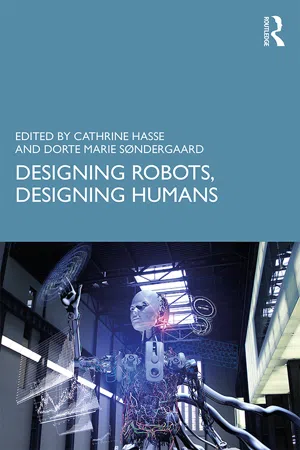
Designing Robots, Designing Humans
eBook - ePub

Designing Robots, Designing Humans

  1. 148 pages
  2. English
  3. ePUB (mobile friendly)
  4. Available on iOS & Android
eBook - ePub

Designing Robots, Designing Humans

About this book

Whilst most research concentrates on the imagined future of robotics, this book brings together a group of international researchers to explore the different ways that robots and humans engage with one another at this point in history.

Robotic design is advancing at an incredible pace, and consequently the role of robots has expanded beyond mechanical work in the industrial sector to the social and domestic environment. From kitchen table pets in the shape of dinosaurs or baby seals, to robot arms that assist with eating, to self-driving cars, this book explores the psychological impact of robotic engagement, especially in domestic settings. Each chapter explores a different aspect of humanoid robotics, for example, the relationship between robotics and gender, citizenship, moral agency, ethics, inequality, and psychological development, as well as exploring the growing role of robots in education, care work, and intimate relationships.

Drawing on research from across the fields of psychology, anthropology, and philosophy, this ground-breaking volume discusses the emerging social side of robotics. By examining our relationship with robots now, this book offers a new and innovative opportunity for understanding our future with robots and robotic culture. Designing Robots, Designing Humans will be interest to researchers of artificial intelligence and humanoid robotics, as well as researchers from cognitive and social psychology, philosophy, computer science, anthropology, linguistics, and engineering backgrounds.

Frequently asked questions

Yes, you can cancel anytime from the Subscription tab in your account settings on the Perlego website. Your subscription will stay active until the end of your current billing period. Learn how to cancel your subscription.
No, books cannot be downloaded as external files, such as PDFs, for use outside of Perlego. However, you can download books within the Perlego app for offline reading on mobile or tablet. Learn more here.
Perlego offers two plans: Essential and Complete
  • Essential is ideal for learners and professionals who enjoy exploring a wide range of subjects. Access the Essential Library with 800,000+ trusted titles and best-sellers across business, personal growth, and the humanities. Includes unlimited reading time and Standard Read Aloud voice.
  • Complete: Perfect for advanced learners and researchers needing full, unrestricted access. Unlock 1.4M+ books across hundreds of subjects, including academic and specialized titles. The Complete Plan also includes advanced features like Premium Read Aloud and Research Assistant.
Both plans are available with monthly, semester, or annual billing cycles.
We are an online textbook subscription service, where you can get access to an entire online library for less than the price of a single book per month. With over 1 million books across 1000+ topics, we’ve got you covered! Learn more here.
Look out for the read-aloud symbol on your next book to see if you can listen to it. The read-aloud tool reads text aloud for you, highlighting the text as it is being read. You can pause it, speed it up and slow it down. Learn more here.
Yes! You can use the Perlego app on both iOS or Android devices to read anytime, anywhere — even offline. Perfect for commutes or when you’re on the go.
Please note we cannot support devices running on iOS 13 and Android 7 or earlier. Learn more about using the app.
Yes, you can access Designing Robots, Designing Humans by Cathrine Hasse,Dorte Marie Søndergaard in PDF and/or ePUB format, as well as other popular books in Psychology & Cognitive Psychology & Cognition. We have over one million books available in our catalogue for you to explore.

Information

Table of contents

  1. Cover
  2. Half Title
  3. Title Page
  4. Copyright Page
  5. Table of Contents
  6. Contributors
  7. Introduction
  8. 1. Gotai: corporeal aesthetics and robotic exoskeletons in Japan
  9. 2. On humanoids, avatars and the rest of us: gender and designing our new Others
  10. 3. Performing the kitchen: becoming a queering witness to the enactments of subject–object relations in a robotic kitchen lab
  11. 4. The automation of ethics: the case of self-driving cars
  12. 5. ‘Active citizenship’ and feeding assistive robotics: a crumbling story?
  13. 6. Material concept formation: inequality in children’s conceptual robot imaginaries
  14. 7. Unpacking the cultural baggage of travelling robots: how socially assistive robots are integrated in practice
  15. 8. Robot companions for children and older people: ethical issues and evidence
  16. Index