eBook - ePub
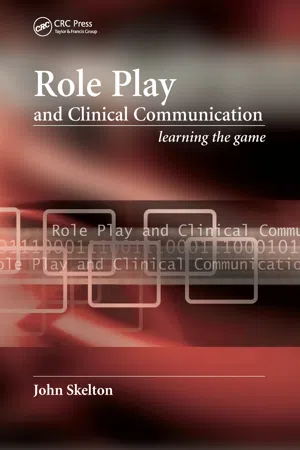
Role Play and Clinical Communication
Learning the Game
- 152 pages
- English
- ePUB (mobile friendly)
- Available on iOS & Android
eBook - ePub
About this book
In "Role Play and Clinical Communication", John Skelton critically considers the practice and benefits of this mainstream teaching method. His wide-ranging approach reflects on the recent developments within medical education, incorporating the medical humanities, the nature of language and communication, and the rules of human behaviour. You will find Skelton's light-hearted and open-minded attitude to communication unquestionably illuminating.
Information
CHAPTER 1
Introduction
Instruction, Madam, is the pill; amusement is the gilding.
(Samuel Richardson, Letters1)
The game of education
This is a book about certain aspects of simulation in clinical education. At its heart is a discussion of the use of role play in the teaching of communication and other issues, and I would like at the outset to be careful about how much – or how little – I am claiming originality for what I say. The kind of work I describe in this book is routine in clinical (particularly medical) education, it is often done exceptionally well, and the nuts and bolts of putting it into effect have been well described.2 However, what doesn’t happen particularly well or often is an attempt to put this kind of activity into its broader educational context, or to tease out its roots in the traditions of language in education. I shall discuss the latter point at some length, because without an understanding of the kind of language associated with the classroom, it is easy to miss the similarity between the professional language one tries to develop in students of the health professions, and the kind of language that is used by teachers – and it is easy therefore to miss the way that role-play exercises mirror the language of the lesson during which they take place. The doctor, the teacher and the role player do certain things in rather similar ways, and so too does the successful student.
I should also say that the book is not at all concerned with the use of clinical skills laboratories and the sophisticated equipment found in them which, from the days of Resusci Anne onwards, have enabled students to become more confident and dextrous (Cooper and Taqueti3 offer a brief historical review of developments in such areas). Rather, I attempt to use role play as an entry-point for a more broad-based consideration of clinical education as a construct, as in some sense a product of artifice. The companion to this book (Language and Clinical Communication: this bright Babylon) was an extended exploration of the Chomskyean metaphor of ‘surface’ and ‘depth’ in language,4 and by extension, education. This book is concerned similarly with what has been called – although the phrase is much less famous than Chomsky’s – ‘the language game of teaching’5 and the game of role play and simulation in a clinical setting.
Bellack and colleagues picked up the ‘game’ analogy from Wittgenstein. The idea appears in The Blue and Brown Books6 (transcripts of notes taken from Wittgenstein’s lectures dating from the 1930s), and is pursued in Philosophical Investigations.7 Above all, Wittgenstein is concerned with the relationship between words and their meanings. It is not enough to know a word, Wittgenstein argues in Philosophical Investigations – one must also know what the word is for:
When one shows someone the king in chess and says: ‘This is the king’, this does not tell him the use of this piece – unless he already knows the rules of the game up to this last point . . .
For Wittgenstein, the fundamental problem with philosophy was its focus, as Hacker puts it,8 ‘on forms of expression rather than their use in the stream of life.’ As any contemporary linguist would phrase it after Hymes,9 it is wrong to focus on language usage (in the abstract) at the expense of language use (in fact) – or, as Wittgenstein states in Philosophical Investigations, ‘The meaning of a word is its use in the language.’
Thus, in the abstract, without context, a sentence like ‘The grass is long’ is a statement about, well, the length of the grass. Provide it with a context, and it might mean ‘Didn’t you say you would definitely cut it this weekend?’ or ‘How can you play golf on a surface like this?’ or any number of other things. Or, although we understand the difference between a compulsion and a choice, between what you must do and what you want to do, we are nevertheless too polite to say to our hosts, at the end of the evening, ‘I want to leave.’ We say we must leave, we affect surprise at the lateness of the hour, we talk of babysitters, the long road home, how early we are obliged to get up. But we know the rules – we cannot say we’re leaving because we never wanted to come in the first place, we’ve put in the bare minimum length of stay, and now we’ve had enough.
So, then, we must understand the rules of chess in order to know what the meaning of ‘the king’ is. ‘A king’, we might say, ‘is a piece which moves in such and such a way.’ But this tells us little. Beyond this decontextualised piece of knowledge, and in order for us to begin to understand why this matters, we must add more information. That the object of chess is to checkmate the king – that the freedom of movement of the king is so restricted that a lot of game strategy is based on the defensive measures necessary to secure one’s own king . . . and so on. Our understanding of the term ‘king’ as it is used in chess, we might say, grows as our understanding of the game of chess itself grows. In exactly the same way, a cardiologist’s understanding of a phrase like ‘His cholesterol is high’ develops throughout their career.
All uses of language, from this analogy, may be considered as games, in the sense that there are certain conventions in all aspects of language use, in all settings, which must be followed, and many, many more which are typically followed. And, as Bellack and his colleagues pointed out, the classroom is also a setting, and has its rules. (I should stress here that the purpose of Bellack and his colleagues was to take Wittgenstein’s metaphor to its limits, and to describe what they observed in the classroom – ‘not (their emphasis) as a prescriptive guide to teacher behaviour.’)
Or at any rate, each setting has its tendencies – the word ‘rule’ perhaps gives the wrong impression. This is where the analogy with a game like chess breaks down. In chess, if one ‘breaks the rules’ by attempting to move the king two squares rather than one, then the game cannot continue. The rule breaker is presumably disqualified, and the game is at an end. There are rules of ordinary language which absolutely must be adhered to in a classroom, or in most settings, for the game to continue (e.g. for the conversation to be sustained). For example, don’t insult the person you are speaking to, and don’t hit them. However, these rules are so obvious that they are normally beside the point. What is of much greater interest is to specify the things which are less obvious, although in doing so you begin to talk of what often happens, not of what must happen. It is part of the social function of language to provide us with language norms through which we can talk to each other without causing offence. And it is part of its creative function to allow these norms to be broken for any number of reasons. One may offer an apparent insult to a friend (‘You’re such an idiot!’) as an indicator of intimacy, and so on. The person who is a poor judge of when and how these norms can be breached is perceived as odd, or eccentric, or unconventional. The person who is an excellent judge of these matters will gain a reputation for being inventive, creative, or even something of a poet.
The rules of the game of teaching are one set of conventions, which I shall explore in some detail. The rules of the game of consulting with patients present us with another set which, as I shall try to argue, closely resemble those of teaching. The rules of the game of clinical role play are poorly understood, but straddle these two worlds.
Life is full of professional occasions. If we are teachers we need to interact with students, and if we are health professionals we need to interact with patients. But whoever we are, we also interact with the waiter who asks us whether we want to order wine, the garage mechanic who tells us we need new tyres, and so on, and such interactions are no less the result of language conventions. They are games in the restricted sense that they are played according to rules (or to tendencies), but they are life itself in all of its quotidian humdrum guise, and in that sense the game is as real as it gets. Yet in such exchanges we adopt social roles (as we inevitably call them), we do a kind of formal linguistic dance round each other, signalling status, level of formality, and the like. And – as I observe I have inadvertently done in this paragraph – we might end up talking of ‘reality’ as a ‘guise.’
Simulation as an educational tool
Simulation – as employed in teaching – is something quite different, at one level. However, we should be aware that when we use role play to develop a medical student’s communication skills, we are using simulation to teach him or her to play the role of ‘doctor’ more effectively.
This brings us to educational simulation itself. It is normal to trace educational simulations back to the development of board games which mirror war and the manoeuvres of war, so that – once more – the analogy is among other things with chess, although Wei Qi (better known in the west through its Japanese name, Go) probably pre-dates it. Cohen and Rhenman – who give an excellent historical overview10 of simulation up to the early 1960s, on which I draw for the next couple of paragraphs – point out:
As is well recognized by the students of the history of chess, this and other similar board games were at a very early stage used as symbolic equivalents to warfare. From this beginning it was probably a very short step to attempt to use these games for planning and training purposes.
Such games became more elaborate through Europe in the eighteenth century, culminating in Schleswig in the 1790s, with a game developed by George Venturini, played over 3600 painted squares. ‘Unfortunately’, as has dryly been pointed out, ‘the complexity of the game grew to such an extent that it became almost impossible to play or referee it’11 (translation by this author).
From here to the elaborate war games undertaken by modern armies is a short step, and from there to the use of simulation in other contexts is an equally short one. The American Management Association (AMA) was looking at this by the 1950s:12
In the war games conducted by the Armed Forces, command officers of the Army, Navy and Air Force have an opportunity to practice decision-making creatively in a myriad of hypothetical yet true-to-life competitive situations. Moreover they are forced to make decisions in areas outside their own specialty; a naval communications officer for example may play the role of a task force commander.
Why then shouldn’t businessmen have the same opportunity? Why shouldn’t a vice-president say in charge of advertising have a chance to play the role of company president for fun and for practice?
‘For fun and for practice.’ There has always been a strong link between the idea of context and simulation, and the idea of fun. Contexts, it is argued, provide meaning, and therefore contexts motivate. They provide both instruction and amusement.
Since the 1950s there has been a huge increase in the use of simulation in all disciplines, not least as a result of the developing sophistication of computer simulations, and of the understanding of how these might be used in teaching (see, for example, the journal Simulation and Gaming).
There are three central points to make at this stage. First, the history of simulation for educational and training purposes is a history of the development of complex contexts. Simulations are typically pared down to some degree, but they have always been detailed enough to create an illusion of reality. Indeed, if they lack this kind of depth, we deny them the name of simulation. This, for instance, is the original AMA game, as it was briefly described at the time:12
The game consists of five teams of three to five persons each. These companies produce a single product which they sell in competition with each other in a common market . . . There are six types of decisions which each team must make every quarter [i.e. every simulated quarter of a year]. They must choose a selling price for their product, decide how much to spend for marketing activities, determine their research and development expenditures, select a rate of production, consider whether or not to change plant capacity and decide whether marketing research information about competitors’ behavior should be purchased.
It is the rich context of simulations which drives them. Within the kind of simulation that is dealt with in this book – role-play activity for health professionals and students of the health professions – the richness of the context should be made as clear as possible to the participants.
Secondly, the clinician’s instinct, faced with complex data, is Holmesian. That is to say, it is Sherlock Holmes’ brilliance to look at the mysterious and unsorted data of the crime scene, and to identify possible hypotheses (‘I have devised seven separate explanations, each of which would cover the facts as far as we know them’, he says in The Adventure of the Copper Beeches13). These possibilities are closed down as evidence accumulates. So it is the doctor’s task to identify, seize and work with the single truth which is in there somewhere. This is the essence of the account that Greenhalgh gives us in what has become a locus classicus of narrative-based medicine, ‘Dr Jenkins’s hunch’:14
I got a call from a mother who said her little girl had had diarrhoea and was behaving strangely. I knew the family well, and was sufficiently concerned to break off my Monday morning surgery and visit immediately.
This, Greenhalgh tells us, is ‘a comment made by a general practitioner . . . which I have expanded into a hypothetical example.’ The point is that the doctor picked up on the use of the unexpected word ‘strangely’ – rather than ‘poorly’, ‘off-colour’ or the like – and felt that there was something there which needed his immediate attention. And sure enough, the child had meningococcal men...
Table of contents
- Cover
- Half Title
- Title Page
- Copyright Page
- Contents
- Preface
- About the authors
- Dedication Page
- 1 Introduction
- 2 A reflection on Socrates
- 3 The language of the classroom
- 4 Rich contexts
- 5 The rules of the game
- 6 Ask, don’t tell
- 7 The basic scenario
- 8 Strange shadows
- 9 Notes on the game of writing scientific text
- 10 The good doctor
- Appendix
- Index
Trusted by 375,005 students
Access to over 1.5 million titles for a fair monthly price.
Study more efficiently using our study tools.
Frequently asked questions
Yes, you can cancel anytime from the Subscription tab in your account settings on the Perlego website. Your subscription will stay active until the end of your current billing period. Learn how to cancel your subscription
No, books cannot be downloaded as external files, such as PDFs, for use outside of Perlego. However, you can download books within the Perlego app for offline reading on mobile or tablet. Learn how to download books offline
Perlego offers two plans: Essential and Complete
- Essential is ideal for learners and professionals who enjoy exploring a wide range of subjects. Access the Essential Library with 800,000+ trusted titles and best-sellers across business, personal growth, and the humanities. Includes unlimited reading time and Standard Read Aloud voice.
- Complete: Perfect for advanced learners and researchers needing full, unrestricted access. Unlock 1.5M+ books across hundreds of subjects, including academic and specialized titles. The Complete Plan also includes advanced features like Premium Read Aloud and Research Assistant.
We are an online textbook subscription service, where you can get access to an entire online library for less than the price of a single book per month. With over 1.5 million books across 990+ topics, we’ve got you covered! Learn about our mission
Look out for the read-aloud symbol on your next book to see if you can listen to it. The read-aloud tool reads text aloud for you, highlighting the text as it is being read. You can pause it, speed it up and slow it down. Learn more about Read Aloud
Yes! You can use the Perlego app on both iOS and Android devices to read anytime, anywhere — even offline. Perfect for commutes or when you’re on the go.
Please note we cannot support devices running on iOS 13 and Android 7 or earlier. Learn more about using the app
Please note we cannot support devices running on iOS 13 and Android 7 or earlier. Learn more about using the app
Yes, you can access Role Play and Clinical Communication by John Skelton,Anneliese Guerin-LeTendre in PDF and/or ePUB format, as well as other popular books in Medicine & Medical Theory, Practice & Reference. We have over 1.5 million books available in our catalogue for you to explore.