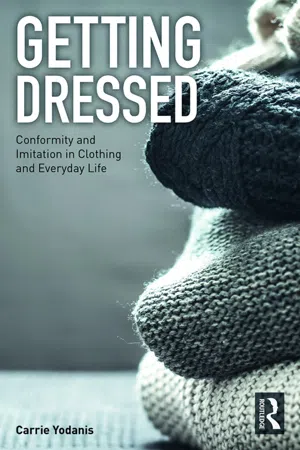
Getting Dressed teaches sociology through the everyday decision of what to wear. It is about the rules that shape how we dress and how and why we conform. It is about how and why we imitate others. We may think about clothing as our personal style and identity. But our personal style is not so personal; it is social, shaped and limited by countless social influences. We use clothes to rank and treat each other as better and worse. Yet we need each other to become who we are when getting dressed. This book is about what we wear, why we wear it, and why it matters.
- 128 pages
- English
- ePUB (mobile friendly)
- Available on iOS & Android
eBook - ePub
About this book
Information
1 The Public Nature of Personal Style
Getting dressed is not an individual experience; it’s social.
Clothing, and what we wear, gets at the heart of a core tension in social life—are we individuals who seek to be different and unique, or do we conform and imitate each other? Are we free to choose what we want to do, or do we follow rules and do what we are supposed to do?1
Many scholars in the literature on fashion and clothing emphasize that we are increasingly free to express our individuality through our clothing. In the past, they say, imitation and conformity were central in explaining what we wore, but today, there has been a shift toward individualism. Where there were once constraints, through pressures to conform to rules, they say, there is now freedom to figure out for ourselves who we are. In the past, there were constraints on who we could be, what we could do, and how we could dress. But in today’s world, they argue, many of these constraints are gone. We are free to be whomever we want, live as we want, and wear what we want. The past was a time of “cookie-cutter uniformity,” but the present, they argue, is a time to be uniquely yourself.2
For example, Diana Crane, a leading sociologist in the study of fashion whose work I will cite throughout this book, concluded that before the 1960s, people conformed. There were rules dictating what we should wear and when and how to wear it, including how long skirts should be and what colors should be worn and when. For dress, there was a set “correct mode of behavior” and people followed it. They followed it because doing so showed that they understood the rules and were capable of choosing the “correct” behavior. There was also fear of doing something incorrectly and facing the social repercussions of not conforming. Since then however, she argued, things have changed.3
There is no longer a correct mode of behavior when it comes to fashion and dress, she argued. Instead, clothes are chosen based on “personal tastes rather than conformity to rules.” People “are less inclined to imitate and more likely to select styles based on their perceptions of their own identities and lifestyles.” We are now “expected to ‘construct’ an individual appearance from a variety of options.”4
Other scholars have also argued that today we can “build-your-own” chosen identity with our clothing.5 For example, Ted Polhemus, an anthropologist whose work will also be covered in this book, wrote,
[I]n the twenty-first century more and more of us refuse to accept the conformity… . Instead we have do-it-yourself confidence and creative throw-away-the rule-book sampling and mixing to produce a unique personal style ‘statement’ which functions as a visual advertisement of who we are and where we are ‘at.’ Never before in human history have individuals had such power and confidence in deciding their own appearance.6
Now, none of these scholars say that there are no rules today. They all acknowledge that constraints in some forms and some areas still exist. Yet, they all emphasize that we are freer today.
But how free are we, really? We may be freer in some ways, but are conformity, imitation, and even “cookie-cutter uniformity” dead or even dying? In this book, we will see that we are not quite there yet. We may seek to be unique and individual. We may even see ourselves as different. Yet we follow rules and look to other people to decide what to do and how to think about who we are as individuals. Limits on our individuality and freedom in dress continue today. The focus in the fashion literature on agency, choice, and our ability to create unique and individual versions of ourselves through clothing, a sociology professor who studies fashion and age argued, are “greatly overstated.” To the contrary, she emphasized, “It is notable in modern society how similar people in fact appear.” Conformity and imitation remain just as, if not more, significant in our clothing choices than individual freedom. Today, “wearing the right clothes, the appropriate dress for the occasion, fitting in rather than standing out, are the dominant concerns of most people.”7 Conformity and imitation are alive and well, still shaping what we wear and how we construct our identity through our “personal style.”
It is through our personal style that we define who we are for ourselves and let other people know who we are. Through how we look, we express ourselves and tell people what we are like. Through our clothing, we choose our identities and share it with others. The author of the book Fear and Clothing: Unbuckling American Fashion captured this idea well when she called clothing our “visual interface with the rest of the world.” “We dress to define our own characters for ourselves,” she wrote, as well as to define “who we want people to think we are, and how we expect to be treated… . When you compose an outfit, you are creating a statement that is, essentially, a shorthand mini-autobiography.”8
But there is an important second part of this process. Who others think we are and even who we think we are is not just up to us as individuals. Our identities don’t emerge from within us to be unilaterally shared with others. Instead, our identity is shaped by our interactions with other people. As we present ourselves to the world, people react. We are treated a certain way. These reactions work into our sense of self. We interpret how we think people perceive us and these interpretations become part of who we think we are. We figure out who we are both by how we appear to other people and what we think they think of us.9
Our clothing sends messages. Different pants, shirts, jackets, shoes, socks, underwear symbolize different backgrounds, values, beliefs, tastes, lifestyles, interests, statuses. These messages are not inherent in the items of clothing. Rather, items of clothing take on different social meanings at different times and different places. The same item might mean something quite different now than in the future, say in 2030, or in the United States than in another country, like Japan. The meanings tied to clothes are also not always agreed upon or known by everyone. Thus, the meanings may be misunderstood or misread by others.10
But for the most part, by putting on certain clothes, and not others, we are sending a message to the people who see us in our clothes about what we do, think, or have. The people who see our clothes instantly react to us based on the message about us that they are receiving from seeing us in what we are wearing. When we see the reactions from others, we use this information to reinforce or reconstruct our identity and sense of self. People are constantly reacting to us every day as soon as we leave the house in our clothes. We, in turn, are also constantly reacting to other people in their clothes.11
Even when no one is around and we are alone in our bedrooms in front of our closets or mirrors deciding what to wear, we are still thinking, based on past experience and future expectations, about how people will interpret the message our clothing is sending.12 There is a constant ongoing exchange of evaluation and reaction between individuals based on clothes. It is through these constant interactions that our identities are created and our sense of who we are is formed.13 As anthropologists, Daniel Miller and Sophie Woodward, whose studies of clothing are discussed throughout this book, explained, “establishing what is ‘me’ … [is] always through the imagined and remembered opinions of others.”14
When we see someone in a certain uniform, for instance, we know instantly what they do, without knowing anything more about them than what they are wearing. From uniforms, we know who is driving the bus, providing health care, policing the area, and assisting us on a plane. We also have expectations, good and bad, of how these people will behave and we react to them accordingly.15
The uniform, its meaning and how people react to it, also impacts how the people wearing uniforms think of themselves.16 Flight attendants, for example, reported both being treated by passengers in a more professional way and feeling more professional themselves when wearing a formal uniform.17 A doctor’s white lab coat can have a similar effect, leading someone to be both assessed as more competent and actually acting more competently.18
These same evaluations extend beyond uniforms. How we dress affects how people see us, treat us, and in turn, how we see ourselves. White-collar men reported that wearing suits led coworkers and clients to see them as good at their jobs, and they themselves felt like they were doing a good job when dressed in a suit.19 Students evaluate teachers’ intelligence, expertise, interestingness, and likeability at least partly based on what the teachers are wearing.20
But not everyone is evaluated using the same standards. Some people, for example, are freer to express themselves through their clothing than others. Wearing unique clothing to stand out may raise a person’s perceived social status when the person dressing uniquely and standing out is perceived by others as having enough status that they are free to do what they want. For example, wearing red sneakers to teach class may increase a professor’s perceived status among students.21 People in more marginalized positions have less freedom. An immigrant who feels that their status is at risk going through Customs may carefully pick an outfit that hides their ethnic identity so as to not attract attention.22
Our personal style—and the identity we express through it—is actually not so personal at all. While we may think about clothing as self-expression to form a personal identity, what we wear and the identity we create with our clothing is not something we do on our own. Instead, it is social, something we do in interaction with others.
And we are far from free to wear whatever we want. Our freedom of self-expression through clothing is restricted. As we will see in the rest of this book, there are consequences to what we wear. Our choice in clothing is not simply a matter personal tastes and styles. Rather, social rules constrain and restrict what we can wear.23 In certain places and at certain times or because of who we are supposed to be, we are supposed to wear certain things and not others. These rules are so common and we have lived among them for so long that we may not be aware that they are there and that we are following them. But they are there, nonetheless. Some of the most restrictive, overarching rules for dress may have broken down over the years, but we still conform to rules and expectations for dress, often coming from the smaller social groups to which we want to fit in and belong. Within and beyond the rules, we also imitate others. We look at what others are wearing and wear the same thing. This helps to alleviate the uncertainty and anxiety of potentially picking the “wrong” thing to wear, standing out, and being different. We may not think that we are following the rules and imitating, but we often are. Conformity and imitation are still rife in our clothing choices, and thus any identity we are trying to create through them.
Dressing by the Rules
2
The Written Dress Codes
Most of us, at some point in our lives, have been expected to follow a dress code—whether at school, work, or when going to a restaurant or club at night. We may not have thought about these codes as restrictions on our personal style or expressions of identity, but they are. If someone doesn’t dress according to the codes, they face formal punishment, including not being allowed into an establishment or being asked to leave until they dress according to the rules.1 This is the opposite of personal freedom of expression.
Uniforms are the most restrictive dress codes. Some schools and workplaces require some people to dress exactly alike in a uniform. As mentioned, there are some practical benefits to uniforms. A uniform lets us know immediately, at first glance, to whom we should turn for guidance if the airplane we are on needs to make an emergency landing.2 Uniforms, such as school uniforms, also homogenize people. This can hide, if not remove, inequality among people.3
Homogenizing people, however, is also about hiding individuality. Uniforms are meant to suppress individuality, not foster it.4 And those most affected by this homogenizing are people in positions of limited power. The people required...
Table of contents
- Cover
- Title
- Copyright
- Contents
- Preface
- Introduction
- 1 The Public Nature of Personal Style
- Dressing by the Rules
- Dressing Like Others Do
- Notes
- References
Trusted by 375,005 students
Access to over 1.5 million titles for a fair monthly price.
Study more efficiently using our study tools.
Frequently asked questions
Yes, you can cancel anytime from the Subscription tab in your account settings on the Perlego website. Your subscription will stay active until the end of your current billing period. Learn how to cancel your subscription
No, books cannot be downloaded as external files, such as PDFs, for use outside of Perlego. However, you can download books within the Perlego app for offline reading on mobile or tablet. Learn how to download books offline
Perlego offers two plans: Essential and Complete
- Essential is ideal for learners and professionals who enjoy exploring a wide range of subjects. Access the Essential Library with 800,000+ trusted titles and best-sellers across business, personal growth, and the humanities. Includes unlimited reading time and Standard Read Aloud voice.
- Complete: Perfect for advanced learners and researchers needing full, unrestricted access. Unlock 1.5M+ books across hundreds of subjects, including academic and specialized titles. The Complete Plan also includes advanced features like Premium Read Aloud and Research Assistant.
We are an online textbook subscription service, where you can get access to an entire online library for less than the price of a single book per month. With over 1.5 million books across 990+ topics, we’ve got you covered! Learn about our mission
Look out for the read-aloud symbol on your next book to see if you can listen to it. The read-aloud tool reads text aloud for you, highlighting the text as it is being read. You can pause it, speed it up and slow it down. Learn more about Read Aloud
Yes! You can use the Perlego app on both iOS and Android devices to read anytime, anywhere — even offline. Perfect for commutes or when you’re on the go.
Please note we cannot support devices running on iOS 13 and Android 7 or earlier. Learn more about using the app
Please note we cannot support devices running on iOS 13 and Android 7 or earlier. Learn more about using the app
Yes, you can access Getting Dressed by Carrie Yodanis in PDF and/or ePUB format, as well as other popular books in Social Sciences & Popular Culture. We have over 1.5 million books available in our catalogue for you to explore.