1 What Is a Tribosystem?
Sooner or later, everyone experiences a friction or wear problem. What people choose to do about it is a different matter. You could simply ignore the problem or discard the worn-out device. If that is not an option, then you can replace the part or the entire device with a new one. As an engineer who needs to dig deeper into the problem, you may decide to improve the component design, try a different lubricant, or consider using alternative materials, surface treatments, finishes, or coatings. This book is intended to help those who need to do something about a wear (or friction) problem, whether it involves understanding how it happened, diagnosing the kind of wear that is occurring, developing or using a test to select alternate materials or lubricants, or completing a root cause analysis that could eventually lead to longer product life, improved design, and greater component reliability.
Wear problems belong to the multidisciplinary field of science and engineering that is called “tribology.” Its name derives from the Greek word tribos, which in English means “I rub.” The word tribosystem refers to a physical arrangement of two or more interacting structural parts, including the materials of which they are composed and the environment in which friction and wear is occurring.
ASTM terminology standard G40-15 [1] formally defines a tribosystem as follows:
tribosystem, n.—any system that contains one or more triboelements, including all mechanical, chemical, and environmental factors relevant to tribological behavior.
And it goes on to define triboelement as follows:
triboelement, n.—one of two or more solid bodies comprising a sliding, rolling, or abrasive contact, or a body subjected to impingement or cavitation. (Each triboelement contains one or more tribosurfaces.) Discussion—Contacting triboelements may be in direct contact or may be separated by an intervening lubricant, oxide, or other film that affects tribological interaction between them.
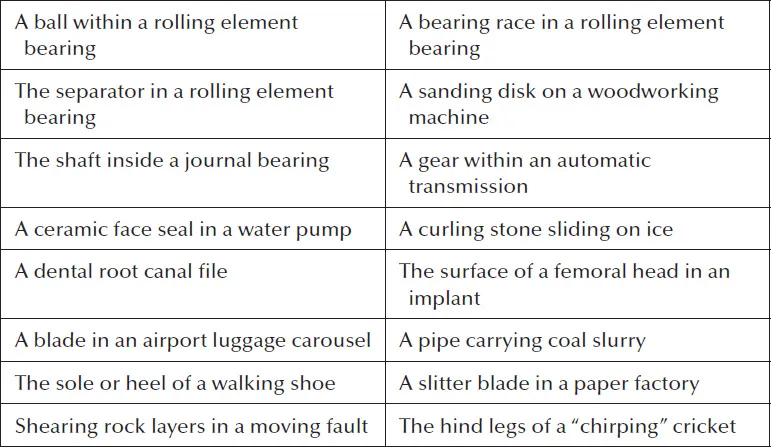
Examples of triboelements include the following:
From a macroscopic point of view, a complex mechanical device like an engine, a pump, or a gearbox can be composed of more than one (sub)tribo-system, each of which contains a number of discrete triboelements. Thus, the definition of a tribosystem's boundaries is more obvious in some cases and less so in others. However, a working definition should include all the components and materials that surround the tribological interface of interest and that could influence its friction or wear behavior. That is, to establish the boundaries of a tribosystem, it is usually best to begin with the contacting surface(s) of interest and work outward.
In his book on wear analysis, Bayer [2] distinguishes between a macrotribosys-tem and a microtribosystem, with the latter being the contact zone experiencing friction or wear and the former containing the surrounding parts of the device. The exercise of defining a tribosystem's boundaries can be helpful when troubleshooting because it forces one to consider both internal and external influences.
One example of a complex tribosystem whose subassemblies can be considered tribosystems in and of themselves is the automatic transmission in an automobile. A conventional automatic transmission consists of a torque converter, a planetary gearset, clutches and bands, and the fluid system, which includes a pump and the associated valve body. Any assembly of individual gears (triboelements) could be considered a tribosystem, as could a clutch, or a seal, or a set of bearings that operate within that transmission. If a particular gear might be more problematic than others, then it would be appropriate to narrow the tribosystem of interest to include that gear and the surrounding gear or gears that come into contact with it. In bench-scale laboratory testing, the definition of tribosystem is more straightforward: The tribosystem is the test apparatus, the materials and any lubricants within it, and the immediate surroundings.
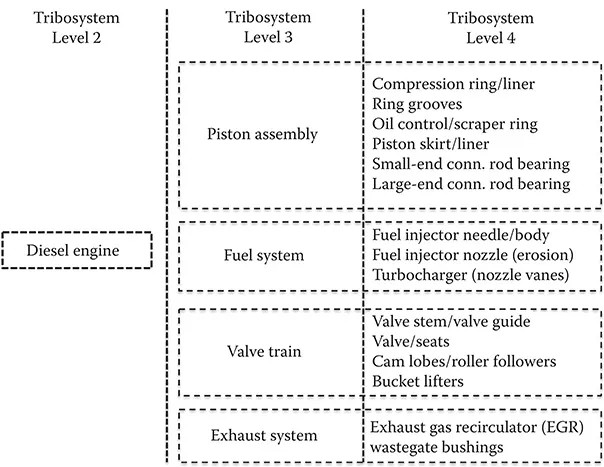
Figure 1.1 shows how a large and complex machine can be partitioned into a series of smaller tribosystems, each having its own functional requirements, surroundings, operating conditions, and materials. In this case, level 1 (not shown in the figure) would be the entire vehicle. Level 2 (one of several subtribosystems) shows just the engine. Owing to the large number of friction and wear interfaces involved, multiple types of wear can occur even within the same subtribosystem. For example, a piston ring in a ring groove in level 4 could experience microweld-ing, impact, rocking, circumferential slip, and fretting. Therefore, the process of conducting a tribosystem analysis is not limited to discovering only one dominant type of wear or surface damage, but rather identifying any and all relevant influences on the desired function of that tribosystem.
A similar approach to that in Figure 1.1 has been taken to categorize test methods that simulate practical tribology problems. For example, German standard 50 322 [3] has proposed six levels of tribotesting, ranging from full-scale machinery operating in the field to small coupons in bench-scale experiments. As will be discussed later in this book, the effectiveness of a simulation in obtaining meaningful data to screen or select materials or lubricants in practical tribology problem solving depends on matching the key characteristics of the engineering tribosystem with those of the test bench, which is its own tribosystem.
Figure 1.1 An example of how a large tribosystem can be broken down into sublevÉis containing smaller tribosystems. Level 1, not shown in the figure, is the entire vehicle, the driver, and its environment.
When diagnosing wear problems, especially those concerning lubricants, tri-bosystems can be characterized as being either open or closed [4]. Open systems have the potential to introduce contaminants or chemical species into the tribo-system while operating. For example, jaw crushers in ore processing or recycling plants are continually being fed new rock, and the composition of the foreign bodies in the input stream may contain unexpected wear-causing materials, like nuts, bolts, or spalled wear plates broken off upstream from the mining equipment itself. Likewise, rolling mill rolls could pick up mill scale or hard particles from elsewhere in the plant.
A transmission fluid pump with a recirculating working fluid and a bearing that is “sealed for life” are examples of closed tribosystems. Some systems have both open and closed characteristics. Internal combustion engines contain recirculating oil and coolant systems, but there is a potential to introduce wear-causing material through the fuel or air intake if filters are not working properly. Obviously, wear debris particles can be generated in both open and closed tribosystems. Years ago, an automotive engine manufacturer had postmanufacturing problems with leftover casting sand from the cylinder blocks finding its way into their engines. Here, an external source of abradants produced wear in what is designed to be a closed tribosystem.
The primary goal of this book is to present a systematic approach for defining tribosystems and their characteristics. In that way, root cause analyses and tribolog-ical problem solving can be facilitated, as can the selection of materials, lubricants, and test methods for use in evaluating candidate solutions. While the flexibility of the approach makes it useful for attacking both basic and applied tribology problems, the emphasis in this book is mainly on engineering challenges.
Having established the concept of a tribosystem, the rest of this book is focused on how that basic concept can be applied to analyze and diagnose wear problems. Chapter 2 describes how wear problems present themselves. It includes a discussion of how wear problems are detected, quantified, and monitored. Chapter 3 presents the author's approach to categorizing wear or surface damage based on the type of relative motion that is producing them and their observed features or artifacts. It discusses the role of terminology in the process, including both formal definitions and field-specific jargon, and it introduces a coding system that can provide a measure of consistency and a shorthand system for identifying the type(s) of wear. Since visual observations, both unaided and aided, are key in the diagnosis of wear and surface damage, Chapter 4 highlights a range of surface imaging tools, specimen preparation methods, and their practical advantages and shortcomings. Chapter 5 describes the tribosystem analysis form and how tribosystems, even relatively complex ones, can be characterized. Chapter 6 adds a discussion of problem-solving options, the selection and types of information available from wear testing, and a few examples of matching the performance of large-scale tribosystems with data from simulative test methods.
Finding solutions to wear problems is not equivalent to solving friction problems, but a tribosystem analysis approach can be applied to define friction-critical situations as well. (Recall that the word tribology has its roots in the Greek word for rubbing with friction.) As will be discussed later, friction is a manifestation of the energy available to do work between rubbing materials, and creating wear particles is one of the ways (but not the only way) in which that energy is dissipated. Therefore, the relationship between friction and wear varies depending on the nature of each tribosystem, and many similar concerns are involved in both friction problem diagnosis and wear problem analysis. At the center of it all is the notion of a properly functioning tribosystem and how the knowledge of its details enables one to improve its performance.
References
ASTM G40-15 (2015) “Terminology relating to wear and erosion,” in ASTM Annual Book of Standards, Vol. 03.02, ASTM International, West Conshohocken, PA, p. 164, http://www.astm.org/BOOKSTORE/.
R. G. Bayer (2002) Wear Analysis for Engineers, HNB Publishing, New York, Chapter 3.1.
“Kategorien der Verschleifiprufung,” Standard DIN 50 322, Deutsche Inst. fur Normen, Berlin, Germany.
P. J. Blau (1989) Friction and Wear Transitions of Materials: Break-in, Run-in, Wear-in, Noyes Publications, Saddle River, NJ.