This module introduces Teaching Proficiency through Reading and Storytelling (TPRS), an input-based language teaching method. TPRS provides a framework for teaching classes completely in the target language—even those at the beginner level. Through the steps of establishing meaning, creating a story that is acted out live in class, and reading, students understand and use the target language to communicate right away. Research shows that over time TPRS creates fluent speakers who excel both on traditional tests and—more importantly—in real-life situations. This is a valuable resource on TPRS for world language teachers, language teacher educators, and second language researchers.
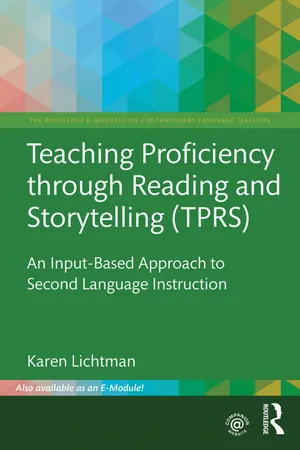
eBook - ePub
Teaching Proficiency Through Reading and Storytelling (TPRS)
An Input-Based Approach to Second Language Instruction
- 38 pages
- English
- ePUB (mobile friendly)
- Available on iOS & Android
eBook - ePub
Teaching Proficiency Through Reading and Storytelling (TPRS)
An Input-Based Approach to Second Language Instruction
About this book
Information
Teaching Proficiency Through Reading and Storytelling (TPRS)
An Input-Based Approach to Second Language Instruction
Overview
In this module, you will explore the following topics:
- input and comprehensible input
- input-based approaches to instruction
- Teaching Proficiency through Reading and Storytelling (TPRS)
- the principles of TPRS
- the three steps of TPRS
- TPRS skills
- techniques that complement TPRS
- current research on TPRS
Where does a baby’s first word come from? Parents joyfully record that first “dada” or “no” or “uh-oh” in a baby book—but, for the baby, the celebrated first utterance is a product of a year or more of listening to language. Before babies begin to speak, they understand plenty of words and can follow commands such as “no,” “touch your nose,” or “look at the kitty.” Children’s receptive vocabulary (words they understand) is larger than their productive vocabulary (words they can say)—and this tends to last throughout life. Children learn language by pairing new words they hear with meaning, which is made clear from the context—the objects and actions in the real world that other speakers refer to. A statement like “Look! A horse!” is accompanied by clues to meaning: the presence of a real horse (or at least a horse in a picture book,) pointing, and other speakers directing their attention towards the horse. All this provides children with the meaning of the new word “horse.”
Speech from parents or caregivers to children, including giving commands and naming objects in the environment, is a great example of input. Input is language that learners see or hear in a communicative (meaning-bearing) context. When a two-year old hears, “Don’t touch that, honey. It’s hot,” that stretch of speech is input to the child because it is couched within the context of an adult telling the child what to do. When a Spanish student hears, “Abran los libros en la página 32” (Open your books to page 32), that stretch of speech is input to the learner because it is couched within the context of an instructor giving directions to the class. Input is indispensable in language acquisition, both first and second. Just as we must take in food in order to grow, we must take in input in order for language to grow in our heads (see, for example, the discussion in Gregory Keating’s module titled Second Language Acquisition: The Basics in this series).
Learners must first take in input (hear new words and link them to their meaning during comprehension, process sentence structure, link grammatical forms to their meaning and functions) in order to be able to produce output (e.g., express meaning). This applies whether we are talking about a first language, or a second language. Children hear a new word such as “horse” a number of times in the context of seeing a horse, and Spanish learners hear the word “adiós” many times in the context of saying goodbye. Eventually, the child will be able to say the word “horse” to refer to a horse, and the Spanish learner will be able to say “adiós” when someone is leaving.
Of course, young children—unlike older children and adults—have thousands of hours of uninterrupted time to spend learning language. A child who hears a new language for eight hours per day at school will reach a hundred hours of language exposure in less than two weeks. In contrast, a high school student who gets three hours of language class per week will only hear the language for a little more than a hundred hours per year. Even if they are fortunate enough to learn in an immersion setting, older children and adults may contend with obstacles such as friends and family who want to speak to them in their native language, work, family obligations, TV, social media, and so on. The pull to use the first language is great. Given that second language learners cannot devote twenty-four hours a day, seven days a week to learning their new language, it is important that they get as much comprehensible input as possible in the very brief time they have available.
Input and Comprehensible Input
One of the major discoveries of language researchers in the 1960s and 1970s is that language acquisition is critically dependent on processing language input during communication. Whether we are talking about child first language learners or adolescent or adult second language learners, people must be engaged in communication in order to learn language. This may seem obvious regarding children, but, for some teachers, this idea seems to defy their experience with adolescents and adults. After all, don’t most adolescents and adults engage in the learning of rules and vocabulary and then the practice of those items? Doesn’t this lead to acquisition? The short answer is “no.” Why would we say this? The Suggested Further Readings section at the end of this module provides places where the reader can explore this topic in depth, but here, we will touch briefly on two ideas. The first concerns the nature of language. The second concerns the research on attempting to teach language.
In his book While We’re On the Topic, Bill Van Patten offers the following insight about language based on current linguistic theory and research: Language is too abstract and complex to teach and learn explicitly. What this claim means is that the rules and paradigms in language textbooks aren’t linguistically or psycholinguistically “real.” Such rules and paradigms can’t reflect what actually exists in the minds of speakers of a language. On pages 24–25, Van Patten offers an example of this using the “personal a” in Spanish. Personal a is a case marker that Spanish places on the objects of prepositions when they are human, or humanlike. For instance, example (1) uses the personal a, but example (2) doesn’t because “the material” is not human.
- (1) María conoce a Juan. ‘Mary knows John.’
- (2) María conoce la materia. ‘Mary knows the material.’
Textbooks explain this phenomenon using rules such as: In Spanish, when the direct object is a person, it is preceded by the preposition “a.” This word has no English translation. The personal “a” is not used when the direct object is not a person or is an animal for which no personal feelings are felt.
This textbook rule works for the examples we saw already, but it is easy to find “exceptions” to the “rule”:
- (3) Tengo una hermana. ‘I have a sister.’
- (4) El camión sigue al carro. ‘The truck is following the car.’
As we can see, “my sister” does not get the personal a, even though a sister is a person, and “the car” gets the personal a, even though a car is definitely not a person. So much for this particular rule. As Van Patten explains, the personal a case marker is actually controlled by “a complex interplay of abstract features such as definiteness, specificity, agency, and to a certain extent, animacy.”
How do learners build such an abstract and complex linguistic system in their minds? By exposure to communicative language data (input) that is processed and “worked on” by the internal mechanisms responsible for constructing a linguistic system. The fundamental role of input in acquisition just can’t be bypassed. How do we know this? From research on attempting to instruct second language learners.
The process of “teaching learners rules” is actually quite difficult. Stephen Krashen has pointed out that not even linguists—much less teachers—fully understand all the grammatical “rules” of a language. But, more importantly, even when teachers “teach rules,” this does not affect the stages through which learners pass as they acquire language. As Gregory Keating explains in his module in this series, all language acquisition exhibits developmental stages and ordered development. For example, learners of English acquire —ing on the ends of verbs (e.g., He’s watching TV) before they acquire past tense, —ed (e.g., He watched TV), which, in turn, is acquired before third-person, —s, in the present (e.g., He watches TV). What the research has shown is that such ordered development cannot be taught away. Even with intense practice, any effects of instruction are short-lived and ordered development soon reasserts itself. Every language teacher knows that students who have studied a language for many years can be non-nativelike on forms that were supposedly “taught” in the first week of class.
In addition to the above, there is one more reason we know input is critical for all language acquisition contexts: All advanced learners of languages have had massive exposure to language in communication. They study or live/work abroad for extended periods of time (e.g., not six weeks, but for a year or more). They marry into an L2-speaking family or environment. They watch films. They read extensively. They seek out speakers of the language. Of course, this takes time, but input and interaction with that input is the common thread in all successful cases of acquisition. What is not a common thread? Instruction in grammar. And as we noted previously, grammar instruction does little to circumvent the natural processes of acquisition.
The argument that language is acquired only by processing communicative input is complex, and we have not explored all facets of it here. However, the takeaway point is that linguists have converged on the idea that our mental representation of language does not consist of what we think of as “rules” and is not acquired through effortful study of these “rules.” Instead, it is a complex and abstract system that is acquired through exposure over time to language in communicative contexts. The fundamental role of input in language acquisition is central to all current mainstream theories about second language acquisition. More specifically, the input needs to be comprehensible input: language that a learner can, in general, understand; language whose basic message is comprehended by the learner.
The input that helps learners develop language must be at about the right level for the learners. If we could learn from any level of input, we could pick up a new language simply by turning on the TV or the radio in that language or picking up a newspaper. This strategy wouldn’t work because we wouldn’t be able to understand enough of the unknown language to process it as language—rather, we would process it as mere noise. On the other hand, imagine watch...
Table of contents
- Cover
- Title
- Copyright
- Contents
- Teaching Proficiency Through Reading and Storytelling (TPRS): An Input-Based Approach to Second Language Instruction
Trusted by 375,005 students
Access to over 1.5 million titles for a fair monthly price.
Study more efficiently using our study tools.
Frequently asked questions
Yes, you can cancel anytime from the Subscription tab in your account settings on the Perlego website. Your subscription will stay active until the end of your current billing period. Learn how to cancel your subscription
No, books cannot be downloaded as external files, such as PDFs, for use outside of Perlego. However, you can download books within the Perlego app for offline reading on mobile or tablet. Learn how to download books offline
Perlego offers two plans: Essential and Complete
- Essential is ideal for learners and professionals who enjoy exploring a wide range of subjects. Access the Essential Library with 800,000+ trusted titles and best-sellers across business, personal growth, and the humanities. Includes unlimited reading time and Standard Read Aloud voice.
- Complete: Perfect for advanced learners and researchers needing full, unrestricted access. Unlock 1.5M+ books across hundreds of subjects, including academic and specialized titles. The Complete Plan also includes advanced features like Premium Read Aloud and Research Assistant.
We are an online textbook subscription service, where you can get access to an entire online library for less than the price of a single book per month. With over 1.5 million books across 990+ topics, we’ve got you covered! Learn about our mission
Look out for the read-aloud symbol on your next book to see if you can listen to it. The read-aloud tool reads text aloud for you, highlighting the text as it is being read. You can pause it, speed it up and slow it down. Learn more about Read Aloud
Yes! You can use the Perlego app on both iOS and Android devices to read anytime, anywhere — even offline. Perfect for commutes or when you’re on the go.
Please note we cannot support devices running on iOS 13 and Android 7 or earlier. Learn more about using the app
Please note we cannot support devices running on iOS 13 and Android 7 or earlier. Learn more about using the app
Yes, you can access Teaching Proficiency Through Reading and Storytelling (TPRS) by Karen Lichtman in PDF and/or ePUB format, as well as other popular books in Languages & Linguistics & Linguistics. We have over 1.5 million books available in our catalogue for you to explore.