- 832 pages
- English
- ePUB (mobile friendly)
- Available on iOS & Android
eBook - ePub
About this book
With quantum leaps in science and technology occurring at breakneck speed, professionals in virtually every field face a daunting task-practicing their discipline while keeping abreast of new advances and applications in their filed. In no field is this more applicable than in the rapidly growing field of telecommunications engineering. Practicing engineers who work with ATM technology on a daily basis must not only keep their skill sharp in areas such as ATM network interfaces, protocols, and standards, but they must also stay informed, about new classes of ATM applications.
A Textbook on ATM Telecommunications gives active telecommunications engineers the advantage they need to stay sharp in their field. From the very basics of ATM to state-of-the-art applications, it covers the gamut of topics related to this intriguing switching and multiplexing strategy.
Starting with an introduction to telecommunications, this text combines the theory underlying broadband communications technology with applied practical instruction and lessons gleaned from industry. The author covers fundamental communications and network theory, followed by applied ATM networking. Each chapter includes design exercises as well as worked examples .
A Textbook on ATM Telecommunications includes examples of design and implementation-making it an ideal took for both aspiring and practicing telecommunication professionals.
Features
Information
1
INTRODUCTION
A Perspective of Telecommunications: What is new?
“If there is a cliché that hounds our lives unmercifully, it is that we live in the Information Age, a time when ever more information, wanted and unwanted, pours in on us from every side. So relentless and insistent has this flood become that it often seems impossible to escape. Marshall Mcluhan’s once fanciful ‘global village’ has emerged with astonishing swiftness in the form of a planet interconnected by elaborate media networks that transfer data and images almost instantly….”
Maury Klein
invention& Technology, Spring, 1993
invention& Technology, Spring, 1993
1.1 The Tale of Telecommunication
One way industrial societies measure progress (and productivity) is the speed with which their technologies compete, cherish, and develop and mutate [1.1]. In this lasting marathon, an impressive record has been set by communication technology ever since its birth and stretching all the way into “the modern maze of telephones, radio, television, computers, fax machines, and satellites”. The motivation of deploying telecommunication was spelt even at its inception through telegraphy “as a prophetic foreshadowing of the important part which electrical communications were to play in bringing nations into a better understanding and closer cooperation”. An informal telegraphic transmission over a ten-mile wire by Samuel F.B. Morse on January 24, 1838 at the New York University was the imprint and utterance of this prophecy - “Attention, the Universe! By kingdoms, right wheel” [1.2].
Scores of years have passed since communicating a message by electrical signal was conceived; and, as prophesized in 1838 there has been stupendous growth, radical advances and outstanding applications mushrooming in the telecommunication arena shrinking the world within the yard-stick of mass-communication and linking the nations via information superhighways. Specifically, the on-course of current years has faced a more furious pace of changes in the associated technology as the world marches ahead into the twenty-first century on the set tracks of information passage. But, there is a gamut of engineering challenges strewn along this path while facilitating the socioeconomic needs posed in the telecommunication sector which is inevitably entwined with and progressively surfing along the computer environment.
Such challenges are, however, the part of any societal transformations dictated by technological innovations. Even at the birth of telecommunication conceived through telegraphy, the man who ushered that system into society, Samuel Morse, “knew too little to realize the obstacles that lay ahead”. Nevertheless, the obsessing quest of Morse, namely, “the instantaneous transmission of intelligence by electricity to any distance” has sprawled across the past and present centuries and spurred technology and engineering not only to overcome the intervening obstacles but also to inspire inventions and installations of newer marvels of telecommunication. It has been an effort comparable to that of Hannibal trying to find his way into Europe across the Alps. When he could not find a route, he rather chose to make one! So has been the aggressiveness that has molded a stage on which the story of telecommunication can be well enacted.
1.1.1 Just what is telecommunication?
It is an art — a technology and a science of communicating a message at a distance by electrical means. It follows the basic notion of transporting an electrical signal — an entity that contains information. The concomitant of a message depicts the presence of useful information-content.
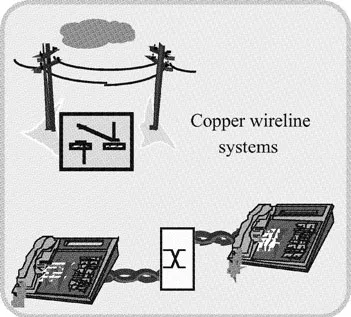
Fig. 1.1: Wireline telecommunications systems
The message is intended for transportation between communicating end-points — namely the point of origin and the point of destination. The link that establishes the connection between these end-points could be wireline or wireless.
In the modern context of telecommunications, the wireline connection is conceived via electrical conduction through a copper conductor or by optical transmission in a fiber. Classical telegraphic and telephone transmissions were supported by open copper-wire transmission systems. Subsequent versions adopted are largely twisted pair of copper-lines and to some extent are the so-called coaxial lines.
Optical fiber transmission is a state-of-the-art method used widely in high-speed telecommunication links.
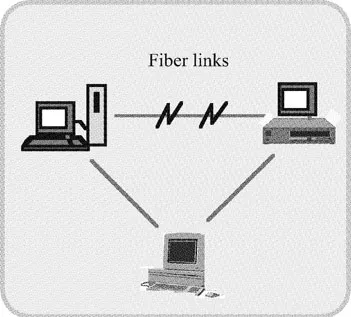
Fig. 1.2: Optical fiber links
Wireless communications refers to a system realized with a propagating electromagnetic wave as the via media between the transmitter and the receiver. The information transmitted over telecommunications systems could be simple telegraphic messages, voice signals over telephone, facsimile transmissions, data transfer between machines (computers), an integrated passage of voice, video and data, or a collection of cohesive, multimedia presentations. These information types have dictated the dawn of comprehensive telecommunication engineering and its subsequent growth as a technology. Further, the need for a single framework that can support a large number of diverse services of kaleidoscopic information has paved an alley to explore the varieties in networks and modes of information transmission.
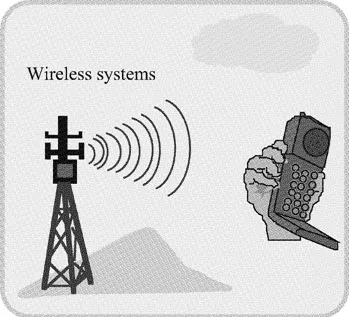
Fig. 1.3: Wireless telecommunication
The following subsections trace the history and conjectural necessities that placed telecommunication in its present status.
1.1.2 Telecommunication -an inception from telegraphy
Morse telegraphy
The genesis of telecommunication can be traced to the invention of wireline telegraphy by Samuel Morse in 1837. The performance exhibition of telegraphy in 1838 was followed by an official operational system envisaged between the railroad depot on Pratt Street in Baltimore and the Supreme Court Chamber in Washington D.C. on Friday May 24th 1844. In the following year, telegraph lines began to be built over other routes. It was a “landmark in human development from which there could be no retreat. For the first time messages could routinely travel great distances faster than man or beast could carry them” [1.1]. Ironically, this technological breakthrough was an epiphany of electromagnetism, of which Samuel Morse knew very little. Yet his intuitive innovation helped him to develop “a system that could reduce the way of writing the letters of the alphabet to a very simple form so that they could be written by an electrically-controlled instrument” [1.3], the necessary electrical signals being produced by switching on and off a d.c. circuit. This “very simple form” of depicting the alphabets corresponds to the on and off states of an electrical switch (known as the Morse key).
Two distinguishable durations of keeping the switch closed yield the so-called “dots and dashes”, a combination of which is used to represent an alphabet. Shorter and simpler combinations are reserved for most frequently used letters, thus reducing the average length of time required to signal a message. Hence emerged the first variable length code - the Morse code.
The first official message telegraphed by Samuel Morse from Baltimore to Washington D.C. was the historic sentence:
What hath God wrought?
“A hundred and fifty years after Morse sent his first message, our information-soaked world still gropes for an answer to the query it contained!” [1.1].
The telegraph, as the first form of modern communication, “burst upon the sensibilities of a people proud of progress but still new to technical leaps of such magnitude”. The invention and implementation of telegraphy by Morse in its day “was no less a miracle of its modern offspring. It dazzled and bewildered people the same way computers can today, with feats that seemed magical if not unnatural” [1.1].
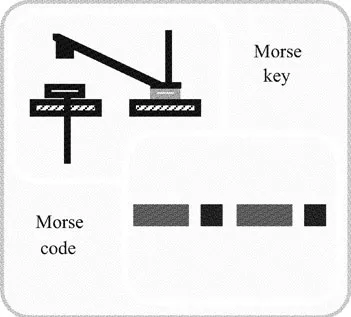
Fig. 1.4: Morse key and Morse code
Morse conceived a few feasible versions of telegraphy and ultimately arrived at a semiautomatic mechanism in which a set of arranged metal contacts (as per a combination of dots and dashes) sent electrical currents, switched on and off in accordance with the encoding of the message envisaged, then the receiver used a pencil to mark the encoded message on paper. Morse also devised repeaters, which facilitated long-distance wireline telegraphic communication. As a result of Morse’s invention, the Western Union Telegraph Company was formed in 1845. By the 1860s the telegraphic lines not only spanned the continent, they also became a global telecommunication link with the advent of installing the Trans-Atlantic cable.
Despite the development of automated telegraphic systems, the manual telegraphy was deployed as a means of telecommunication even in the 1960s in many parts of the world. Even today, amateur radio operators (HAMs) enjoy transmitting Morse code on a wireless basis by switching on and off a radio frequency carrier using a Morse key connected to a transmitter. Such a wireless telegraphy also played a vital role in the military during the last two world wars.
Apart from the humble, automated on-off telegraphic keying developed by Morse, a more rigorous line of automation of telegraphy refers essentially to a machine operation through the use of what is known as the Baudot transmitter/receiver system. Here, unlike the Morse code with varying number of dots and dashes representing each alphanumeric character uniquely, a fixed length code (due to Emile Baudot) with distinct five binary (on-off) representations to depict each alphanumeric character was used on a punched tape. The corresponding electrical signals were sensed via contact strips on which the encoded punched tape was enabled to traverse.
Even in the nineteenth century itself, multiplexing several telegraphic messages was also conceived in line with the principle, which in modern terminology refers to the time-division multiplexing. The relevant method used a plurality of time division intervals, one for each alphanumeric character.
Many of the telegraphy-based studies were more experimental and practical demonstrations. As Black points out “what seems extraordinary in retrospect is the slow evolution of quantitative expressions concerning the abov...
Table of contents
- Cover
- Half Title
- Title Page
- Copyright Page
- Table of Contents
- Preface
- Acknowledgements
- About the Author
- Chapter 1 Introduction
- Chapter 2 Basics of Electrical Communication Systems
- Chapter 3 Networking: Concepts and Technology
- Chapter 4 ATM Network Interfaces and Protocols
- Chapter 5 ATM Signaling and Traffic Control
- Chapter 6 ATM Switching and Network Products
- Chapter 7 ATM: Operations, Administration, Maintenance, and Provisioning
- Chapter 8 ATM Networking: Implementation Considerations
- Glossary of Networking Terms: Definitions and Acronyms
- Subject Index
Trusted by 375,005 students
Access to over 1.5 million titles for a fair monthly price.
Study more efficiently using our study tools.
Frequently asked questions
Yes, you can cancel anytime from the Subscription tab in your account settings on the Perlego website. Your subscription will stay active until the end of your current billing period. Learn how to cancel your subscription
No, books cannot be downloaded as external files, such as PDFs, for use outside of Perlego. However, you can download books within the Perlego app for offline reading on mobile or tablet. Learn how to download books offline
Perlego offers two plans: Essential and Complete
- Essential is ideal for learners and professionals who enjoy exploring a wide range of subjects. Access the Essential Library with 800,000+ trusted titles and best-sellers across business, personal growth, and the humanities. Includes unlimited reading time and Standard Read Aloud voice.
- Complete: Perfect for advanced learners and researchers needing full, unrestricted access. Unlock 1.5M+ books across hundreds of subjects, including academic and specialized titles. The Complete Plan also includes advanced features like Premium Read Aloud and Research Assistant.
We are an online textbook subscription service, where you can get access to an entire online library for less than the price of a single book per month. With over 1.5 million books across 990+ topics, we’ve got you covered! Learn about our mission
Look out for the read-aloud symbol on your next book to see if you can listen to it. The read-aloud tool reads text aloud for you, highlighting the text as it is being read. You can pause it, speed it up and slow it down. Learn more about Read Aloud
Yes! You can use the Perlego app on both iOS and Android devices to read anytime, anywhere — even offline. Perfect for commutes or when you’re on the go.
Please note we cannot support devices running on iOS 13 and Android 7 or earlier. Learn more about using the app
Please note we cannot support devices running on iOS 13 and Android 7 or earlier. Learn more about using the app
Yes, you can access A Textbook on ATM Telecommunications by P. S. Neelakanta in PDF and/or ePUB format, as well as other popular books in Tecnologia e ingegneria & Ingegneria informatica. We have over 1.5 million books available in our catalogue for you to explore.