We cannot afford to miss the remarkable rise of Chinese business ecosystems. Alibaba and their peers Baidu, Tencent, Xiaomi, and LeEco showcase unprecedented growth and success in China and are expanding their impact globally. With a combined market capitalization of close to 600 billion USD, incubating over 1,000 new ventures and an average annual growth of over 50%, they have become a force to reckon with for the likes of Google, Microsoft, Apple, Amazon, and IBM. 'Business ecosystem' is a frequently used concept to describe the unique competitive advantages of the American technology giants. This book explores not only the application of a business ecosystem approach in the Chinese context but also deals with the key strategic question: How did these five Chinese business ecosystems grow so rapidly and successfully?
The book takes the growth and transformation of Alibaba's business ecosystem as a focus case in comparison with Baidu, Tencent, Xiaomi, and LeEco. These business ecosystems developed in less than 20 years and transformed from organic growth to rapid expansion by investment and acquisition, entrepreneurship and incubation of new ventures, continuous innovation, and internationalization. This book brings insights and practical lessons on leading, creating, and disrupting markets for corporate executives and professionals in global business, a comparative case study for researchers and students of management, and food for thought on Chinese ways of doing business.
At the end of the 1990s in China, three young men saw the rise of the Internet and started crafting business ideas. While one man was based in Beijing and was part of a bustling technology scene, the two other men were in the newly emerging Hangzhou (East coast) and Shenzhen (South coast). They independently built three Internet platforms in a time when most Chinese people had not heard of the Internet, and did not own computers, or credit cards for that matter. Within less than two decades these three platforms grew into China’s largest business ecosystems encompassing online and offline businesses with a combined estimated market capitalization of over 500 billion USD by the end of 2016. These three men are Ma Yun, Li Yanhong and Ma Huateng and they respectively established Alibaba, Baidu and Tencent.
Ma Yun’s business has its roots in trading and ecommerce, mostly focusing on facilitating small and medium enterprises in global market places. Li Yanhong’s core business is search technology and is often dubbed the ‘Google of China’. Ma Huateng’s business has its roots in instant messaging and online communication. Nevertheless, all three platforms have been diversifying in the last five years into Internet finance, digital healthcare, culture and entertainment, enterprise services and location based services, among others. Moreover, they have incubated a combined total of over 1,000 new ventures. Transforming from three independent platforms to three competing business ecosystems, these three pioneers are now commonly known as BAT.
Then, in 2004 a small online video platform was established by a young man named Jia Yueting. It would be impossible for him to imagine that only ten years later he will openly and publicly challenge the mighty BAT and have an estimated market capitalization of 50 billion USD by the beginning of 2017. His video platform transformed into one the most innovative business ecosystems in China: LeEco. The business ecosystem includes businesses ranging from entertainment production, smart TVs and smartphones to driverless cars; his ecosystem includes already four unicorns, i.e. a company with over 1 billion USD valuation before IPO. Although BAT is equally successful in their diversified investments, the new kid on the block posed a serious challenge.
However, as with everything in China, the story took a sudden turn when in 2010 several Chinese technology veterans established Xiaomi. With the speed of light and an unheard of business model that revolutionized online social marketing and built an instant fan base while lacking hardware R&D, production facilities and offline sales channels, Lei Jun and his co-founders were able to launch a smartphone that conquered the hearts of many young Chinese. It took only two years to surpass the Chinese market share of Apple and enter the national smartphone top five. After initial success, Lei Jun announced their five year plan and started building a Xiaomi family of hardware products, including TVs, air purifiers, smart wearables and rice cookers. They not only challenged local traditional manufacturers and BAT but also established multinationals as an underdog in their familiar markets.
What do these entrepreneurs and their success stories have in common? They strategically used business ecosystems for their rapid growth, transformation and success in China. This book is about the business ecosystems of Baidu, Alibaba, Tencent, Xiaomi and LeEco (BATXL).
1.2 What this book is about
This book is about how leading Chinese companies adopt a business ecosystem approach to not only lead but also create and disrupt the market. The unique competitive advantage of American companies like Google, Microsoft and Apple is often attributed to the business ecosystem approach to organizing their businesses (e.g. Moore, 1996; Adner, 2006; Iansiti and Levien, 2004). Recently the popular (Chinese) press explained the success of Chinese pioneers such as Alibaba and Xiaomi in a similar way. For instance, a search on Chinese search engine Baidu on the keyword ‘business ecosystem’ (in Chinese: ‘shangyeshengtai’) gave 2.1 million results in Chinese in January 2017. The purpose of our book is to adopt and explore the business ecosystem concept in the Chinese context by providing a definitive and systematic account of Alibaba’s growth and transformation as a business ecosystem in comparison with other leading Chinese business ecosystems: Baidu, Tencent, Xiaomi and LeEco. The book is written for business professionals, executives, academics and students seeking deep insight into the success of Alibaba’s business ecosystem in comparative context; academics and students seeking a deeper understanding of comparative business ecosystems in the Chinese context; business professionals and executives seeking insights in the leading business ecosystems in China; and researchers of strategy, business ecosystem and innovation in general.
A business ecosystem refers to particular arrangements between organizations that combine their own products and service offerings into a relatively coherent and customer centric offering (Adner, 2006). Moore (1996), one of the early thinkers on business ecosystems, took business ecosystems as new patterns of competition, rather than as a specific strategy. Moore sees a business ecosystem as an “economic community supported by a foundation of interacting organizations and individuals – the organisms of the business world” (Moore, 1996: 26). Iansiti and Levien (2004) conceptualize business ecosystems as networks of firms that collectively provide competitive advantages. They perceive ecosystems as loose networks of suppliers, distributors, outsourcing firms, makers of related products or services, technology providers and hosts of other organizations that affect and are affected by the creation and delivery of a company’s own offerings. Iansiti and Levien take a stakeholder perspective, including in particular non-business stakeholders such as media and regulators. Weill and Woerner (2015) note that companies establish an ecosystem by creating relationships with other providers that offer complementary but sometimes also competing services.
In our book we refer to business ecosystems as new organizational forms where the businesses are interdependent through a variety of equity relationships combining product and service offerings into a customer centric offering. While the boundaries of a business ecosystem are fluent and dynamic, we take equity relationships as a criteria to be included in the business ecosystem. Therefore, we can distinguish business ecosystems from companies (full ownership and diversified businesses organized in business units), holdings (organizations connected by equity based relationship but no specific mutual interdependencies or necessary synergies beyond financial arrangements), and business networks (loosely connected groups of companies), as illustrated in Table 1.1.
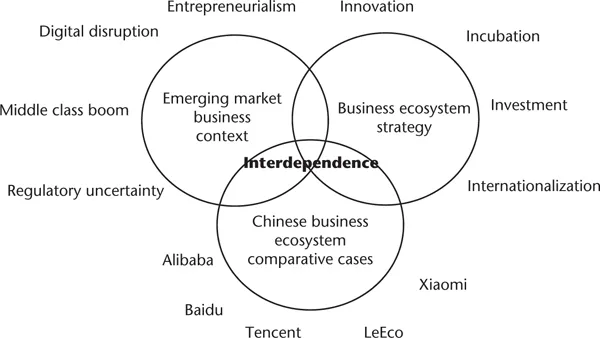
While previous contributions by Moore (1996), Adner (2006, 2013), Iansiti and Levien (2004) and Weill and Woerner (2015) provide a solid academic and professional basis for the exploration of business ecosystems, they, first of all, are mostly limited to the US market context and entirely miss the rise of Chinese business ecosystems. China’s business context has been particularly conducive to new organizational forms that explore and exploit the dynamics in the market: the rise of entrepreneurialism, digital disruption, middle class boom and regulatory uncertainty. These conditions will be explored in Section 1.5. Second, while previous studies address some strategic questions, they fail to systematically explore important strategic questions such as how does an ecosystem grow? What is the role of investment and acquisition in ecosystem development? To what extent does an ecosystem facilitate innovation? What are the challenges for strategy making? Does an ecosystem provide specific opportunities for entrepreneurship and incubation of new ventures? And to what extent can ecosystems as business models be internationalized? We adopt a framework of strategic growth to investigate such questions for leading Chinese business ecosystems. In particular we will focus on four growth approaches: innovation, investment, incubation and internationalization. Third, instead of discussing business context and companies as two independent units of analysis, we emphasize that business ecosystems are both part of and interdependent with the business context. Last, most of the previous publications are descriptive and insightful but fail to put insights into comparative perspective. We will take the growth and transformation of Alibaba’s business ecosystem as a focus case to explore the above topics. We will compare the business ecosystem of Alibaba with other leading Chinese business ecosystems Baidu, Tencent, Xiaomi and LeEco to explore differences and similarities in order to gain a better understanding of the strategic aspects of business ecosystems in general and in the Chinese context in particular. In Figure 1.1 we visualize our contributions.
TABLE 1.1 Comparing business ecosystems to other organizational forms
Business Ecosystem
Company
Holding
Business Network
Ownership structure
Equity sharing
Single ownership
Equity sharing
No equity sharing
Industry involved
Related and diverse
Single or limited
Unrelated and diverse
Single or limited
Decision-making mechanism
Orchestrated and interdependent
Centralized
Decentralized and independent
Limited coordination
1.3 BATXL: Alibaba, Baidu, Tencent, Xiaomi and LeEco
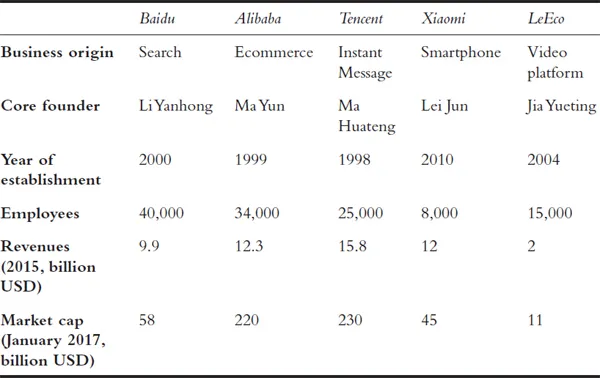
The book is organized around a large case study of Alibaba’s ecosystem (part 2) and comparison with other leading Chinese ecosystems: Baidu, Tencent, Xiaomi and LeEco (part 3). Table 1.2 summarizes the key facts of BATXL.
FIGURE 1.1 Contributions of this bookSource: authors’ own figure.
TABLE 1.2 Case studies in this book: BATXL
Source: website and annual reports from BATXL
Many accounts of BATXL have been published in the last couple of years. We suggest readers interested in the more personalized or journalistic stories of the various companies and founders read the following books. Erisman (2015) is an insightful yet more journalistic account of Alibaba, providing insights based on the author’s employment as head of international marketing until 2008. It provides an account on Alibaba’s role as harbinger of new global business. Clark (2016) provides a more personal story of Ma Yun. It is filled with anecdotes and personal reminiscences but mostly emphasizes the positive aspects and Alibaba’s local context. Lee and Song (2016) contains more than 200 quotes and aims to provide a direct look into the mind of Ma Yun. Many of these quotes are translated directly from the Chinese press and interviews. While the above books certainly document the development of Alibaba and describe Ma Yun’s achievements, these accounts are of more journalistic nature with limited academic basis. Moreover, the books neither provide a comparative perspective nor explore strategic questions in Alibaba’s ecosystem.
Baidu and founder Li Yanhong have been reported or described in over 50 Chinese book publications. Tencent and founder Ma Huateng have received signifi...
Table of contents
Cover
Half Title
Title Page
Copyright Page
Contents
List of figures
List of tables
Preface
PART I Business ecosystems in China
PART II Alibaba case
PART III Beyond Alibaba: the leading Chinese ecosystems of Baidu, Tencent, Xiaomi, and LeEco
Index
Trusted by 375,005 students
Access to over 1.5 million titles for a fair monthly price.
Study more efficiently using our study tools.
Frequently asked questions
Yes, you can cancel anytime from the Subscription tab in your account settings on the Perlego website. Your subscription will stay active until the end of your current billing period. Learn how to cancel your subscription
No, books cannot be downloaded as external files, such as PDFs, for use outside of Perlego. However, you can download books within the Perlego app for offline reading on mobile or tablet. Learn how to download books offline
Perlego offers two plans: Essential and Complete
Essential is ideal for learners and professionals who enjoy exploring a wide range of subjects. Access the Essential Library with 800,000+ trusted titles and best-sellers across business, personal growth, and the humanities. Includes unlimited reading time and Standard Read Aloud voice.
Complete: Perfect for advanced learners and researchers needing full, unrestricted access. Unlock 1.5M+ books across hundreds of subjects, including academic and specialized titles. The Complete Plan also includes advanced features like Premium Read Aloud and Research Assistant.
Both plans are available with monthly, semester, or annual billing cycles.
We are an online textbook subscription service, where you can get access to an entire online library for less than the price of a single book per month. With over 1.5 million books across 990+ topics, we’ve got you covered! Learn about our mission
Look out for the read-aloud symbol on your next book to see if you can listen to it. The read-aloud tool reads text aloud for you, highlighting the text as it is being read. You can pause it, speed it up and slow it down. Learn more about Read Aloud
Yes! You can use the Perlego app on both iOS and Android devices to read anytime, anywhere — even offline. Perfect for commutes or when you’re on the go. Please note we cannot support devices running on iOS 13 and Android 7 or earlier. Learn more about using the app
Yes, you can access Business Ecosystems in China by Mark J. Greeven,Wei Wei in PDF and/or ePUB format, as well as other popular books in Business & Business General. We have over 1.5 million books available in our catalogue for you to explore.